
The whole hunk
from line 30, old and new numbered
/
lines
from line 30
3030| You are choosing or switching models | Compare on cost per completed task, not per token | [Compare models](https://platform.claude.com/docs/en/about-claude/models/optimizing-for-cost-and-intelligence#compare-models-on-cost-per-task) |
3131| Quality isn't good enough | If you lowered effort, restore it; otherwise try the next tier up at `low` effort | [Tune effort](https://platform.claude.com/docs/en/about-claude/models/optimizing-for-cost-and-intelligence#tune-effort) · [Compare models](https://platform.claude.com/docs/en/about-claude/models/optimizing-for-cost-and-intelligence#compare-models-on-cost-per-task) |
3232| Attempts end with `stop_reason: max_tokens` | Raise `max_tokens`; 64,000 covered all but 2 of 14,000 turns measured at the default effort, and 128,000 cost nothing extra per solved task | [Set budgets](https://platform.claude.com/docs/en/about-claude/models/optimizing-for-cost-and-intelligence#set-budgets-and-output-caps) |
33| You can check outputs (tests, a verifier) | Run everything at low effort and re-run failures at the default (`high`); on the coding benchmark measured, the pass rate held at about half the cost | [Re-run failures](https://platform.claude.com/docs/en/about-claude/models/optimizing-for-cost-and-intelligence#re-run-failures-at-higher-effort) |
33| You can check outputs (tests, a verifier) | Run everything at low effort and re-run failures at `high`; on the coding benchmark measured, the pass rate held at about half the cost | [Re-run failures](https://platform.claude.com/docs/en/about-claude/models/optimizing-for-cost-and-intelligence#re-run-failures-at-higher-effort) |
3434| Agent loops with a few very costly runs | Set a task budget (beta; check the support table for which models), a Claude Managed Agents session budget, and a workspace spend limit | [Set budgets](https://platform.claude.com/docs/en/about-claude/models/optimizing-for-cost-and-intelligence#set-budgets-and-output-caps) |
3535| A lower-cost model stalls only on hard decisions | Add a frontier advisor. It pays off when priced well above the executor and actually consulted, so first price the advisor's model alone at low effort and measure the consult rate | [Advisor strategy](https://platform.claude.com/docs/en/about-claude/models/optimizing-for-cost-and-intelligence#advisor-strategy-escalate-hard-decisions) |
3636| The work exceeds one context window | Delegate partitions to cheaper workers | [Orchestrator strategy](https://platform.claude.com/docs/en/about-claude/models/optimizing-for-cost-and-intelligence#orchestrator-strategy-delegate-bulk-work) |
from line 269
269269
270270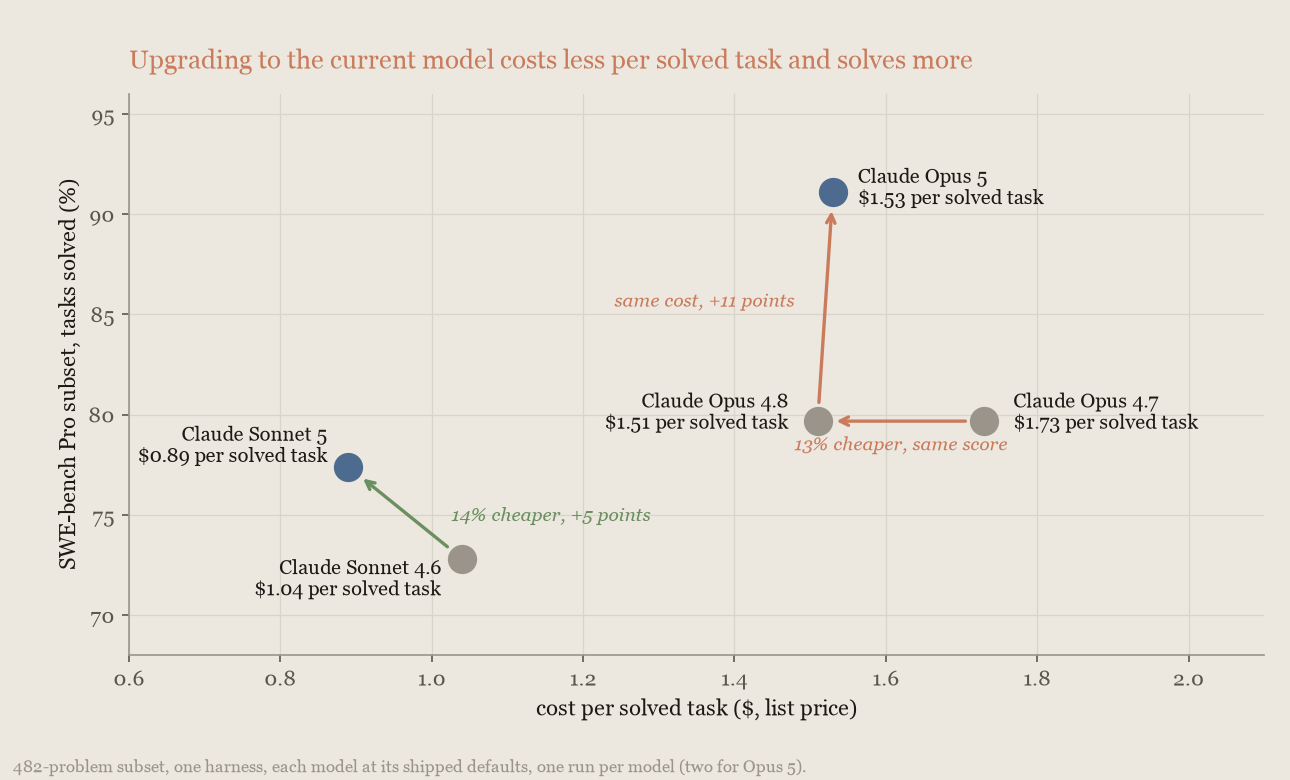
271271
272Anthropic prices the Opus line identically per token across versions, so any difference comes from how much work each model does per task: priced as a customer is billed, Claude Opus 4.8 solves the same share of tasks as Claude Opus 4.7 for 14% less per solved task, and Claude Opus 5 then solves 12 more points of tasks at 21% more per solved task. Claude Opus 5 at `low` effort beats Opus 4.8's default on this benchmark for about 30% of its cost per solved task, so the cheapest upgrade is the new model at a lower setting. Sonnet 5's saving comes from its lower per-token price, which more than offsets the extra tokens it uses per task compared with Sonnet 4.6: 15% less per solved task for 5 more points. The frontier tier gained the same way: Claude Fable 5.1 matches Claude Fable 5's score for 43% less per solved task, most of it the lower cache-read price. That direction is not guaranteed: on DeepResearch Bench II[7](https://platform.claude.com/docs/en/about-claude/models/optimizing-for-cost-and-intelligence#refs) the same upgrade costs 41% more per task at `high` (79% more at `low`) for its 2 to 3 extra points on the tasks clean in every arm (reference 7), because the new model does more work per task there. The input and output prices are the same and the cache read is 4x cheaper, so measure the upgrade on your own workload before assuming it saves.
272Anthropic prices Claude Opus 4.7, Opus 4.8, and Opus 5 identically per token, so any difference among them comes from how much work each model does per task: priced as a customer is billed, Claude Opus 4.8 solves the same share of tasks as Claude Opus 4.7 for 14% less per solved task, and Claude Opus 5 then solves 12 more points of tasks at 21% more per solved task. Claude Opus 5 at `low` effort beats Opus 4.8's default on this benchmark for about 30% of its cost per solved task, so the cheapest upgrade is the new model at a lower setting. Sonnet 5's saving comes from its lower per-token price, which more than offsets the extra tokens it uses per task compared with Sonnet 4.6: 15% less per solved task for 5 more points. The frontier tier gained the same way: Claude Fable 5.1 matches Claude Fable 5's score for 43% less per solved task, most of it the lower cache-read price. That direction is not guaranteed: on DeepResearch Bench II[7](https://platform.claude.com/docs/en/about-claude/models/optimizing-for-cost-and-intelligence#refs) the same upgrade costs 41% more per task at `high` (79% more at `low`) for its 2 to 3 extra points on the tasks clean in every arm (reference 7), because the new model does more work per task there. The input and output prices are the same and the cache read is 4x cheaper, so measure the upgrade on your own workload before assuming it saves.
273273
274274On harder work the gap widens. On Terminal-Bench 3[20](https://platform.claude.com/docs/en/about-claude/models/optimizing-for-cost-and-intelligence#refs), where the tasks are hard enough that pass rate rather than tokens sets the bill, Claude Opus 4.7, Opus 4.8, and Opus 5 each spend $8 to $15 per task but solve 7%, 15%, and 41% of tasks, so cost per solved task falls from $183 to $63 to $28 up the ladder. The 21% premium Claude Opus 5 carries over Opus 4.8 on the saturated coding subset becomes a 56% saving on Terminal-Bench 3, where the older model mostly fails: the more your workload defeats the old model, the more the upgrade saves per result.
275275
from line 461
461461 ```bash cURL
462462 # Per-million-token prices from the pricing page; change these three for another model.
463463 INPUT_PER_MTOK=5.00 # Claude Opus 5
464 CACHE_READ_PER_MTOK=0.50 # 0.1x the input price; 0.025x on Claude Fable 5.1 and Claude Mythos 5.1
464 CACHE_READ_PER_MTOK=0.50 # 0.1x the input price on Claude Opus 5; some models use a different multiplier
465465 OUTPUT_PER_MTOK=25.00
466466
467467 response=$(curl --fail-with-body -sS https://api.anthropic.com/v1/messages \
from line 488
488488 ```bash CLI
489489 # Per-million-token prices from the pricing page; change these three for another model.
490490 INPUT_PER_MTOK=5.00 # Claude Opus 5
491 CACHE_READ_PER_MTOK=0.50 # 0.1x the input price; 0.025x on Claude Fable 5.1 and Claude Mythos 5.1
491 CACHE_READ_PER_MTOK=0.50 # 0.1x the input price on Claude Opus 5; some models use a different multiplier
492492 OUTPUT_PER_MTOK=25.00
493493
494494 USAGE=$(ant messages create \
from line 510
510510 ```python Python
511511 # Per-million-token prices from the pricing page; change these three for another model.
512512 INPUT_PER_MTOK = 5.00 # Claude Opus 5
513 # 0.1x the input price; 0.025x on Claude Fable 5.1 and Claude Mythos 5.1
513 # 0.1x the input price on Claude Opus 5; some models use a different multiplier
514514 CACHE_READ_PER_MTOK = 0.50
515515 OUTPUT_PER_MTOK = 25.00
516516
from line 538
538538 ```typescript TypeScript
539539 // Per-million-token prices from the pricing page; change these three for another model.
540540 const INPUT_PER_MTOK = 5.0; // Claude Opus 5
541 const CACHE_READ_PER_MTOK = 0.5; // 0.1x the input price; 0.025x on Claude Fable 5.1 and Claude Mythos 5.1
541 const CACHE_READ_PER_MTOK = 0.5; // 0.1x the input price on Claude Opus 5; some models use a different multiplier
542542 const OUTPUT_PER_MTOK = 25.0;
543543
544544 const client = new Anthropic();
from line 561
561561 ```csharp C#
562562 // Per-million-token prices from the pricing page; change these three for another model.
563563 const double InputPerMtok = 5.00; // Claude Opus 5
564 const double CacheReadPerMtok = 0.50; // 0.1x the input price; 0.025x on Claude Fable 5.1 and Claude Mythos 5.1
564 const double CacheReadPerMtok = 0.50; // 0.1x the input price on Claude Opus 5; some models use a different multiplier
565565 const double OutputPerMtok = 25.00;
566566
567567 AnthropicClient client = new();
from line 589
589589 // Per-million-token prices from the pricing page; change these three for another model.
590590 const (
591591 inputPerMTok = 5.00 // Claude Opus 5
592 cacheReadPerMTok = 0.50 // 0.1x the input price; 0.025x on Claude Fable 5.1 and Claude Mythos 5.1
592 cacheReadPerMTok = 0.50 // 0.1x the input price on Claude Opus 5; some models use a different multiplier
593593 outputPerMTok = 25.00
594594 )
595595
from line 619
619619 ```java Java
620620 // Per-million-token prices from the pricing page; change these three for another model.
621621 static final double INPUT_PER_MTOK = 5.00; // Claude Opus 5
622 static final double CACHE_READ_PER_MTOK = 0.50; // 0.1x the input price; 0.025x on Claude Fable 5.1 and Claude Mythos 5.1
622 static final double CACHE_READ_PER_MTOK = 0.50; // 0.1x the input price on Claude Opus 5; some models use a different multiplier
623623 static final double OUTPUT_PER_MTOK = 25.00;
624624
625625 void main() {
from line 646
646646 ```php PHP
647647 // Per-million-token prices from the pricing page; change these three for another model.
648648 const INPUT_PER_MTOK = 5.00; // Claude Opus 5
649 const CACHE_READ_PER_MTOK = 0.50; // 0.1x the input price; 0.025x on Claude Fable 5.1 and Claude Mythos 5.1
649 const CACHE_READ_PER_MTOK = 0.50; // 0.1x the input price on Claude Opus 5; some models use a different multiplier
650650 const OUTPUT_PER_MTOK = 25.00;
651651
652652 $client = new Client();
from line 669
669669 ```ruby Ruby
670670 # Per-million-token prices from the pricing page; change these three for another model.
671671 INPUT_PER_MTOK = 5.00 # Claude Opus 5
672 CACHE_READ_PER_MTOK = 0.50 # 0.1x the input price; 0.025x on Claude Fable 5.1 and Claude Mythos 5.1
672 CACHE_READ_PER_MTOK = 0.50 # 0.1x the input price on Claude Opus 5; some models use a different multiplier
673673 OUTPUT_PER_MTOK = 25.00
674674
675675 client = Anthropic::Client.new