
The whole hunk
from line 65, old and new numbered
/
lines
from line 65
6565* Turns arrive seconds apart: stay on the 5-minute default. When nothing paused, it cost 15% less than the 1-hour setting on Claude Sonnet 5 and 11% less on Claude Opus 5.
6666* Gaps over an hour are common: stay on the default. A gap over an hour expires both durations, and the 1-hour setting then re-writes the prefix at its higher write price, so it loses on each of those gaps. Of your pauses longer than 5 minutes, if about 60% or more also run past an hour, stay on the default; the 1-hour duration pays only when at least about 40% of long pauses end within the hour.
6767
68Anthropic measured the triage job from [Trim input and context tokens](https://platform.claude.com/docs/en/about-claude/models/optimizing-for-cost-and-intelligence#trim-input-and-context-tokens) with pauses inserted before some turns to simulate a person's delay[16](https://platform.claude.com/docs/en/about-claude/models/optimizing-for-cost-and-intelligence#refs). On both models measured, the 1-hour cache became the cheaper setting once about 1 turn in 30 followed a pause, so the 1-in-20 rule leaves a margin, and the gap widens quickly past the crossover because every paused turn on the 5-minute setting re-writes the whole prefix. Every current model uses the same cache-write multipliers, and every model but Claude Fable 5.1 and Claude Mythos 5.1 the same read price, so the crossover is in the same range on the other models; Fable 5.1 is the case covered next. Accuracy stayed within run-to-run noise in every cell. The turn after a pause kept its warm-cache latency on the 1-hour setting. The following chart plots cost per session against the share of paused turns on Claude Sonnet 5:
68Anthropic measured the triage job from [Trim input and context tokens](https://platform.claude.com/docs/en/about-claude/models/optimizing-for-cost-and-intelligence#trim-input-and-context-tokens) with pauses inserted before some turns to simulate a person's delay[16](https://platform.claude.com/docs/en/about-claude/models/optimizing-for-cost-and-intelligence#refs). On both models measured, the 1-hour cache became the cheaper setting once about 1 turn in 30 followed a pause, so the 1-in-20 rule leaves a margin, and the gap widens quickly past the crossover because every paused turn on the 5-minute setting re-writes the whole prefix. Every current model uses the same cache-write multipliers, and every model but Claude Fable 5.1, Claude Mythos 5.1, and Claude Opus 5.5 the same read price, so the crossover is in the same range on the other models; Fable 5.1 is the case covered next. Accuracy stayed within run-to-run noise in every cell. The turn after a pause kept its warm-cache latency on the 1-hour setting (measured on Claude Sonnet 5 and Claude Opus 5, not on Claude Opus 5.5). The following chart plots cost per session against the share of paused turns on Claude Sonnet 5:
6969
7070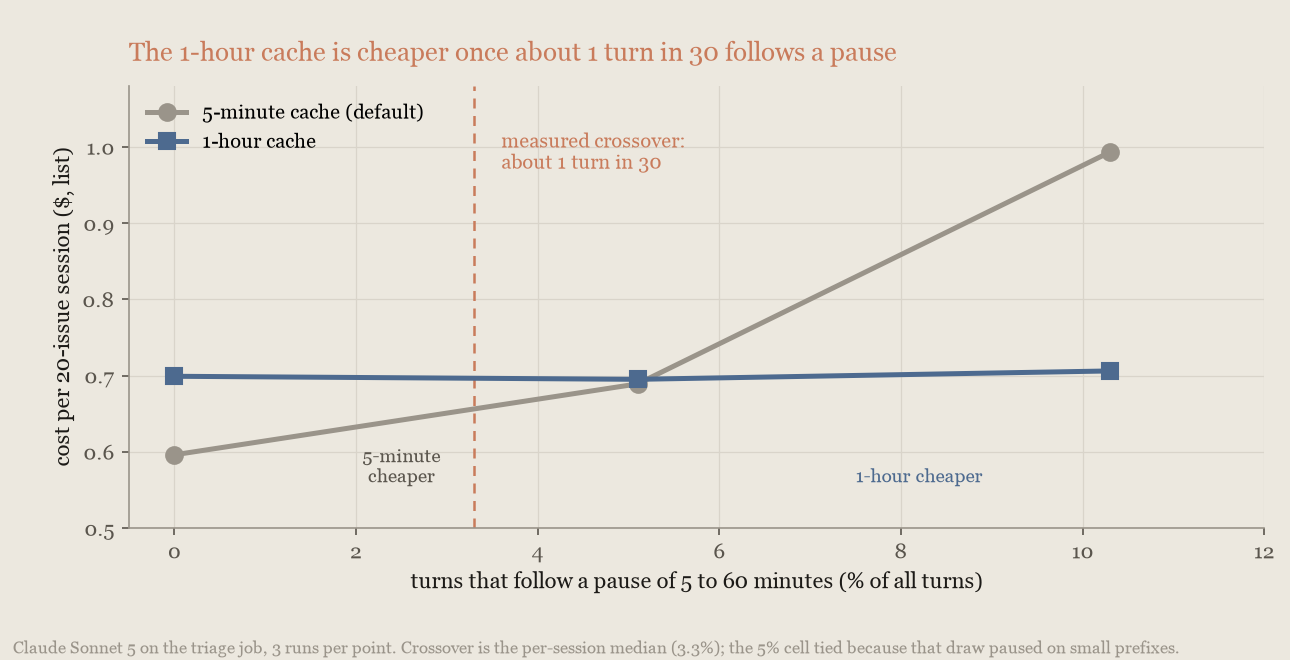
7171
from line 241
241241
242242## Trade cost against intelligence
243243
244These levers set where a single model sits between cost and intelligence: model choice, effort, re-running failures at a higher setting, and the budgets and caps it works within. Start with an effort sweep on your current model ([Tune effort](https://platform.claude.com/docs/en/about-claude/models/optimizing-for-cost-and-intelligence#tune-effort)). From lowest to highest cost and capability, the current models are Claude Haiku 4.5, Claude Sonnet 5, Claude Opus 5, and Claude Fable 5.1 (the frontier model); [Models overview](https://platform.claude.com/docs/en/models/overview) has the full lineup and prices.
244These levers set where a single model sits between cost and intelligence: model choice, effort, re-running failures at a higher setting, and the budgets and caps it works within. Start with an effort sweep on your current model ([Tune effort](https://platform.claude.com/docs/en/about-claude/models/optimizing-for-cost-and-intelligence#tune-effort)). From lowest to highest cost and capability, the current models are Claude Haiku 4.5, Claude Sonnet 5, Claude Opus 5.5, and Claude Fable 5.1 (the frontier model); [Models overview](https://platform.claude.com/docs/en/models/overview) has the full lineup and prices.
245245
246246### Compare models on cost per task
247247
from line 277
277277
278278### Tune effort
279279
280Effort is the most direct way to tune a model to your task. The `effort` parameter governs how much thinking, tool calling, and self-verification the model does, and the default (`high`) suits demanding tasks. Cost scales with all that activity; accuracy scales only with the part your task needs. Below the model's ceiling, the highest effort levels pay for depth the task never uses.
280Effort is the most direct way to tune a model to your task. The `effort` parameter governs how much thinking, tool calling, and self-verification the model does, and `high`, the default on most models, suits demanding tasks; Claude Opus 5.5 defaults to `medium`. Cost scales with all that activity; accuracy scales only with the part your task needs. Below the model's ceiling, the highest effort levels pay for depth the task never uses.
281281
282282On the research and knowledge-work benchmarks (WideSearch[1](https://platform.claude.com/docs/en/about-claude/models/optimizing-for-cost-and-intelligence#refs), DeepWideSearch[6](https://platform.claude.com/docs/en/about-claude/models/optimizing-for-cost-and-intelligence#refs), BrowseComp[4](https://platform.claude.com/docs/en/about-claude/models/optimizing-for-cost-and-intelligence#refs), and GDPval[2](https://platform.claude.com/docs/en/about-claude/models/optimizing-for-cost-and-intelligence#refs), all with Claude Fable 5), the curve of accuracy against cost is nearly flat: `low` gave up 1 to 3 points for a third to a half off the cost per task, `medium` matched the default's accuracy at about 70% to 87% of its cost, and the default bought nothing measurable over `medium` on any of the four. On DeepWideSearch, `low` also matched an orchestrator with a Claude Sonnet 5 worker at 29% lower cost: lowering effort beat an architecture change.
283283