
#### Defer unused tool definitions #### Keep data files out of the prompt #### Manage the context lifecycle
The whole hunk
from line 6, old and new numbered
/
lines
from line 6
66
77When a workload moves from prototype to production, cost becomes a first-class design constraint. The most capable model can be too expensive at scale, and the least expensive model can fall short on quality. Managing cost well means understanding how each cost lever affects output quality, because some levers trade against quality and some don't. The Claude Platform gives you direct control over that tradeoff. You choose the model, the effort level, and the architecture for each request, which lets you place a workload almost anywhere on the cost-to-intelligence frontier.
88
9Cost and intelligence are usually pictured as a frontier where one buys the other. The first group of levers on this page moves a workload toward that frontier by cutting cost without touching quality; only the second group moves along it:
10
11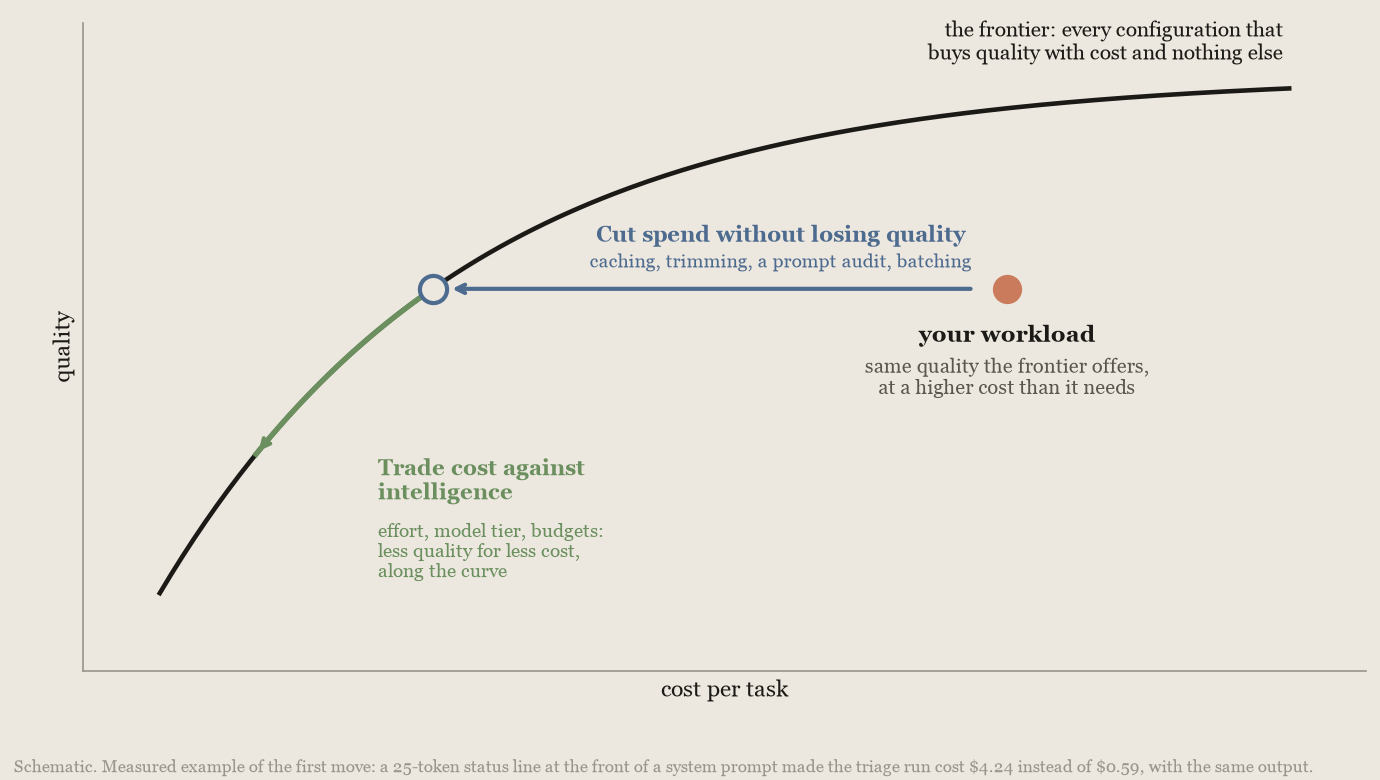
12
913The levers come in two kinds:
1014
1115* **Free wins** cut spend without touching quality: prompt caching, token hygiene, a prompt audit against the model you are running, [batch processing](https://platform.claude.com/docs/en/build-with-claude/batch-processing) at 50% off for work that can wait up to 24 hours, and [workspace spend limits](https://platform.claude.com/docs/en/api/rate-limits#setting-lower-limits-for-workspaces) as the backstop.
from line 47
4347
4448Turn on [prompt caching](https://platform.claude.com/docs/en/build-with-claude/prompt-caching) before any other lever, because every turn of an agentic task resends the entire growing conversation: system prompt, tool definitions, and every prior turn. A 40-turn task sends its first turn 40 times, so task cost grows with roughly the square of turn count. Caching does not stop the resending, but each resend costs about a tenth as much and processes faster: the prefix is billed at the [cache-read rate](https://platform.claude.com/docs/en/build-with-claude/prompt-caching#pricing), a tenth of the input price, and each turn pays the 1.25x cache-write rate only for what is new.
4549
50**What good looks like.** Over a full day of real traffic, agent loops read a median 84% of their input from the cache, and the top 10% of harnesses, coding or not, read 94% or more[17](https://platform.claude.com/docs/en/about-claude/models/optimizing-for-cost-and-intelligence#refs). Deep in a task, a well-built loop pays full price on under 1% of its input. Below about 80%, look for something breaking the cache (see [What breaks the cache](https://platform.claude.com/docs/en/about-claude/models/optimizing-for-cost-and-intelligence#what-breaks-the-cache)).
51
4652Across Anthropic's measured runs, cache reads are routinely the largest single component of task cost, making caching worth more than most model-choice decisions. Anthropic priced WideSearch[1](https://platform.claude.com/docs/en/about-claude/models/optimizing-for-cost-and-intelligence#refs) and DeepResearch Bench II[7](https://platform.claude.com/docs/en/about-claude/models/optimizing-for-cost-and-intelligence#refs) runs with and without caching:
4753
4854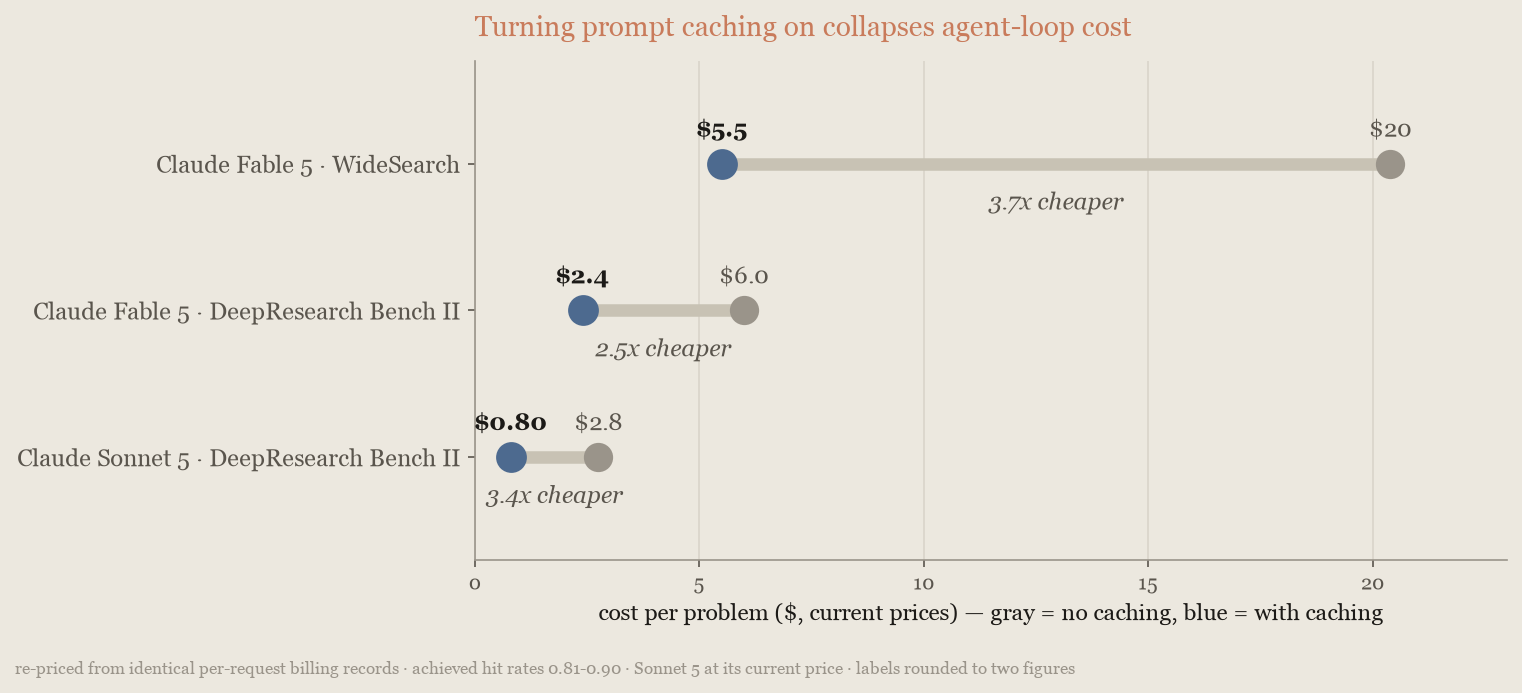
from line 62
5662To decide, count the gaps between consecutive requests in a conversation:
5763
5864* More than about 1 gap in 20 falls between 5 minutes and an hour, and gaps over an hour are rare: use the 1-hour duration.
59* Turns arrive seconds apart: stay on the 5-minute default. With no pauses, it cost 15% less than the 1-hour setting on Claude Sonnet 5 and 11% less on Claude Opus 5.
65* Turns arrive seconds apart: stay on the 5-minute default. When nothing paused, it cost 15% less than the 1-hour setting on Claude Sonnet 5 and 11% less on Claude Opus 5.
6066* Gaps over an hour are common: stay on the default. A gap over an hour expires both durations, and the 1-hour setting then re-writes the prefix at 2x the input price instead of 1.25x, so it loses on each of those gaps. It pays off only when, beyond the 1-in-20 share, gaps between 5 minutes and an hour are at least about two-thirds as frequent as gaps over an hour (each in-band gap saves about 1.15x the prefix; each gap over an hour costs about 0.75x).
6167
62Anthropic measured the 20-issue triage job from [Trim input and context tokens](https://platform.claude.com/docs/en/about-claude/models/optimizing-for-cost-and-intelligence#trim-input-and-context-tokens) with pauses inserted before some turns to simulate a person's delay[16](https://platform.claude.com/docs/en/about-claude/models/optimizing-for-cost-and-intelligence#refs). On both models measured, Claude Sonnet 5 and Claude Opus 5, the 1-hour cache became the cheaper setting once about 3% of turns followed a pause, about 1 turn in 30. The 1-in-20 rule is set above that crossover to leave a margin. With a pause before every turn, the 5-minute setting cost $4.13 per 20-issue session compared with $0.70 for the 1-hour setting on Claude Sonnet 5, and $13.41 compared with $2.70 on Claude Opus 5. Every current model uses the same cache multipliers, so the crossover is in the same range on the other models; the exact share depends on how much of a session the model re-reads. Accuracy stayed within run-to-run noise in every cell. The turn after a pause kept its warm-cache latency on the 1-hour setting. The following chart plots cost per session against the share of paused turns on Claude Sonnet 5:
68Anthropic measured the triage job from [Trim input and context tokens](https://platform.claude.com/docs/en/about-claude/models/optimizing-for-cost-and-intelligence#trim-input-and-context-tokens) with pauses inserted before some turns to simulate a person's delay[16](https://platform.claude.com/docs/en/about-claude/models/optimizing-for-cost-and-intelligence#refs). On both models measured, the 1-hour cache became the cheaper setting once about 1 turn in 30 followed a pause, so the 1-in-20 rule leaves a margin, and the gap widens quickly past the crossover because every paused turn on the 5-minute setting re-writes the whole prefix. Every current model uses the same cache multipliers, so the crossover is in the same range on the other models; the exact share depends on how much of a session the model re-reads. Accuracy stayed within run-to-run noise in every cell. The turn after a pause kept its warm-cache latency on the 1-hour setting. The following chart plots cost per session against the share of paused turns on Claude Sonnet 5:
6369
6470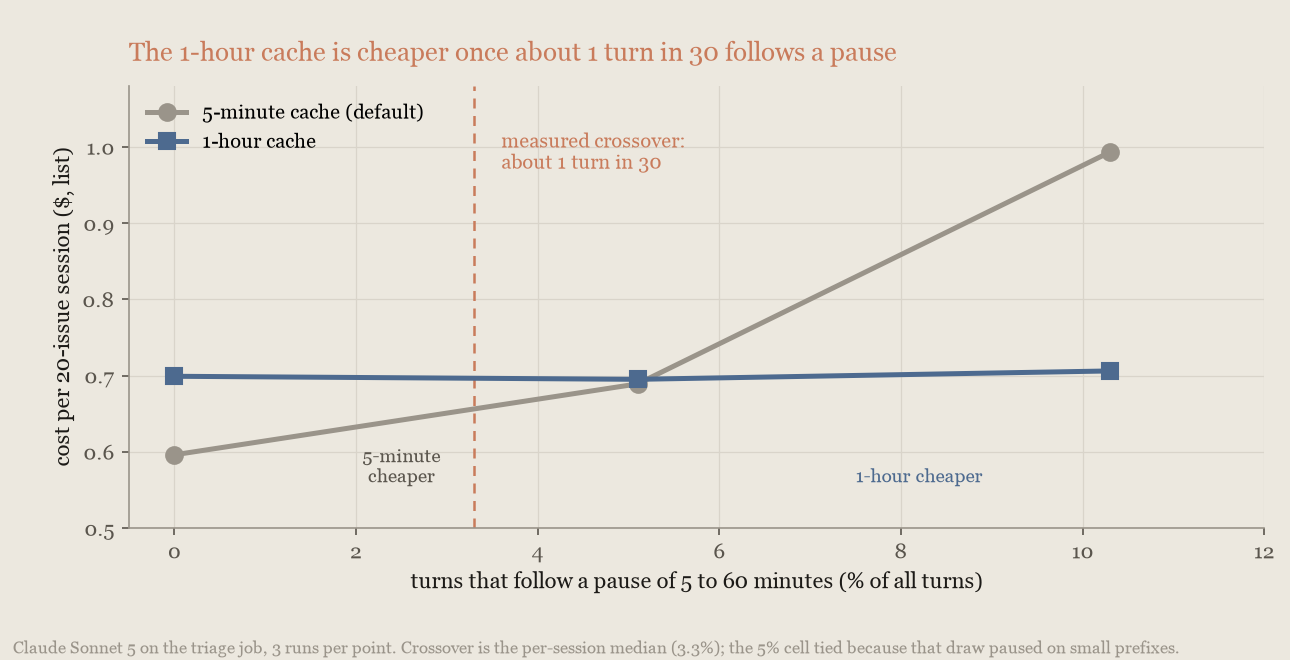
6571
from line 98
9298
9399#### What breaks the cache
94100
95Four things can break your cache during a task. Anything that changes per request, such as a timestamp or a queue position, placed ahead of the stable prefix turns every request into a full cache write: on the triage run in [Trim input and context tokens](https://platform.claude.com/docs/en/about-claude/models/optimizing-for-cost-and-intelligence#trim-input-and-context-tokens), a 25-token status line at the front of the system prompt cost $4.24 per run instead of $0.59, more than running with caching off. Keep per-request text in the newest user turn. Changing [`effort`](https://platform.claude.com/docs/en/build-with-claude/effort) between requests invalidates the cached prefix, so change it only where you would re-cache anyway, such as at a [compaction](https://platform.claude.com/docs/en/build-with-claude/compaction) boundary. Changing a [task budget](https://platform.claude.com/docs/en/build-with-claude/task-budgets) partway through does the same, so set it once, on the first request. Every [context editing](https://platform.claude.com/docs/en/build-with-claude/context-editing#context-editing-and-prompt-caching) pass invalidates the prefix from the point it clears and the next request pays to re-cache everything after it, so clear in a few large batches rather than many small ones. Make the last three changes at natural breaks, then confirm cache reads have not dropped; if they have, [cache diagnostics](https://platform.claude.com/docs/en/build-with-claude/cache-diagnostics) shows where the prefix diverged.
101Several things can break your cache during a task. Anything that changes per request, such as a timestamp or a queue position, placed ahead of the stable prefix turns every request into a full cache write: on the triage run in [Trim input and context tokens](https://platform.claude.com/docs/en/about-claude/models/optimizing-for-cost-and-intelligence#trim-input-and-context-tokens), a 25-token status line at the front of the system prompt cost $4.24 per run instead of $0.59, more than running with caching off. Keep per-request text in the newest user turn.
96102
103The cache is a byte-exact prefix match over the request in order (tools, then system prompt, then messages), so a change anywhere invalidates everything after it. Changing [`effort`](https://platform.claude.com/docs/en/build-with-claude/effort) or the thinking configuration between requests invalidates the cache from that point onward, and on some models the tools and system prompt ahead of it as well; any edit to the system prompt invalidates the cache from that point onward; setting or changing an output format invalidates the cache for the whole conversation; adding, removing, or reordering a tool definition invalidates all of it. The [prompt caching](https://platform.claude.com/docs/en/build-with-claude/prompt-caching#what-invalidates-the-cache) page lists these cases, apart from the output format, which [structured outputs](https://platform.claude.com/docs/en/build-with-claude/structured-outputs#prompt-modification-and-token-costs) covers. On Claude Opus 5 (and Claude Fable 5, Claude Mythos 5, and Claude Opus 4.8), change instructions with a [mid-conversation system message](https://platform.claude.com/docs/en/build-with-claude/mid-conversation-system-messages), a `{"role": "system"}` message appended to `messages`, instead of editing the top-level `system` field: the cached prefix stays intact. The same page covers mid-conversation tool changes, in beta on those models. Otherwise, make such changes only where you would re-cache anyway, such as at a [compaction](https://platform.claude.com/docs/en/build-with-claude/compaction) boundary, and on the first request after the compaction rather than the one that triggers it.
104
105Anthropic measured this on the triage agent's long sessions[18](https://platform.claude.com/docs/en/about-claude/models/optimizing-for-cost-and-intelligence#refs). An effort change and an added tool made mid-session rewrote 39,000 and 60,000 cached tokens, and those sessions cost $0.95 per session. The same two changes on the first request after compaction cost $0.75, and on the request that triggered the compaction $0.92, because the compaction's summarization pass then re-processed the 81,000-token context at the cache-write price: that summarization pass cost $0.21, against $0.04 when the same changes came one request later, with accuracy within run-to-run noise in every arm:
106
107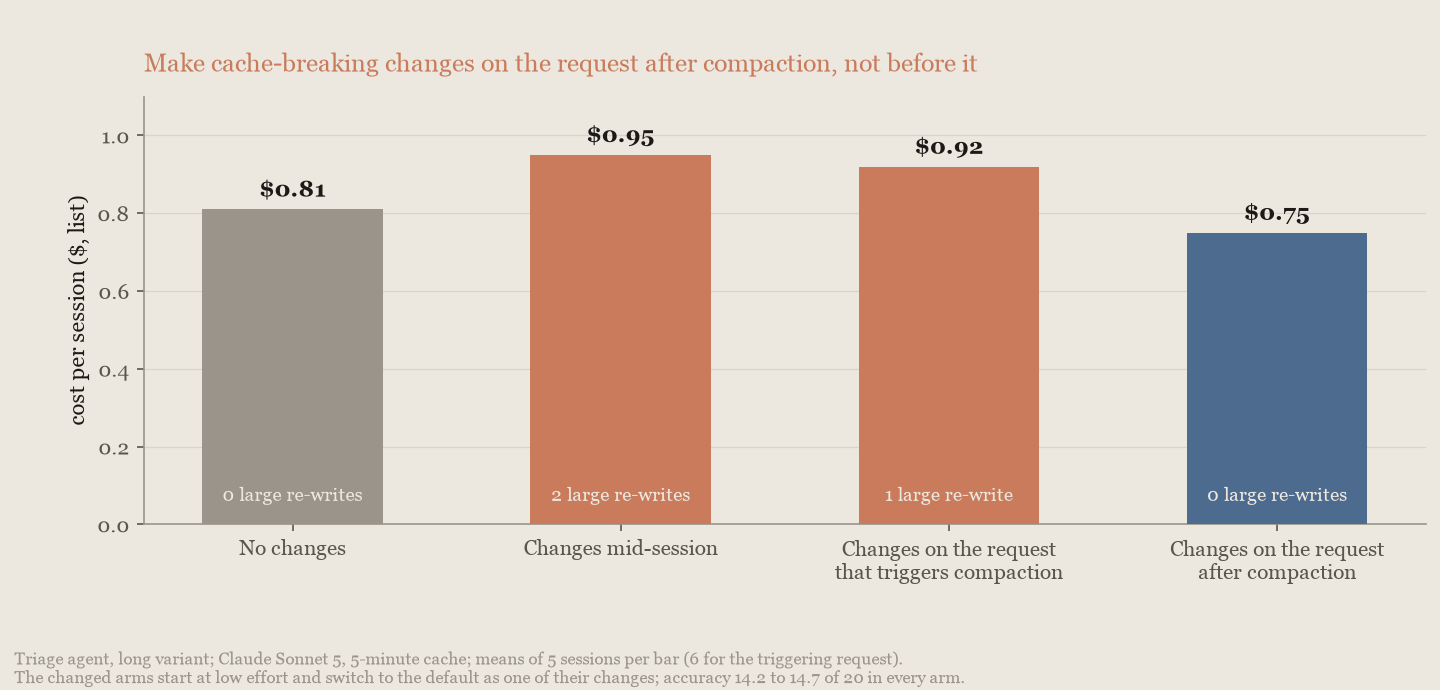
108
109Changing a [task budget](https://platform.claude.com/docs/en/build-with-claude/task-budgets) partway through invalidates any cached prefix that contains the budget value, so set it once, on the first request. Every [context editing](https://platform.claude.com/docs/en/build-with-claude/context-editing#context-editing-and-prompt-caching) pass invalidates the prefix from the point it clears and the next request pays to re-cache everything after it, so clear in a few large batches rather than many small ones. Make every cache-invalidating change at natural breaks, then confirm cache reads have not dropped; if they have, [cache diagnostics](https://platform.claude.com/docs/en/build-with-claude/cache-diagnostics) shows where the prefix diverged.
110
97111### Trim input and context tokens
98112
99113Most agent requests carry tokens that never influence the answer. Trimming them costs nothing in output quality, although not every lever here saved money when measured. Two places to look:
from line 115
101115* **Input trimming.** [Dynamic filtering](https://platform.claude.com/docs/en/agents-and-tools/tool-use/web-fetch-tool#dynamic-filtering) in the web fetch tool keeps boilerplate out of fetched pages, [image resizing](https://platform.claude.com/docs/en/build-with-claude/vision#evaluate-image-size) right-sizes vision inputs, and [tool search with deferred loading](https://platform.claude.com/docs/en/agents-and-tools/tool-use/tool-search-tool) loads tool definitions only when needed (measured later in this section). [Programmatic tool calling](https://platform.claude.com/docs/en/agents-and-tools/tool-use/programmatic-tool-calling) lets Claude run several tool calls from code so only the filtered result enters the context; its documentation reports 24% fewer input tokens on agentic search benchmarks, with a higher score. [Manage tool context](https://platform.claude.com/docs/en/agents-and-tools/tool-use/manage-tool-context) compares tool search, programmatic tool calling, prompt caching, and context editing.
102116* **Context lifecycle.** [Context editing](https://platform.claude.com/docs/en/build-with-claude/context-editing) clears stale tool results, and [automatic compaction](https://platform.claude.com/docs/en/build-with-claude/compaction) with its threshold stops long loops from carrying their whole history forward.
103117
104Defer tool definitions you are not using. Every tool definition attached to a request is input on every turn, and a few MCP servers add up to hundreds of them. Anthropic ran the triage agent with its own two tools plus a catalog of real tool definitions from public MCP servers, for a total of up to 502 tools, loading all of them or marking the extras `defer_loading` behind [tool search](https://platform.claude.com/docs/en/agents-and-tools/tool-use/tool-search-tool):
118The levers interact with the cache and each other, so judge them by net effect, and use [cache diagnostics](https://platform.claude.com/docs/en/build-with-claude/cache-diagnostics) to confirm your cached prefix survives each change. Anthropic measured them on an issue-triage agent working through 20 real bug reports with screenshots from a public repository, and on a longer variant of the same job with 2.6 times the tokens. With caching on, input trimming (image resizing and tool search) took a further 26% off the short run and 21% off the long one.
105119
120#### Defer unused tool definitions
121
122Every tool definition attached to a request is input on every turn, and a few MCP servers add up to hundreds of them. Anthropic ran the triage agent with its own two tools plus a catalog of real tool definitions from public MCP servers, for a total of up to 502 tools, loading all of them or marking the extras `defer_loading` behind [tool search](https://platform.claude.com/docs/en/agents-and-tools/tool-use/tool-search-tool):
123
106124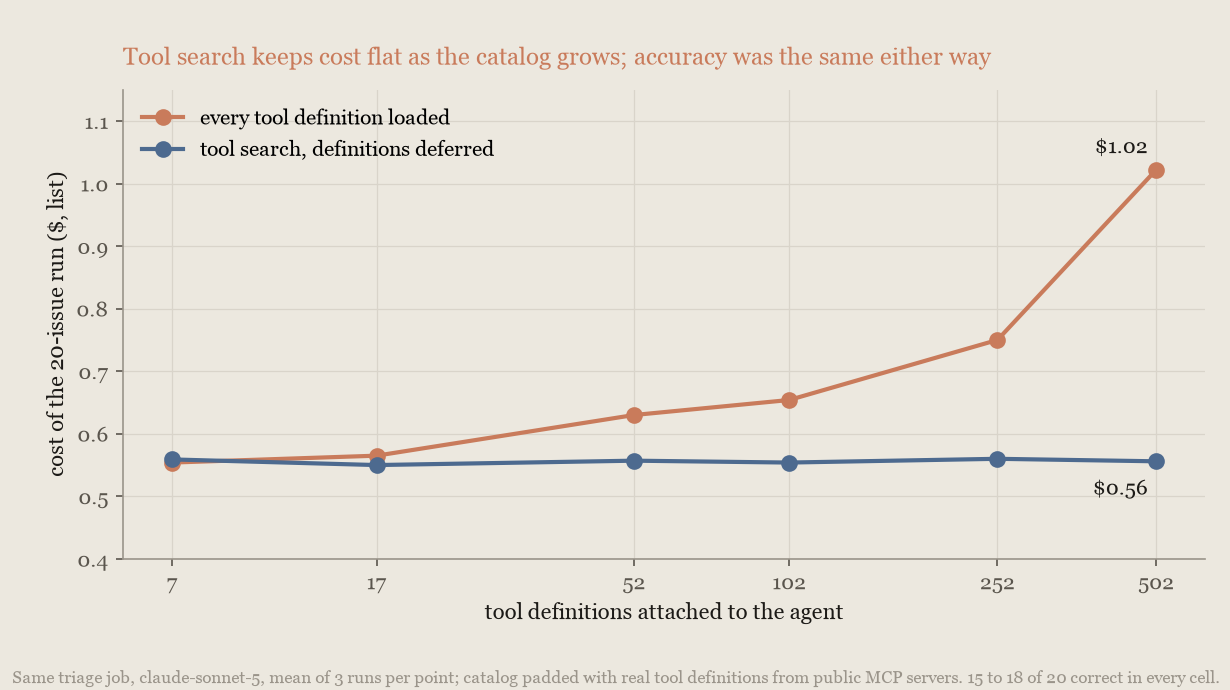
107125
108126With every definition loaded, the run cost rose from $0.55 to $1.02, tracking the schema tokens on each request. With tool search, it stayed at $0.56 at every catalog size, 45% less at 502 tools. Accuracy was 15 to 18 of 20 in every cell either way, and the model never called a wrong tool, so at this scale the catalog costs money, not correctness. The same holds for tools that come through the [MCP connector](https://platform.claude.com/docs/en/agents-and-tools/mcp-connector): with a public GitHub MCP server attached, deferring its toolset (`default_config: {defer_loading: true}`) cut the run 20% at the same accuracy.
109127
110Keep data files out of the prompt. When the model has to compute over a table, upload it with the [Files API](https://platform.claude.com/docs/en/build-with-claude/files) and let the model query it with [code execution](https://platform.claude.com/docs/en/agents-and-tools/tool-use/code-execution-tool) instead of pasting it in. Anthropic asked 25 aggregate questions[15](https://platform.claude.com/docs/en/about-claude/models/optimizing-for-cost-and-intelligence#refs) (sums, filtered counts, group-bys, and a date filter) over a 1,862-row public CSV, with the answers computed by pandas:
128#### Keep data files out of the prompt
111129
130When the model has to compute over a table, upload it with the [Files API](https://platform.claude.com/docs/en/build-with-claude/files) and let the model query it with [code execution](https://platform.claude.com/docs/en/agents-and-tools/tool-use/code-execution-tool) instead of pasting it in. Anthropic asked 25 aggregate questions[15](https://platform.claude.com/docs/en/about-claude/models/optimizing-for-cost-and-intelligence#refs) (sums, filtered counts, group-bys, and a date filter) over a 1,862-row public CSV, with the answers computed by pandas:
131
112132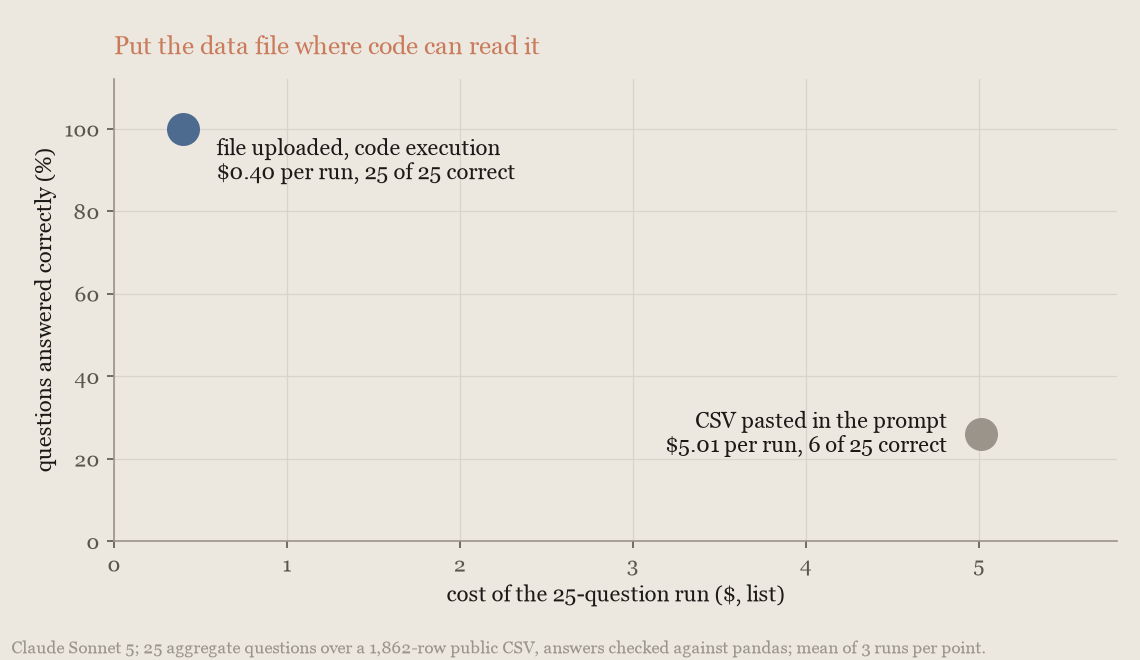
113133
114134Pasted into the prompt, the table is about 91,000 input tokens on every request, and Claude Sonnet 5 answered 6 of 25 questions correctly at $5.01 per run. Uploaded, with code execution, it answered 25 of 25 at $0.40. Claude Opus 5 showed the same pattern (6 of 25 at $13.45 against 25 of 25 at $1.91).
115135
116The levers interact with the cache and each other, so judge them by net effect, and use [cache diagnostics](https://platform.claude.com/docs/en/build-with-claude/cache-diagnostics) to confirm your cached prefix survives each change. Anthropic measured them on an issue-triage agent working through 20 real bug reports with screenshots from a public repository, and on a longer variant of the same job with 2.6 times the tokens. With caching on, input trimming (image resizing and tool search) took a further 26% off the short run and 21% off the long one. The context levers are where the two runs diverge:
136#### Manage the context lifecycle
117137
138The context levers are where the two runs diverge:
139
118140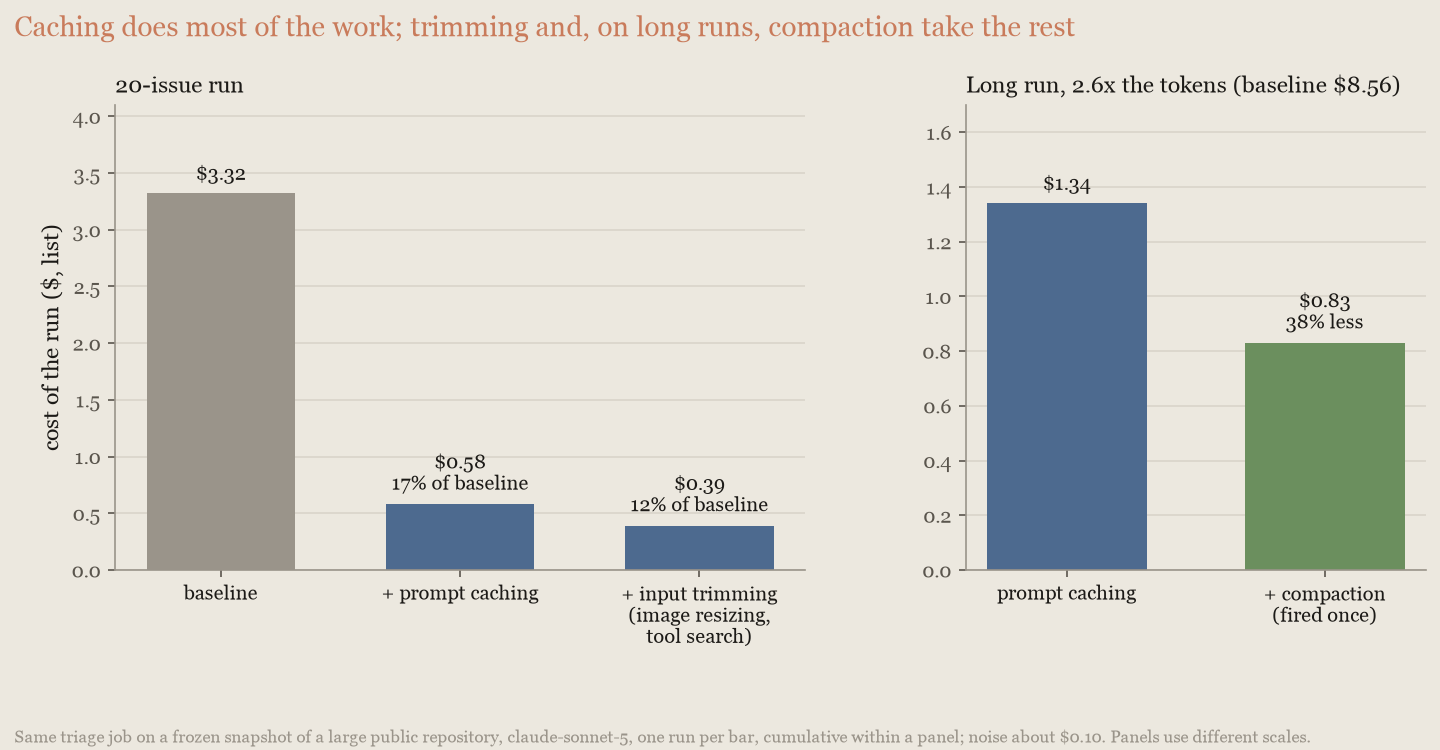
119141
120142The context levers only pay on a session long enough to need them. On the 20-issue run, context editing cost 74% more, and compaction and the prune changed nothing. On the long run, context editing changed nothing, compaction saved 32%, and the prune saved 39%. The prune is a few lines you write yourself: at each task boundary, replace large stale tool results with a one-line extract. It caches well because the edits sit at the tail of the conversation, where the next task adds new content anyway: 89% cache reads on the first request after a boundary and 81% on the requests between boundaries. Run-wide, the prune and context editing cache equally well. The prune is cheaper because context editing rewrites content mid-task that the prune deletes (about two thirds of the gap) and because it keeps the context about half the size (the other third). If you use context editing, [clear in a few large batches](https://platform.claude.com/docs/en/build-with-claude/context-editing#context-editing-and-prompt-caching). The prune, adapted from the harness:
from line 688
666688
667689## Benchmarks referenced
668690
669All measurements are Anthropic-internal runs of these benchmarks. Unless noted, costs are USD at the list prices in effect when each benchmark ran; Claude Sonnet 5 figures use $2 and $10 per million input and output tokens. Charts labeled "notional USD" price each request's token counts at those rates rather than reporting invoices.
691Except where a reference says otherwise, measurements are Anthropic-internal runs of these benchmarks. Unless noted, costs are USD at the list prices in effect when each benchmark ran; Claude Sonnet 5 figures use $2 and $10 per million input and output tokens. Charts labeled "notional USD" price each request's token counts at those rates rather than reporting invoices.
670692
6716931. **WideSearch:** Wong et al., "WideSearch: Benchmarking Agentic Broad Info-Seeking," arXiv:2508.07999, 2025. Broad web-research tasks graded on a many-row table's completeness and accuracy; 200 problems, 3 runs per configuration, run August 1 to 2, 2026. The caching chart re-prices the effort chart's default-effort runs from their per-request billing records; per-problem costs differ slightly because the two charts use different cost accounting. The cost-concentration chart is a separate 20-problem run, 3 runs per problem, run August 3 to 4, 2026, costed from per-request billing records.
6726942. **GDPval:** OpenAI, "GDPval: Evaluating AI Model Performance on Real-World Economically Valuable Tasks," 2025. Knowledge-work deliverables graded against task rubrics; a 210-task run of the released gold set, one attempt per task, run August 2, 2026. A Claude model grades, so absolute scores may differ from published results.
from line 703
68170311. **Internal agentic-coding benchmark:** Anthropic-internal: 370 repository tasks graded by the repositories' own tests. The API figures (Opus 5 alone, Fable 5 alone, and the pairing) were measured August 9 to 10, 2026, at the default effort with a 128,000-token output cap, one run per configuration: five attempts per task at the default settings and for the pairing, one at `low` and `medium`; the pairing averaged about two advisor consultations per attempt; costs are per attempt. The Claude Code figures are runs of the same tasks from July 8 to 23, 2026, one run per configuration, costs approximate.
68270412. **Internal repository-task benchmark (cap measurement):** A separate Anthropic-internal set of about 130 repository tasks, run August 8 to 10, 2026, with a plain API agent loop, one attempt per task. The 16,384-token figures average two runs per model; the 64,000-token figures are single runs (124 tasks scored for Opus 5; 108 for Claude Fable 5, the environment having skipped the rest before the model ran). About half the Fable attempts the 16,384 cap had ended solved at 64,000; a further Fable run at 128,000 scored 56.1%, within noise of the 64,000 run. The SWE-bench Pro cap figures are one Claude Fable 5 run per cap (August 10, 2026) at the default effort on a 100-problem subset stratified from reference 3's 482-problem set, not comparable to its scores. The chart's per-turn distributions come from the Opus run at 64,000 and the Fable run at 128,000, so neither is cut off by its own cap.
68370513. **Chartography:** Surge AI, "Chartography," 2026. The complete released 100-question set, measured August 8 to 10, 2026, with Anthropic's implementation on Claude Managed Agents (standard cloud sandbox; advisor configurations use the Managed Agents advisor). Claude Sonnet 4.6 grades instead of the reference judge and the benchmark runs with tools, so scores compare across configurations here but not to the published leaderboard. Two runs per configuration, pooled; run-to-run spreads were 4 to 10 points. Costs exclude sandbox time, which added under 1%. The consult-rate comparison comes from rerunning the same configurations on the Messages API with a container tool set, August 10 to 11, 2026.
68414. **Support-desk prompt-audit evaluation:** An Anthropic-constructed set of 44 support tickets with deterministic grading, run August 2026 under six system prompts, each adding to the same clean prompt one pattern common in prompts written for Claude Opus 4.8 and Claude Sonnet 4.6. Each chart point is one of three cases (older model, newer model on the same prompt, newer model after the audit) averaged over the six prompts and 44 tickets. The Opus 5 accuracy gain has a 95% confidence interval of 3 to 8 points; the Sonnet accuracy differences are within noise.
70614. **Support-desk prompt-audit evaluation:** An Anthropic-constructed set of 44 support tickets with deterministic grading, run in early August 2026 and reported on August 8, 2026, under six system prompts, each adding to the same clean prompt one pattern common in prompts written for Claude Opus 4.8 and Claude Sonnet 4.6. Each chart point is one of three cases (older model, newer model on the same prompt, newer model after the audit) averaged over the six prompts and 44 tickets. The Opus 5 accuracy gain has a 95% confidence interval of 3 to 8 points; the Sonnet accuracy differences are within noise.
68570715. **Data-file question set:** An Anthropic-constructed set of 25 aggregate questions over a 1,862-row slice of a public liquor-sales CSV, with ground truth computed by pandas and exact-match grading, run on Claude Sonnet 5 and Claude Opus 5 with thinking disabled (the in-context arm cannot complete at the default), a 4,000-token output cap, and no prompt caching, three runs per configuration, run August 19, 2026. The file arm uploads the CSV through the Files API and uses the `code_execution_20260120` tool.
68670816. **Cache duration measurement:** The 20-issue triage job from [Trim input and context tokens](https://platform.claude.com/docs/en/about-claude/models/optimizing-for-cost-and-intelligence#trim-input-and-context-tokens), run August 23, 2026, on Claude Sonnet 5 and Claude Opus 5 on the Messages API with the same harness, the Claude Opus 5 cells with `max_tokens` raised to 4,096, with pauses inserted before a randomly chosen share of turns (none, 5%, 10%, and every turn at 6 minutes on all 20 issues on both models, plus every turn at 2 minutes on Claude Sonnet 5; 20-minute pauses on a 5-issue subset on both models; 45-minute pauses on a 5-issue subset on Claude Sonnet 5 only). Three runs per cell, cost computed from each response's `usage` fields on a customer-billed organization at list prices, accuracy against the same gold labels. The crossover is about 3.3% of turns on both models: the median of each session's break-even share, computed by the cost model from that session's turn-by-turn context sizes, over all 45 Claude Sonnet 5 and 36 Claude Opus 5 twenty-issue sessions in the analysis (every pause schedule run on the full job, under all three cache settings, three runs each; the 5-issue cells are not in it). The 5% cell tied on Claude Sonnet 5 because that draw's pauses fell on small prefixes. The page's 1-in-20 rule sits above the measured crossover. Anthropic measured keep-alive requests that refresh the 5-minute cache as a comparator only. They matched the 1-hour setting at best and cost more with a pause before every turn, so do not use them.
70917. **Cache-read share in production:** Aggregated first-party Claude API usage for the 14 days ending August 23, 2026, direct API product only, Anthropic-internal organizations excluded, no organization identified. An organization-day counts as an agent loop when its requests carry tool definitions and tool results, its prompts hold 9 or more prior tool calls on average, caching was used, and it made at least 10 such requests (the API has no conversation identifier, so this stands in for conversation length): 303,003 organization-days across 106,487 organizations, median cache-read share 84.2% of all input tokens, upper quartile 91.7%. Use-case labels (the organization's declared use case, or otherwise its classified one) cover 74% of those organization-days and 99% of their tokens; coding organizations supply 87% of agentic input tokens and read a median 88.5% (90.9% at 25 or more prior tool calls), upper quartile 93.4%, with about 72% of coding organization-days at 80% or more; support, research, and data agents read 84% to 85%. The top decile of organization-days reads 95.9% or more for coding and 94.2% to 94.8% for support, research, data, and other agents. The request-level split at 25 or more prior tool calls comes from a six-hour sample: coding 92% read, 7% write, under 1% uncached. Unlabeled organizations, mostly small, read a median 11%. Organization-days with no tool definitions read a median 34.6%. An independent query over the same window that reconstructs conversations of 10 or more requests, rather than scoring organization-days, puts the median at 90.2%; the difference is scope, not data.
71018. **Compaction timing measurement:** The triage agent's long variant from [Trim input and context tokens](https://platform.claude.com/docs/en/about-claude/models/optimizing-for-cost-and-intelligence#trim-input-and-context-tokens), run August 24, 2026, on Claude Sonnet 5 with the 5-minute cache, cost from the usage fields at list prices, five sessions per arm: a no-change arm at the default effort throughout ($0.81 per session), and two arms that start at low effort and make the same two cache-breaking changes, a switch to the default effort and one added tool, either mid-session at requests 12 and 17 ($0.95) or together on the first request after the first compaction ($0.75). A fourth arm of six sessions, run August 25, 2026, made the same two changes on the request that triggered the first compaction ($0.92 per session): that request's summarization pass wrote the 81,000-token context to the cache instead of reading it, so that pass cost $0.21 against $0.04 for the same pass in the boundary arm. Sessions first compacted at request 21 to 25 (16 of the 21 sessions at request 22), once the prompt passed the 80,000-token compaction trigger, and two no-change sessions compacted a second time near the end. The boundary arm's lower total than the no-change arm reflects its low-effort requests before the change and those second compactions rather than caching: the two arms' re-write costs differ by under a cent. The mid-session arm paid $0.23 per session in cache re-writes; the difference between the mid-session and boundary arms was $0.20 with a 95% confidence interval of $0.11 to $0.29. One mid-session session ran cheap ($0.82) after its model mis-called the search tool following compaction and got empty results; it is included, and without it the arm averages $0.98. Accuracy averaged 14.2 of 20 labels in each August 24 arm and 14.7 in the August 25 arm; cache reads were 91% of prompt tokens with no changes, 85% mid-session, 91% at the boundary, and 86% with the changes on the triggering request.
687711
688712## Next steps
689713