
optimizing-for-cost-and-intelligence changedabout-claude/models/optimizing-for-cost-and-intelligence
Nearest release: v2.1.250, published an hour before this site recorded the change. Shown because the two are within 24 hours of each other. Nothing here says the release caused the edit.
Recorded here
Lines+88added
Lines−51removed
From line
20
where the diff opens
First seen
14 Aug 2026
this site's first read of the page
Recorded edits24to this page, all time
#### Why caching comes first #### Pick the cache duration #### Turn on caching #### What breaks the cache
The whole hunk
from line 20, old and new numbered
/
from line 20
2020| Your situation | Do this | Where |
2121| ------------------------------------------------ | ----------------------------------------------------------------------------------------------------------------------------------------------------------------------------------- | ----------------------------------------------------------------------------------------------------------------------------------------------------------------------------------------------------------------------------------------------------------------------------------------- |
2222| Any workload, any model | Turn on prompt caching and trim unneeded tokens; both are free | [Cache repeated context](https://platform.claude.com/docs/en/about-claude/models/optimizing-for-cost-and-intelligence#cache-repeated-context) · [Trim tokens](https://platform.claude.com/docs/en/about-claude/models/optimizing-for-cost-and-intelligence#trim-input-and-context-tokens) |
23| A person waits between turns | Use the 1-hour cache duration; it is cheaper once about 1 turn in 20 follows a pause between 5 minutes and an hour and few gaps run over an hour | [Pick the cache duration](https://platform.claude.com/docs/en/about-claude/models/optimizing-for-cost-and-intelligence#pick-the-cache-duration) |
2324| Costs are too high; quality is fine | Sweep effort down on your current model | [Tune effort](https://platform.claude.com/docs/en/about-claude/models/optimizing-for-cost-and-intelligence#tune-effort) |
2425| You are not on the latest model | Upgrade; the current model solves more, usually at lower cost per solved task | [Upgrade the model](https://platform.claude.com/docs/en/about-claude/models/optimizing-for-cost-and-intelligence#upgrade-the-model) |
2526| You are choosing or switching models | Compare on cost per completed task, not per token | [Compare models](https://platform.claude.com/docs/en/about-claude/models/optimizing-for-cost-and-intelligence#compare-models-on-cost-per-task) |
from line 39
3839
3940### Cache repeated context
4041
42#### Why caching comes first
43
4144Turn on [prompt caching](https://platform.claude.com/docs/en/build-with-claude/prompt-caching) before any other lever, because every turn of an agentic task resends the entire growing conversation: system prompt, tool definitions, and every prior turn. A 40-turn task sends its first turn 40 times, so task cost grows with roughly the square of turn count. Caching does not stop the resending, but each resend costs about a tenth as much and processes faster: the prefix is billed at the [cache-read rate](https://platform.claude.com/docs/en/build-with-claude/prompt-caching#pricing), a tenth of the input price, and each turn pays the 1.25x cache-write rate only for what is new.
4245
4346Across Anthropic's measured runs, cache reads are routinely the largest single component of task cost, making caching worth more than most model-choice decisions. Anthropic priced WideSearch[1](https://platform.claude.com/docs/en/about-claude/models/optimizing-for-cost-and-intelligence#refs) and DeepResearch Bench II[7](https://platform.claude.com/docs/en/about-claude/models/optimizing-for-cost-and-intelligence#refs) runs with and without caching:
from line 47
4447
4548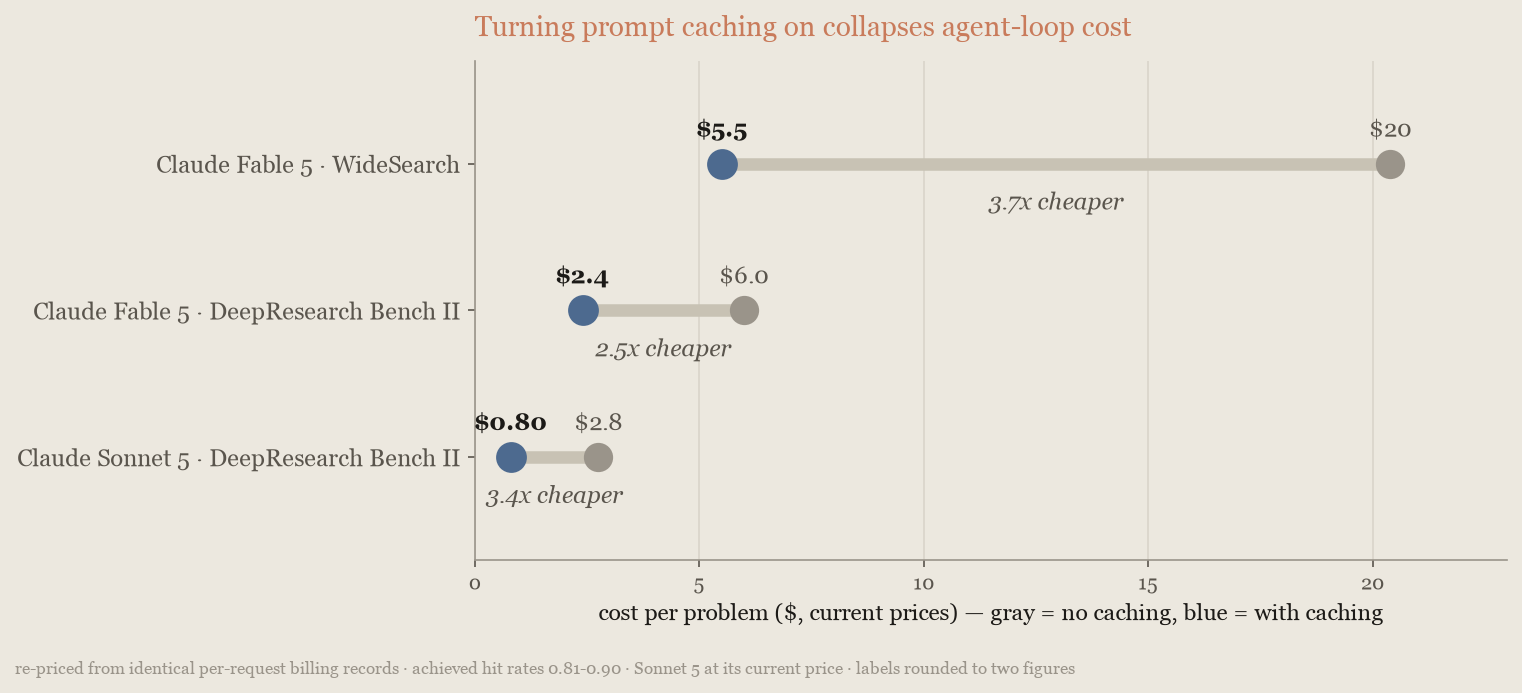
4649
47The cache's default lifetime is 5 minutes and an agent loop's turns are seconds apart, so the discount applies to most tokens on every turn; the charted runs achieved 81% to 90% hit rates. The saving varies with episode depth, because shorter loops re-read less, but caching stayed the largest single lever on every model and benchmark measured.
50The cache's default lifetime is 5 minutes and an agent loop's turns are seconds apart, so the discount applies to most tokens on every turn. The caching chart's runs achieved 81% to 90% hit rates. The saving varies with episode depth, because shorter loops re-read less, but caching stayed the largest single lever on every model and benchmark measured.
4851
49If your loop waits on humans between turns, use the [1-hour cache duration](https://platform.claude.com/docs/en/build-with-claude/prompt-caching#1-hour-cache-duration). It costs more to write (2x the input price instead of 1.25x) but pays for itself on the first prevented miss, because a miss resends the whole prefix at full price and writes it again.
52#### Pick the cache duration
5053
54If your loop waits on a person between turns, use the [1-hour cache duration](https://platform.claude.com/docs/en/build-with-claude/prompt-caching#1-hour-cache-duration). It costs more to write (2x the input price instead of 1.25x). A miss on either duration bills the whole prefix at the write price instead of the read price, so the longer duration pays off once a few turns per session follow a pause between 5 minutes and an hour.
55
56To decide, count the gaps between consecutive requests in a conversation:
57
58* More than about 1 gap in 20 falls between 5 minutes and an hour, and gaps over an hour are rare: use the 1-hour duration.
59* Turns arrive seconds apart: stay on the 5-minute default. With no pauses, it cost 15% less than the 1-hour setting on Claude Sonnet 5 and 11% less on Claude Opus 5.
60* Gaps over an hour are common: stay on the default. A gap over an hour expires both durations, and the 1-hour setting then re-writes the prefix at 2x the input price instead of 1.25x, so it loses on each of those gaps. It pays off only when, beyond the 1-in-20 share, gaps between 5 minutes and an hour are at least about two-thirds as frequent as gaps over an hour (each in-band gap saves about 1.15x the prefix; each gap over an hour costs about 0.75x).
61
62Anthropic measured the 20-issue triage job from [Trim input and context tokens](https://platform.claude.com/docs/en/about-claude/models/optimizing-for-cost-and-intelligence#trim-input-and-context-tokens) with pauses inserted before some turns to simulate a person's delay[16](https://platform.claude.com/docs/en/about-claude/models/optimizing-for-cost-and-intelligence#refs). On both models measured, Claude Sonnet 5 and Claude Opus 5, the 1-hour cache became the cheaper setting once about 3% of turns followed a pause, about 1 turn in 30. The 1-in-20 rule is set above that crossover to leave a margin. With a pause before every turn, the 5-minute setting cost $4.13 per 20-issue session compared with $0.70 for the 1-hour setting on Claude Sonnet 5, and $13.41 compared with $2.70 on Claude Opus 5. Every current model uses the same cache multipliers, so the crossover is in the same range on the other models; the exact share depends on how much of a session the model re-reads. Accuracy stayed within run-to-run noise in every cell. The turn after a pause kept its warm-cache latency on the 1-hour setting. The following chart plots cost per session against the share of paused turns on Claude Sonnet 5:
63
64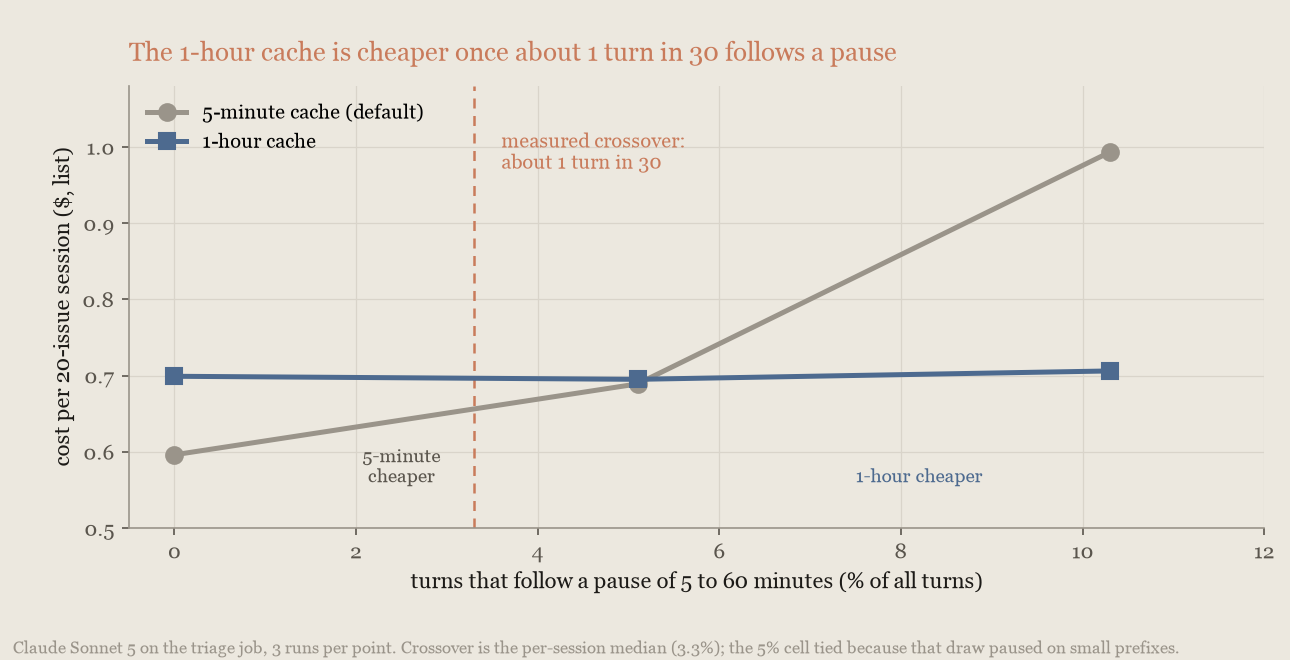
65
66Anthropic also measured extra requests that keep the 5-minute cache warm. They saved nothing measurable over the 1-hour duration at any share of paused turns and cost more with a pause before every turn, so use the duration instead.
67
68#### Turn on caching
69
5170Setup takes little work. [Automatic caching](https://platform.claude.com/docs/en/build-with-claude/prompt-caching#automatic-caching) places breakpoints for you; otherwise, the [Claude API skill](https://platform.claude.com/docs/en/agents-and-tools/agent-skills/claude-api-skill) that ships with Claude Code can add caching to an existing integration from one prompt. The following excerpt shows the skill adding it to the harness that produced these measurements:
5271
5372```text wrap
from line 90
7190
7291Those breakpoint placements follow the standard pattern in [Explicit cache breakpoints](https://platform.claude.com/docs/en/build-with-claude/prompt-caching#explicit-cache-breakpoints).
7392
93#### What breaks the cache
94
7495Four things can break your cache during a task. Anything that changes per request, such as a timestamp or a queue position, placed ahead of the stable prefix turns every request into a full cache write: on the triage run in [Trim input and context tokens](https://platform.claude.com/docs/en/about-claude/models/optimizing-for-cost-and-intelligence#trim-input-and-context-tokens), a 25-token status line at the front of the system prompt cost $4.24 per run instead of $0.59, more than running with caching off. Keep per-request text in the newest user turn. Changing [`effort`](https://platform.claude.com/docs/en/build-with-claude/effort) between requests invalidates the cached prefix, so change it only where you would re-cache anyway, such as at a [compaction](https://platform.claude.com/docs/en/build-with-claude/compaction) boundary. Changing a [task budget](https://platform.claude.com/docs/en/build-with-claude/task-budgets) partway through does the same, so set it once, on the first request. Every [context editing](https://platform.claude.com/docs/en/build-with-claude/context-editing#context-editing-and-prompt-caching) pass invalidates the prefix from the point it clears and the next request pays to re-cache everything after it, so clear in a few large batches rather than many small ones. Make the last three changes at natural breaks, then confirm cache reads have not dropped; if they have, [cache diagnostics](https://platform.claude.com/docs/en/build-with-claude/cache-diagnostics) shows where the prefix diverged.
7596
7697### Trim input and context tokens
from line 409
388409
389410## Measure on your own workload
390411
391The numbers on this page are from July and August 2026, at the list prices of the time, and will drift as models and prices change. Your escalation rate, how cleanly tasks split, and transcript length move them too. The method stays the same:
412The numbers on this page reflect list prices at the time of measurement and drift as models and prices change. Your escalation rate, how cleanly tasks split, and transcript length move them too. The method stays the same:
392413
3931. Pull a few tasks from production logs, weighted like real traffic, and [write outcome checks](https://platform.claude.com/docs/en/test-and-evaluate/develop-tests) for each: tests pass, ticket closed, row count correct. Record cost per task beside the score: price the four token counts in each response's `usage` at their own rates, summed across the task's requests (the [Usage and Cost API](https://platform.claude.com/docs/en/manage-claude/usage-cost-api) reports the aggregate).
4141. Pull a few tasks from production logs, weighted like real traffic, and [write outcome checks](https://platform.claude.com/docs/en/test-and-evaluate/develop-tests) for each: tests pass, ticket closed, row count correct. Record cost per task beside the score: price the five priced token counts in each response's `usage` at their own rates, summed across the task's requests (the [Usage and Cost API](https://platform.claude.com/docs/en/manage-claude/usage-cost-api) reports the aggregate). The 1-hour cache write bills at 2x the input price, and the 5-minute write at 1.25x.
3944152. Baseline the model tiers across effort levels, not only the default, and plot score against spend. A multi-model configuration must beat the single model's whole curve.
3954163. If the curve shows a gap effort can't close, add the multi-model strategy that fits and re-run the suite.
3964174. Run the winner in shadow on a traffic slice before cutover, then keep the suite running.
from line 437
416437 cost=$(jq -r --argjson in_price "$INPUT_PER_MTOK" --argjson out_price "$OUTPUT_PER_MTOK" '
417438 .usage
418439 | (.input_tokens * $in_price
419 + (.cache_creation_input_tokens // 0) * $in_price * 1.25 # 5-minute cache write
420 + (.cache_read_input_tokens // 0) * $in_price * 0.10 # cache read
440 + (.cache_creation.ephemeral_1h_input_tokens // 0) * $in_price * 2.00 # 1-hour cache write
441 + (.cache_creation.ephemeral_5m_input_tokens // 0) * $in_price * 1.25 # 5-minute cache write
442 + (.cache_read_input_tokens // 0) * $in_price * 0.10 # cache read
421443 + .output_tokens * $out_price) / 1e6
422444 ' <<<"$response")
423445 printf 'Request cost: $%.6f\n' "$cost"
from line 458
436458
437459 COST=$(jq -r --argjson in_price "$INPUT_PER_MTOK" --argjson out_price "$OUTPUT_PER_MTOK" '
438460 (.input_tokens * $in_price
439 + (.cache_creation_input_tokens // 0) * $in_price * 1.25 # 5-minute cache write
440 + (.cache_read_input_tokens // 0) * $in_price * 0.10 # cache read
461 + (.cache_creation.ephemeral_1h_input_tokens // 0) * $in_price * 2.00 # 1-hour cache write
462 + (.cache_creation.ephemeral_5m_input_tokens // 0) * $in_price * 1.25 # 5-minute cache write
463 + (.cache_read_input_tokens // 0) * $in_price * 0.10 # cache read
441464 + .output_tokens * $out_price) / 1e6
442465 ' <<<"$USAGE")
443466 printf 'Request cost: $%.6f\n' "$COST"
from line 478
455478 messages=[{"role": "user", "content": "Hello, Claude"}],
456479 )
457480 usage = response.usage
481 cache_writes = usage.cache_creation
482 writes_1h = cache_writes.ephemeral_1h_input_tokens if cache_writes else 0
483 writes_5m = cache_writes.ephemeral_5m_input_tokens if cache_writes else 0
458484 cost = (
459485 usage.input_tokens * INPUT_PER_MTOK
460 # Cache writes bill at 1.25x the input price (5-minute cache); cache reads at 0.1x.
461 + (usage.cache_creation_input_tokens or 0) * INPUT_PER_MTOK * 1.25
486 # 1-hour cache writes bill at 2x the input price, 5-minute at 1.25x; reads at 0.1x.
487 + writes_1h * INPUT_PER_MTOK * 2.0
488 + writes_5m * INPUT_PER_MTOK * 1.25
462489 + (usage.cache_read_input_tokens or 0) * INPUT_PER_MTOK * 0.10
463490 + usage.output_tokens * OUTPUT_PER_MTOK
464491 ) / 1_000_000
from line 506
479506 const usage = response.usage;
480507 const cost =
481508 (usage.input_tokens * INPUT_PER_MTOK +
482 (usage.cache_creation_input_tokens ?? 0) * INPUT_PER_MTOK * 1.25 + // 5-minute cache write
509 (usage.cache_creation?.ephemeral_1h_input_tokens ?? 0) * INPUT_PER_MTOK * 2 + // 1-hour cache write
510 (usage.cache_creation?.ephemeral_5m_input_tokens ?? 0) * INPUT_PER_MTOK * 1.25 + // 5-minute cache write
483511 (usage.cache_read_input_tokens ?? 0) * INPUT_PER_MTOK * 0.1 + // cache read
484512 usage.output_tokens * OUTPUT_PER_MTOK) /
485513 1_000_000;
from line 532
504532 double cost =
505533 (
506534 usage.InputTokens * InputPerMtok
507 + (usage.CacheCreationInputTokens ?? 0) * InputPerMtok * 1.25 // 5-minute cache write
535 + (usage.CacheCreation?.Ephemeral1hInputTokens ?? 0) * InputPerMtok * 2.00 // 1-hour cache write
536 + (usage.CacheCreation?.Ephemeral5mInputTokens ?? 0) * InputPerMtok * 1.25 // 5-minute cache write
508537 + (usage.CacheReadInputTokens ?? 0) * InputPerMtok * 0.10 // cache read
509538 + usage.OutputTokens * OutputPerMtok
510539 ) / 1_000_000;
from line 563
534563
535564 usage := response.Usage
536565 cost := (float64(usage.InputTokens)*inputPerMTok +
537 float64(usage.CacheCreationInputTokens)*inputPerMTok*1.25 + // 5-minute cache write
566 float64(usage.CacheCreation.Ephemeral1hInputTokens)*inputPerMTok*2.00 + // 1-hour cache write
567 float64(usage.CacheCreation.Ephemeral5mInputTokens)*inputPerMTok*1.25 + // 5-minute cache write
538568 float64(usage.CacheReadInputTokens)*inputPerMTok*0.10 + // cache read
539569 float64(usage.OutputTokens)*outputPerMTok) / 1_000_000
540570 fmt.Printf("Request cost: $%.6f\n", cost)
from line 585
555585 .build());
556586
557587 Usage usage = response.usage();
588 long writes1h = usage.cacheCreation().map(CacheCreation::ephemeral1hInputTokens).orElse(0L);
589 long writes5m = usage.cacheCreation().map(CacheCreation::ephemeral5mInputTokens).orElse(0L);
558590 double cost = (usage.inputTokens() * INPUT_PER_MTOK
559 + usage.cacheCreationInputTokens().orElse(0L) * INPUT_PER_MTOK * 1.25 // 5-minute cache write
591 + writes1h * INPUT_PER_MTOK * 2.00 // 1-hour cache write
592 + writes5m * INPUT_PER_MTOK * 1.25 // 5-minute cache write
560593 + usage.cacheReadInputTokens().orElse(0L) * INPUT_PER_MTOK * 0.10 // cache read
561594 + usage.outputTokens() * OUTPUT_PER_MTOK) / 1_000_000;
562595 IO.println("Request cost: $%.6f".formatted(cost));
from line 610
577610 $usage = $response->usage;
578611 $cost = (
579612 $usage->inputTokens * INPUT_PER_MTOK
580 + ($usage->cacheCreationInputTokens ?? 0) * INPUT_PER_MTOK * 1.25 // 5-minute cache write
613 + ($usage->cacheCreation?->ephemeral1hInputTokens ?? 0) * INPUT_PER_MTOK * 2.00 // 1-hour cache write
614 + ($usage->cacheCreation?->ephemeral5mInputTokens ?? 0) * INPUT_PER_MTOK * 1.25 // 5-minute cache write
581615 + ($usage->cacheReadInputTokens ?? 0) * INPUT_PER_MTOK * 0.10 // cache read
582616 + $usage->outputTokens * OUTPUT_PER_MTOK
583617 ) / 1_000_000;
from line 632
598632 usage = response.usage
599633 cost = (
600634 usage.input_tokens * INPUT_PER_MTOK +
601 usage.cache_creation_input_tokens.to_i * INPUT_PER_MTOK * 1.25 + # 5-minute cache write
635 usage.cache_creation&.ephemeral_1h_input_tokens.to_i * INPUT_PER_MTOK * 2.00 + # 1-hour cache write
636 usage.cache_creation&.ephemeral_5m_input_tokens.to_i * INPUT_PER_MTOK * 1.25 + # 5-minute cache write
602637 usage.cache_read_input_tokens.to_i * INPUT_PER_MTOK * 0.10 + # cache read
603638 usage.output_tokens * OUTPUT_PER_MTOK
604639 ) / 1_000_000
from line 641
606641 ```
607642</CodeGroup>
608643
609In agent loops the cache-read term is usually the largest of the four; if not, check that caching is engaged. When the [advisor tool](https://platform.claude.com/docs/en/agents-and-tools/tool-use/advisor-tool#usage-and-billing) or [compaction](https://platform.claude.com/docs/en/build-with-claude/compaction#understanding-usage) is enabled, some tokens are reported only in `usage.iterations` and not in the top-level totals, so sum over `usage.iterations` instead, pricing `advisor_message` entries at the advisor model's rates.
644In agent loops the cache-read term is usually the largest of the five; if not, check that caching is engaged. When the [advisor tool](https://platform.claude.com/docs/en/agents-and-tools/tool-use/advisor-tool#usage-and-billing) or [compaction](https://platform.claude.com/docs/en/build-with-claude/compaction#understanding-usage) is enabled, some tokens are reported only in `usage.iterations` and not in the top-level totals, so sum over `usage.iterations` instead, pricing `advisor_message` entries at the advisor model's rates.
610645
611646The following table lists the levers in the order to try them:
612647
613| Lever | Saving in these runs | Quality cost | Latency | Where |
614| ------------------------------------------- | --------------------------------------------------------------------------------------------------------------------------------------------------------- | ------------------------------------------------------ | ------------------------------- | ------------------------------------------------------------------------------------------------------------------------------------------------------------------------------- |
615| Prompt caching | Cost cut by a factor of 2.5 to 3.7 on agent loops; 83% on the triage run | None | Faster | [Cache repeated context](https://platform.claude.com/docs/en/about-claude/models/optimizing-for-cost-and-intelligence#cache-repeated-context) |
616| Input trimming | A further 5 percentage points on the triage run | None | Neutral | [Trim input and context tokens](https://platform.claude.com/docs/en/about-claude/models/optimizing-for-cost-and-intelligence#trim-input-and-context-tokens) |
617| Prune stale tool results at task boundaries | 39% on the long triage run (compaction 32%); nothing on short loops | None measured | Neutral | [Trim input and context tokens](https://platform.claude.com/docs/en/about-claude/models/optimizing-for-cost-and-intelligence#trim-input-and-context-tokens) |
618| Tool search | 45% with 500 tool definitions attached; 20% with a GitHub MCP server | None | Neutral | [Trim input and context tokens](https://platform.claude.com/docs/en/about-claude/models/optimizing-for-cost-and-intelligence#trim-input-and-context-tokens) |
619| Data files through code execution | 92% on a 25-question data task | A gain, 25 of 25 instead of 6 of 25 | Faster | [Trim input and context tokens](https://platform.claude.com/docs/en/about-claude/models/optimizing-for-cost-and-intelligence#trim-input-and-context-tokens) |
620| Batch API | 50% | None | Results within 24 hours | [Batch work that can wait](https://platform.claude.com/docs/en/about-claude/models/optimizing-for-cost-and-intelligence#batch-work-that-can-wait) |
621| Prompt audit against the current model | 14% on both migrations measured | None; a gain on one | Faster (fewer tool rounds) | [Audit prompts against the current model](https://platform.claude.com/docs/en/about-claude/models/optimizing-for-cost-and-intelligence#audit-prompts-against-the-current-model) |
622| Upgrade the model | Opus 4.7 to Opus 5: about 12% less per solved task, 11 more points; Sonnet 4.6 to Sonnet 5: 14% less, 5 more points | A gain | Neutral | [Upgrade the model](https://platform.claude.com/docs/en/about-claude/models/optimizing-for-cost-and-intelligence#upgrade-the-model) |
623| Lower effort | Knowledge work: `medium` 15% to 30%, `low` a third to a half; long coding: `medium` about half, `low` about three quarters | 1 to 3 points on knowledge work, 2 to 8 on long coding | Faster | [Tune effort](https://platform.claude.com/docs/en/about-claude/models/optimizing-for-cost-and-intelligence#tune-effort) |
624| Re-run failures | About half, at the same pass rate | None | Two runs on the tasks that fail | [Re-run failures at higher effort](https://platform.claude.com/docs/en/about-claude/models/optimizing-for-cost-and-intelligence#re-run-failures-at-higher-effort) |
625| Task budget | 18% to 47% | 3 to 4 points | Faster | [Set budgets and output caps](https://platform.claude.com/docs/en/about-claude/models/optimizing-for-cost-and-intelligence#set-budgets-and-output-caps) |
626| Ask for shorter answers | 39% of output tokens, 14% of cost on the triage run | None | Faster | [Set budgets and output caps](https://platform.claude.com/docs/en/about-claude/models/optimizing-for-cost-and-intelligence#set-budgets-and-output-caps) |
627| Raising `max_tokens` | None per solved task, but more tasks solved | Gains of 2 to 18 points | Neutral | [Set budgets and output caps](https://platform.claude.com/docs/en/about-claude/models/optimizing-for-cost-and-intelligence#set-budgets-and-output-caps) |
628| Advisor | Depends on the capability gap and the consult rate; the chart-reading pairing scored above both models' effort curves, the coding pairing only marginally | Small gains | About two extra calls per task | [Advisor strategy](https://platform.claude.com/docs/en/about-claude/models/optimizing-for-cost-and-intelligence#advisor-strategy-escalate-hard-decisions) |
629| Orchestrator | More than 60% below the frontier model beyond one context window; about half on routine tails | 2 to 6 points below the frontier model | Much faster on large inputs | [Orchestrator strategy](https://platform.claude.com/docs/en/about-claude/models/optimizing-for-cost-and-intelligence#orchestrator-strategy-delegate-bulk-work) |
648| Lever | Saving in these runs | Quality cost | Latency | Where |
649| ------------------------------------------- | -------------------------------------------------------------------------------------------------------------------------------------------------------------------------------------------------------------------------------- | ------------------------------------------------------ | ------------------------------- | ------------------------------------------------------------------------------------------------------------------------------------------------------------------------------- |
650| Prompt caching | Cost cut by a factor of 2.5 to 3.7 on agent loops; 83% on the triage run | None | Faster | [Cache repeated context](https://platform.claude.com/docs/en/about-claude/models/optimizing-for-cost-and-intelligence#cache-repeated-context) |
651| 1-hour cache duration | Cheaper than the 5-minute default once about 1 turn in 20 follows a pause between 5 minutes and an hour and few gaps run over an hour; with no pauses the default cost 15% less on Claude Sonnet 5 and 11% less on Claude Opus 5 | None | Stays warm after a pause | [Pick the cache duration](https://platform.claude.com/docs/en/about-claude/models/optimizing-for-cost-and-intelligence#pick-the-cache-duration) |
652| Input trimming | A further 5 percentage points on the triage run | None | Neutral | [Trim input and context tokens](https://platform.claude.com/docs/en/about-claude/models/optimizing-for-cost-and-intelligence#trim-input-and-context-tokens) |
653| Prune stale tool results at task boundaries | 39% on the long triage run (compaction 32%); nothing on short loops | None measured | Neutral | [Trim input and context tokens](https://platform.claude.com/docs/en/about-claude/models/optimizing-for-cost-and-intelligence#trim-input-and-context-tokens) |
654| Tool search | 45% with 500 tool definitions attached; 20% with a GitHub MCP server | None | Neutral | [Trim input and context tokens](https://platform.claude.com/docs/en/about-claude/models/optimizing-for-cost-and-intelligence#trim-input-and-context-tokens) |
655| Data files through code execution | 92% on a 25-question data task | A gain, 25 of 25 instead of 6 of 25 | Faster | [Trim input and context tokens](https://platform.claude.com/docs/en/about-claude/models/optimizing-for-cost-and-intelligence#trim-input-and-context-tokens) |
656| Batch API | 50% | None | Results within 24 hours | [Batch work that can wait](https://platform.claude.com/docs/en/about-claude/models/optimizing-for-cost-and-intelligence#batch-work-that-can-wait) |
657| Prompt audit against the current model | 14% on both migrations measured | None; a gain on one | Faster (fewer tool rounds) | [Audit prompts against the current model](https://platform.claude.com/docs/en/about-claude/models/optimizing-for-cost-and-intelligence#audit-prompts-against-the-current-model) |
658| Upgrade the model | Opus 4.7 to Opus 5: about 12% less per solved task, 11 more points; Sonnet 4.6 to Sonnet 5: 14% less, 5 more points | A gain | Neutral | [Upgrade the model](https://platform.claude.com/docs/en/about-claude/models/optimizing-for-cost-and-intelligence#upgrade-the-model) |
659| Lower effort | Knowledge work: `medium` 15% to 30%, `low` a third to a half; long coding: `medium` about half, `low` about three quarters | 1 to 3 points on knowledge work, 2 to 8 on long coding | Faster | [Tune effort](https://platform.claude.com/docs/en/about-claude/models/optimizing-for-cost-and-intelligence#tune-effort) |
660| Re-run failures | About half, at the same pass rate | None | Two runs on the tasks that fail | [Re-run failures at higher effort](https://platform.claude.com/docs/en/about-claude/models/optimizing-for-cost-and-intelligence#re-run-failures-at-higher-effort) |
661| Task budget | 18% to 47% | 3 to 4 points | Faster | [Set budgets and output caps](https://platform.claude.com/docs/en/about-claude/models/optimizing-for-cost-and-intelligence#set-budgets-and-output-caps) |
662| Ask for shorter answers | 39% of output tokens, 14% of cost on the triage run | None | Faster | [Set budgets and output caps](https://platform.claude.com/docs/en/about-claude/models/optimizing-for-cost-and-intelligence#set-budgets-and-output-caps) |
663| Raising `max_tokens` | None per solved task, but more tasks solved | Gains of 2 to 18 points | Neutral | [Set budgets and output caps](https://platform.claude.com/docs/en/about-claude/models/optimizing-for-cost-and-intelligence#set-budgets-and-output-caps) |
664| Advisor | Depends on the capability gap and the consult rate; the chart-reading pairing scored above both models' effort curves, the coding pairing only marginally | Small gains | About two extra calls per task | [Advisor strategy](https://platform.claude.com/docs/en/about-claude/models/optimizing-for-cost-and-intelligence#advisor-strategy-escalate-hard-decisions) |
665| Orchestrator | More than 60% below the frontier model beyond one context window; about half on routine tails | 2 to 6 points below the frontier model | Much faster on large inputs | [Orchestrator strategy](https://platform.claude.com/docs/en/about-claude/models/optimizing-for-cost-and-intelligence#orchestrator-strategy-delegate-bulk-work) |
630666
631667## Benchmarks referenced
632668
633All measurements are Anthropic-internal runs of these benchmarks. Unless noted, costs are USD at August 2026 list prices; Claude Sonnet 5 figures use $2 and $10 per million input and output tokens. Charts labeled "notional USD" price each request's token counts at those rates rather than reporting invoices.
669All measurements are Anthropic-internal runs of these benchmarks. Unless noted, costs are USD at the list prices in effect when each benchmark ran; Claude Sonnet 5 figures use $2 and $10 per million input and output tokens. Charts labeled "notional USD" price each request's token counts at those rates rather than reporting invoices.
634670
6351. **WideSearch:** Wong et al., "WideSearch: Benchmarking Agentic Broad Info-Seeking," arXiv:2508.07999, 2025. Broad web-research tasks graded on a many-row table's completeness and accuracy; 200 problems, 3 runs per configuration. The caching and effort charts come from separate runs, so per-problem costs differ slightly. The cost-concentration chart is a separate 20-problem run, 3 runs per problem, costed from per-request billing records.
6362. **GDPval:** OpenAI, "GDPval: Evaluating AI Model Performance on Real-World Economically Valuable Tasks," 2025. Knowledge-work deliverables graded against task rubrics; a 210-task run of the released gold set, one attempt per task. A Claude model grades, so absolute scores may differ from published results.
6373. **SWE-bench Pro:** Scale AI, "SWE-Bench Pro: Can AI Agents Solve Long-Horizon Software Engineering Tasks?", 2025. A 482-problem subset selected for compatibility with Anthropic's evaluation harness; scores are not comparable to the public leaderboard. Claude Opus 5 at the default effort averages two runs; reduced-effort settings are single runs. Escalation figures come task by task from those runs: `low` first, then the default on its failures, solved 92.5% to 93.6% across run pairings for about $0.70; `medium` first, 93.8% to 94.2% for about $0.95; the default re-run on its own failures, 94.0% for $1.58; everything at the default, 90.9% to 92.5% for $1.39. The Claude Sonnet 5 executor pairings on the advisor chart come from the same August 2026 series on this subset: the Sonnet-plus-Opus pairing was run twice (a run and an exact replication), the low-effort pairing once, and Claude Sonnet 5 alone twice (77.4%, the baseline for both Pro rows); the task-budget figures are one run per budget on the same subset. The Claude Fable 5 figure in [Compare models](https://platform.claude.com/docs/en/about-claude/models/optimizing-for-cost-and-intelligence#compare-models-on-cost-per-task) is a single July 2026 run, also the task-budget chart's unbudgeted baseline; every budgeted run completed all 482 problems without harness errors. The upgrade ladder is one run per model at its shipped defaults (two each for Opus 5 and Sonnet 5), run the same week in one harness and organization.
6384. **BrowseComp:** Wei et al., "BrowseComp: A Simple Yet Challenging Benchmark for Browsing Agents," OpenAI, 2025. Effort figures use a 500-problem cut, one to three runs per setting. The cost-insurance chart uses 10 reliably solved problems from a 26-problem slice, 50 delegated and 70 solo runs ($6.45 compared with $11.99 per run in expectation); delegated figures carry a measurement band of about 20%.
6711. **WideSearch:** Wong et al., "WideSearch: Benchmarking Agentic Broad Info-Seeking," arXiv:2508.07999, 2025. Broad web-research tasks graded on a many-row table's completeness and accuracy; 200 problems, 3 runs per configuration, run August 1 to 2, 2026. The caching chart re-prices the effort chart's default-effort runs from their per-request billing records; per-problem costs differ slightly because the two charts use different cost accounting. The cost-concentration chart is a separate 20-problem run, 3 runs per problem, run August 3 to 4, 2026, costed from per-request billing records.
6722. **GDPval:** OpenAI, "GDPval: Evaluating AI Model Performance on Real-World Economically Valuable Tasks," 2025. Knowledge-work deliverables graded against task rubrics; a 210-task run of the released gold set, one attempt per task, run August 2, 2026. A Claude model grades, so absolute scores may differ from published results.
6733. **SWE-bench Pro:** Scale AI, "SWE-Bench Pro: Can AI Agents Solve Long-Horizon Software Engineering Tasks?", 2025. A 482-problem subset selected for compatibility with Anthropic's evaluation harness; scores are not comparable to the public leaderboard. Claude Opus 5 at the default effort averages two runs; reduced-effort settings are single runs; all ran August 4, 2026, as did the task-budget arms. Escalation figures come task by task from those runs: `low` first, then the default on its failures, solved 92.5% to 93.6% across run pairings for about $0.70; `medium` first, 93.8% to 94.2% for about $0.95; the default re-run on its own failures, 94.0% for $1.58; everything at the default, 90.9% to 92.5% for $1.39. The Claude Sonnet 5 executor pairings on the advisor chart come from the same measurement series on this subset: the Sonnet-plus-Opus pairing was run twice (August 7 and August 8, 2026, a run and an exact replication), the low-effort pairing once (August 8, 2026), and Claude Sonnet 5 alone twice (77.4%, the baseline for both Pro rows); the task-budget figures are one run per budget on the same subset. The Claude Fable 5 figure in [Compare models](https://platform.claude.com/docs/en/about-claude/models/optimizing-for-cost-and-intelligence#compare-models-on-cost-per-task) is a single run from July 2, 2026, also the task-budget chart's unbudgeted baseline; every budgeted run completed all 482 problems without harness errors. The upgrade ladder is one run per model at its shipped defaults (two each for Opus 5 and Sonnet 5), run the same week in one harness and organization.
6744. **BrowseComp:** Wei et al., "BrowseComp: A Simple Yet Challenging Benchmark for Browsing Agents," OpenAI, 2025. Effort figures use a 500-problem cut, one to three runs per setting, run August 3, 2026, with the default point pooling two runs from July 26 to 27, 2026. The cost-insurance chart uses 10 reliably solved problems from a 26-problem slice, 50 delegated runs (August 1 to 2, 2026) and 70 solo runs (50 from August 2 to 3, 2026; 20 archived from July 12 to 13 and August 1, 2026), $6.45 compared with $11.99 per run in expectation; delegated figures carry a measurement band of about 20%.
6396755. **Agent-architecture scaling:** Kim et al., "Towards a Science of Scaling Agent Systems," arXiv:2512.08296, 2025. Independent external study, cited only for the direction of the finding on when delegation does not pay, not for any figure.
6406. **DeepWideSearch:** "DeepWideSearch: Benchmarking Depth and Width in Agentic Information Seeking," arXiv:2510.20168, 2025. The 220 questions span 15 domains, each combining many-row collection with multi-hop retrieval; measured on the benchmark's standing row set, 3 runs per configuration.
6417. **DeepResearch Bench II:** Li et al., "DeepResearch Bench II: Diagnosing Deep Research Agents via Rubrics from Expert Report," arXiv:2601.08536, 2026. Its 132 research tasks across 22 domains are graded against expert-derived binary rubrics; measured on a 50-task subset stratified across all themes, one attempt per task, 3 runs, scored on tasks no configuration refused. Claude Opus 4.6 judges under the benchmark's rubric protocol; the original uses a different judge, and an Anthropic judge may favor the house style. The runs predate Claude Opus 5, hence its absence from the [Compare models](https://platform.claude.com/docs/en/about-claude/models/optimizing-for-cost-and-intelligence#compare-models-on-cost-per-task) chart. The Sonnet 5 cost differs slightly between the caching chart (inference cost, with and without caching) and that chart (all-in cost, caching on); both come from the same runs.
6428. **Corpus defect sweep:** Anthropic-internal, for work larger than one context window: a 21.6-million-token corpus from 14 public Python package sources with 130 planted defects and deterministic grading; protocol fixed before the runs and internally reviewed; three runs per configuration. Every configuration ran on Claude Managed Agents. The charted team configuration is an August 2026 run in which the Claude Fable 5 coordinator ran the whole sweep inside the platform at its documented limit of 25 concurrent Claude Sonnet 5 workers; its three episodes scored F1 0.842, 0.805, and 0.810 for $263, $299, and $261. The solo configurations are July 2026 runs on the same corpus build. Absolute F1 is specific to this corpus build, not comparable across benchmarks; configuration comparisons are like for like.
6439. **GPQA Diamond:** Rein et al., "GPQA: A Graduate-Level Google-Proof Q\&A Benchmark," 2023. The 198-question Diamond subset, measured August 2026, two runs per configuration, model-graded against reference answers, advisor tokens metered per request. A platform safety check refused two biology questions on the Sonnet and Opus executors; excluding them changes no comparison by more than one point.
64410. **DeepSWE:** Datacurve, "DeepSWE: Measuring Frontier Coding Agents on Original, Long-Horizon Engineering Tasks," arXiv:2607.07946, 2026. Measured August 2026: 113 original tasks across five languages with program-based verifiers. Pairings are two runs each with advisor tokens metered per request, and used a client-side advisor loop rather than the advisor tool, with identical accounting. Single-model effort sweeps are single runs priced from token counts, a cache-aware approximation. Costs per task are run totals divided by 113.
64511. **Internal agentic-coding benchmark:** Anthropic-internal: 370 repository tasks graded by the repositories' own tests. The API figures (Opus 5 alone, Fable 5 alone, and the pairing) were measured August 2026 at the default effort with a 128,000-token output cap, one run per configuration: five attempts per task at the default settings and for the pairing, one at `low` and `medium`; the pairing averaged about two advisor consultations per attempt; costs are per attempt. The Claude Code figures are July 2026 runs of the same tasks, one run per configuration, costs approximate.
64612. **Internal repository-task benchmark (cap measurement):** A separate Anthropic-internal set of about 130 repository tasks, run August 2026 with a plain API agent loop, one attempt per task. The 16,384-token figures average two runs per model; the 64,000-token figures are single runs (124 tasks scored for Opus 5; 108 for Claude Fable 5, the environment having skipped the rest before the model ran). About half the Fable attempts the 16,384 cap had ended solved at 64,000; a further Fable run at 128,000 scored 56.1%, within noise of the 64,000 run. The SWE-bench Pro cap figures are one Claude Fable 5 run per cap at the default effort on a 100-problem subset stratified from reference 3's 482-problem set, not comparable to its scores. The chart's per-turn distributions come from the Opus run at 64,000 and the Fable run at 128,000, so neither is cut off by its own cap.
64713. **Chartography:** Surge AI, "Chartography," 2026. The complete released 100-question set, measured August 2026 with Anthropic's implementation on Claude Managed Agents (standard cloud sandbox; advisor configurations use the Managed Agents advisor). Claude Sonnet 4.6 grades instead of the reference judge and the benchmark runs with tools, so scores compare across configurations here but not to the published leaderboard. Two runs per configuration, pooled; run-to-run spreads were 4 to 10 points. Costs exclude sandbox time, which added under 1%. The consult-rate comparison comes from rerunning the same configurations on the Messages API with a container tool set.
6766. **DeepWideSearch:** "DeepWideSearch: Benchmarking Depth and Width in Agentic Information Seeking," arXiv:2510.20168, 2025. The 220 questions span 15 domains, each combining many-row collection with multi-hop retrieval; measured on the benchmark's standing row set, 3 runs per configuration, run August 2, 2026 (the single-worker team point ran July 26 to 27, 2026).
6777. **DeepResearch Bench II:** Li et al., "DeepResearch Bench II: Diagnosing Deep Research Agents via Rubrics from Expert Report," arXiv:2601.08536, 2026. Its 132 research tasks across 22 domains are graded against expert-derived binary rubrics; measured on a 50-task subset stratified across all themes, one attempt per task, 3 runs (August 2 to 3, 2026), scored on tasks no configuration refused. Claude Opus 4.6 judges under the benchmark's rubric protocol; the original uses a different judge, and an Anthropic judge may favor the house style. Anthropic did not run Claude Opus 5 on this benchmark, so it is absent from the [Compare models](https://platform.claude.com/docs/en/about-claude/models/optimizing-for-cost-and-intelligence#compare-models-on-cost-per-task) chart. The Sonnet 5 cost differs slightly between the caching chart (inference cost, with and without caching) and that chart (all-in cost, caching on); both come from the same runs.
6788. **Corpus defect sweep:** Anthropic-internal, for work larger than one context window: a 21.6-million-token corpus from 14 public Python package sources with 130 planted defects and deterministic grading; protocol fixed before the runs and internally reviewed; three runs per configuration. Every configuration ran on Claude Managed Agents. The charted team configuration is an August 13, 2026, run in which the Claude Fable 5 coordinator ran the whole sweep inside the platform at its documented limit of 25 concurrent Claude Sonnet 5 workers; its three episodes scored F1 0.842, 0.805, and 0.810 for $263, $299, and $261. The solo configurations ran August 3 to 4, 2026, on the same corpus build. Absolute F1 is specific to this corpus build, not comparable across benchmarks; configuration comparisons are like for like.
6799. **GPQA Diamond:** Rein et al., "GPQA: A Graduate-Level Google-Proof Q\&A Benchmark," 2023. The 198-question Diamond subset, two runs per configuration, run August 7, 2026, model-graded against reference answers, advisor tokens metered per request. A platform safety check refused two biology questions on the Sonnet and Opus executors; excluding them changes no comparison by more than one point.
68010. **DeepSWE:** Datacurve, "DeepSWE: Measuring Frontier Coding Agents on Original, Long-Horizon Engineering Tasks," arXiv:2607.07946, 2026. The set has 113 original tasks across five languages with program-based verifiers. Pairings are two runs each, run August 7, 2026, with advisor tokens metered per request, and used a client-side advisor loop rather than the advisor tool, with identical accounting. Single-model effort sweeps are single runs priced from token counts, a cache-aware approximation. Costs per task are run totals divided by 113.
68111. **Internal agentic-coding benchmark:** Anthropic-internal: 370 repository tasks graded by the repositories' own tests. The API figures (Opus 5 alone, Fable 5 alone, and the pairing) were measured August 9 to 10, 2026, at the default effort with a 128,000-token output cap, one run per configuration: five attempts per task at the default settings and for the pairing, one at `low` and `medium`; the pairing averaged about two advisor consultations per attempt; costs are per attempt. The Claude Code figures are runs of the same tasks from July 8 to 23, 2026, one run per configuration, costs approximate.
68212. **Internal repository-task benchmark (cap measurement):** A separate Anthropic-internal set of about 130 repository tasks, run August 8 to 10, 2026, with a plain API agent loop, one attempt per task. The 16,384-token figures average two runs per model; the 64,000-token figures are single runs (124 tasks scored for Opus 5; 108 for Claude Fable 5, the environment having skipped the rest before the model ran). About half the Fable attempts the 16,384 cap had ended solved at 64,000; a further Fable run at 128,000 scored 56.1%, within noise of the 64,000 run. The SWE-bench Pro cap figures are one Claude Fable 5 run per cap (August 10, 2026) at the default effort on a 100-problem subset stratified from reference 3's 482-problem set, not comparable to its scores. The chart's per-turn distributions come from the Opus run at 64,000 and the Fable run at 128,000, so neither is cut off by its own cap.
68313. **Chartography:** Surge AI, "Chartography," 2026. The complete released 100-question set, measured August 8 to 10, 2026, with Anthropic's implementation on Claude Managed Agents (standard cloud sandbox; advisor configurations use the Managed Agents advisor). Claude Sonnet 4.6 grades instead of the reference judge and the benchmark runs with tools, so scores compare across configurations here but not to the published leaderboard. Two runs per configuration, pooled; run-to-run spreads were 4 to 10 points. Costs exclude sandbox time, which added under 1%. The consult-rate comparison comes from rerunning the same configurations on the Messages API with a container tool set, August 10 to 11, 2026.
64868414. **Support-desk prompt-audit evaluation:** An Anthropic-constructed set of 44 support tickets with deterministic grading, run August 2026 under six system prompts, each adding to the same clean prompt one pattern common in prompts written for Claude Opus 4.8 and Claude Sonnet 4.6. Each chart point is one of three cases (older model, newer model on the same prompt, newer model after the audit) averaged over the six prompts and 44 tickets. The Opus 5 accuracy gain has a 95% confidence interval of 3 to 8 points; the Sonnet accuracy differences are within noise.
64915. **Data-file question set:** An Anthropic-constructed set of 25 aggregate questions over a 1,862-row slice of a public liquor-sales CSV, with ground truth computed by pandas and exact-match grading, run August 2026 on Claude Sonnet 5 and Claude Opus 5 with thinking disabled (the in-context arm cannot complete at the default), a 4,000-token output cap, and no prompt caching, three runs per configuration. The file arm uploads the CSV through the Files API and uses the `code_execution_20260120` tool.
68515. **Data-file question set:** An Anthropic-constructed set of 25 aggregate questions over a 1,862-row slice of a public liquor-sales CSV, with ground truth computed by pandas and exact-match grading, run on Claude Sonnet 5 and Claude Opus 5 with thinking disabled (the in-context arm cannot complete at the default), a 4,000-token output cap, and no prompt caching, three runs per configuration, run August 19, 2026. The file arm uploads the CSV through the Files API and uses the `code_execution_20260120` tool.
68616. **Cache duration measurement:** The 20-issue triage job from [Trim input and context tokens](https://platform.claude.com/docs/en/about-claude/models/optimizing-for-cost-and-intelligence#trim-input-and-context-tokens), run August 23, 2026, on Claude Sonnet 5 and Claude Opus 5 on the Messages API with the same harness, the Claude Opus 5 cells with `max_tokens` raised to 4,096, with pauses inserted before a randomly chosen share of turns (none, 5%, 10%, and every turn at 6 minutes on all 20 issues on both models, plus every turn at 2 minutes on Claude Sonnet 5; 20-minute pauses on a 5-issue subset on both models; 45-minute pauses on a 5-issue subset on Claude Sonnet 5 only). Three runs per cell, cost computed from each response's `usage` fields on a customer-billed organization at list prices, accuracy against the same gold labels. The crossover is about 3.3% of turns on both models: the median of each session's break-even share, computed by the cost model from that session's turn-by-turn context sizes, over all 45 Claude Sonnet 5 and 36 Claude Opus 5 twenty-issue sessions in the analysis (every pause schedule run on the full job, under all three cache settings, three runs each; the 5-issue cells are not in it). The 5% cell tied on Claude Sonnet 5 because that draw's pauses fell on small prefixes. The page's 1-in-20 rule sits above the measured crossover. Anthropic measured keep-alive requests that refresh the 5-minute cache as a comparator only. They matched the 1-hour setting at best and cost more with a pause before every turn, so do not use them.
650687
651688## Next steps
652689
No line in this hunk matches that.