
thinking changedbuild-with-claude/thinking
Nearest release: v2.1.293, published an hour before this site recorded the change. Shown because the two are within 24 hours of each other. Nothing here says the release caused the edit.
Recorded here
Lines+16added
Lines−8removed
From line
52
where the diff opens
First seen
14 Aug 2026
this site's first read of the page
Recorded edits22to this page, all time
The whole hunk
from line 52, old and new numbered
/
from line 52
5252| --------------------- | ------------------- | ----------------- | -------------------------------- | ----------------------------------------------- | -------------------------------------- |
5353| Claude Opus 5.5 | Adaptive thinking | Adaptive thinking | 400 error | 400 error | 400 error |
5454| Claude Sonnet 5.5 | Adaptive thinking | Adaptive thinking | 400 error | Up-front thinking off at `high` effort or below | 400 error |
55| Claude Haiku 5.5 | Adaptive thinking | Adaptive thinking | 400 error | 400 error | Thinking off at `high` effort or below |
5556| Claude Fable 5.1 | Adaptive thinking | Adaptive thinking | 400 error | 400 error | 400 error |
5657| Claude Mythos 5.1 | Adaptive thinking | Adaptive thinking | 400 error | 400 error | 400 error |
5758| Claude Fable 5 | Adaptive thinking | Adaptive thinking | 400 error | 400 error | 400 error |
from line 70
6970
7071In the table, "at `high` effort or below" means the request works at `low`, `medium`, and `high` effort and returns a 400 error at `xhigh` or `max`.
7172
72On Claude Opus 5.5, Claude Opus 5, Claude Sonnet 5.5, Claude Sonnet 5, Claude Fable 5.1, Claude Mythos 5.1, Claude Fable 5, Claude Mythos 5, and Claude Mythos Preview, thinking is already on and needs no configuration. `display` defaults to `"omitted"` on these models, so the thinking text is hidden until you opt in. Opt in with `thinking: {"type": "adaptive", "display": "summarized"}`, which is exactly the following request with the [model string](https://platform.claude.com/docs/en/models/overview) swapped.
73On Claude Opus 5.5, Claude Opus 5, Claude Sonnet 5.5, Claude Sonnet 5, Claude Fable 5.1, Claude Mythos 5.1, Claude Fable 5, Claude Mythos 5, Claude Mythos Preview, and Claude Haiku 5.5, thinking is already on and needs no configuration. `display` defaults to `"omitted"` on these models, so the thinking text is hidden until you opt in. Opt in with `thinking: {"type": "adaptive", "display": "summarized"}`, which is exactly the following request with the [model string](https://platform.claude.com/docs/en/models/overview) swapped.
7374
7475On Claude Opus 4.8, Claude Opus 4.7, Claude Opus 4.6, and Claude Sonnet 4.6, thinking is off until you set `thinking: {type: "adaptive"}`, which lets Claude determine when and how deeply to think based on the request. The following examples do that, set `display: "summarized"` so the thinking text is visible, and use a roomy `max_tokens`:
7576
from line 469
468469
469470Claude Sonnet 5.5 also has thinking on by default, and it rejects `thinking: {type: "disabled"}` with a 400 error. To turn off up-front thinking, send `thinking: {type: "between_tools"}` instead. It's the lowest thinking setting on Claude Sonnet 5.5, and it's accepted at [effort](https://platform.claude.com/docs/en/build-with-claude/effort) `high` or below. The model still returns its [progress updates between tool calls](https://platform.claude.com/docs/en/build-with-claude/thinking#progress-updates). Without tools, the response contains only text, as with `disabled` on Claude Sonnet 5. See [Running without up-front thinking](https://platform.claude.com/docs/en/build-with-claude/prompt-engineering/prompting-claude-sonnet-5-5#running-without-up-front-thinking) for prompting guidance.
470471
472Claude Haiku 5.5 also has thinking on by default and accepts `thinking: {type: "disabled"}` at [effort](https://platform.claude.com/docs/en/build-with-claude/effort) `high` or below. At `xhigh` or `max` effort, that combination returns a 400 error. To get less thinking, lower the effort level first. With thinking off, the model can skip a tool call it needs when you also request JSON output. See [Use effort to control thinking](https://platform.claude.com/docs/en/build-with-claude/prompt-engineering/prompting-claude-haiku-5-5#use-effort-to-control-thinking) and [Use adaptive thinking with JSON output and your own tools](https://platform.claude.com/docs/en/build-with-claude/prompt-engineering/prompting-claude-haiku-5-5#json-output-with-your-own-tools).
473
471474Claude Fable 5.1, Claude Mythos 5.1, Claude Fable 5, Claude Mythos 5, Claude Opus 5.5, and Claude Mythos Preview reject `thinking: {type: "disabled"}`. Thinking can't be turned off on these models.
472475
473476To check whether a model accepts `"disabled"` before you send a request, read its `capabilities.thinking.types.disabled.supported` value from the Models API. [Using the Models API](https://platform.claude.com/docs/en/models/overview#using-the-models-api) describes the field.
from line 484
481484The `display` field on the thinking configuration controls how thinking content is returned in API responses. `display` works in both modes: set it alongside `type: "adaptive"` or `type: "enabled"`. It accepts these values:
482485
483486* `"summarized"`: thinking blocks contain [summarized thinking](https://platform.claude.com/docs/en/build-with-claude/thinking#summarized-thinking) text, a readable summary of Claude's reasoning. This is the default on Claude Opus 4.6, Claude Sonnet 4.6, and earlier models.
484* `"omitted"`: thinking blocks are returned with an empty `thinking` field. The `signature` field still carries the encrypted full thinking for multi-turn continuity (see [Thinking encryption](https://platform.claude.com/docs/en/build-with-claude/thinking#thinking-encryption)). This is the default on Claude Fable 5.1, Claude Mythos 5.1, Claude Fable 5, Claude Mythos 5, Claude Opus 5.5, Claude Opus 5, Claude Sonnet 5.5, Claude Sonnet 5, Claude Opus 4.8, Claude Opus 4.7, and [Claude Mythos Preview](https://anthropic.com/glasswing).
487* `"omitted"`: thinking blocks are returned with an empty `thinking` field. The `signature` field still carries the encrypted full thinking for multi-turn continuity (see [Thinking encryption](https://platform.claude.com/docs/en/build-with-claude/thinking#thinking-encryption)). This is the default on Claude Fable 5.1, Claude Mythos 5.1, Claude Fable 5, Claude Mythos 5, Claude Opus 5.5, Claude Opus 5, Claude Sonnet 5.5, Claude Sonnet 5, Claude Opus 4.8, Claude Opus 4.7, [Claude Mythos Preview](https://anthropic.com/glasswing), and Claude Haiku 5.5.
485488* `"updates"` (beta): reasoning blocks are returned with an empty `thinking` field, as with `"omitted"`, and the short [progress updates](https://platform.claude.com/docs/en/build-with-claude/thinking#progress-updates) some models write between tool calls come back as readable text. Requires the beta header `thinking-display-updates-2026-08-18`.
486489
487490Set `display: "omitted"` when your application doesn't surface thinking content to users. The primary benefit is faster time-to-first-text-token when streaming: the server skips streaming thinking tokens entirely and delivers only the signature, so the final text response begins streaming sooner.
from line 1065
10621065
10631066Whether thinking blocks from previous assistant turns stay in context by default depends on the model:
10641067
1065* **Keep all prior turns:** Claude Opus 4.5 and later Opus models, Claude Sonnet 4.6 and later Sonnet models, Claude Fable 5.1, Claude Mythos 5.1, Claude Fable 5, Claude Mythos 5, and Claude Mythos Preview.
1068* **Keep all prior turns:** Claude Opus 4.5 and later Opus models, Claude Sonnet 4.6 and later Sonnet models, Claude Haiku 5.5, Claude Fable 5.1, Claude Mythos 5.1, Claude Fable 5, Claude Mythos 5, and Claude Mythos Preview.
10661069* **Keep the last turn only:** earlier Opus and Sonnet models, and all Haiku models through Claude Haiku 4.5. When you pass older thinking blocks back, the API strips them automatically. You don't need to remove them yourself.
10671070
10681071Preservation brings two benefits:
from line 1075
10721075
10731076The tradeoff is context usage: long conversations consume more context space on keep-all models, because retained thinking blocks count as input like any other conversation history (see [Thinking and the context window](https://platform.claude.com/docs/en/build-with-claude/thinking#thinking-and-the-context-window)). The behavior is automatic in both regimes. No code changes or beta headers are required, and you should keep passing complete, unmodified thinking blocks back as described in [Preserving thinking blocks](https://platform.claude.com/docs/en/build-with-claude/thinking#preserving-thinking-blocks). To override the default in either direction, use [thinking block clearing](https://platform.claude.com/docs/en/build-with-claude/context-editing#thinking-block-clearing).
10741077
1075**Switching models mid-conversation.** Keep passing thinking blocks back unchanged when you switch models, for example after a [classifier refusal fallback](https://platform.claude.com/docs/en/build-with-claude/refusals-and-fallback). A thinking block is readable only by the model that produced it and certain other models, and the API ignores or drops the blocks the target model can't read. On Claude Fable 5.1 and Claude Mythos 5.1 the direction matters: they read every earlier model's thinking blocks and no earlier model reads theirs, so switching up to them keeps the conversation's reasoning and switching down drops it (see [how dropped blocks are billed and reported](https://platform.claude.com/docs/en/build-with-claude/preserved-thinking#switching-models)). Claude Opus 5.5 reads Claude Opus 5's thinking blocks and those of earlier Opus, Sonnet, and Haiku models, but not those of the Claude Fable and Claude Mythos models; on the Claude API, Claude Fable 5.1 and Claude Mythos 5.1 read Claude Opus 5.5's blocks. A switch from Claude Opus 5.5 up to Claude Fable 5.1 on the Claude API keeps the earlier turns' reasoning; a switch from Claude Fable 5.1 to Claude Opus 5.5 drops it. Claude Sonnet 5.5 reads thinking blocks from Claude Sonnet 5, Claude Opus 4.8, Claude Haiku 4.5, and earlier models, but not from Claude Opus 5, Claude Opus 5.5, or any Claude Fable or Claude Mythos model. On the Claude API and Google Cloud, Claude Opus 5.5 reads Claude Sonnet 5.5's blocks and no other model does: a switch from Claude Sonnet 5.5 up to Claude Opus 5.5 on the Claude API and Google Cloud keeps the earlier turns' reasoning, and any other switch away from Claude Sonnet 5.5 drops it. Strip prior `thinking` and `redacted_thinking` blocks yourself only to save input tokens on models that ignore rather than drop them, and never when redeeming a [fallback credit](https://platform.claude.com/docs/en/build-with-claude/fallback-credit), which requires the body unchanged.
1078**Switching models mid-conversation.** Keep passing thinking blocks back unchanged when you switch models, for example after a [classifier refusal fallback](https://platform.claude.com/docs/en/build-with-claude/refusals-and-fallback). A thinking block is readable only by the model that produced it and certain other models, and the API ignores or drops the blocks the target model can't read. On Claude Fable 5.1 and Claude Mythos 5.1 the direction matters: they read every earlier model's thinking blocks and no earlier model reads theirs, so switching up to them keeps the conversation's reasoning and switching down drops it (see [how dropped blocks are billed and reported](https://platform.claude.com/docs/en/build-with-claude/preserved-thinking#switching-models)). Claude Opus 5.5 reads Claude Opus 5's thinking blocks and those of earlier Opus, Sonnet, and Haiku models, and, on the Claude API and Google Cloud, of Claude Haiku 5.5, but not those of the Claude Fable and Claude Mythos models; on the Claude API, Claude Fable 5.1 and Claude Mythos 5.1 read Claude Opus 5.5's blocks. A switch from Claude Opus 5.5 up to Claude Fable 5.1 on the Claude API keeps the earlier turns' reasoning; a switch from Claude Fable 5.1 to Claude Opus 5.5 drops it. Claude Sonnet 5.5 reads thinking blocks from Claude Sonnet 5, Claude Opus 4.8, Claude Haiku 4.5, and earlier models, and, on the Claude API and Google Cloud, from Claude Haiku 5.5, but not from Claude Opus 5, Claude Opus 5.5, or any Claude Fable or Claude Mythos model. On the Claude API and Google Cloud, Claude Opus 5.5 reads Claude Sonnet 5.5's blocks and no other model does: a switch from Claude Sonnet 5.5 up to Claude Opus 5.5 on the Claude API and Google Cloud keeps the earlier turns' reasoning, and any other switch away from Claude Sonnet 5.5 drops it. Strip prior `thinking` and `redacted_thinking` blocks yourself only to save input tokens on models that ignore rather than drop them, and never when redeeming a [fallback credit](https://platform.claude.com/docs/en/build-with-claude/fallback-credit), which requires the body unchanged.
10761079
10771080## Preserved thinking
10781081
from line 1084
10811084* **The model that produced it.** Each model reads its own thinking blocks and those of a fixed set of other models. Claude Fable 5.1 reads blocks from Claude Opus 5 and, on the Claude API, from Claude Opus 5.5; neither Claude Opus 5 nor Claude Opus 5.5 reads blocks from Claude Fable 5.1. The API drops a block the current model can't read, without an error and without billing it. See [Switching models mid-conversation](https://platform.claude.com/docs/en/build-with-claude/preserved-thinking#switching-models).
10821085* **Everything sent before it.** A block stays valid only while the top-level `system` prompt, the `tools`, and the messages before it are unchanged. If any of them changes, that block and every later thinking block are invalid, and the API rejects the request with a 400 error or drops the invalid blocks, whichever you choose. See [Keeping the prefix unchanged](https://platform.claude.com/docs/en/build-with-claude/preserved-thinking#prefix-check).
10831086
1084Claude Sonnet 5.5's thinking blocks are also tied to the account that produced them. See [Thinking blocks stay with the account that produced them](https://platform.claude.com/docs/en/build-with-claude/preserved-thinking#account-bound-thinking) for where the API enforces this.
1087Thinking blocks from Claude Sonnet 5.5 and Claude Haiku 5.5 are also tied to the account that produced them. See [Thinking blocks stay with the account that produced them](https://platform.claude.com/docs/en/build-with-claude/preserved-thinking#account-bound-thinking) for where the API enforces this.
10851088
10861089The model check applies to every account. The API enforces the prefix check by default for accounts created on or after August 31, 2026, 00:00 UTC. On older accounts it enforces the check only on requests that set `thinking.block_binding.prefix_mismatch_behavior`. Make your integration append-only regardless of your account's age, so the same code works on every account, including newer accounts enforced by default.
10871090
from line 1147
11441147
11451148The following diagrams illustrate the last-turn-only (stripping) regime. The first shows a multi-turn conversation: each turn's thinking block is generated in the output but not carried into later turns' input.
11461149
1147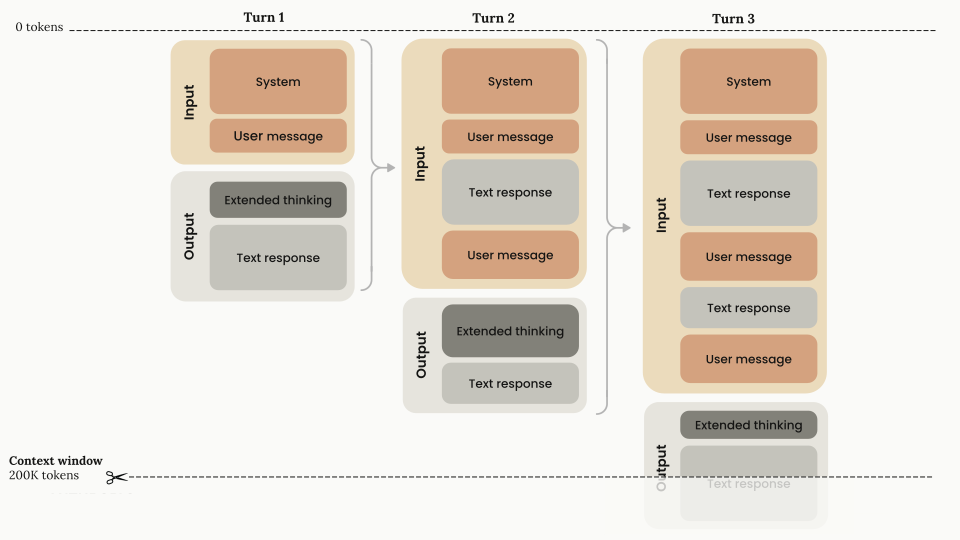
1150<Frame>
1151 
1152</Frame>
11481153
11491154The second shows the same regime with tool use: thinking stays in context alongside its tool result for the duration of the assistant turn, then drops out on the next user turn.
11501155
1151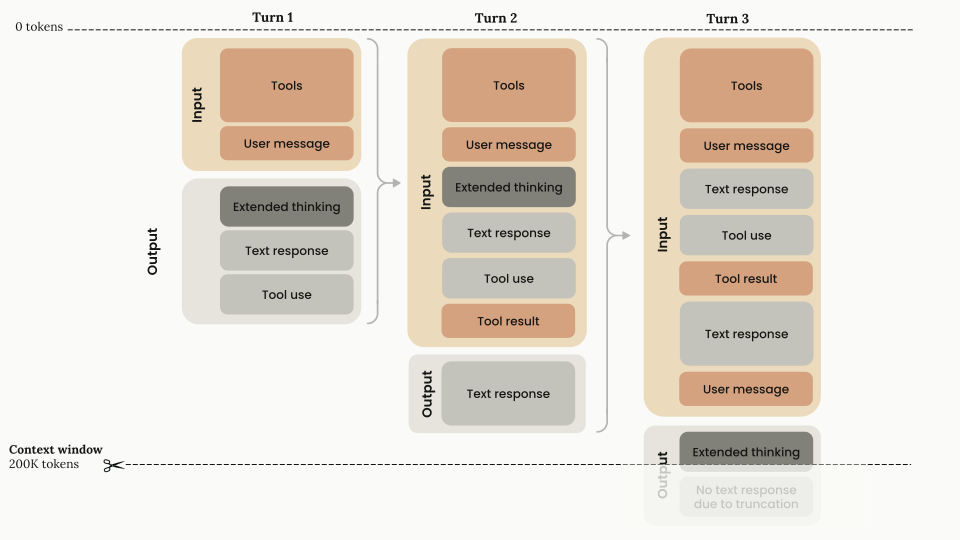
1156<Frame>
1157 
1158</Frame>
11521159
11531160Use the [token counting API](https://platform.claude.com/docs/en/build-with-claude/token-counting) to get accurate counts for your specific use case, especially for multi-turn conversations that include thinking.
11541161
from line 1197
11901197
11911198### Sampling parameters
11921199
1193On Claude Fable 5.1, Claude Mythos 5.1, Claude Fable 5, Claude Mythos 5, Claude Mythos Preview, Claude Opus 5.5, Claude Opus 5, Claude Opus 4.8, Claude Opus 4.7, Claude Sonnet 5.5, and Claude Sonnet 5, non-default `temperature`, `top_p`, or `top_k` values return a 400 error on every request, regardless of whether thinking is used. On older models, the restriction applies only while thinking is on: `temperature` and `top_k` are incompatible with thinking, and `top_p` is allowed at values between 0.95 and 1.
1200On Claude Fable 5.1, Claude Mythos 5.1, Claude Fable 5, Claude Mythos 5, Claude Mythos Preview, Claude Opus 5.5, Claude Opus 5, Claude Opus 4.8, Claude Opus 4.7, Claude Sonnet 5.5, Claude Sonnet 5, and Claude Haiku 5.5, non-default `temperature`, `top_p`, or `top_k` values return a 400 error on every request, regardless of whether thinking is used. On older models, the restriction applies only while thinking is on: `temperature` and `top_k` are incompatible with thinking, and `top_p` is allowed at values between 0.95 and 1.
11941201
11951202### Response prefill and forced tool use
11961203
from line 1224
12171224| Claude Sonnet 5 | 128K | 300K |
12181225| Claude Sonnet 4.6 | 128K | 300K |
12191226| Claude Sonnet 4.5 | 64K | Not available |
1227| Claude Haiku 5.5 | 128K | 300K |
12201228| Claude Haiku 4.5 | 64K | Not available |
12211229
12221230See the [models overview](https://platform.claude.com/docs/en/models/overview) for limits on legacy models.
No line in this hunk matches that.