
One read of Claude Developer Platformapi-20261007T190728Z
91 pages moved out of 754 read.
Pages moved
91
significant first
Pages read
754
in this capture
Captured
19:07 UTC
Corpus hash
4b90aa04d919
corpus-hash
What this read moved
1-25 of 91, page 1 of 4This capture is too large to show at once. Changes 1-25 of 91 are below, significant first; the rest are on the following screens.
about-claude/models/choosing-a-model Changed · +4 / -4 lines
from line 11
1111* **Capabilities:** What specific features or capabilities will you need the model to have to meet your needs?
1212* **Speed:** How quickly does the model need to respond in your application? Claude Opus 5.5, Claude Opus 5, and Claude Opus 4.8 support [fast mode](https://platform.claude.com/docs/en/build-with-claude/fast-mode) (research preview), which delivers up to 2.5x higher output speed at premium pricing.
1313* **Cost:** What's your budget for both development and production usage?
14* **Effort:** Several Claude models support an [effort parameter](https://platform.claude.com/docs/en/build-with-claude/effort) that trades intelligence for latency and cost within a single model. Tuning effort is often a better lever than switching models. On Claude Fable 5.1 and Claude Opus 5, start with the default (`high`) and adjust up or down based on your evals. On Claude Opus 5.5 the default is `medium`; start there and adjust the same way. On Claude Opus 4.8 and Claude Opus 4.7, the `xhigh` effort level, between `high` and `max`, is the best setting for most coding and agentic use cases.
14* **Effort:** Several Claude models support an [effort parameter](https://platform.claude.com/docs/en/build-with-claude/effort) that trades intelligence for latency and cost within a single model. Tuning effort is often a better lever than switching models. On Claude Fable 5.1 and Claude Opus 5, start with the default (`high`) and adjust up or down based on your evals. On Claude Opus 5.5 and Claude Haiku 5.5 the default is `medium`; start there and adjust the same way. On Claude Opus 4.8 and Claude Opus 4.7, the `xhigh` effort level, between `high` and `max`, is the best setting for most coding and agentic use cases.
1515
1616***
1717
from line 21
2121
2222### Option 1: Start efficiency-first
2323
24For many applications, starting with a faster, more cost-effective model like Claude Haiku 4.5 can be the optimal approach:
24For many applications, starting with a faster, more cost-effective model like Claude Haiku 5.5 can be the optimal approach:
2525
261. Begin implementation with Claude Haiku 4.5.
261. Begin implementation with Claude Haiku 5.5.
27272. Test your use case thoroughly.
28283. Evaluate if performance meets your requirements.
29294. Upgrade only if necessary for specific capability gaps.
from line 68
6868| The highest available capability | Claude Fable 5.1 | Agent sessions that run for hours, multistep deep research, analysis carried through to a finished document, spreadsheet, or deck |
6969| Complex agentic coding and enterprise work | Claude Opus 5.5 | Multihour autonomous coding agents, large-scale refactoring, complex systems engineering, vision-heavy workflows, computer use |
7070| Speed and capability for everyday coding, agent, and enterprise workloads | Claude Sonnet 5.5 | Code generation, data analysis, content creation, visual understanding, agentic tool use |
71| The lowest latency and price, with extended thinking | Claude Haiku 4.5 | Real-time applications, high-volume intelligent processing, cost-sensitive deployments needing strong reasoning, sub-agent tasks |
71| The lowest latency and price | Claude Haiku 5.5 | Real-time applications, high-volume intelligent processing, cost-sensitive deployments needing strong reasoning, sub-agent tasks |
7272
7373***
7474
about-claude/models/optimizing-for-cost-and-intelligence Changed · +94 / -40 lines
from line 8
88
99Cost and intelligence are usually pictured as a frontier where one buys the other. The first group of levers on this page moves a workload toward that frontier by cutting cost without touching quality; only the second group moves along it:
1010
11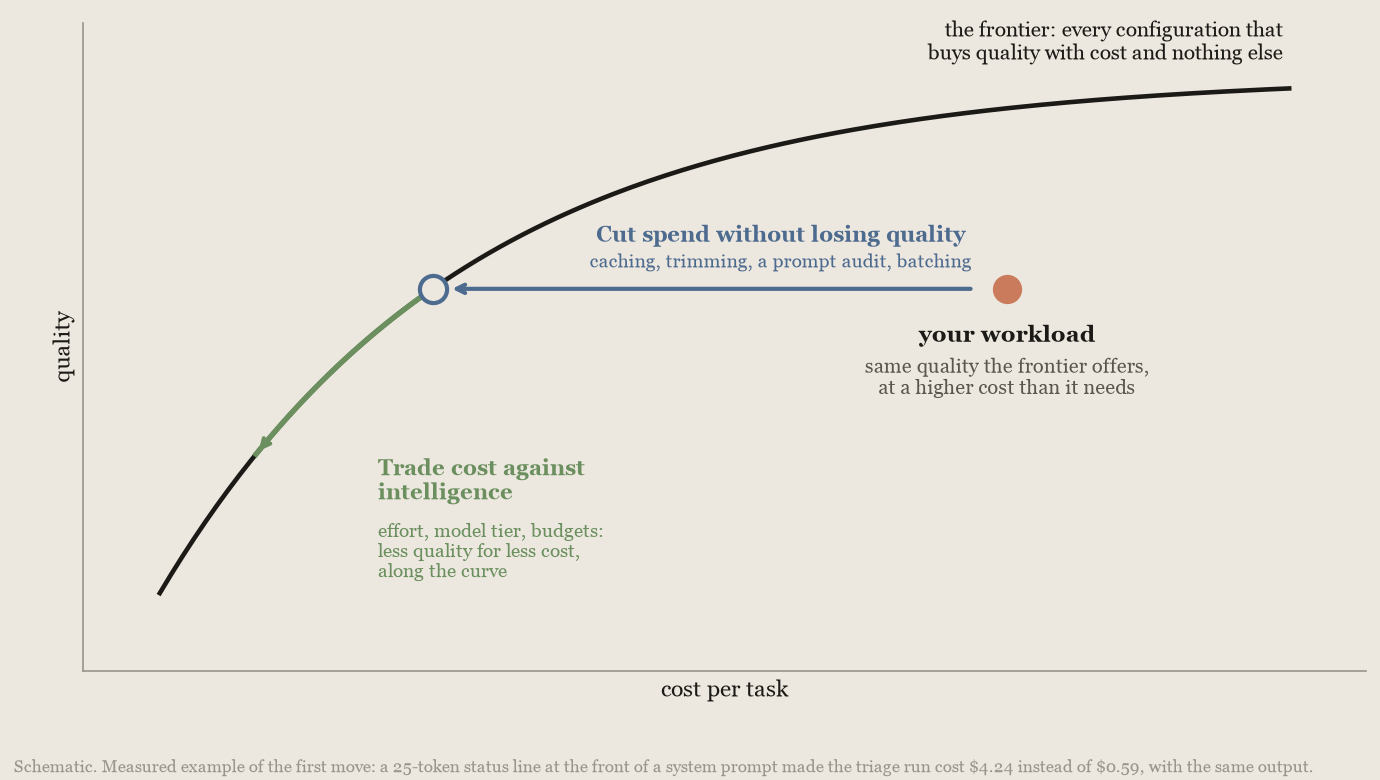
11<Frame>
12 
13</Frame>
1214
1315The levers come in two kinds:
1416
from line 54
5254
5355Across Anthropic's measured runs, cache reads are routinely the largest single component of task cost, making caching worth more than most model-choice decisions. Anthropic priced the DeepResearch Bench II[7](https://platform.claude.com/docs/en/about-claude/models/optimizing-for-cost-and-intelligence#refs) runs with and without caching:
5456
55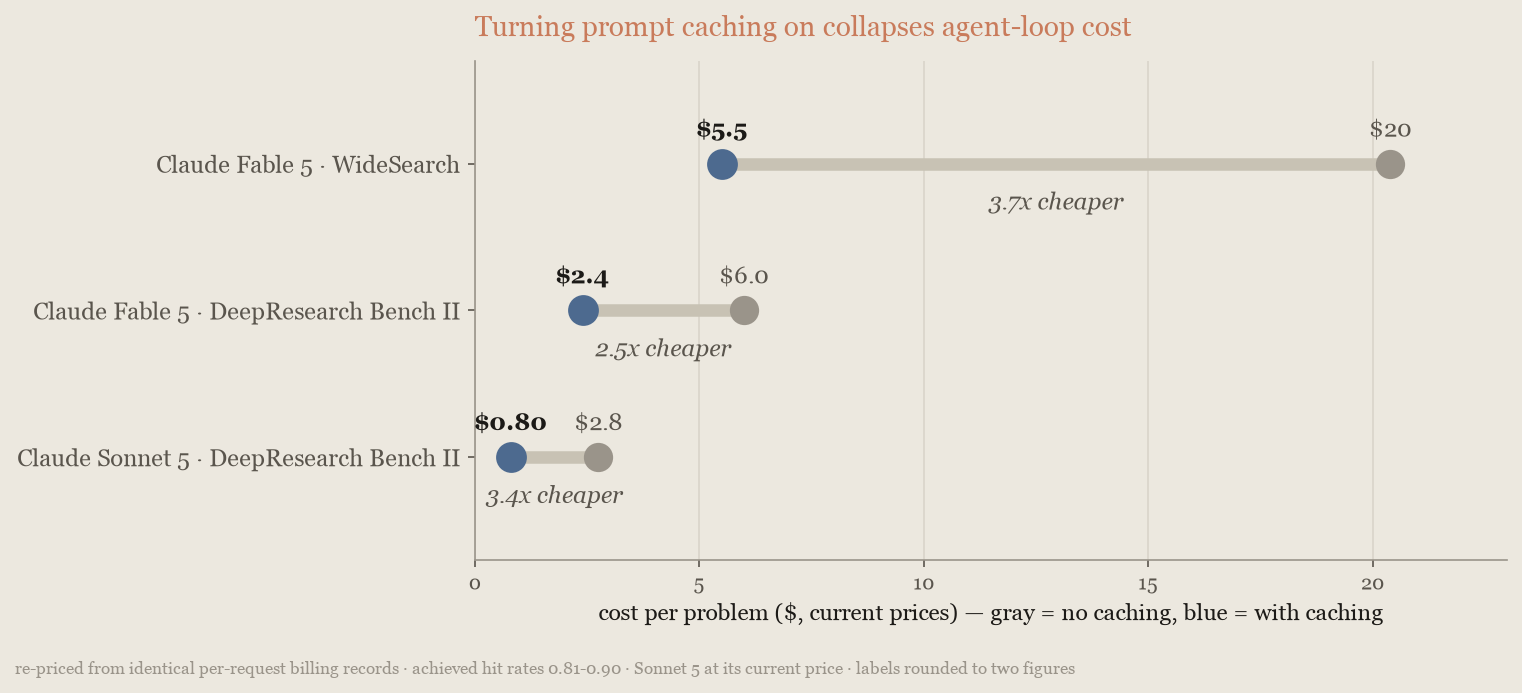
57<Frame>
58 
59</Frame>
5660
5761The cache's default lifetime is 5 minutes and an agent loop's turns are seconds apart, so the discount applies to most tokens on every turn. The caching chart's runs read 79% to 90% of their input tokens from the cache. The saving varies with episode depth, because shorter loops re-read less, but caching stayed the largest single lever on every model and benchmark measured.
5862
from line 70
6670* Turns arrive seconds apart: stay on the 5-minute default. When nothing paused, it cost 15% less than the 1-hour setting on Claude Sonnet 5 and about 15% to 18% less on Claude Opus 5.5.
6771* Gaps over an hour are common: stay on the default. A gap over an hour expires both durations, and the 1-hour setting then re-writes the prefix at its higher write price, so it loses on each of those gaps. Of your pauses longer than 5 minutes, if about 60% or more also run past an hour, stay on the default; the 1-hour duration pays only when at least about 40% of long pauses end within the hour.
6872
69Anthropic measured the triage job from [Trim input and context tokens](https://platform.claude.com/docs/en/about-claude/models/optimizing-for-cost-and-intelligence#trim-input-and-context-tokens) with pauses inserted before some turns to simulate a person's delay[16](https://platform.claude.com/docs/en/about-claude/models/optimizing-for-cost-and-intelligence#refs). On Claude Sonnet 5 and Claude Opus 5.5, the 1-hour cache became the cheaper setting once about 1 turn in 30 followed a pause, so the 1-in-20 rule leaves a margin, and the gap widens quickly past the crossover because every paused turn on the 5-minute setting re-writes the whole prefix. Every current model uses the same cache-write multipliers, and every model but Claude Fable 5.1, Claude Mythos 5.1, and Claude Opus 5.5 the same read price, so the crossover is in the same range on the other models; Fable 5.1 is the case covered next. Accuracy stayed within run-to-run noise in every cell. The turn after a pause kept its warm-cache latency on the 1-hour setting (measured on Claude Sonnet 5 and Claude Opus 5, not on Claude Opus 5.5). The following chart plots cost per session against the share of paused turns on Claude Sonnet 5:
73Anthropic measured the triage job from [Trim input and context tokens](https://platform.claude.com/docs/en/about-claude/models/optimizing-for-cost-and-intelligence#trim-input-and-context-tokens) with pauses inserted before some turns to simulate a person's delay[16](https://platform.claude.com/docs/en/about-claude/models/optimizing-for-cost-and-intelligence#refs). On Claude Sonnet 5 and Claude Opus 5.5, the 1-hour cache became the cheaper setting once about 1 turn in 30 followed a pause, so the 1-in-20 rule leaves a margin, and the gap widens quickly past the crossover because every paused turn on the 5-minute setting re-writes the whole prefix. Every current model uses the same cache-write multipliers, and every model but Claude Fable 5.1, Claude Mythos 5.1, Claude Opus 5.5, and Claude Sonnet 5.5 the same read price (Claude Sonnet 5.5 has the same multipliers as Claude Opus 5.5), so the crossover is in the same range on the other models; Fable 5.1 is the case covered next. Accuracy stayed within run-to-run noise in every cell. The turn after a pause kept its warm-cache latency on the 1-hour setting (measured on Claude Sonnet 5 and Claude Opus 5, not on Claude Opus 5.5). The following chart plots cost per session against the share of paused turns on Claude Sonnet 5:
7074
71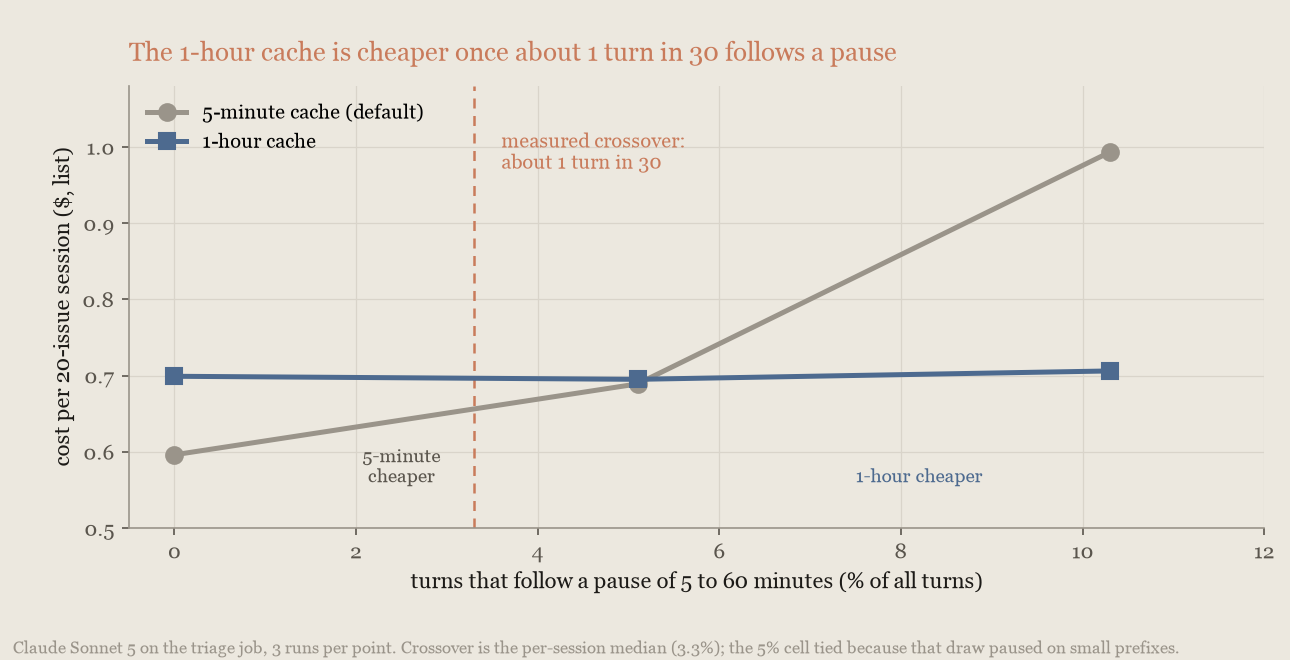
75<Frame>
76 
77</Frame>
7278
7379Anthropic also measured extra requests that keep the 5-minute cache warm. On Claude Sonnet 5 they cost about 8% less than the 1-hour duration when 1 turn in 20 followed a pause, but about the same at 2 in 20; on Claude Opus 5, the previous Opus model, they saved nothing measurable. With a pause of 6 minutes or more before every turn they cost more on both models. Because the Claude Sonnet 5 saving was gone by 2 turns in 20, use the 1-hour duration instead on Claude Sonnet 5 and Claude Opus 5.
7480
7581On Claude Fable 5.1 the cheapest setting is a different one. Its [cache read](https://platform.claude.com/docs/en/about-claude/pricing#prompt-caching) costs 0.025x the input price ($0.25 USD per million tokens) while its cache writes keep the standard multipliers, so a keep-alive request that re-reads the prefix is cheap and the 1-hour duration's write premium is the larger bill. Anthropic measured the triage job on Claude Fable 5.1 with the same three settings[19](https://platform.claude.com/docs/en/about-claude/models/optimizing-for-cost-and-intelligence#refs). Keeping the 5-minute cache warm cost 13% to 20% less per session than the 1-hour cache whenever pauses ran for minutes; only with pauses near 45 minutes did the 1-hour cache win, by about $0.12 USD a session. On Claude Fable 5.1, keep the 5-minute cache warm while a person is away for minutes, and buy the 1-hour duration when pauses run toward an hour:
7682
77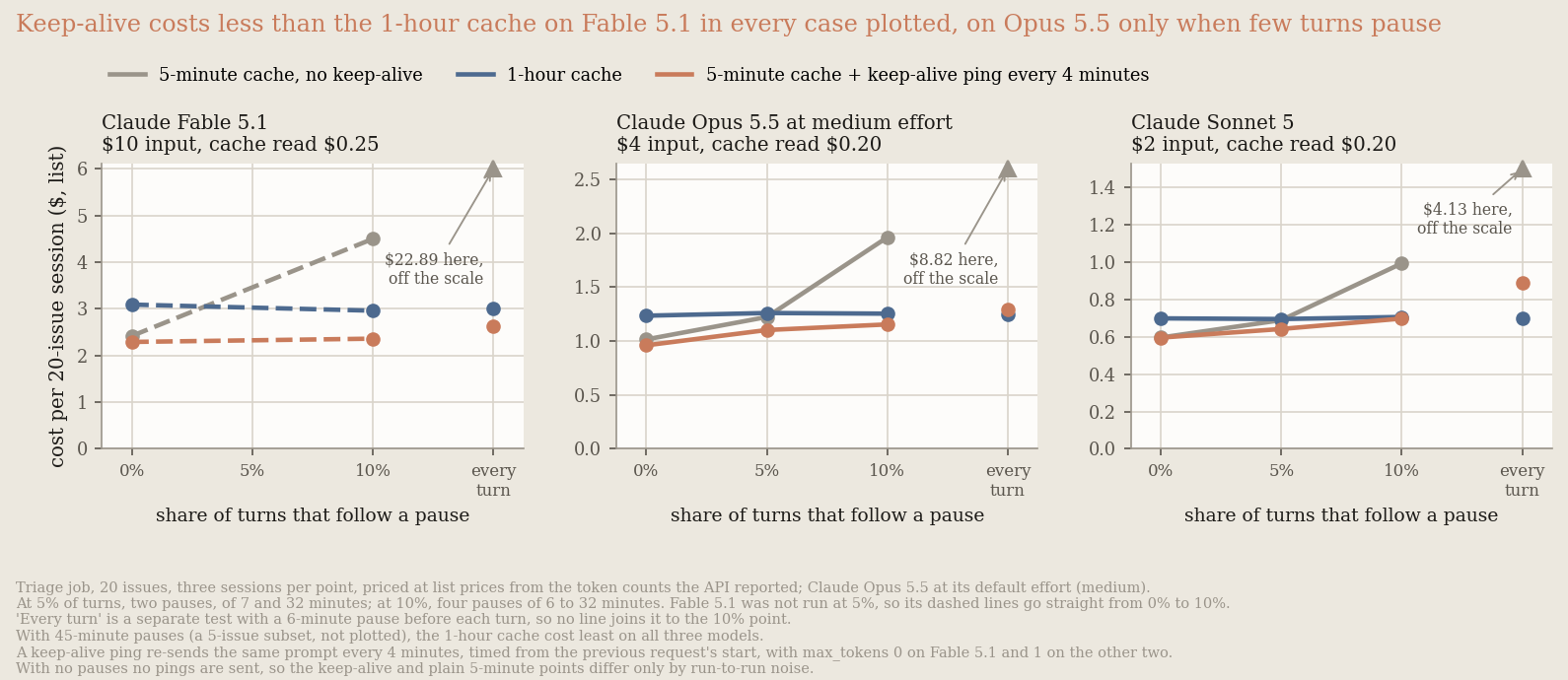
83<Frame>
84 
85</Frame>
7886
7987On Claude Opus 5.5, whose cache read costs 0.05x the input price, keep-alive requests cost 8% to 13% less than the 1-hour duration when 5% or 10% of turns followed a pause of 6 to 32 minutes (at the default effort, `medium`; 10% to 18% less at `high`), but more with a pause before every turn: about 4% to 6% more at 6-minute pauses, rising to over 50% more at 45-minute pauses. So on Claude Opus 5.5, keep the 5-minute cache warm when only a turn or two in 20 follow a pause of up to about half an hour, and otherwise follow the list at the start of this section. These measurements sent keep-alive requests with `max_tokens: 1`. For the `max_tokens: 0` request described next, Anthropic's pre-launch API tests on Claude Opus 5.5 show that it writes the cache and that the next request reads it; whether it refreshes an existing entry was not measured on Opus 5.5.
8088
from line 132
124132
125133Several things can break your cache during a task. Anything that changes per request, such as a timestamp or a queue position, placed ahead of the stable prefix turns every request into a full cache write: on the triage run in [Trim input and context tokens](https://platform.claude.com/docs/en/about-claude/models/optimizing-for-cost-and-intelligence#trim-input-and-context-tokens), a 25-token status line at the front of the system prompt cost $4.24 USD per run instead of $0.59 USD, more than running with caching off. Keep per-request text in the newest user turn.
126134
127The cache is a byte-exact prefix match over the request in order (tools, then system prompt, then messages), so a change anywhere invalidates everything after it. Changing [`effort`](https://platform.claude.com/docs/en/build-with-claude/effort) or the thinking configuration between requests invalidates the cache from that point onward, and on some models the tools and system prompt ahead of it as well; any edit to the system prompt invalidates the cache from that point onward; setting or changing an output format invalidates the cache for the whole conversation; adding, removing, or reordering a tool definition invalidates all of it. The [prompt caching](https://platform.claude.com/docs/en/build-with-claude/prompt-caching#what-invalidates-the-cache) page lists these cases, apart from the output format, which [structured outputs](https://platform.claude.com/docs/en/build-with-claude/structured-outputs#prompt-modification-and-token-costs) covers. On the most recent models, change instructions with a [mid-conversation system message](https://platform.claude.com/docs/en/build-with-claude/mid-conversation-system-messages), a `{"role": "system"}` message appended to `messages`, instead of editing the top-level `system` field: the cached prefix stays intact. Check that page for which models support it. On models that support it, a [per-message effort change](https://platform.claude.com/docs/en/build-with-claude/effort#change-effort-mid-conversation-beta) leaves the cached prefix intact too. The stakes are highest on Claude Fable 5.1 and Claude Mythos 5.1, where a break re-writes the prefix at 1.25x the input price instead of reading it at 0.025x. On a 100,000-token prefix, one broken turn there costs $1.25 USD instead of $0.03 USD, 50 times the read; on Claude Opus 5.5 it costs $0.50 USD instead of $0.02 USD, 25 times, and on the other current models 12.5 times.
135The cache is a byte-exact prefix match over the request in order (tools, then system prompt, then messages), so a change anywhere invalidates everything after it. Changing [`effort`](https://platform.claude.com/docs/en/build-with-claude/effort) or the thinking configuration between requests invalidates the cache from that point onward, and on some models the tools and system prompt ahead of it as well; any edit to the system prompt invalidates the cache from that point onward; setting or changing an output format invalidates the cache for the whole conversation; adding, removing, or reordering a tool definition invalidates all of it. The [prompt caching](https://platform.claude.com/docs/en/build-with-claude/prompt-caching#what-invalidates-the-cache) page lists these cases, apart from the output format, which [structured outputs](https://platform.claude.com/docs/en/build-with-claude/structured-outputs#prompt-modification-and-token-costs) covers. On the most recent models, change instructions with a [mid-conversation system message](https://platform.claude.com/docs/en/build-with-claude/mid-conversation-system-messages), a `{"role": "system"}` message appended to `messages`, instead of editing the top-level `system` field: the cached prefix stays intact. Check that page for which models support it. On models that support it, a [per-message effort change](https://platform.claude.com/docs/en/build-with-claude/effort#change-effort-mid-conversation-beta) leaves the cached prefix intact too. The stakes are highest on Claude Fable 5.1 and Claude Mythos 5.1, where a break re-writes the prefix at 1.25x the input price instead of reading it at 0.025x. On a 100,000-token prefix, one broken turn there costs $1.25 USD instead of $0.03 USD, 50 times the read; on Claude Opus 5.5 it costs $0.50 USD instead of $0.02 USD, and on Claude Sonnet 5.5 $0.25 USD instead of $0.01 USD, 25 times, and on the other current models 12.5 times.
128136
129137Anthropic measured this on the triage agent's long sessions[18](https://platform.claude.com/docs/en/about-claude/models/optimizing-for-cost-and-intelligence#refs). An effort change and an added tool made mid-session rewrote 39,000 and 60,000 cached tokens, and those sessions cost $0.95 USD per session. The same two changes on the first request after compaction cost $0.75 USD, and on the request that triggered the compaction $0.92 USD, because the compaction's summarization pass then re-processed the 81,000-token context at the cache-write price: that summarization pass cost $0.21 USD, against $0.04 USD when the same changes came one request later, with accuracy within run-to-run noise in every arm:
130138
131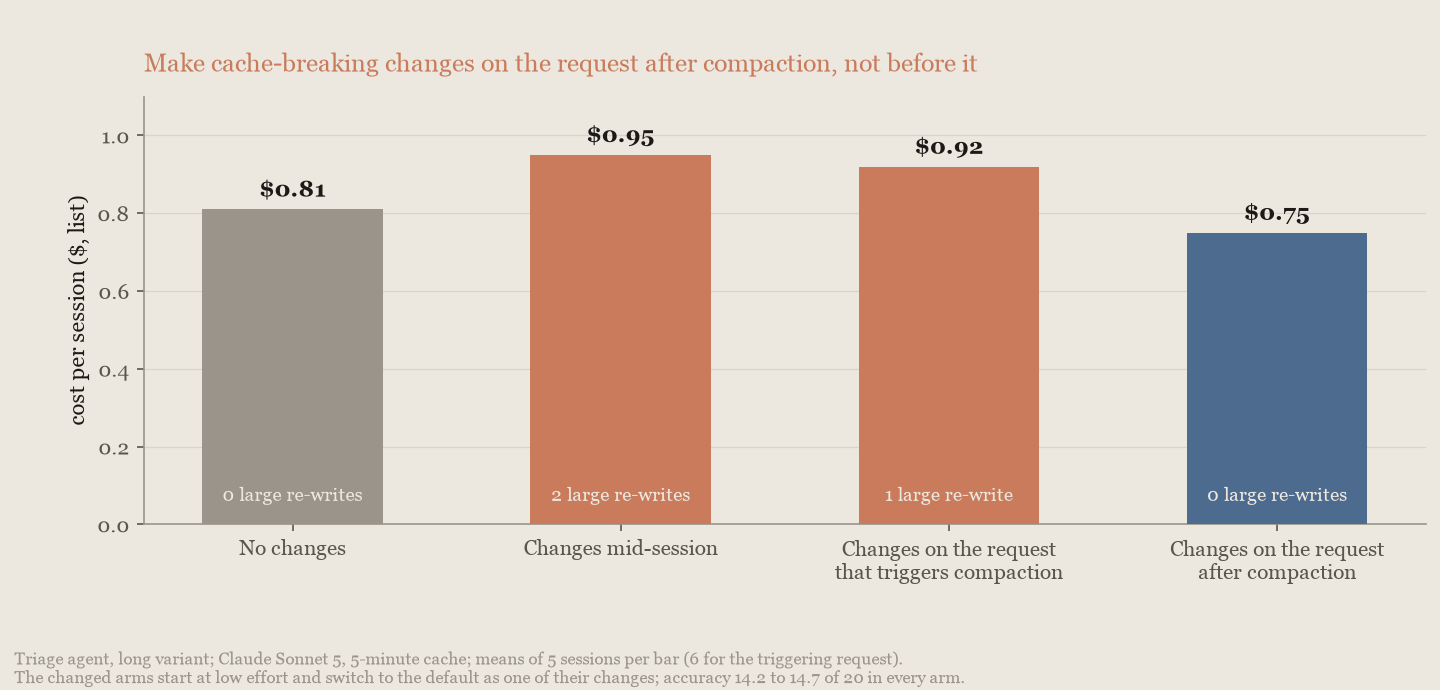
139<Frame>
140 
141</Frame>
132142
133143Changing a [task budget](https://platform.claude.com/docs/en/build-with-claude/task-budgets) partway through invalidates any cached prefix that contains the budget value, so set it once, on the first request. Every [context editing](https://platform.claude.com/docs/en/build-with-claude/context-editing#context-editing-and-prompt-caching) pass invalidates the prefix from the point it clears and the next request pays to re-cache everything after it, so clear in a few large batches rather than many small ones. On Claude Fable 5.1 and Claude Mythos 5.1 each of these costs 50 times the read price per token, so they matter most there. Make every cache-invalidating change at natural breaks, then confirm cache reads have not dropped; if they have, [cache diagnostics](https://platform.claude.com/docs/en/build-with-claude/cache-diagnostics) shows where the prefix diverged.
134144
from line 155
145155
146156Every tool definition attached to a request is input on every turn, and a few MCP servers add up to hundreds of them. Anthropic ran the triage agent with its own two tools plus a catalog of real tool definitions from public MCP servers, for a total of up to 502 tools, loading all of them or marking the extras `defer_loading` behind [tool search](https://platform.claude.com/docs/en/agents-and-tools/tool-use/tool-search-tool):
147157
148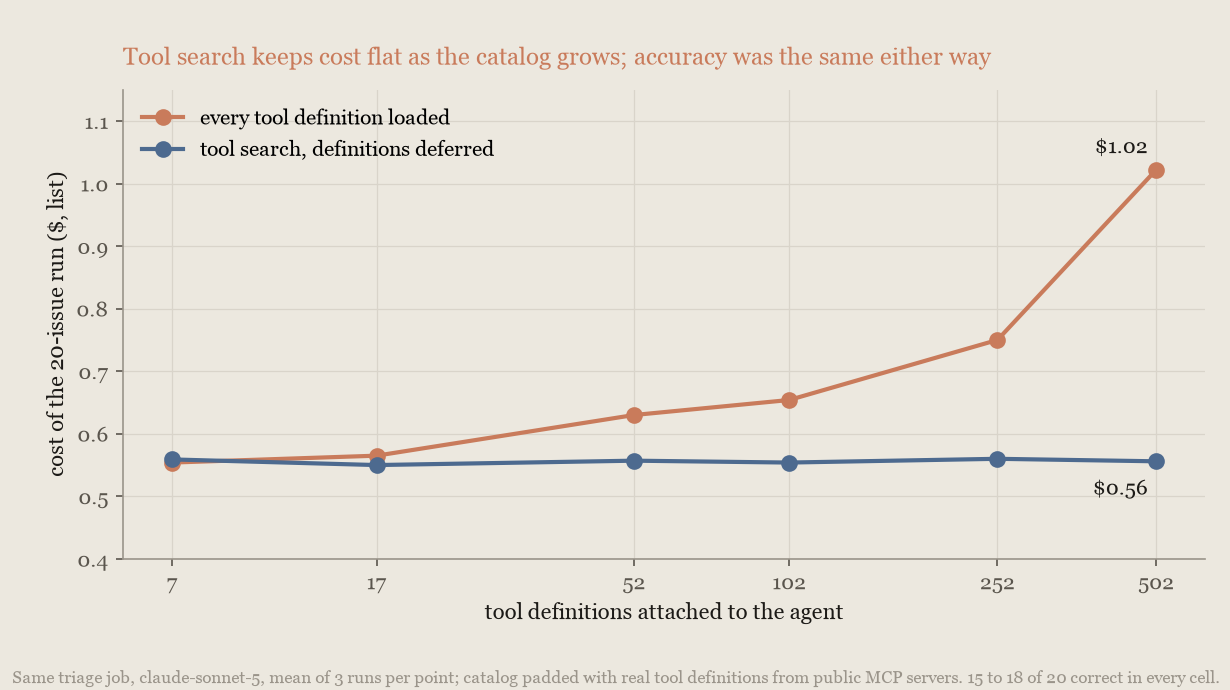
158<Frame>
159 
160</Frame>
149161
150162With every definition loaded, the run cost nearly doubled as the catalog grew, tracking the schema tokens on each request. With tool search it stayed flat at every catalog size, 45% less at 502 tools. Accuracy was 15 to 18 of 20 in every cell either way, and the model never called a wrong tool, so at this scale the catalog costs money, not correctness. The same holds for tools that come through the [MCP connector](https://platform.claude.com/docs/en/agents-and-tools/mcp-connector): with a public GitHub MCP server attached, deferring its toolset (`default_config: {defer_loading: true}`) cut the run 20% at the same accuracy.
151163
from line 165
153165
154166When the model has to compute over a table, upload it with the [Files API](https://platform.claude.com/docs/en/build-with-claude/files) and let the model query it with [code execution](https://platform.claude.com/docs/en/agents-and-tools/tool-use/code-execution-tool) instead of pasting it in. Anthropic asked 25 aggregate questions[15](https://platform.claude.com/docs/en/about-claude/models/optimizing-for-cost-and-intelligence#refs) (sums, filtered counts, group-bys, and a date filter) over a 1,862-row public CSV, with the answers computed by pandas:
155167
156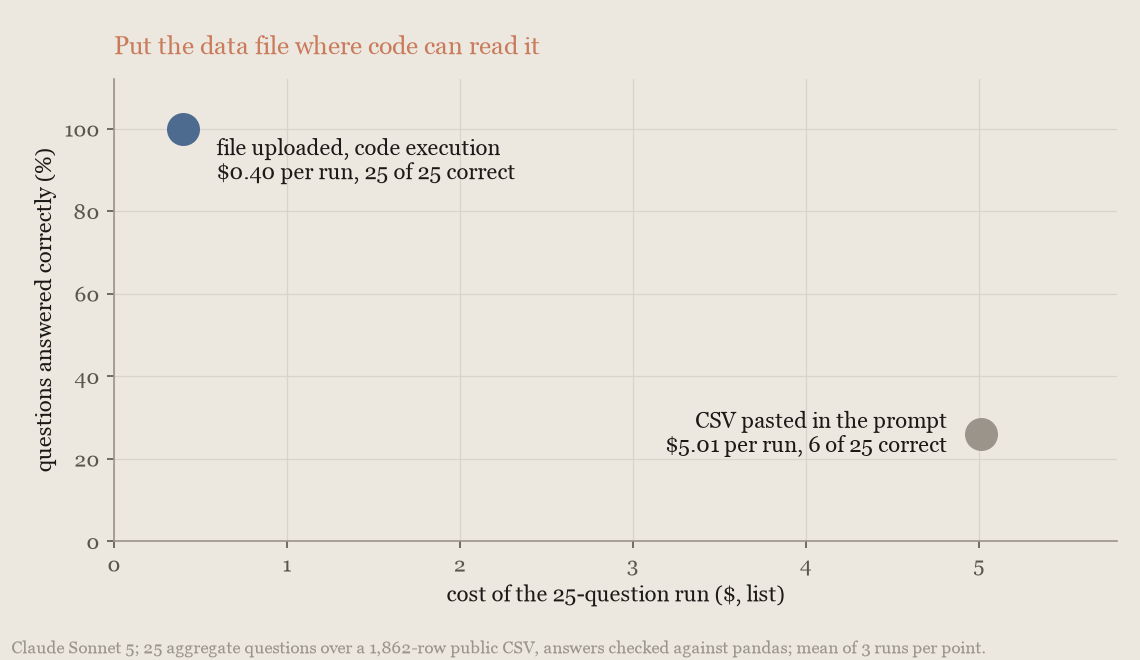
168<Frame>
169 
170</Frame>
157171
158172Pasted into the prompt, the table is about 91,000 input tokens on every request, and Claude Sonnet 5 answered 6 of 25 questions correctly. Uploaded, with code execution, it answered all 25, and the run cost about a twelfth as much. Claude Opus 5 showed the same pattern.
159173
from line 175
161175
162176The context levers only pay on a session long enough to need them:
163177
164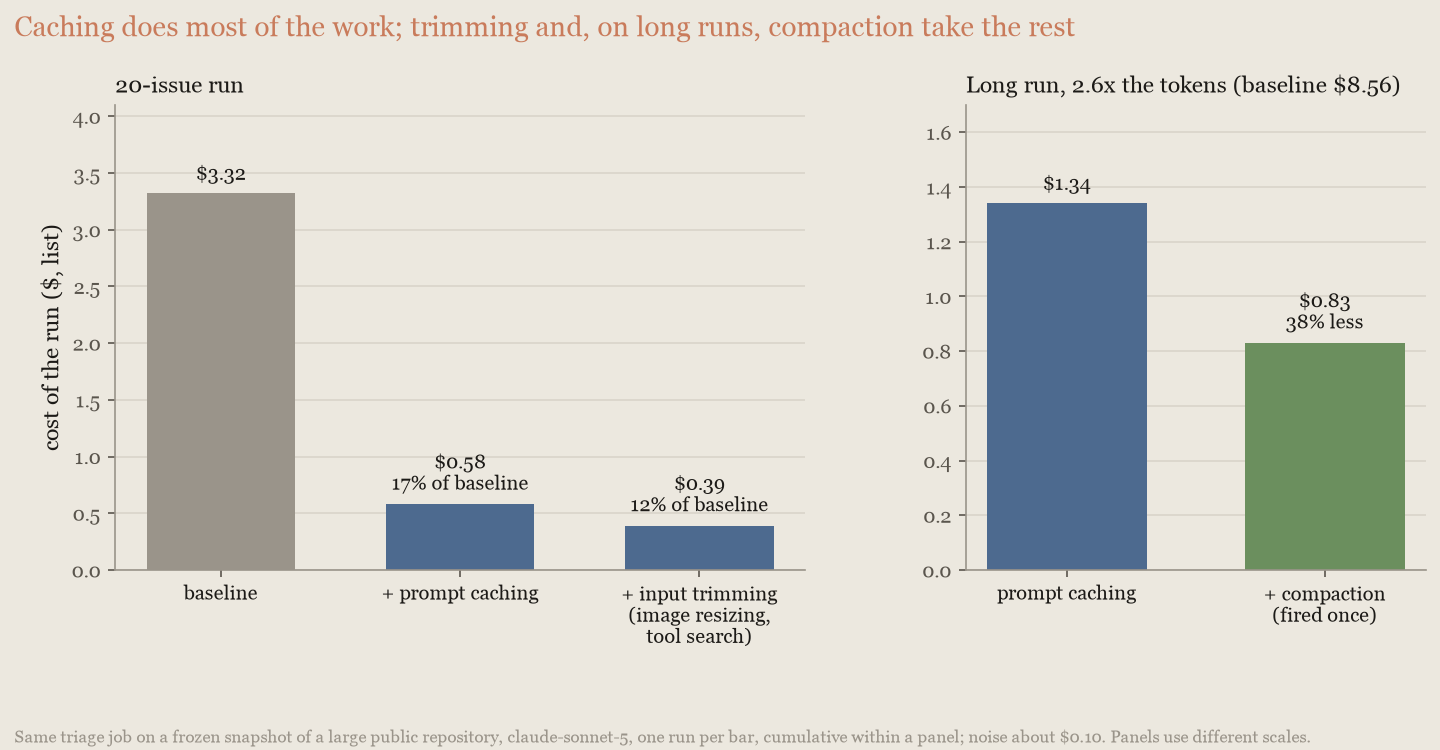
178<Frame>
179 
180</Frame>
165181
166182On the 20-issue run they saved nothing, and context editing cost 74% more. On the long run the prune saved 39% and compaction 32%, while context editing changed nothing. The prune is a few lines you write yourself: at each task boundary, replace large stale tool results with a one-line extract. It caches well because the edits sit at the tail of the conversation, where the next task adds new content anyway: 89% cache reads on the first request after a boundary and 81% on the requests between boundaries. Run-wide, the prune and context editing cache about equally well. The prune is cheaper because context editing rewrites content mid-task that the prune deletes (about two thirds of the gap) and because it keeps the context about half the size (the other third). If you use context editing, [clear in a few large batches](https://platform.claude.com/docs/en/build-with-claude/context-editing#context-editing-and-prompt-caching). The prune, adapted from the harness:
167183
from line 250
234250
235251The effect is measurable. On a support-desk evaluation[14](https://platform.claude.com/docs/en/about-claude/models/optimizing-for-cost-and-intelligence#refs), prompts written for Claude Opus 4.8 cost 36% more per ticket on Claude Opus 5 for no change in accuracy. Running the audit over the same prompts made Opus 5 both cheaper than the unaudited version (by 14%) and more accurate (97% of tickets, up from 92%, a gain outside the noise). On the Claude Sonnet 4.6 to Claude Sonnet 5 migration, the audit took 14% off at the same accuracy:
236252
237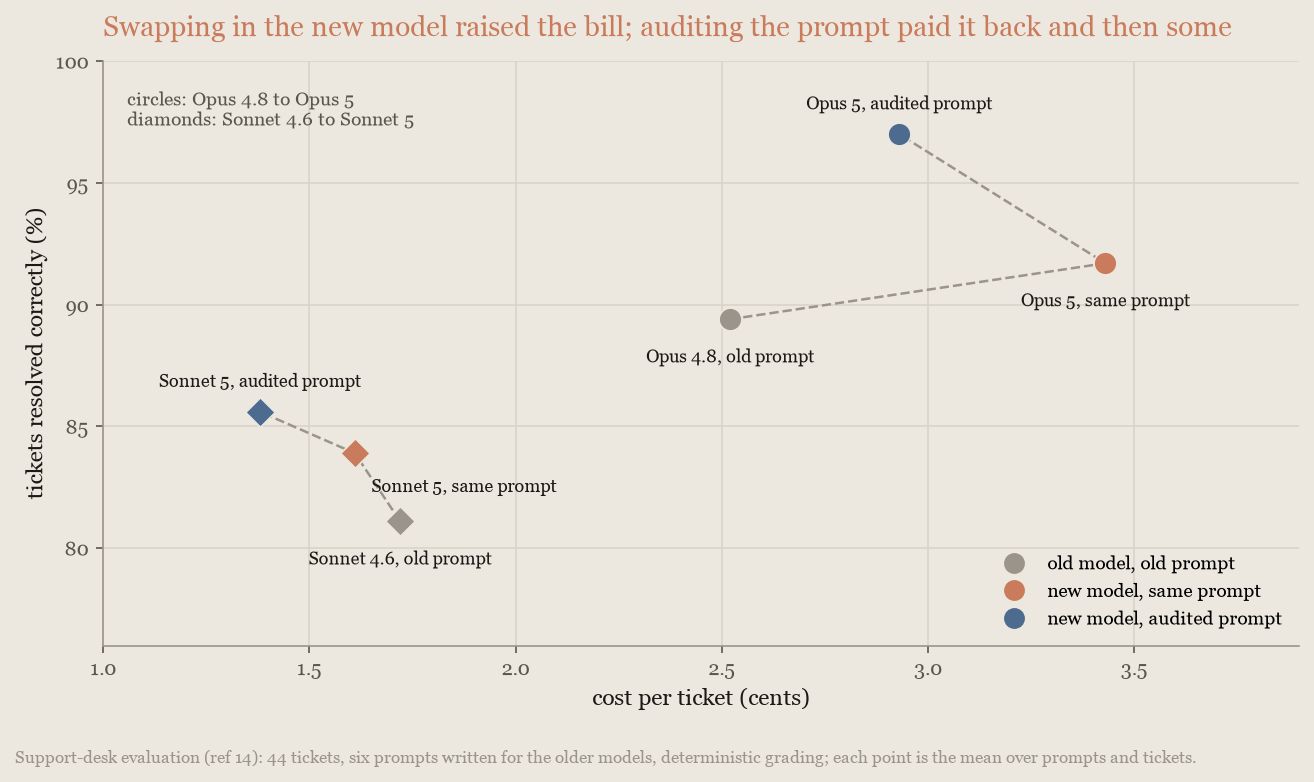
253<Frame>
254 
255</Frame>
238256
239257The two kinds of stale text have different costs. Instructions the new model follows too literally cost money: removing "verify twice" cut Opus 5's cost per ticket by a third, and removing "be maximally thorough" almost as much. Text that no longer fits the model costs accuracy instead: a retired thinking setting, contradictory rules, and a hand-rolled scratchpad that conflicts with the model's own thinking each restored 7 to 11 points on Opus 5 when removed:
240258
241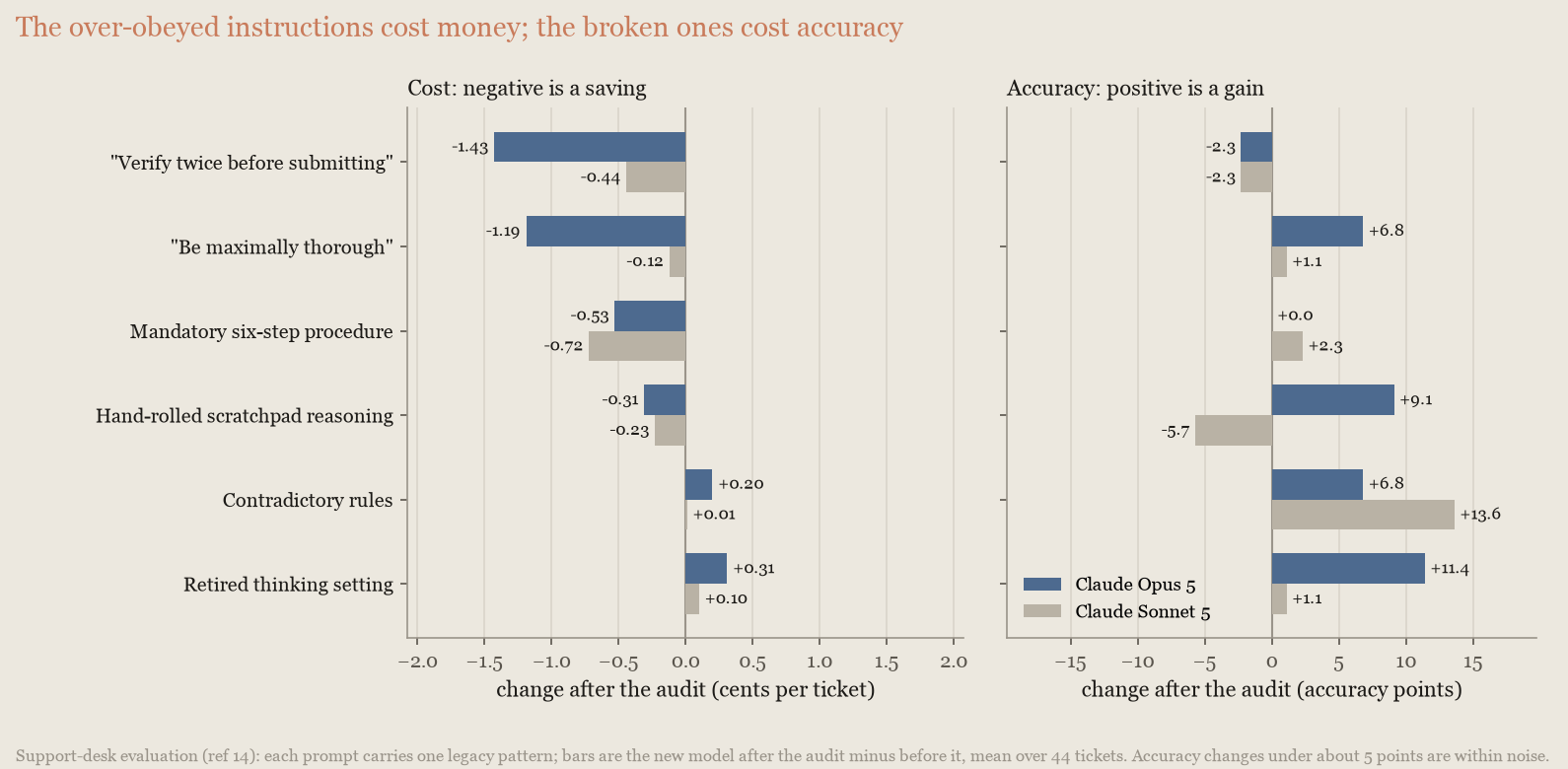
259<Frame>
260 
261</Frame>
242262
243263The same patterns tend to appear in tool descriptions and skills, which are worth auditing too.
244264
245265## Trade cost against intelligence
246266
247These levers set where a single model sits between cost and intelligence: model choice, effort, re-running failures at a higher setting, the budgets and caps it works within, and whether it can see how much time has passed. Start with an effort sweep on your current model ([Tune effort](https://platform.claude.com/docs/en/about-claude/models/optimizing-for-cost-and-intelligence#tune-effort)). From lowest to highest cost and capability, the current models are Claude Haiku 4.5, Claude Sonnet 5.5, Claude Opus 5.5, and Claude Fable 5.1 (the frontier model); [Models overview](https://platform.claude.com/docs/en/models/overview) has the full lineup and prices.
267These levers set where a single model sits between cost and intelligence: model choice, effort, re-running failures at a higher setting, the budgets and caps it works within, and whether it can see how much time has passed. Start with an effort sweep on your current model ([Tune effort](https://platform.claude.com/docs/en/about-claude/models/optimizing-for-cost-and-intelligence#tune-effort)). From lowest to highest cost and capability, the current models are Claude Haiku 5.5, Claude Sonnet 5.5, Claude Opus 5.5, and Claude Fable 5.1 (the frontier model); [Models overview](https://platform.claude.com/docs/en/models/overview) has the full lineup and prices.
248268
249269### Compare models on cost per task
250270
from line 272
252272
253273Anthropic measured this on the SWE-bench Pro[3](https://platform.claude.com/docs/en/about-claude/models/optimizing-for-cost-and-intelligence#refs) subset, priced as a customer is billed:
254274
255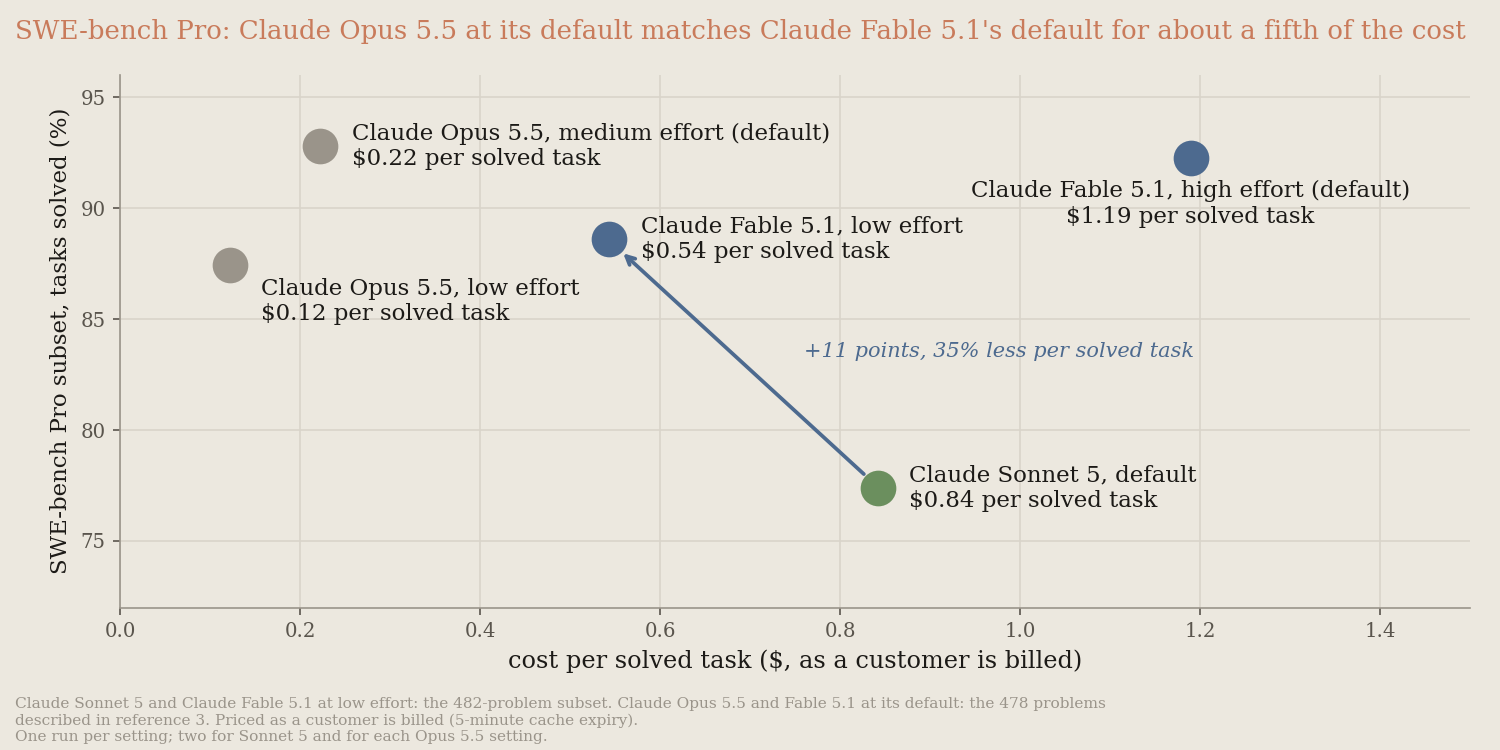
275<Frame>
276 
277</Frame>
256278
257279Claude Fable 5.1 at `low` effort solved 88.6% of tasks for $0.54 USD per solved task, against 77.4% for $0.84 USD from Claude Sonnet 5 at its default: 11 more points for 35% less per solved task, despite a per-token price five times higher. It does not always win, though. On the same subset, which Claude Opus 5.5 and Claude Fable 5.1 both largely saturate and whose scores are not comparable to the public leaderboard, Opus 5.5 at its default, `medium`, matched Fable 5.1 at its default (92.8% against 92.3%, inside run-to-run noise) for about a fifth of the cost per solved task ($0.22 USD against $1.19 USD). At `low`, Opus 5.5 solved 87.4% for $0.12 USD. These figures use the 478 problems described in reference 3. And on long research loops the frontier model does more work, not less: on DeepResearch Bench II[7](https://platform.claude.com/docs/en/about-claude/models/optimizing-for-cost-and-intelligence#refs), Fable 5.1 at `low` scored 10 points above Sonnet 5 (66% against 56%) at about four times the cost per task ($4.66 USD against $1.20 USD), because it runs a longer research loop over a larger context. Claude Opus 5 at its default scored 71% on the same basis for $6.71 USD per task, above Fable 5.1 at its default (65% for $7.12 USD), so on research too Fable 5.1 earns its price only at `low`.
258280
259For most agent workloads, start with Claude Opus 5.5 at its default effort (`medium`), and use Claude Fable 5.1 for demanding reasoning and long-horizon agentic work, or when your evals on Claude Opus 5.5 at higher effort still fall short. On the SWE-bench Pro subset, Opus 5.5 at its default matched Fable 5.1 at its default for about a fifth of the cost per solved task, as noted earlier. On the coding benchmark in [Advisor strategy](https://platform.claude.com/docs/en/about-claude/models/optimizing-for-cost-and-intelligence#advisor-strategy-escalate-hard-decisions), it scored 86.6% against 84.2% for Fable 5.1 at `medium` (a single Fable 5.1 run), for under a third of the cost per attempt ($0.84 USD against $2.68 USD). On Chartography[13](https://platform.claude.com/docs/en/about-claude/models/optimizing-for-cost-and-intelligence#refs), a chart-reading benchmark, Opus 5.5 at `low` scored 68.7 for about $0.03 USD a chart, against 62.5 for $0.15 USD from Fable 5.1 at `low` and 49 for $0.16 USD from Claude Opus 5 at `low`. At the other end, Claude Haiku 4.5 answered GPQA Diamond[9](https://platform.claude.com/docs/en/about-claude/models/optimizing-for-cost-and-intelligence#refs) questions at about a fifth of Claude Opus 5.5's cost per question, with 63% accuracy compared with 92% for Opus 5.5, and fell much further behind on long coding tasks. It fits high-volume work with checkable outputs, not long agentic loops.
281For most agent workloads, start with Claude Opus 5.5 at its default effort (`medium`), and use Claude Fable 5.1 for demanding reasoning and long-horizon agentic work, or when your evals on Claude Opus 5.5 at higher effort still fall short. On the SWE-bench Pro subset, Opus 5.5 at its default matched Fable 5.1 at its default for about a fifth of the cost per solved task, as noted earlier. On the coding benchmark in [Advisor strategy](https://platform.claude.com/docs/en/about-claude/models/optimizing-for-cost-and-intelligence#advisor-strategy-escalate-hard-decisions), it scored 86.6% against 84.2% for Fable 5.1 at `medium` (a single Fable 5.1 run), for under a third of the cost per attempt ($0.84 USD against $2.68 USD). On Chartography[13](https://platform.claude.com/docs/en/about-claude/models/optimizing-for-cost-and-intelligence#refs), a chart-reading benchmark, Opus 5.5 at `low` scored 68.7 for about $0.03 USD a chart, against 62.5 for $0.15 USD from Fable 5.1 at `low` and 49 for $0.16 USD from Claude Opus 5 at `low`. At the other end, Claude Haiku 5.5 answered GPQA Diamond[9](https://platform.claude.com/docs/en/about-claude/models/optimizing-for-cost-and-intelligence#refs) questions at about a twentieth of Claude Opus 5.5's cost per question, with 85% accuracy compared with 91% for Opus 5.5 run the same way. It suits high-volume and latency-sensitive work with checkable outputs.
260282
261283The ranking flips by workload, and no price list tells you which way. Price every candidate in cost per completed task on your own traffic, including Claude Opus 5.5 at its default effort and the frontier model at reduced effort.
262284
263285Price the tail of your workload, not the median: compare models on the hardest tenth of your tasks, not the typical one. On the typical task every model looks similar and the cheapest looks best, but the bill is decided by the tasks the cheaper model fails, because a failed task still bills its tokens, then the retry, then whatever the failure costs downstream. The tail is also where the money goes even when nothing fails. On a 20-problem WideSearch[1](https://platform.claude.com/docs/en/about-claude/models/optimizing-for-cost-and-intelligence#refs) run, two problems carried 43% of the spend:
264286
265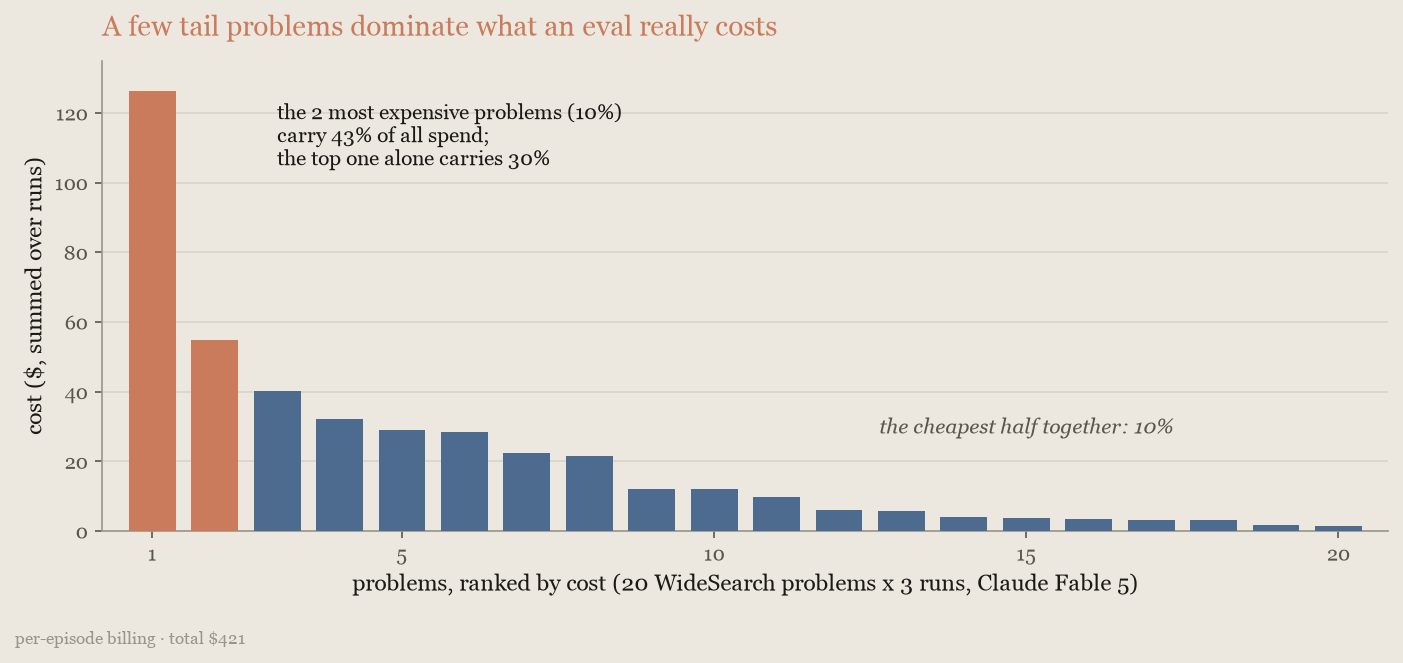
287<Frame>
288 
289</Frame>
266290
267291The [multi-model strategies](https://platform.claude.com/docs/en/about-claude/models/optimizing-for-cost-and-intelligence#combine-models) exist to spend frontier intelligence on that tail without paying frontier rates for the rest.
268292
from line 294
270294
271295If you are a model or two behind, the cheapest lever is the model string. Anthropic ran recent Claude Opus, Claude Sonnet, and Claude Fable models through the same harness on the SWE-bench Pro[3](https://platform.claude.com/docs/en/about-claude/models/optimizing-for-cost-and-intelligence#refs) subset, each at its shipped defaults and priced at list rates, and ran the Opus line again on Terminal-Bench 3[20](https://platform.claude.com/docs/en/about-claude/models/optimizing-for-cost-and-intelligence#refs):
272296
273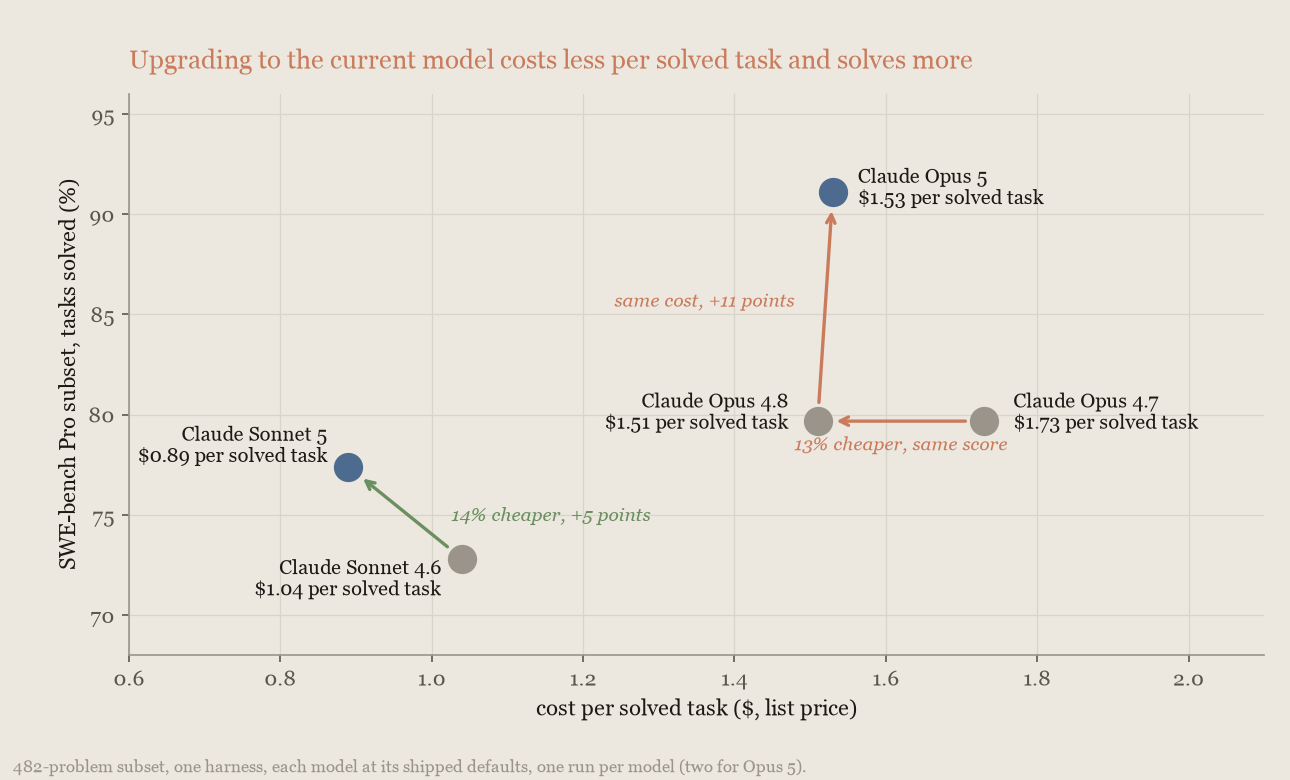
297<Frame>
298 
299</Frame>
274300
275301Anthropic prices Claude Opus 4.7, Opus 4.8, and Opus 5 identically per token, so any difference among them comes from how much work each model does per task: priced as a customer is billed, Claude Opus 4.8 solves the same share of tasks as Claude Opus 4.7 for 14% less per solved task, and Claude Opus 5 then solves 12 more points of tasks at 21% more per solved task. Claude Opus 5 at `low` effort beats Opus 4.8's default on this benchmark for about 30% of its cost per solved task, so the cheapest upgrade is the new model at a lower setting. Sonnet 5's saving comes from its lower per-token price, which more than offsets the extra tokens it uses per task compared with Sonnet 4.6: 15% less per solved task for 5 more points. The frontier tier gained the same way: Claude Fable 5.1 matches Claude Fable 5's score for 43% less per solved task, most of it the lower cache-read price. That direction is not guaranteed: on DeepResearch Bench II[7](https://platform.claude.com/docs/en/about-claude/models/optimizing-for-cost-and-intelligence#refs) the same upgrade costs 41% more per task at `high` (79% more at `low`) for its 2 to 3 extra points on the tasks clean in every arm (reference 7), because the new model does more work per task there. The input and output prices are the same and the cache read is 4x cheaper, so measure the upgrade on your own workload before assuming it saves.
276302
from line 306
280306
281307### Tune effort
282308
283Effort is the most direct way to tune a model to your task. The `effort` parameter governs how much thinking, tool calling, and self-verification the model does, and `high`, the default on most models, suits demanding tasks; Claude Opus 5.5 defaults to `medium`. Cost scales with all that activity; accuracy scales only with the part your task needs. Below the model's ceiling, the highest effort levels pay for depth the task never uses.
309Effort is the most direct way to tune a model to your task. The `effort` parameter governs how much thinking, tool calling, and self-verification the model does, and `high`, the default on most models, suits demanding tasks; Claude Opus 5.5 and Claude Haiku 5.5 default to `medium`. Cost scales with all that activity; accuracy scales only with the part your task needs. Below the model's ceiling, the highest effort levels pay for depth the task never uses.
284310
285311On the research and knowledge-work benchmarks (WideSearch[1](https://platform.claude.com/docs/en/about-claude/models/optimizing-for-cost-and-intelligence#refs), DeepWideSearch[6](https://platform.claude.com/docs/en/about-claude/models/optimizing-for-cost-and-intelligence#refs), BrowseComp[4](https://platform.claude.com/docs/en/about-claude/models/optimizing-for-cost-and-intelligence#refs), and GDPval[2](https://platform.claude.com/docs/en/about-claude/models/optimizing-for-cost-and-intelligence#refs), all with Claude Fable 5), the curve of accuracy against cost is nearly flat: `low` gave up 1 to 3 points for a third to a half off the cost per task, `medium` matched the default's accuracy at about 70% to 87% of its cost, and the default bought nothing measurable over `medium` on any of the four. On DeepWideSearch, `low` also matched an orchestrator with a Claude Sonnet 5 worker at 29% lower cost: lowering effort beat an architecture change.
286312
from line 314
288314
289315Long-horizon coding is where effort genuinely buys accuracy. On SWE-bench Pro[3](https://platform.claude.com/docs/en/about-claude/models/optimizing-for-cost-and-intelligence#refs), measured against `high`, Claude Opus 5.5 scored about 2.5 points lower at its default, `medium`, for about 70% of the cost, and about 8 points lower at `low` for about a third of the cost; `xhigh` scored about 1.4 points higher for 2.5 times the cost of `high`: a real tradeoff, which [re-running failures at higher effort](https://platform.claude.com/docs/en/about-claude/models/optimizing-for-cost-and-intelligence#re-run-failures-at-higher-effort) turns back into a saving. This chart plots accuracy against cost for the research and knowledge-work benchmarks and for SWE-bench Pro:
290316
291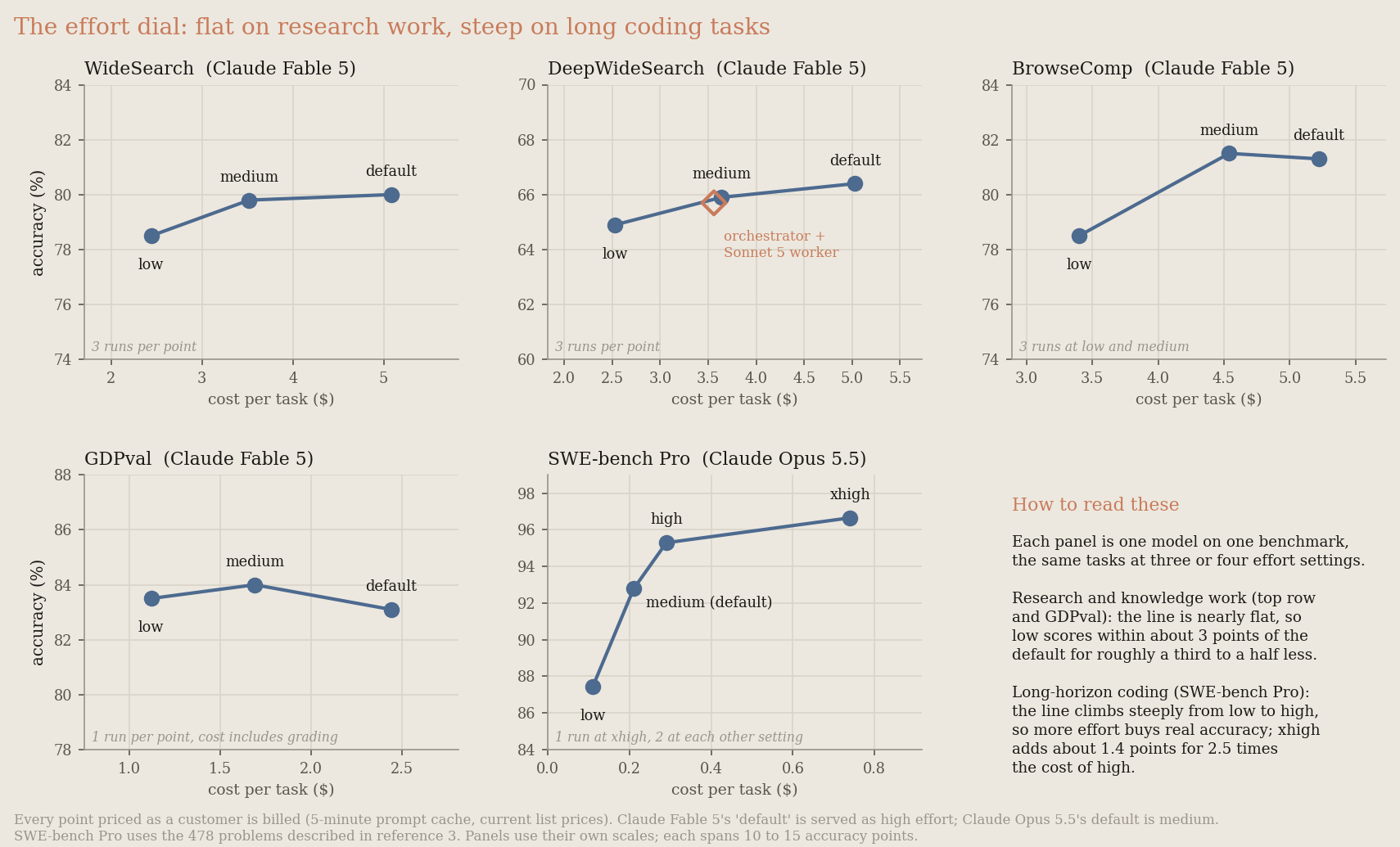
317<Frame>
318 
319</Frame>
292320
293321Two consequences follow. First, draw this curve for your own workload before you add a second model: in these internal measurements, a multi-model configuration that looked cheaper than the default single model cost more than that same model at lower effort. Second, this curve is the single-model baseline any multi-model strategy must beat, so [step 2 of measuring on your own workload](https://platform.claude.com/docs/en/about-claude/models/optimizing-for-cost-and-intelligence#measure-on-your-own-workload) baselines across effort levels.
294322
295323Hard work does not automatically need high effort. On DeepResearch Bench II[7](https://platform.claude.com/docs/en/about-claude/models/optimizing-for-cost-and-intelligence#refs), Claude Fable 5.1 scored nearly the same at `low`, `medium`, and `high` while the cost per task rose from $4.66 USD to $7.12 USD, so raising the effort in this case does not increase the quality of the output noticeably; on the 21 tasks clean in every arm (reference 7), Claude Fable 5 was flat across effort too, though the chart's 33-task basis, which drops each model's own cut-short attempts, shows it climbing. Measure the curve on the model you ship, not the one you measured last:
296324
297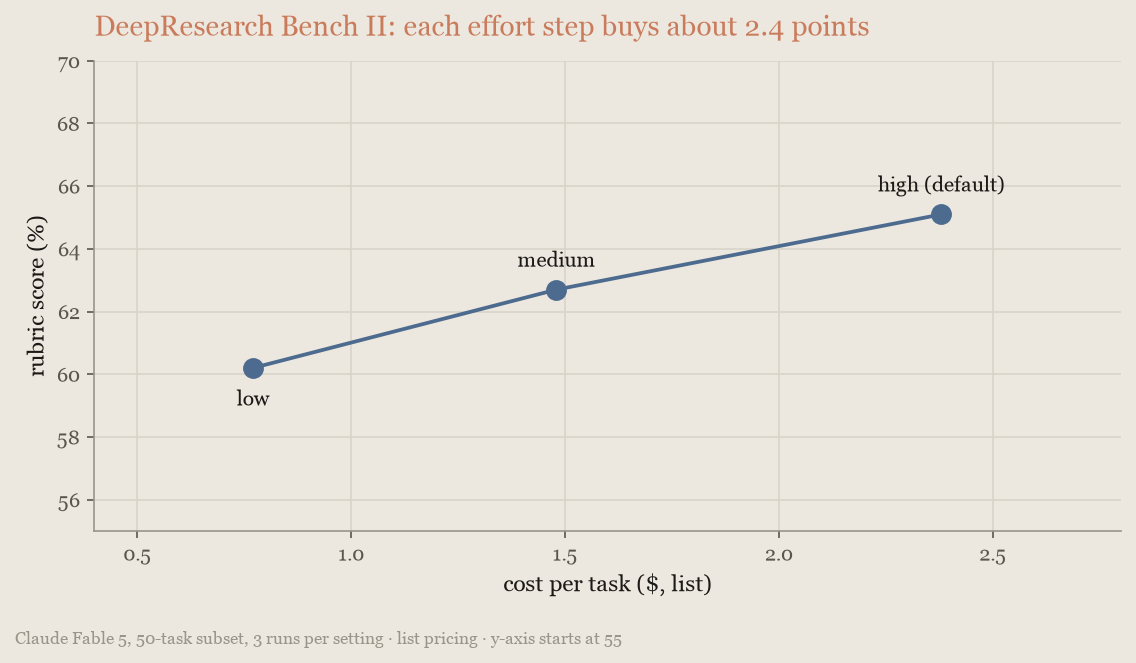
325<Frame>
326 
327</Frame>
298328
299329The task description alone does not reveal which kind of workload you have, so sweep two or three effort levels on a sample of your own traffic and read the answer off the curve. Test each level in a separate session: changing top-level effort mid-session invalidates the cache (see [Cache repeated context](https://platform.claude.com/docs/en/about-claude/models/optimizing-for-cost-and-intelligence#cache-repeated-context)) and distorts the comparison. For parameter details, see [Effort](https://platform.claude.com/docs/en/build-with-claude/effort).
300330
from line 334
304334
305335Anthropic computed this policy task by task from the effort runs on the SWE-bench Pro[3](https://platform.claude.com/docs/en/about-claude/models/optimizing-for-cost-and-intelligence#refs) subset in [Tune effort](https://platform.claude.com/docs/en/about-claude/models/optimizing-for-cost-and-intelligence#tune-effort). With Claude Opus 5.5 at `low`, 13% of tasks failed; with those re-run at `high`, about 97% passed for about $0.17 USD each, against 95.3% for $0.29 USD running everything at `high`: a slightly higher pass rate for a little over half the cost, counting the failed cheap attempts. Starting at `medium` instead solved about 97% for about $0.24 USD. Most of the small lift is the second attempt (re-running the failures of one `high` run at `high` scores about the same, for more money), so use this policy for the saving, not the lift:
306336
307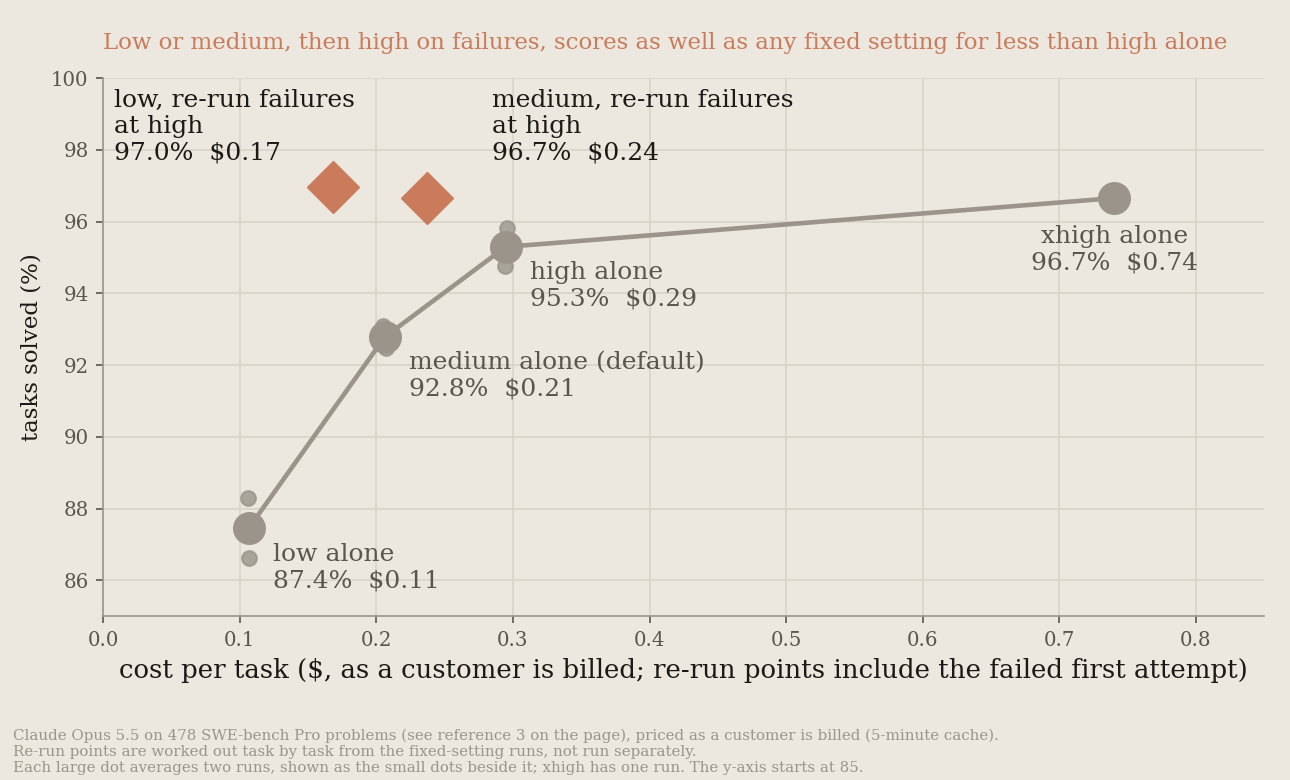
337<Frame>
338 
339</Frame>
308340
309341Two conditions apply. First, you need a failure signal (here, the benchmark's own tests); a checker that passes bad work lets those failures through. Second, every first-pass failure takes two runs' worth of wall-clock time, so the saving is paid for in latency on the failures.
310342
from line 346
314346
315347Anthropic measured pass rate and cost per task on SWE-bench Pro[3](https://platform.claude.com/docs/en/about-claude/models/optimizing-for-cost-and-intelligence#refs) with Claude Fable 5.1 as the budget tightened:
316348
317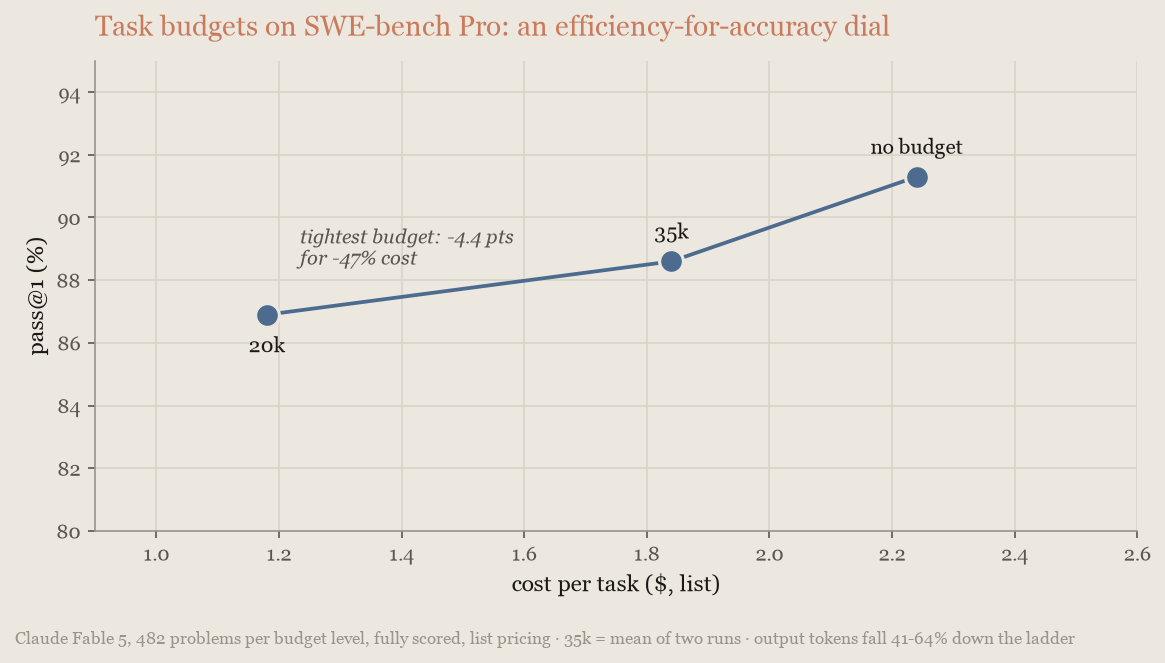
349<Frame>
350 
351</Frame>
318352
319353A generous budget cut cost per task 44% for about 3 points of pass rate, at the edge of run-to-run noise, and the tightest allowed budget cut it 58% for 6 points. Budgets bought efficiency here, at a price in pass rate that grows as the budget tightens.
320354
from line 385
351385triage-now | bug-confirmed | Clear repro steps show prompt queues indefinitely after cancelled question.
352386```
353387
354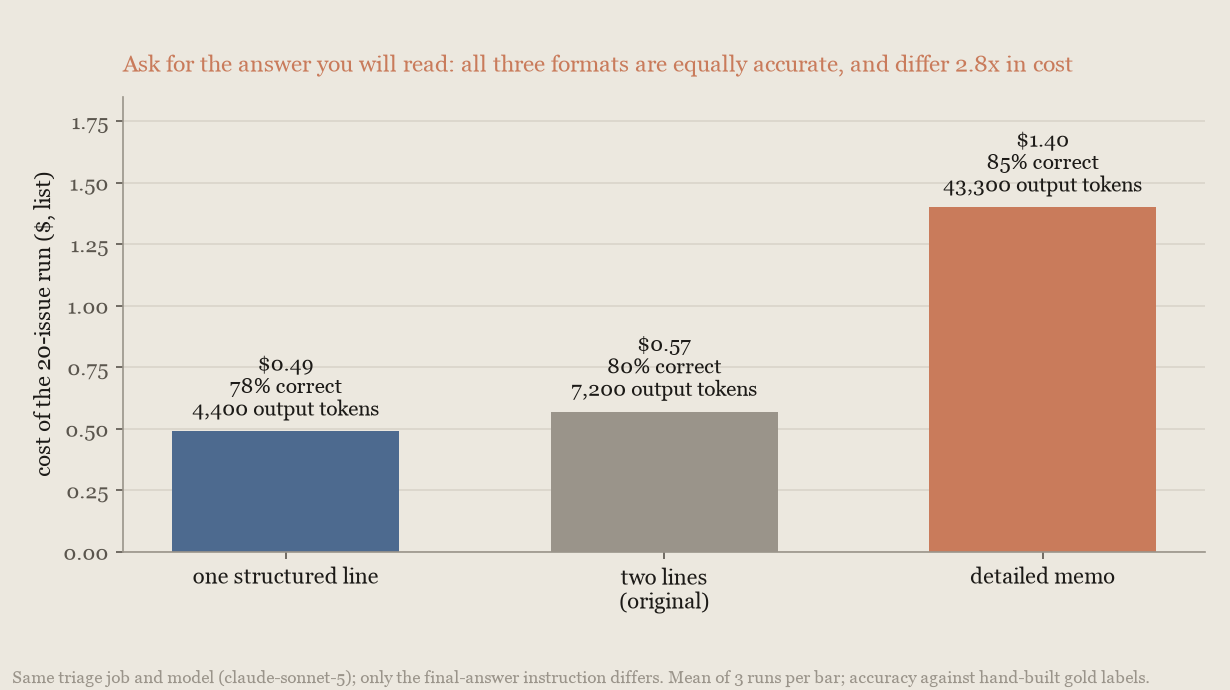
388<Frame>
389 
390</Frame>
355391
356392The one-line answer used 39% fewer output tokens than the two-line original and cost 14% less per run. The memo used six times the output tokens and cost 2.8 times the one-line answer. All three scored within run-to-run noise of each other against the gold labels, so the formats differ in what you pay far more than in what they get right. Ask for the answer you will read, not the one that looks thorough.
357393
358394At the lower `max_tokens` cap both models spend less per attempt but solve proportionally fewer tasks, so cost per solved task barely moves:
359395
360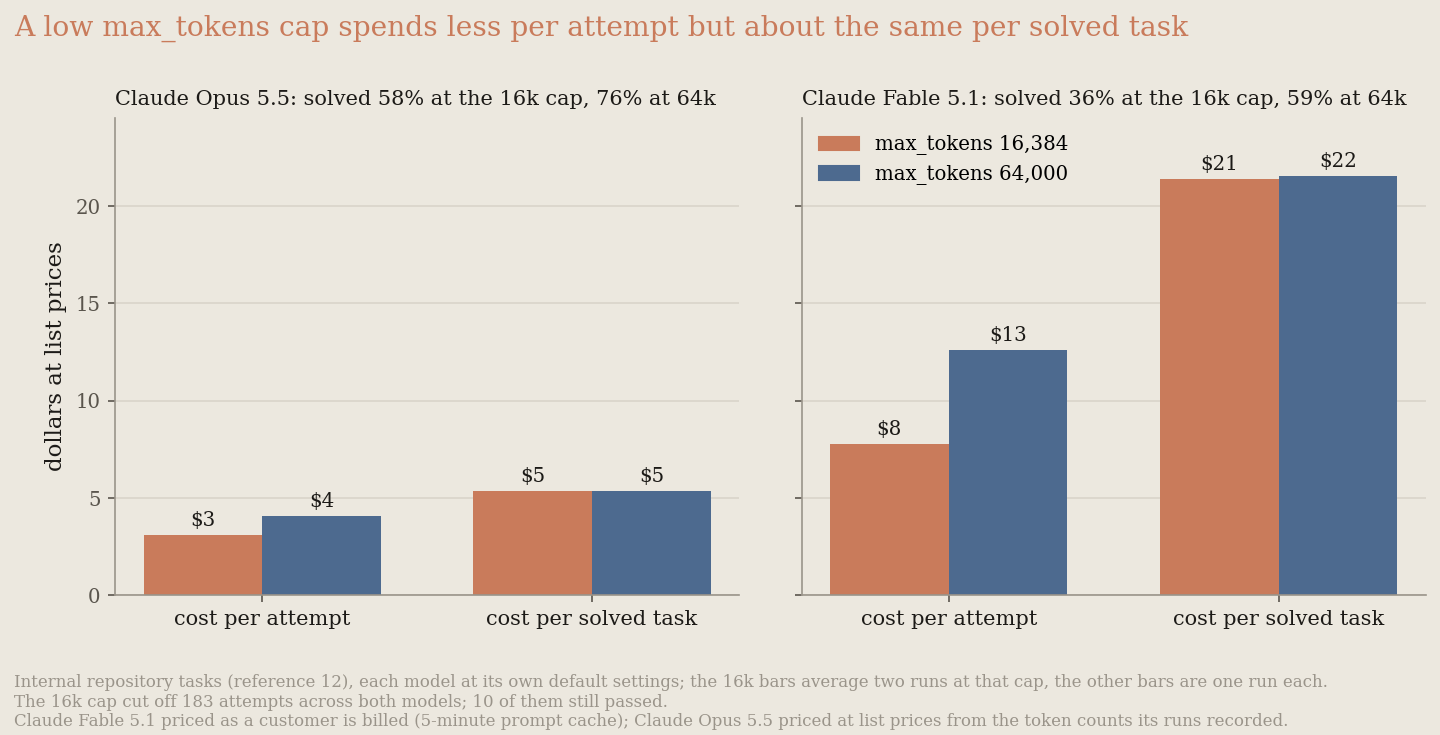
396<Frame>
397 
398</Frame>
361399
362400Almost every turn finishes far below either cap. The rare long turn is what the higher cap buys:
363401
364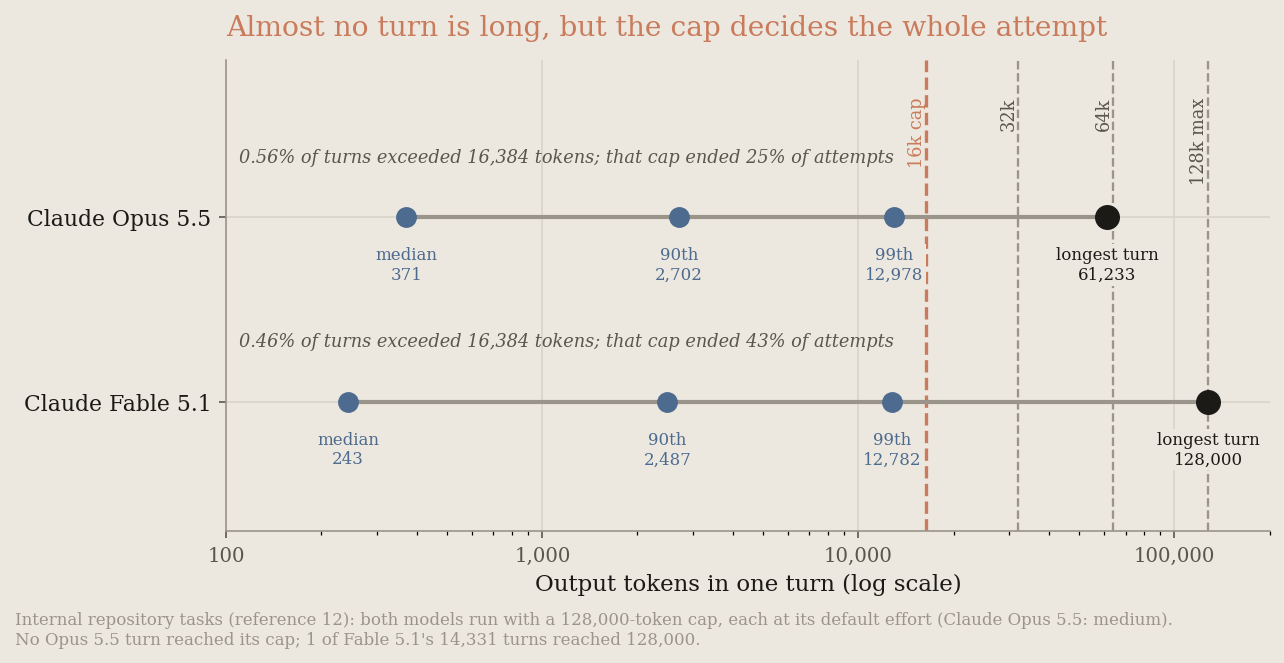
402<Frame>
403 
404</Frame>
365405
366406### Show the model elapsed time
367407
from line 409
369409
370410Anthropic measured both changes together with Claude Opus 5.5 at its default effort, `medium`, on two public benchmarks, DRACO[21](https://platform.claude.com/docs/en/about-claude/models/optimizing-for-cost-and-intelligence#refs) and HLE[22](https://platform.claude.com/docs/en/about-claude/models/optimizing-for-cost-and-intelligence#refs), and on an internal set of 70 research-level physics problems, adapted from the public CritPt benchmark[23](https://platform.claude.com/docs/en/about-claude/models/optimizing-for-cost-and-intelligence#refs). This page calls that set the physics set. Each of the three ran with a single agent, with a team in which a lead agent can start any number of helper agents of the same model, and, for comparison, with a single agent at `low` effort and no changes. Unless a sentence says average, time and cost figures are for the typical task: the median, over tasks, of each task's ratio between the two configurations compared. The following chart plots average score against average cost per task for each configuration. A second row gives the typical task's time as a ratio, with both changes compared with the same setup without them, and at `low` effort compared with `medium`. A third row gives the average score change for the same comparisons, with its 95% interval:
371411
372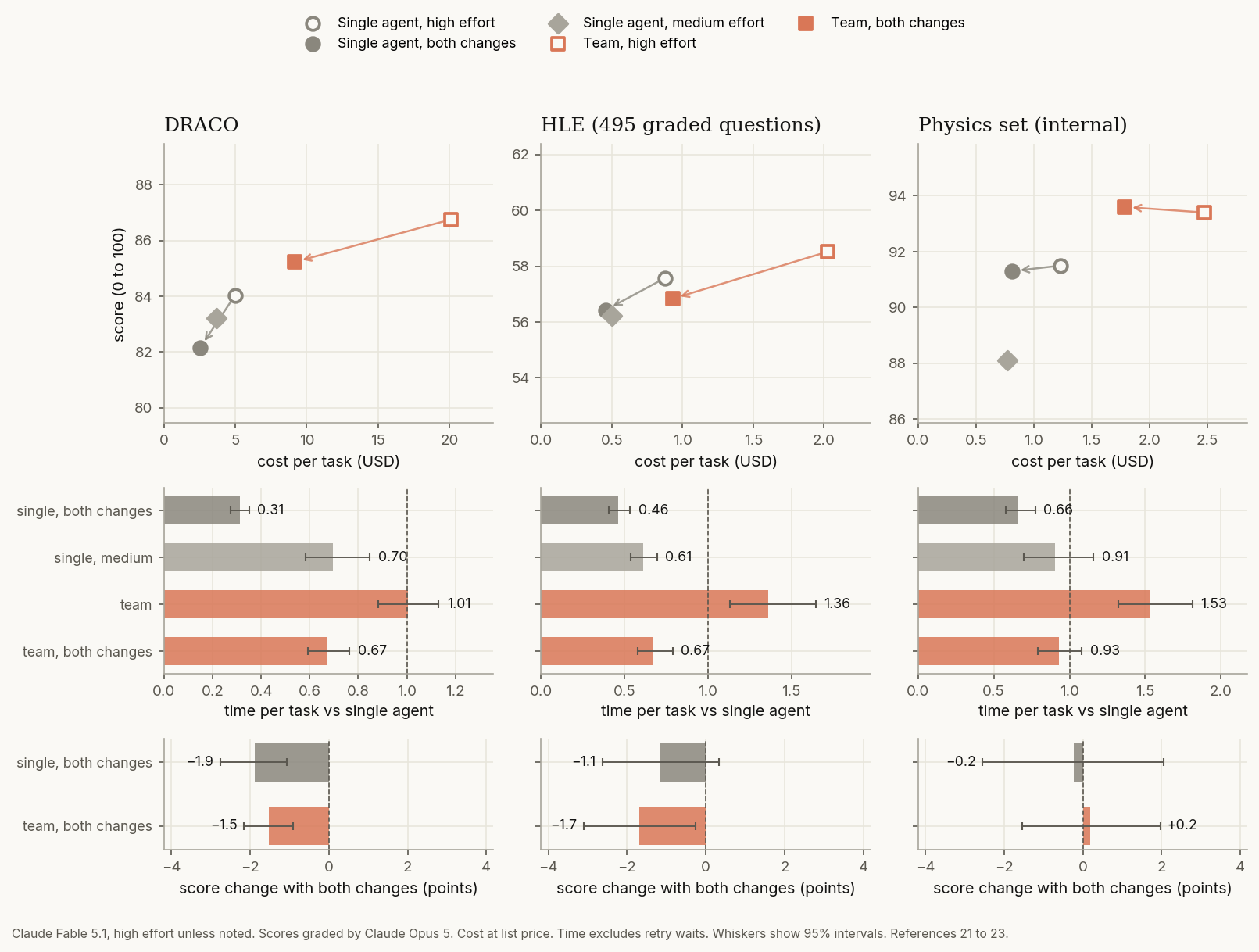
412<Frame>
413 
414</Frame>
373415
374416**On long research tasks.** On DRACO[21](https://platform.claude.com/docs/en/about-claude/models/optimizing-for-cost-and-intelligence#refs), the two changes cut a single agent's time by 47% and its cost by 60% on the typical task. Its average cost fell from $1.13 USD to $0.44 USD per task, and it made about half as many requests per attempt. Its score was 4.1 points lower (95% interval 2.9 to 5.2 lower).
375417
from line 517
475517
476518To use it, add the [advisor tool](https://platform.claude.com/docs/en/agents-and-tools/tool-use/advisor-tool) to your request. This beta feature runs the whole strategy server-side in one `/v1/messages` request: the executor emits a tool call, Anthropic runs the advisor inference, and the executor continues with the advice; you write no orchestration code. On Claude Managed Agents, [give the session an advisor](https://platform.claude.com/docs/en/managed-agents/multiagent-orchestration#give-the-session-an-advisor) by adding an `advisor` entry to the agent's `multiagent` roster; the session's primary thread consults it the same way. Claude Code supports it too; see [escalating hard decisions with the advisor tool](https://code.claude.com/docs/en/advisor).
477519
478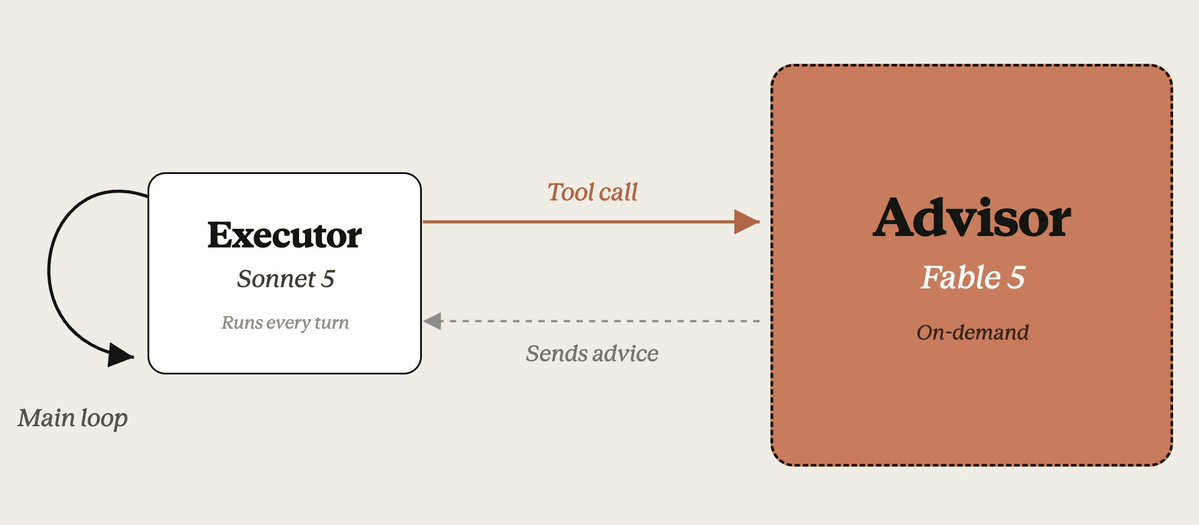
520<Frame>
521 
522</Frame>
479523
480524**What sets the payoff.** The advisor sees the task only through the executor's calls, so two things decide how much it helps.
481525
482The first is the gap between the models. The advisor can only hand over capability the executor lacks: on GPQA Diamond[9](https://platform.claude.com/docs/en/about-claude/models/optimizing-for-cost-and-intelligence#refs) a Claude Haiku 4.5 executor gained a great deal from a Claude Opus 5 advisor, a Claude Sonnet 5 executor gained a few points, and a frontier executor almost nothing.
526The first is the gap between the models. The advisor can only hand over capability the executor lacks: on GPQA Diamond[9](https://platform.claude.com/docs/en/about-claude/models/optimizing-for-cost-and-intelligence#refs), Claude Sonnet 5.5 alone tied Claude Opus 5.5 alone at 91% with refusals counted as wrong, but only because Opus 5.5 refused six biology questions per run against Sonnet 5.5's one. On the questions each answered, Opus 5.5 led by about 2 points. Claude Haiku 5.5 alone scored 6 points below Opus 5.5 (85%), so an Opus 5.5 advisor had more to hand over to it.
483527
484The second, and the fragile one, is whether the executor actually asks (the consult rate). An executor at low effort can stop detecting that it is stuck: a pairing that consults on most tasks at the default effort can fall to consulting on almost none when effort is lowered, and then scores below the executor alone. The rate also varies by task: on DeepSWE[10](https://platform.claude.com/docs/en/about-claude/models/optimizing-for-cost-and-intelligence#refs) a low-effort Sonnet 5 executor kept asking and gained 23 points; on SWE-bench Pro[3](https://platform.claude.com/docs/en/about-claude/models/optimizing-for-cost-and-intelligence#refs) the same executor stopped. When the executor does ask, it recovers much of the gap. Across the pairings in the following chart whose executor kept asking, the advisor closed at least half the gap to the stronger model (the coding pairing beat the stronger model outright), and you pay for the stronger model only on the consultations, which is what makes the cost cases possible:
528The second, and the fragile one, is whether the executor actually asks (the consult rate). Neither of those executors asked. In two runs each, Claude Haiku 5.5 and Claude Sonnet 5.5 called the Opus 5.5 advisor on none of the 198 questions, so both pairings scored within run-to-run noise of the executor alone. These runs added the advisor tool as is, without a system prompt that asks the executor to consult it, like those the [advisor tool page suggests](https://platform.claude.com/docs/en/agents-and-tools/tool-use/advisor-tool#prompting-for-coding-and-agent-tasks). The advisor tool's definition, about 1,000 prompt tokens per request, still added 12% to Haiku 5.5's cost per question and 25% to Sonnet 5.5's. An executor at low effort can stop detecting that it is stuck: a pairing that consults on most tasks at the default effort can fall to consulting on almost none when effort is lowered, and then scores below the executor alone. The rate also varies by task: on DeepSWE[10](https://platform.claude.com/docs/en/about-claude/models/optimizing-for-cost-and-intelligence#refs) a low-effort Sonnet 5 executor kept asking and gained 23 points; on SWE-bench Pro[3](https://platform.claude.com/docs/en/about-claude/models/optimizing-for-cost-and-intelligence#refs) the same executor stopped. In the following chart, only the coding pairing's executor consulted on most attempts, and only its gain can be credited to the advisor: 1.7 points above Opus 5.5 alone at `high`, at the edge of run-to-run noise. The executors that rarely or never consulted gained nothing beyond noise, and the one at `low` effort lost 7 points. When the executor does ask, you pay for the stronger model only on the consultations, which is what makes the cost cases possible:
485529
486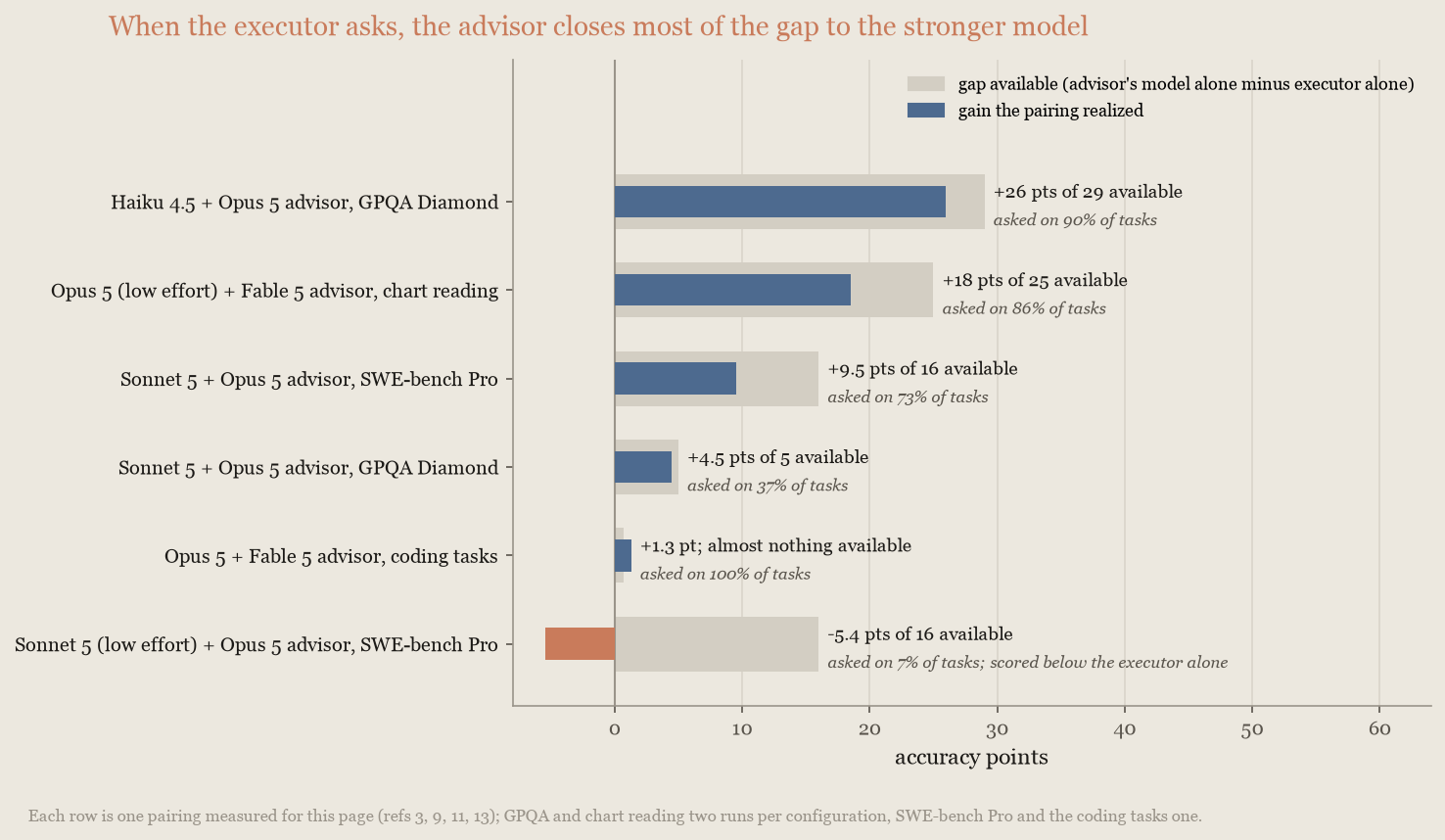
530<Frame>
531 
532</Frame>
487533
488534The consult rate responds to prompting. With only the tool's built-in description, executors under-call, especially on coding work, so the [advisor tool documentation](https://platform.claude.com/docs/en/agents-and-tools/tool-use/advisor-tool#prompting-for-coding-and-agent-tasks) gives a system prompt that asks for one call before substantive work and one before finishing, about two to three calls per task. The coding pairing measured next ran at that cadence with Claude Opus 5 as the executor, about two consultations on every task; with Claude Opus 5.5 as the executor it asked for advice about 1.4 times per attempt, and 4% of its attempts received no advice. That page also covers nudging an under-calling executor and capping calls client-side to bound cost. So watch the consult rate: prompt for it, measure it, and restore the executor's effort if it collapses.
489535
from line 537
491537
492538On an internal agentic-coding benchmark[11](https://platform.claude.com/docs/en/about-claude/models/optimizing-for-cost-and-intelligence#refs), run with a plain API agent, a Claude Opus 5.5 executor at `high` with a Claude Fable 5.1 advisor scored 90.1% at $2.92 USD per attempt. That is 1.7 points over Opus 5.5 alone at `high`, the executor's own setting, a gap at the edge of run-to-run noise with five attempts per task, for about 2.1 times the money; against Opus 5.5 at its default, `medium`, it is 3.5 points for about 3.5 times the money. It lands about on Opus 5.5's own effort curve, so the advisor buys about what more effort does: Opus 5.5 alone at `xhigh` scored 91.1% for $4.11 USD per attempt (one attempt per task). In August, a Claude Fable 5.1 advisor over a Claude Opus 5 executor was the most accurate configuration measured, at $6.21 USD per attempt, a little over twice what the Opus 5.5 pairing costs. The chart plots the Opus 5.5 pairing against Opus 5.5's own effort curve and Claude Fable 5.1's from August:
493539
494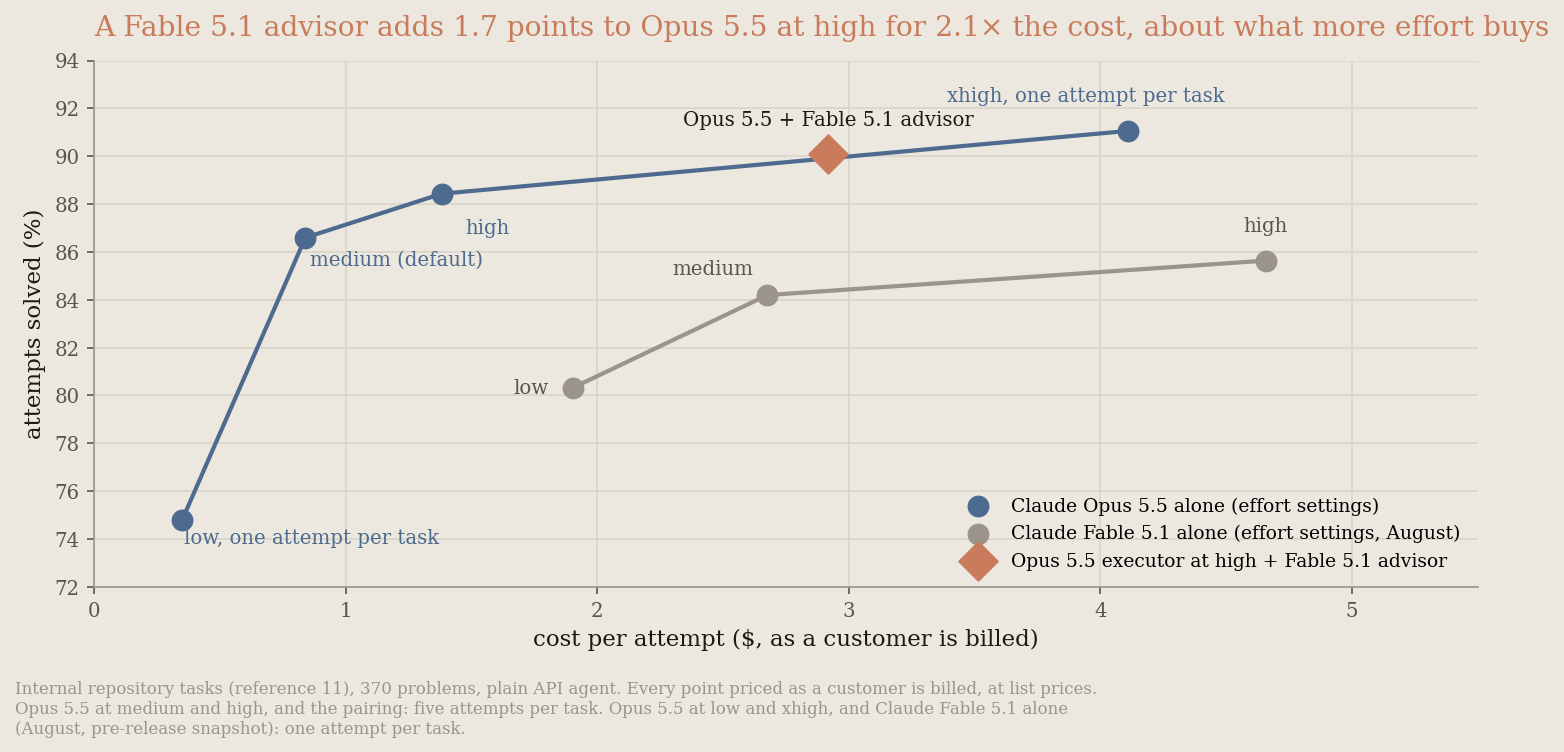
540<Frame>
541 
542</Frame>
495543
496544An earlier measurement through [Claude Code's advisor mode](https://code.claude.com/docs/en/advisor) also ranked its advisor pairing above both of its models alone. Read the Claude Opus 5.5 result as a shape to test on your workload: the advisor buys a few points for about twice what the executor costs alone. A wider capability gap does not guarantee a better deal. The latency cost is the consultations themselves: about one or two extra frontier-model calls per task on this benchmark, each on the task's critical path.
497545
from line 555
507555
508556To build one, use [multiagent orchestration](https://platform.claude.com/docs/en/managed-agents/multiagent-orchestration) in Claude Managed Agents: configure a coordinator agent (the orchestrator) and a roster of worker agents, each with its own model. For a complete working example with a frontier coordinator and Claude Sonnet 5 workers, see the Claude Cookbook recipe [Coordinator pattern: big models for planning, small models for execution](https://github.com/anthropics/claude-cookbooks/blob/main/managed_agents/CMA_plan_big_execute_small.ipynb).
509557
510
558<Frame>
559 
560</Frame>
511561
512562This pattern saves wall-clock time when workers can run in parallel: on the corpus benchmark[8](https://platform.claude.com/docs/en/about-claude/models/optimizing-for-cost-and-intelligence#refs), an episode took about 2.3 hours with the coordinator running the platform's documented limit of 25 concurrent workers, compared with 15 to 20 hours solo. It saved money in only two measured situations. On work a single model could handle alone, the same model at lower effort was cheaper every time.
513563
from line 565
515565
516566Anthropic measured this on a deliberately easy slice of BrowseComp[4](https://platform.claude.com/docs/en/about-claude/models/optimizing-for-cost-and-intelligence#refs) (10 problems the solo model reliably solves; 50 delegated and 70 solo runs). A Claude Fable 5 coordinator with one Claude Sonnet 5 worker cost about half as much as Claude Fable 5 alone on average and about a third as much at the 90th percentile ($12 USD compared with $33 USD), and the solo model's single most expensive run, at $84 USD, was also wrong:
517567
518
568<Frame>
569 
570</Frame>
519571
520572Delegation paid on the routine, normally solvable share of the work, the opposite of the intuition that workers are for hard problems. On the full, harder BrowseComp set, the economics reversed. If your traffic has a long cost tail on routine tasks, this is the orchestrator case to measure first.
521573
from line 575
523575
524576Anthropic built a benchmark for this case[8](https://platform.claude.com/docs/en/about-claude/models/optimizing-for-cost-and-intelligence#refs): a 21.6-million-token corpus of 14 public Python packages with 130 planted defects, too large for any context window. Lowering effort cannot help, because the bill is the corpus read itself: Claude Fable 5.1 solo cost $468 USD to $552 USD per episode across the three effort settings, and only its accuracy moved. The coordinator configuration, a Claude Fable 5.1 lead over 25 Claude Sonnet 5 workers, cost about half as much as those settings (47% to 55% less) and scored 10 to 12 points below them, in about 2.3 hours per episode against 15 to 20, while beating a Claude Sonnet 5 solo baseline outright:
525577
526
578<Frame>
579 
580</Frame>
527581
528582The token accounting shows the scale of the reading: the coordinator configuration read about 560 million cached tokens per episode, about one and a half times the solo model's roughly 365 million, nearly all of them at Claude Sonnet 5's cache-read rate, and still cost about half as much overall. Fable 5.1 at `high` effort still holds peak accuracy, at about 2.2 times the coordinator configuration's cost, so delegation here buys most of the accuracy, not all of it.
529583
from line 877
8238776. **DeepWideSearch:** "DeepWideSearch: Benchmarking Depth and Width in Agentic Information Seeking," arXiv:2510.20168, 2025. The 220 questions span 15 domains, each combining many-row collection with multi-hop retrieval; measured on the benchmark's standing row set, 3 runs per configuration, run August 2, 2026 (the single-worker team point ran July 26 to 27, 2026).
8248787. **DeepResearch Bench II:** Li et al., "DeepResearch Bench II: Diagnosing Deep Research Agents via Rubrics from Expert Report," arXiv:2601.08536, 2026. Its 132 research tasks across 22 domains are graded against expert-derived binary rubrics; measured on a 50-task subset stratified across all themes, one attempt per task, 3 runs per setting, on [Claude Managed Agents](https://platform.claude.com/docs/en/managed-agents/overview) with the platform's own web search and fetch tools (August 26 to 27, 2026); scored on the 33 tasks no configuration refused, with attempts the production safety classifiers cut short removed; costs are what a customer is billed, the platform's requests plus web-search fees. Scores are each model's mean on the 33-task basis with its own pre-empted tasks removed; on the 21 tasks clean in every arm, Claude Fable 5.1 holds a 2-to-3-point lead over Claude Fable 5 at every effort level and both models are flat across effort. The caching chart re-prices the same requests with every input token at the uncached rate. Claude Opus 4.6 judges under the benchmark's rubric protocol; the original uses a different judge, and an Anthropic judge may favor the house style. Claude Opus 5 at its default effort ran on the same surface and subset, three runs, on August 28, 2026: 68.8% on the raw 50 tasks, 70.8% on the 33-task basis, and 71.1% on the 21-task set, at $6.71 USD per task ($23.72 USD without caching); none of its attempts was cut short by the safety classifiers, under a safeguards deployment newer than the one the other models ran under.
8258798. **Corpus defect sweep:** Anthropic-internal, for work larger than one context window: a 21.6-million-token corpus from 14 public Python package sources with 130 planted defects and deterministic grading; protocol fixed before the runs and internally reviewed; three runs per configuration. Every configuration ran on Claude Managed Agents. The charted team configuration is a run in which the Claude Fable 5.1 coordinator ran the whole sweep inside the platform at its documented limit of 25 concurrent Claude Sonnet 5 workers, run August 30, 2026; its three episodes scored F1 0.764, 0.825, and 0.791 after the extras audit (raw 0.751, 0.821, and 0.781) for $225 USD, $234 USD, and $283 USD. The Claude Sonnet 5 solo configuration ran August 3 to 4, 2026; the Claude Fable 5.1 solo configurations ran August 24 to 25, 2026, under the platform's launch serving settings, three seeds per effort setting, on the same corpus build. The sandbox image carried installed copies of part of the corpus, and Claude Fable 5.1's final assembly step compared against them in 7 of 9 episodes; re-grading without those additions moved the affected seeds by up to 3 points. Absolute F1 is specific to this corpus build, not comparable across benchmarks; configuration comparisons are like for like.
8269. **GPQA Diamond:** Rein et al., "GPQA: A Graduate-Level Google-Proof Q\&A Benchmark," 2023. The 198-question Diamond subset, two runs per configuration, run August 7, 2026 (Claude Opus 5.5: September 19, 2026), model-graded against reference answers, advisor tokens metered per request. A platform safety check refused two biology questions on the Claude Sonnet 5 executors, and one of them also on Claude Opus 5; excluding them changes no comparison by more than one point. Claude Opus 5.5's 92% comes from two runs that set `fallbacks: "default"` to opt into [server-side fallback](https://platform.claude.com/docs/en/build-with-claude/refusals-and-fallback#server-side-fallback), with any attempt that still ended in a refusal counted as wrong. In each run the safety check flagged six biology questions, Claude Opus 5 answered five of them through the fallback, and the sixth still ended in a refusal. Opus 5.5's cost per question includes those fallback answers. Without counting refusals as wrong, these runs score 93%, because the grader still assigns an answer option to a refused attempt, usually the correct one. With refusals counted as wrong, Claude Opus 5's runs score 91% (one refusal per run), as do two Claude Opus 5.5 runs with fallback off, in which Opus 5.5 refused five or six biology questions per run.
8809. **GPQA Diamond:** Rein et al., "GPQA: A Graduate-Level Google-Proof Q\&A Benchmark," 2023. The 198-question Diamond subset, two runs per configuration, run August 7, 2026 (Claude Opus 5.5: September 19, 2026), model-graded against reference answers, advisor tokens metered per request. A platform safety check refused two biology questions on the Claude Sonnet 5 executors, and one of them also on Claude Opus 5; excluding them changes no comparison by more than one point. Claude Opus 5.5's 92% comes from two runs that set `fallbacks: "default"` to opt into [server-side fallback](https://platform.claude.com/docs/en/build-with-claude/refusals-and-fallback#server-side-fallback), with any attempt that still ended in a refusal counted as wrong. In each run the safety check flagged six biology questions, Claude Opus 5 answered five of them through the fallback, and the sixth still ended in a refusal. Opus 5.5's cost per question includes those fallback answers. Without counting refusals as wrong, these runs score 93%, because the grader still assigns an answer option to a refused attempt, usually the correct one. With refusals counted as wrong, Claude Opus 5's runs score 91% (one refusal per run), as do two Claude Opus 5.5 runs with fallback off, in which Opus 5.5 refused five or six biology questions per run. Claude Haiku 5.5 and Claude Sonnet 5.5, each alone and with a Claude Opus 5.5 advisor, ran two runs per configuration on October 7, 2026, alongside two more Claude Opus 5.5 runs, all with fallback off, at each model's default effort, and with refusals counted as wrong. The safety check refused one biology question per run on Claude Haiku 5.5 and Claude Sonnet 5.5 alone, one in two runs on Haiku 5.5 with the advisor, none on Sonnet 5.5 with the advisor, and six per run on Opus 5.5, which scored 91% with them counted as wrong and 93.5% on the questions it answered. The advisor configurations added the tool without a prompt asking for consultations, and neither executor called the advisor on any question.
82788110. **DeepSWE:** Datacurve, "DeepSWE: Measuring Frontier Coding Agents on Original, Long-Horizon Engineering Tasks," arXiv:2607.07946, 2026. The set has 113 original tasks across five languages with program-based verifiers. Pairings are two runs each, run August 7, 2026, with advisor tokens metered per request, and used a client-side advisor loop rather than the advisor tool, with identical accounting. Single-model effort sweeps are single runs priced from token counts, a cache-aware approximation. Costs per task are run totals divided by 113.
82811. **Internal agentic-coding benchmark:** Anthropic-internal: 370 repository tasks graded by the repositories' own tests. The API figures were measured with a 128,000-token output cap, one run per configuration: Opus 5 alone at the default effort August 9 to 10, 2026, and at `low` and `medium` August 10, 2026; Claude Fable 5.1 alone at five explicitly set effort values August 20, 2026 (the chart shows three of them); and the pairing August 24 to 25, 2026. Claude Opus 5.5 alone ran on all 370 tasks, September 19 to 20, 2026: at its default effort (`medium`) and at `high` with five attempts per task, and at `low` and `xhigh` with one (369 of 370 scored at each, after a setup-check failure). The Claude Opus 5.5 executor at `high` with the released Claude Fable 5.1 as advisor (the August runs used a pre-release snapshot) ran five attempts per task on the same dates; one task failed its setup check, so 1,845 attempts were scored. The 279 attempts in which the advisor was turned away under load were re-run, and attempts whose consults timed out were kept, as in August. The August runs had five attempts per task for the pairing and the Claude Opus 5 control and one for the other points. The August pairing averaged about two advisor consultations per attempt; the Claude Opus 5.5 pairing requested 1.39 and received 1.35. Costs are per attempt. Costs are priced as a customer's organization is metered: each agent-loop request's prior prompt as a cache read and its new tokens as a 5-minute cache write, from the runs' own usage records, and each advisor call, which uses no cache, from its recorded tokens, all at list prices. The Claude Code figures are runs of the same tasks from July 8 to 23, 2026, one run per configuration, costs approximate.
88211. **Internal agentic-coding benchmark:** Anthropic-internal: 370 repository tasks graded by the repositories' own tests. The API figures were measured with a 128,000-token output cap, one run per configuration: Opus 5 alone at the default effort August 9 to 10, 2026, and at `low` and `medium` August 10, 2026; Claude Fable 5.1 alone at five explicitly set effort values August 20, 2026 (the chart shows three of them); and the pairing August 24 to 25, 2026. Claude Opus 5.5 alone ran on all 370 tasks, September 19 to 20, 2026: at its default effort (`medium`) and at `high` with five attempts per task, and at `low` and `xhigh` with one (369 of 370 scored at each, after a setup-check failure). The Claude Opus 5.5 executor at `high` with the released Claude Fable 5.1 as advisor (the August runs used a pre-release snapshot) ran five attempts per task on the same dates; one task failed its setup check, so 1,845 attempts were scored. The advisor chart compares that pairing with the released Claude Fable 5.1 alone at `high`, its default, one attempt per task on October 7, 2026: 85.7%, 317 of 370 tasks. The 279 attempts in which the advisor was turned away under load were re-run, and attempts whose consults timed out were kept, as in August. The August runs had five attempts per task for the pairing and the Claude Opus 5 control and one for the other points. The August pairing averaged about two advisor consultations per attempt; the Claude Opus 5.5 pairing requested 1.39 and received 1.35. Costs are per attempt. Costs are priced as a customer's organization is metered: each agent-loop request's prior prompt as a cache read and its new tokens as a 5-minute cache write, from the runs' own usage records, and each advisor call, which uses no cache, from its recorded tokens, all at list prices. The Claude Code figures are runs of the same tasks from July 8 to 23, 2026, one run per configuration, costs approximate.
82988312. **Internal repository-task benchmark (cap measurement):** A separate Anthropic-internal set of about 130 repository tasks, run August 20, 2026 (Claude Fable 5.1) and September 19, 2026 (Claude Opus 5.5, at its default effort, `medium`), with a plain API agent loop, one attempt per task. The Claude Fable 5.1 runs are 135 tasks per cap at the default effort set explicitly: the 16,384-token figure averages two runs (36.3% on both); the 64,000 and 128,000 figures are single runs (58.5% and 60.0%). Six problems drew a safety refusal in every run and count as failures. The Claude Opus 5.5 16,384-token figure averages two runs (134 and 135 tasks scored), and its 64,000 and 128,000 figures are single runs (135 tasks each); two attempts in each 16,384-token run ended in a safety refusal and count as failures. The SWE-bench Pro cap figures are one Claude Fable 5.1 run per cap at the default effort, run August 26, 2026, on a 100-problem subset stratified from reference 3's 482-problem set, not comparable to its scores; the two caps scored the same at the default. The chart's per-turn distributions come from the Claude Opus 5.5 and Claude Fable 5.1 runs at 128,000: no Opus 5.5 turn reached the cap (the longest was about 61,000 tokens, and 0.56% of its turns exceeded 16,384), and one Fable 5.1 turn reached 128,000 (0.46% of its turns exceeded 16,384).
83013. **Chartography:** Surge AI, "Chartography," 2026. The complete released 100-question set, measured August 6 and 9, 2026 (Claude Opus 5 alone) and September 20, 2026 (Claude Opus 5.5), with Anthropic's implementation on Claude Managed Agents (standard cloud sandbox; advisor configurations use the Managed Agents advisor). Claude Sonnet 4.6 grades instead of the reference judge and the benchmark runs with tools, so scores compare across configurations here but not to the published leaderboard. They are also not comparable to the Chartography results in the Claude Opus 5.5 system card, which use a different grader and run at `max` effort. Two runs per configuration (three for Claude Opus 5.5), pooled; run-to-run spreads were up to 10 points. Costs are what a customer running the agent routinely is billed: each chart's first request reads the agent's shared system prompt and tools from the cache, as it does when another session of the same agent ran in the previous 5 minutes. A chart run on its own costs about $0.03 USD more with Claude Opus 5 or Claude Opus 5.5 and about $0.12 USD more with Claude Fable 5.1. The August figures are re-priced this way from the runs' usage records; the evaluation organization's own metering, which until September 10, 2026, billed Claude Opus 5's cache reads in 8,192-token blocks, overstated Claude Opus 5's costs. Costs exclude sandbox time, which added under 1% to the August runs. The Claude Fable 5.1 solo runs are from August 24, 2026, under the platform's launch serving settings, two runs per setting; six attempts hit the 15-minute session cap and score 0, and two charts per run were answered by Claude Opus 5 after a safety refusal. The Claude Opus 5 low-effort executor with a Claude Fable 5.1 advisor ran twice on August 30, 2026, under the same settings (63.0 and 67.0, mean 65.0, at $0.47 USD a chart; the advisor was consulted on 88% of tasks in each run, and 4 of its 219 replies came from Claude Opus 5 instead, each after a production safety filter stopped the advisor's own reply). Claude Opus 5.5 ran at `low`, with server-side fallback off and a safety classifier judging every tool call: three runs alone (70, 68, and 68) and three with a Claude Fable 5.1 advisor configured (59, 63, and 63), in which it consulted the advisor on 1 of 300 tasks. The consult-rate comparison for the earlier pairings comes from rerunning the same configurations on the Messages API with a container tool set, August 10 to 11, 2026.
88413. **Chartography:** Surge AI, "Chartography," 2026. The complete released 100-question set, measured August 6 and 9, 2026 (Claude Opus 5 alone) and September 20, 2026 (Claude Opus 5.5), with Anthropic's implementation on Claude Managed Agents (standard cloud sandbox; advisor configurations use the Managed Agents advisor). Claude Sonnet 4.6 grades instead of the reference judge and the benchmark runs with tools, so scores compare across configurations here but not to the published leaderboard. They are also not comparable to the Chartography results in the Claude Opus 5.5 system card, which use a different grader and run at `max` effort. Two runs per configuration (three for Claude Opus 5.5), pooled; run-to-run spreads were up to 10 points. Costs are what a customer running the agent routinely is billed: each chart's first request reads the agent's shared system prompt and tools from the cache, as it does when another session of the same agent ran in the previous 5 minutes. A chart run on its own costs about $0.03 USD more with Claude Opus 5 or Claude Opus 5.5 and about $0.12 USD more with Claude Fable 5.1. The August figures are re-priced this way from the runs' usage records; the evaluation organization's own metering, which until September 10, 2026, billed Claude Opus 5's cache reads in 8,192-token blocks, overstated Claude Opus 5's costs. Costs exclude sandbox time, which added under 1% to the August runs. The Claude Fable 5.1 solo runs are from August 24, 2026, under the platform's launch serving settings, two runs per setting; six attempts hit the 15-minute session cap and score 0, and two charts per run were answered by Claude Opus 5 after a safety refusal. The Claude Opus 5 low-effort executor with a Claude Fable 5.1 advisor ran twice on August 30, 2026, under the same settings (63.0 and 67.0, mean 65.0, at $0.47 USD a chart; the advisor was consulted on 88% of tasks in each run, and 4 of its 219 replies came from Claude Opus 5 instead, each after a production safety filter stopped the advisor's own reply). Claude Opus 5.5 ran at `low`, with server-side fallback off and a safety classifier judging every tool call: three runs alone (70, 68, and 68) and three with a Claude Fable 5.1 advisor configured (59, 63, and 63), in which it consulted the advisor on 1 of 300 tasks. The advisor chart compares that pairing with Claude Fable 5.1 alone at `high`, its default, run three times on October 7, 2026, with the same implementation and settings as the Claude Opus 5.5 runs: 82, 79, and 79, a mean of 80.0. The consult-rate comparison for the earlier pairings comes from rerunning the same configurations on the Messages API with a container tool set, August 10 to 11, 2026.
83188514. **Support-desk prompt-audit evaluation:** An Anthropic-constructed set of 44 support tickets with deterministic grading, run in early August 2026 and reported on August 8, 2026, under six system prompts, each adding to the same clean prompt one pattern common in prompts written for Claude Opus 4.8 and Claude Sonnet 4.6. Each chart point is one of three cases (older model, newer model on the same prompt, newer model after the audit) averaged over the six prompts and 44 tickets. The Opus 5 accuracy gain has a 95% confidence interval of 3 to 8 points; the Sonnet accuracy differences are within noise.
83288615. **Data-file question set:** An Anthropic-constructed set of 25 aggregate questions over a 1,862-row slice of a public liquor-sales CSV, with ground truth computed by pandas and exact-match grading, run on Claude Sonnet 5 and Claude Opus 5 with thinking disabled (the in-context arm cannot complete at the default), a 4,000-token output cap, and no prompt caching, three runs per configuration, run August 19, 2026. The file arm uploads the CSV through the Files API and uses the `code_execution_20260120` tool.
83388716. **Cache duration measurement:** The 20-issue triage job from [Trim input and context tokens](https://platform.claude.com/docs/en/about-claude/models/optimizing-for-cost-and-intelligence#trim-input-and-context-tokens), run on Claude Sonnet 5 on August 23, 2026, and on Claude Opus 5.5 on September 19 and 20, 2026, at its default effort (`medium`) and at `high`, on the Messages API with the same harness (for Claude Opus 5.5, a port of it that sends the same request bodies), the Claude Opus 5.5 cells with `max_tokens` raised to 4,096, with pauses inserted before a randomly chosen share of turns (none, 5%, 10%, and every turn at 6 minutes on all 20 issues on both models, plus every turn at 2 minutes on Claude Sonnet 5; 20-minute and 45-minute pauses on a 5-issue subset on both models). Claude Opus 5's keep-alive figures below come from the same job on August 23, 2026, with `max_tokens` raised to 4,096, on the same schedules except the 2-minute and 45-minute pauses. Three runs per cell, cost computed from each response's `usage` fields at list prices (for Claude Opus 5.5, $4 USD input, $5 USD 5-minute write, $8 USD 1-hour write, $0.20 USD cache read, and $20 USD output per million tokens; Claude Sonnet 5 ran on an Anthropic-internal organization whose usage is metered the same way as a customer organization's), accuracy against the same gold labels. The Claude Opus 5.5 figures on this page cover both effort levels. The crossover is about 3.3% of turns on Claude Sonnet 5 and 3.1% to 3.2% on Claude Opus 5.5: the median of each session's break-even share, computed by the cost model from that session's turn-by-turn context sizes, over all 45 Claude Sonnet 5 twenty-issue sessions and the 36 Claude Opus 5.5 twenty-issue sessions at each effort level (every pause schedule run on the full job, under all three cache settings, three runs each; the 5-issue cells are not in it). In the 5% cell the 5-minute and 1-hour settings tied on Claude Sonnet 5, because that draw's pauses fell on small prefixes; on Claude Opus 5.5 they nearly tied. The page's 1-in-20 rule sits above the measured crossover. Claude Opus 5.5's time to first token after a pause was not measured. Anthropic measured keep-alive requests that refresh the 5-minute cache on Claude Sonnet 5 and Claude Opus 5 on August 23, 2026, and on Claude Opus 5.5 in the runs above, always sent with `max_tokens: 1`. On Claude Sonnet 5 they cost 7.7% less than the 1-hour setting with 5% of turns paused and about the same with 10%; on Claude Opus 5 no difference was measurable at either share; on both they cost more with a pause of 6 minutes or more before every turn. On Claude Opus 5.5 they cost 8% to 18% less than the 1-hour setting with 5% and 10% of turns paused (about 10% to 15% once between-session noise is removed by re-billing each keep-alive session's own tokens at 1-hour cache prices), and more with a pause before every turn: 4% to 6% more at 6 minutes, 9% to 10% at 20 minutes, and 56% to 58% at 45 minutes. Keep-alive saved more on Claude Opus 5.5 because each keep-alive request re-reads the prefix at the cache-read price: 0.05x the input price, against 0.1x on Claude Sonnet 5 and Claude Opus 5; Claude Opus 5's sessions, re-billed at Claude Opus 5.5's prices, show nearly the same savings as Claude Opus 5.5. Anthropic's pre-launch API tests on Claude Opus 5.5 show that a `max_tokens: 0` request writes the cache and that the next request reads it; whether such a request refreshes an existing entry was not measured on Opus 5.5. On Claude Fable 5.1, at 0.025x, keep-alive was cheaper even with a pause before every turn, except at 45-minute pauses (reference 19).
about-claude/pricing Changed · +15 / -8 lines
from line 31
3131| Claude Sonnet 4.6 | $3 / MTok | $3.75 / MTok | $6 / MTok | $0.30 / MTok | $15 / MTok |
3232| Claude Sonnet 4.5 | $3 / MTok | $3.75 / MTok | $6 / MTok | $0.30 / MTok | $15 / MTok |
3333| Claude Sonnet 4 ([retired, except on Bedrock and Google Cloud](https://platform.claude.com/docs/en/about-claude/model-deprecations)) | $3 / MTok | $3.75 / MTok | $6 / MTok | $0.30 / MTok | $15 / MTok |
34| Claude Haiku 5.5 (for prompts up to 100,000 tokens) | $0.10 / MTok | $0.125 / MTok | $0.20 / MTok | $0.01 / MTok | $0.50 / MTok |
35| Claude Haiku 5.5 (for prompts over 100,000 tokens) | $0.50 / MTok | $0.625 / MTok | $1 / MTok | $0.05 / MTok | $2.50 / MTok |
3436| Claude Haiku 4.5 | $1 / MTok | $1.25 / MTok | $2 / MTok | $0.10 / MTok | $5 / MTok |
3537| Claude Haiku 3.5 ([retired, except on Bedrock and Google Cloud](https://platform.claude.com/docs/en/about-claude/model-deprecations)) | $0.80 / MTok | $1 / MTok | $1.60 / MTok | $0.08 / MTok | $4 / MTok |
3638
from line 143
141143
142144Prompt caching uses the following pricing multipliers relative to base input token rates:
143145
144| Cache operation | Multiplier | Duration |
145| -------------------- | -------------------------------------------------------------------------------------------------- | ------------------------------------ |
146| 5-minute cache write | 1.25x base input price | Cache valid for 5 minutes |
147| 1-hour cache write | 2x base input price | Cache valid for 1 hour |
148| Cache read (hit) | 0.1x base input price (0.025x on Claude Fable 5.1 and Claude Mythos 5.1; 0.05x on Claude Opus 5.5) | Same duration as the preceding write |
146| Cache operation | Multiplier | Duration |
147| -------------------- | ------------------------------------------------------------------------------------------------------------------------ | ------------------------------------ |
148| 5-minute cache write | 1.25x base input price | Cache valid for 5 minutes |
149| 1-hour cache write | 2x base input price | Cache valid for 1 hour |
150| Cache read (hit) | 0.1x base input price (0.025x on Claude Fable 5.1 and Claude Mythos 5.1; 0.05x on Claude Opus 5.5 and Claude Sonnet 5.5) | Same duration as the preceding write |
149151
150Cache write tokens are charged when content is first stored. Cache read tokens are charged when a subsequent request retrieves the cached content. A cache hit costs 10% of the standard input price, which means caching pays off after one cache read for the 5-minute duration (1.25x write), or after two cache reads for the 1-hour duration (2x write). On Claude Fable 5.1 and Claude Mythos 5.1, a cache hit costs 2.5% of the standard input price ($0.25 USD per million tokens). On Claude Opus 5.5, a cache hit costs 5% of the standard input price ($0.20 USD per million tokens).
152Cache write tokens are charged when content is first stored. Cache read tokens are charged when a subsequent request retrieves the cached content. A cache hit costs 10% of the standard input price, which means caching pays off after one cache read for the 5-minute duration (1.25x write), or after two cache reads for the 1-hour duration (2x write). On Claude Fable 5.1 and Claude Mythos 5.1, a cache hit costs 2.5% of the standard input price ($0.25 USD per million tokens). On Claude Opus 5.5 and Claude Sonnet 5.5, a cache hit costs 5% of the standard input price ($0.20 USD per million tokens on Claude Opus 5.5, $0.10 USD on Claude Sonnet 5.5).
151153
152154These multipliers stack with other pricing modifiers, including the Batch API discount and data residency.
153155
from line 206
204206| Claude Sonnet 4.6 | $1.50 / MTok | $7.50 / MTok |
205207| Claude Sonnet 4.5 | $1.50 / MTok | $7.50 / MTok |
206208| Claude Sonnet 4 ([retired, except on Bedrock and Google Cloud](https://platform.claude.com/docs/en/about-claude/model-deprecations)) | $1.50 / MTok | $7.50 / MTok |
209| Claude Haiku 5.5 (for prompts up to 100,000 tokens) | $0.05 / MTok | $0.25 / MTok |
210| Claude Haiku 5.5 (for prompts over 100,000 tokens) | $0.25 / MTok | $1.25 / MTok |
207211| Claude Haiku 4.5 | $0.50 / MTok | $2.50 / MTok |
208212| Claude Haiku 3.5 ([retired, except on Bedrock and Google Cloud](https://platform.claude.com/docs/en/about-claude/model-deprecations)) | $0.40 / MTok | $2 / MTok |
209213
from line 219
215219
216220### Long context pricing
217221
218Claude 4.6 and later models and [Claude Mythos Preview](https://anthropic.com/glasswing) include the full [1M token context window](https://platform.claude.com/docs/en/build-with-claude/context-windows) at standard pricing. (A 900k-token request is billed at the same per-token rate as a 9k-token request.) Prompt caching and batch processing discounts apply at standard rates across the full context window.
222Claude 4.6 and later models (except Claude Haiku 5.5) and [Claude Mythos Preview](https://anthropic.com/glasswing) include the full [1M token context window](https://platform.claude.com/docs/en/build-with-claude/context-windows) at standard pricing. (A 900k-token request is billed at the same per-token rate as a 9k-token request.) Prompt caching and batch processing discounts apply at standard rates across the full context window.
219223
224Claude Haiku 5.5 is priced by prompt length: a prompt of over 100,000 tokens pays higher prices. [Model pricing](https://platform.claude.com/docs/en/about-claude/pricing#model-pricing) and [Batch processing](https://platform.claude.com/docs/en/about-claude/pricing#batch-processing) list both sets of prices.
225
220226### Tool use pricing
221227
222228Tool use requests are priced based on:
from line 256
250256| Claude Sonnet 4.6 | 497 tokens | 589 tokens |
251257| Claude Sonnet 4.5 | 496 tokens | 588 tokens |
252258| Claude Sonnet 4 ([retired, except on Bedrock and Google Cloud](https://platform.claude.com/docs/en/about-claude/model-deprecations)) | 313 tokens | 315 tokens |
259| Claude Haiku 5.5 | 286 tokens | 406 tokens |
253260| Claude Haiku 4.5 | 496 tokens | 588 tokens |
254261| Claude Haiku 3.5 ([retired, except on Bedrock and Google Cloud](https://platform.claude.com/docs/en/about-claude/model-deprecations)) | 264 tokens | 355 tokens |
255262
about-claude/use-case-guides/content-moderation Changed · +6 / -6 lines
from line 321
321321
322322### Select the right Claude model
323323
324When selecting a model, it’s important to consider the size of your data. If costs are a concern, a smaller model such as Claude Haiku 4.5 is an excellent choice because of its cost-effectiveness. The following is an estimate of the cost to moderate text for a social media platform that receives one billion posts per month:
324When selecting a model, it’s important to consider the size of your data. If costs are a concern, a smaller model such as Claude Haiku 5.5 is an excellent choice because of its cost-effectiveness. The following is an estimate of the cost to moderate text for a social media platform that receives one billion posts per month:
325325
326326* **Content size**
327327
from line 336
336336 * Output tokens per flagged message: 50
337337 * Total output tokens: 1.5B
338338
339* **Claude Haiku 4.5 estimated cost**
339* **Claude Haiku 5.5 estimated cost**
340340
341 * Input token cost: 28,600 MTok \* $1.00/MTok = $28,600 USD
342 * Output token cost: 1,500 MTok \* $5.00/MTok = $7,500 USD
343 * Monthly cost: $28,600 + $7,500 = $36,100 USD
341 * Input token cost: 28,600 MTok \* $0.10/MTok = $2,860 USD
342 * Output token cost: 1,500 MTok \* $0.50/MTok = $750 USD
343 * Monthly cost: $2,860 + $750 = $3,610 USD
344344
345345* **Claude Opus 5 estimated cost**
346346
about-claude/use-case-guides/ticket-routing Changed · +41 / -9 lines
from line 235
235235
236236The choice of model depends on the trade-offs between cost, accuracy, and response time.
237237
238Many customers have found `claude-haiku-4-5-20251001` an ideal model for ticket routing, as it is the fastest and most cost-effective model in the Claude 4 family while still delivering excellent results. If your classification problem requires deep subject matter expertise or a large volume of intent categories, or complex reasoning, you may opt for the [larger Sonnet model](https://platform.claude.com/docs/en/models/overview).
238Claude Haiku 5.5 (`claude-haiku-5-5`) suits ticket routing: it's the fastest and most cost-effective current model, and at `low` effort it handles simple, high-volume requests such as classification. If your classification problem requires deep subject matter expertise or a large volume of intent categories, or complex reasoning, you may opt for the [larger Sonnet model](https://platform.claude.com/docs/en/models/overview).
239239
240240### Build a strong prompt
241241
from line 307
307307```
308308
309309<Note>
310 This prompt is written for Claude Haiku 4.5, which runs here without thinking. On Claude Fable 5.1, Claude Fable 5, Claude Opus 5.5, Claude Opus 5, and Claude Sonnet 5.5, ask for the intent and a one-sentence summary of the request instead. See [Keep reasoning in thinking blocks](https://platform.claude.com/docs/en/build-with-claude/refusals-and-fallback#keep-reasoning-in-thinking-blocks).
310 This prompt is written for Claude Haiku 5.5, which runs here at `low` effort. On Claude Fable 5.1, Claude Fable 5, Claude Opus 5.5, Claude Opus 5, and Claude Sonnet 5.5, ask for the intent and a one-sentence summary of the request instead. See [Keep reasoning in thinking blocks](https://platform.claude.com/docs/en/build-with-claude/refusals-and-fallback#keep-reasoning-in-thinking-blocks).
311311</Note>
312312
313313Here are the key components of this prompt:
from line 333
333333client = anthropic.Anthropic()
334334
335335# Set the default model
336DEFAULT_MODEL = "claude-haiku-4-5-20251001"
336DEFAULT_MODEL = "claude-haiku-5-5"
337337
338338
339339def classify_support_request(ticket_contents):
from line 345
345345 # Send the prompt to the API to classify the support request.
346346 message = client.messages.create(
347347 model=DEFAULT_MODEL,
348 max_tokens=500,
348 max_tokens=2048,
349 output_config={"effort": "low"},
349350 messages=[{"role": "user", "content": classification_prompt}],
350351 stream=False,
351352 )
352 reasoning_and_intent = message.content[0].text
353 reasoning_and_intent = next(
354 (block.text for block in message.content if block.type == "text"), ""
355 )
353356
354357 # Use Python's regular expressions library to extract `reasoning`.
355358 reasoning_match = re.search(
from line 402
399402client = anthropic.Anthropic()
400403
401404# Set the default model
402DEFAULT_MODEL = "claude-haiku-4-5-20251001"
405DEFAULT_MODEL = "claude-haiku-5-5"
403406
404407
405408def classify_support_request(request, actual_intent):
from line 414
411414
412415 message = client.messages.create(
413416 model=DEFAULT_MODEL,
414 max_tokens=500,
417 max_tokens=2048,
418 output_config={"effort": "low"},
415419 messages=[{"role": "user", "content": classification_prompt}],
416420 )
417421 usage = message.usage # Get the usage statistics for the API call for how many input and output tokens were used.
418 reasoning_and_intent = message.content[0].text
422 reasoning_and_intent = next(
423 (block.text for block in message.content if block.type == "text"), ""
424 )
419425
420426 # Use Python's regular expressions library to extract `reasoning`.
421427 reasoning_match = re.search(
from line 469
463469
464470For example, you might have a top-level classifier that broadly categorizes tickets into "Technical Issues," "Billing Questions," and "General Inquiries." Each of these categories can then have its own sub-classifier to further refine the classification.
465471
466
472```mermaid
473---
474config:
475 flowchart:
476 nodeSpacing: 10
477 rankSpacing: 60
478 padding: 8
479 wrappingWidth: 300
480---
481flowchart LR
482 accTitle: Hierarchy of ticket classifiers
483 accDescr: Classifier hierarchy routing tickets to Technical Issues, Billing Questions, or General Inquiries, each with a sub-classifier
484 tickets[Support Tickets] --> technical[Technical Issues]
485 tickets --> billing[Billing Questions]
486 tickets --> general[General Inquiries]
487 technical --> software[Software Installation]
488 technical --> hardware[Hardware Troubleshooting]
489 technical --> network[Network Connectivity]
490 technical --> technicalMore[...]
491 billing --> invoice[Invoice Clarification]
492 billing --> payment[Payment Processing]
493 billing --> refund[Refund Requests]
494 general --> product[Product Information]
495 general --> order[Order Status]
496 general --> partnership[Partnership Opportunities]
497 general --> generalMore[...]
498```
467499
468500* **Pros - greater nuance and accuracy:** You can create different prompts for each parent path, allowing for more targeted and context-specific classification. This can lead to improved accuracy and more nuanced handling of customer requests.
469501
agents-and-tools/agent-skills/best-practices Changed · +9 / -3 lines
from line 262
262262
263263A basic Skill starts with just a SKILL.md file containing metadata and instructions:
264264
265
265<Frame>
266 
267</Frame>
266268
267269As your Skill grows, you can bundle additional content that Claude loads only when needed:
268270
269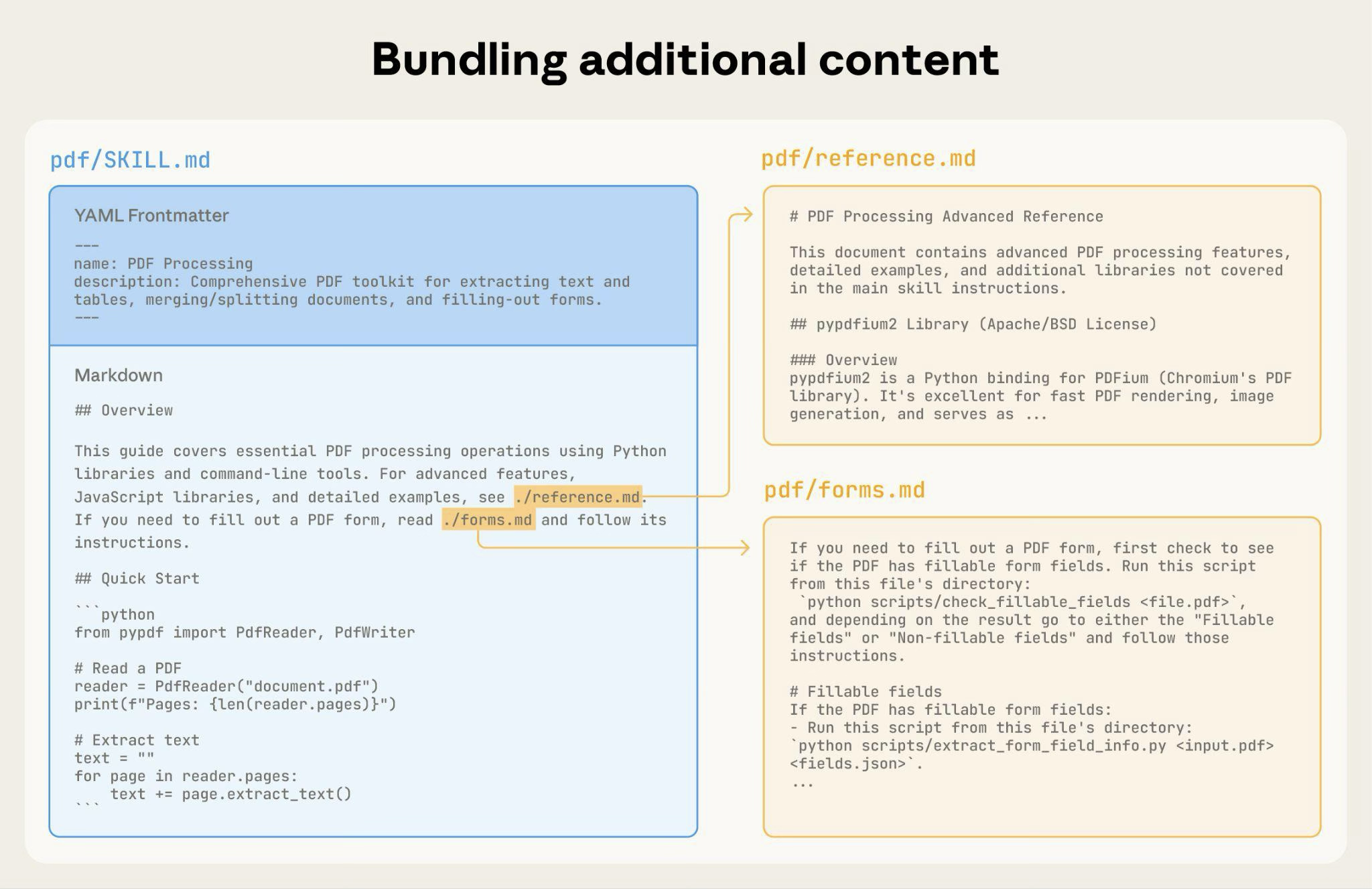
271<Frame>
272 
273</Frame>
270274
271275The complete Skill directory structure might look like this:
272276
from line 941
937941* Save time (no code generation required)
938942* Ensure consistency across uses
939943
940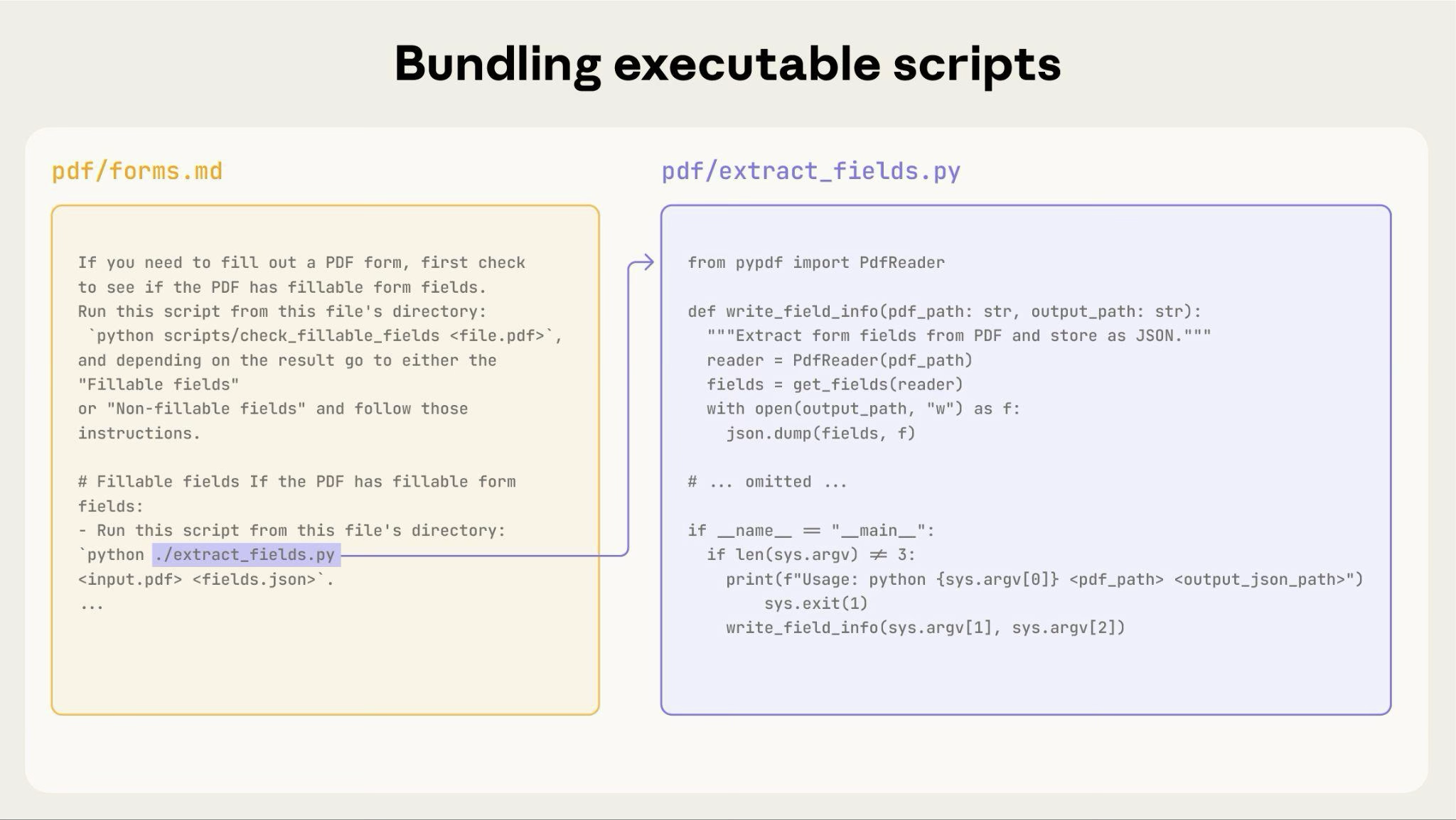
944<Frame>
945 
946</Frame>
941947
942948The preceding diagram shows how executable scripts work alongside instruction files. The instruction file (forms.md) references the script, and Claude can execute it without loading its contents into context.
943949
agents-and-tools/agent-skills/overview Changed · +6 / -2 lines
from line 113
113113
114114Skills run in a code execution environment where Claude has filesystem access, bash commands, and code execution capabilities. Skills exist as directories on a virtual machine, and Claude interacts with them using the same bash commands you'd use to navigate files on your computer.
115115
116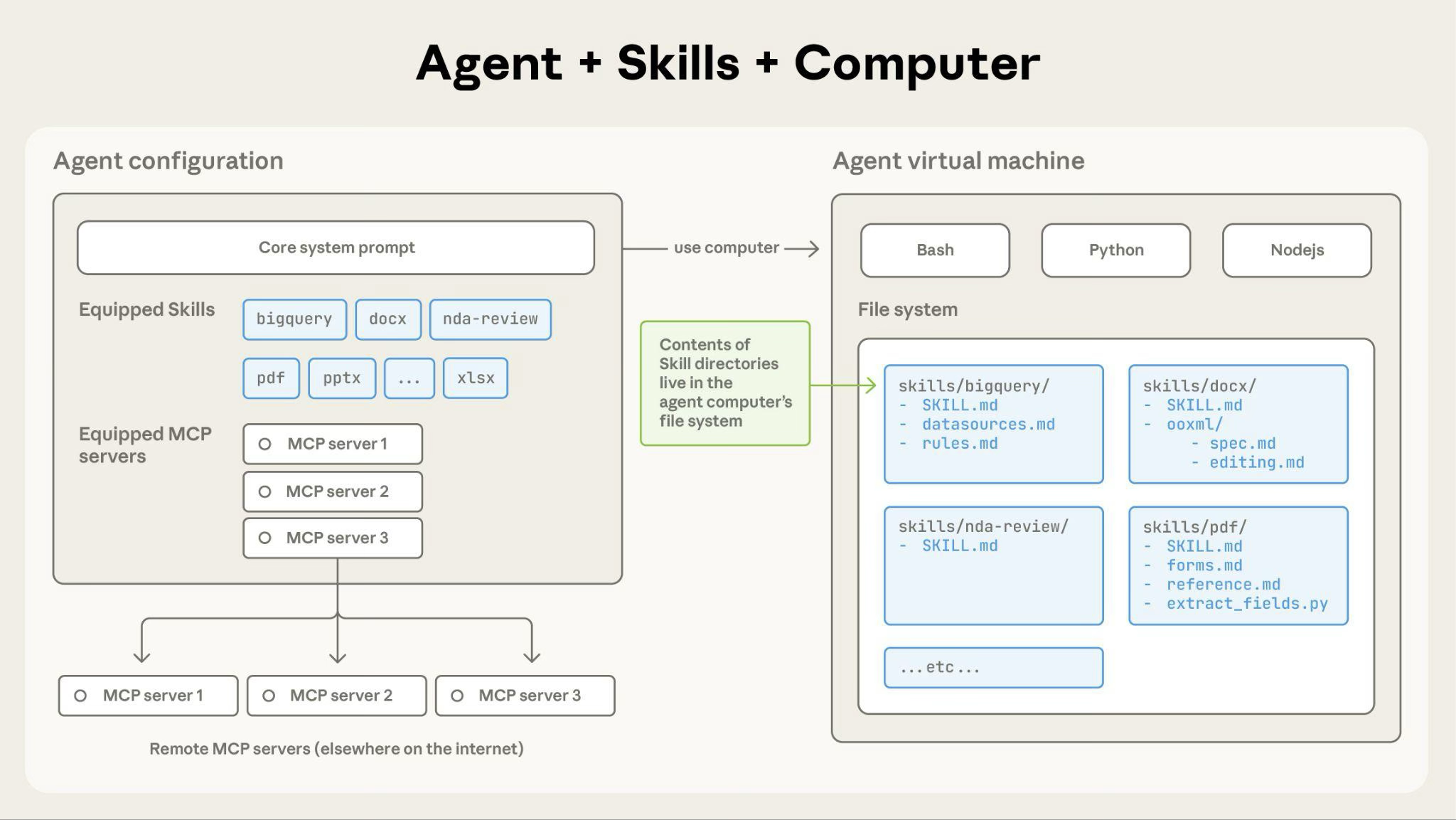
116<Frame>
117 
118</Frame>
117119
118120**How Claude accesses Skill content:**
119121
from line 137
1351374. **Claude determines:** Form filling is not needed, so FORMS.md is not read
1361385. **Claude executes:** Uses instructions from SKILL.md to complete the task
137139
138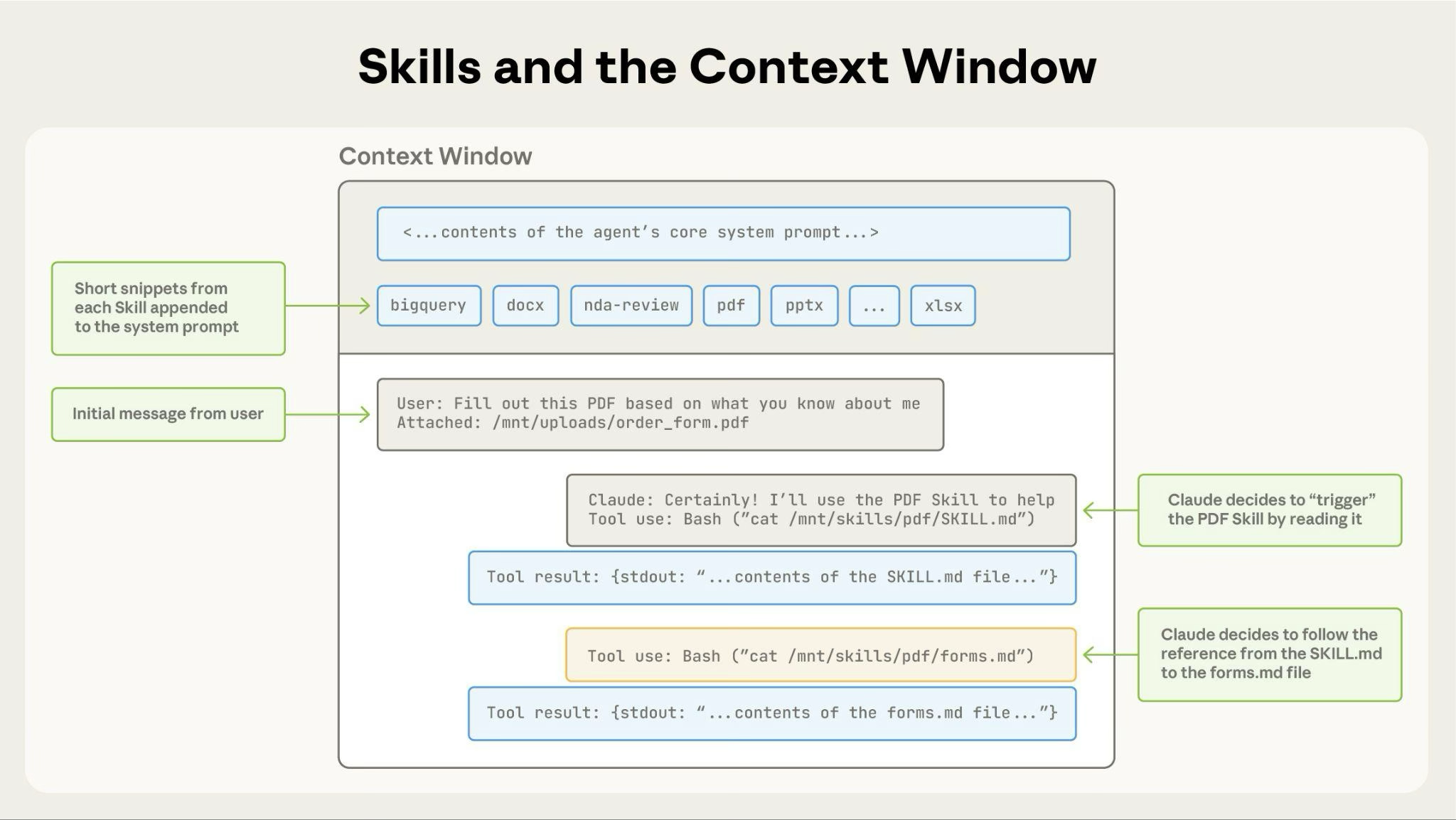
140<Frame>
141 
142</Frame>
139143
140144## Where Skills work
141145
agents-and-tools/mcp-connector Changed · +4 / -4 lines
from line 1236
12361236 <Tabs>
12371237 <Tab title="Gradle">
12381238 ```kotlin
1239 implementation("com.anthropic:anthropic-java:2.68.0")
1240 implementation("com.anthropic:anthropic-java-mcp:2.68.0")
1239 implementation("com.anthropic:anthropic-java:2.69.0")
1240 implementation("com.anthropic:anthropic-java-mcp:2.69.0")
12411241 ```
12421242 </Tab>
12431243
from line 1246
12461246 <dependency>
12471247 <groupId>com.anthropic</groupId>
12481248 <artifactId>anthropic-java</artifactId>
1249 <version>2.68.0</version>
1249 <version>2.69.0</version>
12501250 </dependency>
12511251 <dependency>
12521252 <groupId>com.anthropic</groupId>
12531253 <artifactId>anthropic-java-mcp</artifactId>
1254 <version>2.68.0</version>
1254 <version>2.69.0</version>
12551255 </dependency>
12561256 ```
12571257 </Tab>
agents-and-tools/tool-use/advisor-tool Changed · +18 / -17 lines
from line 343
343343| `advisor_redacted_result` | `encrypted_content`, `stop_reason` | The advisor model returns encrypted output. |
344344
345345<Note>
346 Claude Sonnet 5.5, Claude Fable 5.1, Claude Mythos 5.1, Claude Opus 5.5, Claude Opus 5, Claude Fable 5, and Claude Mythos 5 advisors return the encrypted `advisor_redacted_result`. Every other advisor model in the [compatibility table](https://platform.claude.com/docs/en/agents-and-tools/tool-use/advisor-tool#model-compatibility) returns the plaintext `advisor_result`. To read the advice text in your own responses, use an advisor that returns plaintext, such as `claude-opus-4-8`, where your executor's row in the [compatibility table](https://platform.claude.com/docs/en/agents-and-tools/tool-use/advisor-tool#model-compatibility) lists one. Claude Sonnet 5.5, Claude Fable 5.1, Claude Mythos 5.1, Claude Opus 5.5, Claude Opus 5, Claude Fable 5, and Claude Mythos 5 executors pair only with advisors that return the encrypted form, so on those executors the advice text isn't readable in the response.
346 Claude Sonnet 5.5, Claude Fable 5.1, Claude Mythos 5.1, Claude Opus 5.5, Claude Opus 5, Claude Fable 5, Claude Mythos 5, and Claude Haiku 5.5 advisors return the encrypted `advisor_redacted_result`. Every other advisor model in the [compatibility table](https://platform.claude.com/docs/en/agents-and-tools/tool-use/advisor-tool#model-compatibility) returns the plaintext `advisor_result`. To read the advice text in your own responses, use an advisor that returns plaintext, such as `claude-opus-4-8`, where your executor's row in the [compatibility table](https://platform.claude.com/docs/en/agents-and-tools/tool-use/advisor-tool#model-compatibility) lists one. Claude Sonnet 5.5, Claude Fable 5.1, Claude Mythos 5.1, Claude Opus 5.5, Claude Opus 5, Claude Fable 5, and Claude Mythos 5 executors pair only with advisors that return the encrypted form, so on those executors the advice text isn't readable in the response.
347347</Note>
348348
349349Here is the same request sent twice, identical except for the advisor `model` in the tool definition, showing both variants.
from line 1401
14011401**Keep it consistent:** Set `caching` once and leave it for the whole conversation. Toggling it off and on mid-conversation causes cache misses.
14021402
14031403<Warning>
1404 [`clear_thinking`](https://platform.claude.com/docs/en/build-with-claude/context-editing) with a `keep` value other than `"all"` shifts the advisor's quoted transcript each turn, causing advisor-side cache misses. This is a cost degradation only. Advice quality is unaffected. When extended thinking is enabled without explicit `clear_thinking` configuration, the API defaults to `keep: {type: "thinking_turns", value: 1}`, which triggers this behavior (the default on earlier Opus/Sonnet models and all Haiku models, whereas on Opus 4.5+ and Sonnet 4.6+ the default is to keep all turns). Set `keep: "all"` to preserve advisor cache stability.
1404 [`clear_thinking`](https://platform.claude.com/docs/en/build-with-claude/context-editing) with a `keep` value other than `"all"` shifts the advisor's quoted transcript each turn, causing advisor-side cache misses. This is a cost degradation only. Advice quality is unaffected. When extended thinking is enabled without explicit `clear_thinking` configuration, the API defaults to `keep: {type: "thinking_turns", value: 1}`, which triggers this behavior (the default on earlier Opus/Sonnet models and Haiku models through Claude Haiku 4.5, whereas on Opus 4.5+, Sonnet 4.6+, and Haiku 5.5 the default is to keep all turns). Set `keep: "all"` to preserve advisor cache stability.
14051405</Warning>
14061406
14071407## Combining with other tools
from line 1809
18091809
18101810The executor model (the top-level `model` field) and the advisor model (the `model` field inside the tool definition) must form a valid pair. The advisor must be Claude Sonnet 4.6 or a more capable model, and it must be at least as capable as the executor. Models of equal capability (for example, Claude Opus 4.7 and Claude Opus 4.8) can advise each other.
18111811
1812| Executor models | Advisor models |
1813| ------------------------------------- | ------------------------------------------------------------------------------------------------------------------------------------------------------------------------------------------------------------------------------------------------------------------------------------------------------------------------------------------------------------------------------------------------------------------------------- |
1814| Claude Haiku 4.5 (claude-haiku-4-5) | Claude Mythos 5.1 (claude-mythos-5-1) Claude Fable 5.1 (claude-fable-5-1) Claude Mythos 5 (claude-mythos-5) Claude Fable 5 (claude-fable-5) Claude Opus 5.5 (claude-opus-5-5) Claude Opus 5 (claude-opus-5) Claude Opus 4.8 (claude-opus-4-8) Claude Opus 4.7 (claude-opus-4-7) Claude Opus 4.6 (claude-opus-4-6) Claude Sonnet 5.5 (claude-sonnet-5-5) Claude Sonnet 5 (claude-sonnet-5) Claude Sonnet 4.6 (claude-sonnet-4-6) |
1815| Claude Sonnet 4.6 (claude-sonnet-4-6) | Claude Mythos 5.1 (claude-mythos-5-1) Claude Fable 5.1 (claude-fable-5-1) Claude Mythos 5 (claude-mythos-5) Claude Fable 5 (claude-fable-5) Claude Opus 5.5 (claude-opus-5-5) Claude Opus 5 (claude-opus-5) Claude Opus 4.8 (claude-opus-4-8) Claude Opus 4.7 (claude-opus-4-7) Claude Opus 4.6 (claude-opus-4-6) Claude Sonnet 5.5 (claude-sonnet-5-5) Claude Sonnet 5 (claude-sonnet-5) Claude Sonnet 4.6 (claude-sonnet-4-6) |
1816| Claude Sonnet 5 (claude-sonnet-5) | Claude Mythos 5.1 (claude-mythos-5-1) Claude Fable 5.1 (claude-fable-5-1) Claude Mythos 5 (claude-mythos-5) Claude Fable 5 (claude-fable-5) Claude Opus 5.5 (claude-opus-5-5) Claude Opus 5 (claude-opus-5) Claude Opus 4.8 (claude-opus-4-8) Claude Opus 4.7 (claude-opus-4-7) Claude Sonnet 5.5 (claude-sonnet-5-5) Claude Sonnet 5 (claude-sonnet-5) |
1817| Claude Sonnet 5.5 (claude-sonnet-5-5) | Claude Mythos 5.1 (claude-mythos-5-1) Claude Fable 5.1 (claude-fable-5-1) Claude Mythos 5 (claude-mythos-5) Claude Fable 5 (claude-fable-5) Claude Opus 5.5 (claude-opus-5-5) Claude Opus 5 (claude-opus-5) Claude Sonnet 5.5 (claude-sonnet-5-5) |
1818| Claude Opus 4.6 (claude-opus-4-6) | Claude Mythos 5.1 (claude-mythos-5-1) Claude Fable 5.1 (claude-fable-5-1) Claude Mythos 5 (claude-mythos-5) Claude Fable 5 (claude-fable-5) Claude Opus 5.5 (claude-opus-5-5) Claude Opus 5 (claude-opus-5) Claude Opus 4.8 (claude-opus-4-8) Claude Opus 4.7 (claude-opus-4-7) Claude Opus 4.6 (claude-opus-4-6) Claude Sonnet 5.5 (claude-sonnet-5-5) Claude Sonnet 5 (claude-sonnet-5) |
1819| Claude Opus 4.7 (claude-opus-4-7) | Claude Mythos 5.1 (claude-mythos-5-1) Claude Fable 5.1 (claude-fable-5-1) Claude Mythos 5 (claude-mythos-5) Claude Fable 5 (claude-fable-5) Claude Opus 5.5 (claude-opus-5-5) Claude Opus 5 (claude-opus-5) Claude Opus 4.8 (claude-opus-4-8) Claude Opus 4.7 (claude-opus-4-7) Claude Sonnet 5.5 (claude-sonnet-5-5) |
1820| Claude Opus 4.8 (claude-opus-4-8) | Claude Mythos 5.1 (claude-mythos-5-1) Claude Fable 5.1 (claude-fable-5-1) Claude Mythos 5 (claude-mythos-5) Claude Fable 5 (claude-fable-5) Claude Opus 5.5 (claude-opus-5-5) Claude Opus 5 (claude-opus-5) Claude Opus 4.8 (claude-opus-4-8) Claude Opus 4.7 (claude-opus-4-7) Claude Sonnet 5.5 (claude-sonnet-5-5) |
1821| Claude Opus 5 (claude-opus-5) | Claude Mythos 5.1 (claude-mythos-5-1) Claude Fable 5.1 (claude-fable-5-1) Claude Mythos 5 (claude-mythos-5) Claude Fable 5 (claude-fable-5) Claude Opus 5.5 (claude-opus-5-5) Claude Opus 5 (claude-opus-5) |
1822| Claude Opus 5.5 (claude-opus-5-5) | Claude Mythos 5.1 (claude-mythos-5-1) Claude Fable 5.1 (claude-fable-5-1) Claude Mythos 5 (claude-mythos-5) Claude Fable 5 (claude-fable-5) Claude Opus 5.5 (claude-opus-5-5) Claude Opus 5 (claude-opus-5) |
1823| Claude Fable 5 (claude-fable-5) | Claude Mythos 5.1 (claude-mythos-5-1) Claude Fable 5.1 (claude-fable-5-1) Claude Mythos 5 (claude-mythos-5) Claude Fable 5 (claude-fable-5) Claude Opus 5.5 (claude-opus-5-5) Claude Opus 5 (claude-opus-5) |
1824| Claude Mythos 5 (claude-mythos-5) | Claude Mythos 5.1 (claude-mythos-5-1) Claude Fable 5.1 (claude-fable-5-1) Claude Mythos 5 (claude-mythos-5) Claude Fable 5 (claude-fable-5) Claude Opus 5.5 (claude-opus-5-5) Claude Opus 5 (claude-opus-5) |
1825| Claude Fable 5.1 (claude-fable-5-1) | Claude Mythos 5.1 (claude-mythos-5-1) Claude Fable 5.1 (claude-fable-5-1) |
1826| Claude Mythos 5.1 (claude-mythos-5-1) | Claude Mythos 5.1 (claude-mythos-5-1) Claude Fable 5.1 (claude-fable-5-1) |
1812| Executor models | Advisor models |
1813| ------------------------------------- | ------------------------------------------------------------------------------------------------------------------------------------------------------------------------------------------------------------------------------------------------------------------------------------------------------------------------------------------------------------------------------------------------------------------------------------------------------------------- |
1814| Claude Haiku 4.5 (claude-haiku-4-5) | Claude Mythos 5.1 (claude-mythos-5-1) Claude Fable 5.1 (claude-fable-5-1) Claude Mythos 5 (claude-mythos-5) Claude Fable 5 (claude-fable-5) Claude Opus 5.5 (claude-opus-5-5) Claude Opus 5 (claude-opus-5) Claude Opus 4.8 (claude-opus-4-8) Claude Opus 4.7 (claude-opus-4-7) Claude Opus 4.6 (claude-opus-4-6) Claude Sonnet 5.5 (claude-sonnet-5-5) Claude Sonnet 5 (claude-sonnet-5) Claude Sonnet 4.6 (claude-sonnet-4-6) Claude Haiku 5.5 (claude-haiku-5-5) |
1815| Claude Haiku 5.5 (claude-haiku-5-5) | Claude Mythos 5.1 (claude-mythos-5-1) Claude Fable 5.1 (claude-fable-5-1) Claude Mythos 5 (claude-mythos-5) Claude Fable 5 (claude-fable-5) Claude Opus 5.5 (claude-opus-5-5) Claude Opus 5 (claude-opus-5) Claude Opus 4.8 (claude-opus-4-8) Claude Opus 4.7 (claude-opus-4-7) Claude Sonnet 5.5 (claude-sonnet-5-5) Claude Sonnet 5 (claude-sonnet-5) Claude Haiku 5.5 (claude-haiku-5-5) |
1816| Claude Sonnet 4.6 (claude-sonnet-4-6) | Claude Mythos 5.1 (claude-mythos-5-1) Claude Fable 5.1 (claude-fable-5-1) Claude Mythos 5 (claude-mythos-5) Claude Fable 5 (claude-fable-5) Claude Opus 5.5 (claude-opus-5-5) Claude Opus 5 (claude-opus-5) Claude Opus 4.8 (claude-opus-4-8) Claude Opus 4.7 (claude-opus-4-7) Claude Opus 4.6 (claude-opus-4-6) Claude Sonnet 5.5 (claude-sonnet-5-5) Claude Sonnet 5 (claude-sonnet-5) Claude Sonnet 4.6 (claude-sonnet-4-6) Claude Haiku 5.5 (claude-haiku-5-5) |
1817| Claude Sonnet 5 (claude-sonnet-5) | Claude Mythos 5.1 (claude-mythos-5-1) Claude Fable 5.1 (claude-fable-5-1) Claude Mythos 5 (claude-mythos-5) Claude Fable 5 (claude-fable-5) Claude Opus 5.5 (claude-opus-5-5) Claude Opus 5 (claude-opus-5) Claude Opus 4.8 (claude-opus-4-8) Claude Opus 4.7 (claude-opus-4-7) Claude Sonnet 5.5 (claude-sonnet-5-5) Claude Sonnet 5 (claude-sonnet-5) Claude Haiku 5.5 (claude-haiku-5-5) |
1818| Claude Sonnet 5.5 (claude-sonnet-5-5) | Claude Mythos 5.1 (claude-mythos-5-1) Claude Fable 5.1 (claude-fable-5-1) Claude Mythos 5 (claude-mythos-5) Claude Fable 5 (claude-fable-5) Claude Opus 5.5 (claude-opus-5-5) Claude Opus 5 (claude-opus-5) Claude Sonnet 5.5 (claude-sonnet-5-5) |
1819| Claude Opus 4.6 (claude-opus-4-6) | Claude Mythos 5.1 (claude-mythos-5-1) Claude Fable 5.1 (claude-fable-5-1) Claude Mythos 5 (claude-mythos-5) Claude Fable 5 (claude-fable-5) Claude Opus 5.5 (claude-opus-5-5) Claude Opus 5 (claude-opus-5) Claude Opus 4.8 (claude-opus-4-8) Claude Opus 4.7 (claude-opus-4-7) Claude Opus 4.6 (claude-opus-4-6) Claude Sonnet 5.5 (claude-sonnet-5-5) Claude Sonnet 5 (claude-sonnet-5) Claude Haiku 5.5 (claude-haiku-5-5) |
1820| Claude Opus 4.7 (claude-opus-4-7) | Claude Mythos 5.1 (claude-mythos-5-1) Claude Fable 5.1 (claude-fable-5-1) Claude Mythos 5 (claude-mythos-5) Claude Fable 5 (claude-fable-5) Claude Opus 5.5 (claude-opus-5-5) Claude Opus 5 (claude-opus-5) Claude Opus 4.8 (claude-opus-4-8) Claude Opus 4.7 (claude-opus-4-7) Claude Sonnet 5.5 (claude-sonnet-5-5) |
1821| Claude Opus 4.8 (claude-opus-4-8) | Claude Mythos 5.1 (claude-mythos-5-1) Claude Fable 5.1 (claude-fable-5-1) Claude Mythos 5 (claude-mythos-5) Claude Fable 5 (claude-fable-5) Claude Opus 5.5 (claude-opus-5-5) Claude Opus 5 (claude-opus-5) Claude Opus 4.8 (claude-opus-4-8) Claude Opus 4.7 (claude-opus-4-7) Claude Sonnet 5.5 (claude-sonnet-5-5) |
1822| Claude Opus 5 (claude-opus-5) | Claude Mythos 5.1 (claude-mythos-5-1) Claude Fable 5.1 (claude-fable-5-1) Claude Mythos 5 (claude-mythos-5) Claude Fable 5 (claude-fable-5) Claude Opus 5.5 (claude-opus-5-5) Claude Opus 5 (claude-opus-5) |
1823| Claude Opus 5.5 (claude-opus-5-5) | Claude Mythos 5.1 (claude-mythos-5-1) Claude Fable 5.1 (claude-fable-5-1) Claude Mythos 5 (claude-mythos-5) Claude Fable 5 (claude-fable-5) Claude Opus 5.5 (claude-opus-5-5) Claude Opus 5 (claude-opus-5) |
1824| Claude Fable 5 (claude-fable-5) | Claude Mythos 5.1 (claude-mythos-5-1) Claude Fable 5.1 (claude-fable-5-1) Claude Mythos 5 (claude-mythos-5) Claude Fable 5 (claude-fable-5) Claude Opus 5.5 (claude-opus-5-5) Claude Opus 5 (claude-opus-5) |
1825| Claude Mythos 5 (claude-mythos-5) | Claude Mythos 5.1 (claude-mythos-5-1) Claude Fable 5.1 (claude-fable-5-1) Claude Mythos 5 (claude-mythos-5) Claude Fable 5 (claude-fable-5) Claude Opus 5.5 (claude-opus-5-5) Claude Opus 5 (claude-opus-5) |
1826| Claude Fable 5.1 (claude-fable-5-1) | Claude Mythos 5.1 (claude-mythos-5-1) Claude Fable 5.1 (claude-fable-5-1) |
1827| Claude Mythos 5.1 (claude-mythos-5-1) | Claude Mythos 5.1 (claude-mythos-5-1) Claude Fable 5.1 (claude-fable-5-1) |
18271828
18281829If you request an invalid pair, the API returns a `400 invalid_request_error` naming the unsupported combination.
18291830
agents-and-tools/tool-use/browser-use-tool Changed · +8 / -1 lines
from line 17
1717 - claude-sonnet-5-5
1818 - claude-sonnet-5
1919 - claude-opus-4-8
20 - claude-haiku-5-5
2021 supportedPlatforms:
2122 Claude API: ga
2223 Claude Platform on AWS: not available
from line 30
2930
3031The tool is an Anthropic-defined [client toolset](https://platform.claude.com/docs/en/agents-and-tools/tool-use/tool-reference#client-toolsets): one `browser_toolset_20260801` entry in `tools` gives Claude 27 member tools by default, such as `navigate`, `read_page`, `left_click`, and `screenshot`, plus four more when you [enable them](https://platform.claude.com/docs/en/agents-and-tools/tool-use/browser-use-tool#enable-optional-member-tools). Your application runs every call against its own browser automation; nothing runs on Anthropic's side. The tool isn't currently available in [Claude Managed Agents](https://platform.claude.com/docs/en/managed-agents/tools).
3132
33The Python and TypeScript SDKs include a class that passes these calls to your browser code, runs the URL and file policies you set, and asks your approval callback. See [Browser and computer use with the SDK toolsets](https://platform.claude.com/docs/en/agents-and-tools/tool-use/browser-use-sdk).
34
3235Choose browser use when the task stays inside webpages and means acting on them, or when pages build their content with JavaScript. When a task needs a whole desktop, use the [computer use tool](https://platform.claude.com/docs/en/agents-and-tools/tool-use/computer-use-tool), which works through screenshots and coordinates alone. For reading pages you can point Claude to, or finding sources on the web, the [web fetch tool](https://platform.claude.com/docs/en/agents-and-tools/tool-use/web-fetch-tool) and [web search tool](https://platform.claude.com/docs/en/agents-and-tools/tool-use/web-search-tool) are lighter. They're [server tools](https://platform.claude.com/docs/en/agents-and-tools/tool-use/server-tools) that the API runs for you, with no browser to operate.
3336
3437With browser use, Claude reads and acts on live webpages, so everything a page supplies is untrusted input and the actions Claude takes can have real effects. See [Security considerations](https://platform.claude.com/docs/en/agents-and-tools/tool-use/browser-use-tool#security-considerations) before you deploy.
from line 1585
15821585
15831586## Next steps
15841587
1585<CardGroup cols={3}>
1588<CardGroup cols={2}>
1589 <Card title="Browser and computer use with the SDK toolsets" icon="code" href="https://platform.claude.com/docs/en/agents-and-tools/tool-use/browser-use-sdk">
1590 Write a browser driver in Python or TypeScript. The SDK runs the loop and the checks you configure.
1591 </Card>
1592
15861593 <Card title="Computer use tool" icon="computer" href="https://platform.claude.com/docs/en/agents-and-tools/tool-use/computer-use-tool">
15871594 Give Claude control of a full desktop when the task leaves the browser; its implementation guidance applies to browser executors too.
15881595 </Card>
agents-and-tools/tool-use/computer-use-tool Changed · +8 / -1 lines
from line 17
1717 - claude-sonnet-5-5
1818 - claude-sonnet-5
1919 - claude-opus-4-8
20 - claude-haiku-5-5
2021 supportedPlatforms:
2122 Claude API: ga
2223 Claude Platform on AWS: beta
from line 35
3435
3536The computer use tool is an Anthropic-defined [client toolset](https://platform.claude.com/docs/en/agents-and-tools/tool-use/tool-reference#client-toolsets): one `{"type": "computer_toolset_20260801"}` entry in `tools` gives Claude 17 member tools such as `screenshot`, `left_click`, `type`, and `zoom`, and your application runs every call in an environment you control. It isn't currently available in [Claude Managed Agents](https://platform.claude.com/docs/en/managed-agents/tools). Claude's calls are `tool_use` blocks whose `name` is the member and which carry `"toolset_name": "computer"`, often several per turn (a [batch action](https://platform.claude.com/docs/en/agents-and-tools/tool-use/computer-use-tool#batch-actions)).
3637
38The Python and TypeScript SDKs include a class that passes these calls to your desktop code and asks your approval callback. See [Browser and computer use with the SDK toolsets](https://platform.claude.com/docs/en/agents-and-tools/tool-use/browser-use-sdk#computer-toolset).
39
3740For tasks that stay inside webpages, the [browser use tool](https://platform.claude.com/docs/en/agents-and-tools/tool-use/browser-use-tool) is the closer fit: its member tools read and act on the page itself, and it doesn't need a full desktop environment.
3841
3942<Note>
from line 1832
18291832
18301833* Place one `cache_control` breakpoint after the system prompt and tool definitions, and up to three more on the last `tool_result` block of each of the most recent turns, advancing them each turn. Within a [batch action](https://platform.claude.com/docs/en/agents-and-tools/tool-use/computer-use-tool#batch-actions), markers on several blocks act as a single breakpoint but each still counts toward the limit of four, so use one per turn.
18311834* Prune old screenshots in *batches*, not one each turn. Dropping a screenshot every turn changes the prefix every turn and invalidates the cache. A reasonable default is to keep the last three screenshots and prune every 25 turns, so the prefix stays byte-identical between prune events; if your screenshots exceed 2000 px on either side, choose an interval that keeps each request at 20 or fewer images.
1832* On Claude Fable 5.1, Claude Opus 5.5, and Claude Sonnet 5.5, avoid pruning on the client: removing an earlier screenshot [invalidates every later thinking block](https://platform.claude.com/docs/en/build-with-claude/thinking#preserved-in-conversation) in every request that still carries those turns. Resize screenshots to 2000 px or less per side instead, and use server-side [tool result clearing](https://platform.claude.com/docs/en/build-with-claude/context-editing#tool-result-clearing) to drop old ones from the context. If you must prune, keep [`prefix_mismatch_behavior: "drop_block"`](https://platform.claude.com/docs/en/build-with-claude/thinking#preserved-thinking-controls) set from then on; after each prune, Claude continues without the thinking produced since the pruned screenshot, on that request and every later one. On Claude Sonnet 5.5, `block_binding` works only with `thinking: {"type": "adaptive"}`. With `between_tools`, keep the history append-only, or strip the thinking blocks from the edited turn on.
1835* On Claude Fable 5.1, Claude Opus 5.5, Claude Sonnet 5.5, and Claude Haiku 5.5, avoid pruning on the client: removing an earlier screenshot [invalidates every later thinking block](https://platform.claude.com/docs/en/build-with-claude/thinking#preserved-in-conversation) in every request that still carries those turns. Resize screenshots to 2000 px or less per side instead, and use server-side [tool result clearing](https://platform.claude.com/docs/en/build-with-claude/context-editing#tool-result-clearing) to drop old ones from the context. If you must prune, keep [`prefix_mismatch_behavior: "drop_block"`](https://platform.claude.com/docs/en/build-with-claude/thinking#preserved-thinking-controls) set from then on; after each prune, Claude continues without the thinking produced since the pruned screenshot, on that request and every later one. On Claude Sonnet 5.5, `block_binding` works only with `thinking: {"type": "adaptive"}`. With `between_tools`, keep the history append-only, or strip the thinking blocks from the edited turn on. On Claude Haiku 5.5, `block_binding` works only with `thinking: {"type": "adaptive"}`; with `thinking: {"type": "disabled"}`, keep the history append-only, or strip the thinking blocks from the edited turn on.
18331836
18341837### Diagnose click issues
18351838
from line 2228
22252228## Next steps
22262229
22272230<CardGroup cols={2}>
2231 <Card title="Browser and computer use with the SDK toolsets" icon="code" href="https://platform.claude.com/docs/en/agents-and-tools/tool-use/browser-use-sdk#computer-toolset">
2232 Write a desktop driver in Python or TypeScript. The SDK runs the loop and the approval callback you pass.
2233 </Card>
2234
22282235 <Card title="Troubleshooting tool use" icon="wrench" href="https://platform.claude.com/docs/en/agents-and-tools/tool-use/troubleshooting-tool-use">
22292236 Fix the most common tool-use errors with symptom-to-fix diagnostic tables.
22302237 </Card>
api/errors Changed · +4 / -2 lines
from line 505
505505messages.N: output_config.effort 'low' differs from the 'high' in effect before it; effort cannot change when thinking is disabled on this model. Use effort 'high', or enable thinking.
506506```
507507
508Claude Haiku 5.5 accepts `thinking: {"type": "disabled"}` and holds it to the same two effort limits that apply to `between_tools`: at `xhigh` or `max` effort, or with a per-message `output_config.effort` that differs from the level in effect, the request returns a 400 `invalid_request_error` with the matching message above.
509
508510In both messages, "enable thinking" means adaptive thinking: omit the `thinking` field or send `thinking: {"type": "adaptive"}`. Claude Sonnet 5.5 rejects `"enabled"` with a 400 error. To vary effort per turn, use adaptive thinking.
509511
510512Sending `thinking: {"type": "between_tools"}` to any model other than Claude Sonnet 5.5 returns a 400 `invalid_request_error`:
from line 531
529531
530532### Computer use tool version not supported
531533
532On the Claude API and Google Cloud, Claude Opus 5.5 and Claude Sonnet 5.5 support [computer use](https://platform.claude.com/docs/en/agents-and-tools/tool-use/computer-use-tool) only as the `computer_toolset_20260801` toolset. On those platforms, sending either model a `tools` entry of the earlier `computer_20251124` type (with that tool's beta header) returns a 400 `invalid_request_error`. The message names the rejected type, then lists the tool types the model does accept after `Did you mean one of`. For Claude Opus 5.5, it begins:
534On the Claude API and Google Cloud, Claude Opus 5.5, Claude Sonnet 5.5, and Claude Haiku 5.5 support [computer use](https://platform.claude.com/docs/en/agents-and-tools/tool-use/computer-use-tool) only as the `computer_toolset_20260801` toolset. On those platforms, sending any of these models a `tools` entry of the earlier `computer_20251124` type (with that tool's beta header) returns a 400 `invalid_request_error`. The message names the rejected type, then lists the tool types the model does accept after `Did you mean one of`. For Claude Opus 5.5, it begins:
533535
534536```text wrap
535537'claude-opus-5-5' does not support tool types: computer_20251124.
from line 541
539541
540542### Thinking block no longer matches the conversation
541543
542On Claude Fable 5.1, Claude Opus 5.5, and Claude Sonnet 5.5, the API accepts a replayed thinking block only while the `system` prompt, `tools`, and messages that preceded it are unchanged. For new accounts created on or after August 31, 2026, and for any request that sets `thinking.block_binding.prefix_mismatch_behavior` to `"error"`, a replayed block whose earlier history changed is rejected with a 400 `invalid_request_error` (with `"drop_block"`, the API drops the block and the request succeeds). The message starts with the position of the first failing block:
544On Claude Fable 5.1, Claude Opus 5.5, Claude Sonnet 5.5, and Claude Haiku 5.5, the API accepts a replayed thinking block only while the `system` prompt, `tools`, and messages that preceded it are unchanged. For new accounts created on or after August 31, 2026, and for any request that sets `thinking.block_binding.prefix_mismatch_behavior` to `"error"`, a replayed block whose earlier history changed is rejected with a 400 `invalid_request_error` (with `"drop_block"`, the API drops the block and the request succeeds). The message starts with the position of the first failing block:
543545
544546```text wrap
545547messages.{i}.content.{j}: Invalid `signature` in `thinking` block. The block is bound to a different conversation. Remove the block, or set `thinking.block_binding.prefix_mismatch_behavior` to "drop_block".
build-with-claude/claude-in-amazon-bedrock Changed · +6 / -5 lines
from line 102
102102 <Tabs>
103103 <Tab title="Gradle">
104104 ```kotlin
105 implementation("com.anthropic:anthropic-java:2.68.0")
106 implementation("com.anthropic:anthropic-java-bedrock:2.68.0")
105 implementation("com.anthropic:anthropic-java:2.69.0")
106 implementation("com.anthropic:anthropic-java-bedrock:2.69.0")
107107 ```
108108 </Tab>
109109
from line 112
112112 <dependency>
113113 <groupId>com.anthropic</groupId>
114114 <artifactId>anthropic-java</artifactId>
115 <version>2.68.0</version>
115 <version>2.69.0</version>
116116 </dependency>
117117 <dependency>
118118 <groupId>com.anthropic</groupId>
119119 <artifactId>anthropic-java-bedrock</artifactId>
120 <version>2.68.0</version>
120 <version>2.69.0</version>
121121 </dependency>
122122 ```
123123 </Tab>
from line 345
345345| Claude Opus 4.7 | `anthropic.claude-opus-4-7` | Open |
346346| Claude Sonnet 5.5 | `anthropic.claude-sonnet-5-5` | [See Access](https://platform.claude.com/docs/en/build-with-claude/claude-in-amazon-bedrock#access) |
347347| Claude Sonnet 5 | `anthropic.claude-sonnet-5` | Open |
348| Claude Haiku 5.5 | `anthropic.claude-haiku-5-5` | [See Access](https://platform.claude.com/docs/en/build-with-claude/claude-in-amazon-bedrock#access) |
348349| Claude Haiku 4.5 | `anthropic.claude-haiku-4-5` | Open |
349350
350351Use Claude Code 2.1.255 or later with Claude Fable 5.1 on Amazon Bedrock, and 2.1.280 or later with Claude Opus 5.5; run `claude update` to upgrade.
from line 384
383384* **Global:** dynamic routing across all available regions for maximum availability. No pricing premium.
384385* **Regional:** the endpoint resolves to the single AWS region you specify, for data-residency requirements. Regional endpoints carry a 10% pricing premium over global endpoints. To route across multiple regions within a geography, use an [inference profile](https://docs.aws.amazon.com/bedrock/latest/userguide/cross-region-inference.html) (US, EU, JP, or AU). Regions marked **In-region only** in the table support direct single-region routing without an inference profile.
385386
386The global endpoint is available for Claude Fable 5.1, Claude Fable 5, Claude Opus 5.5, Claude Opus 5, Claude Opus 4.8, Claude Opus 4.7, Claude Sonnet 5.5, Claude Sonnet 5, and Claude Haiku 4.5. For Claude Fable 5.1, regional endpoints are currently available in `us-east-1` only. Claude Mythos Preview is regional only and is available in `us-east-1`.
387The global endpoint is available for Claude Fable 5.1, Claude Fable 5, Claude Opus 5.5, Claude Opus 5, Claude Opus 4.8, Claude Opus 4.7, Claude Sonnet 5.5, Claude Sonnet 5, Claude Haiku 5.5, and Claude Haiku 4.5. For Claude Fable 5.1, regional endpoints are currently available in `us-east-1` only. Claude Mythos Preview is regional only and is available in `us-east-1`.
387388
388389| AWS region | Location | Endpoint types |
389390| ---------------- | ------------------------- | -------------------------- |
build-with-claude/claude-in-microsoft-foundry Changed · +7 / -6 lines
from line 4
44description: Access Claude models through Microsoft Foundry with Azure-native endpoints and authentication.
55---
66
7This guide shows you how to set up and make API calls to Claude in Microsoft Foundry using one of Anthropic's client SDKs or direct HTTP requests. When you access Claude in Microsoft Foundry, you are billed for Claude usage in the Azure Marketplace. You can use Claude models including Claude Fable 5.1, Claude Opus 5.5, Claude Opus 5, Claude Opus 4.8, Claude Sonnet 5.5, and Claude Sonnet 5, and features such as the [1M-token context window](https://platform.claude.com/docs/en/build-with-claude/context-windows), while managing costs through your Azure subscription.
7This guide shows you how to set up and make API calls to Claude in Microsoft Foundry using one of Anthropic's client SDKs or direct HTTP requests. When you access Claude in Microsoft Foundry, you are billed for Claude usage in the Azure Marketplace. You can use Claude models including Claude Fable 5.1, Claude Opus 5.5, Claude Opus 5, Claude Opus 4.8, Claude Sonnet 5.5, Claude Sonnet 5, and Claude Haiku 5.5, and features such as the [1M-token context window](https://platform.claude.com/docs/en/build-with-claude/context-windows), while managing costs through your Azure subscription.
88
99Claude is available in Global Standard and US Data Zone Standard deployment types in Foundry resources, billed in Claude Consumption Units through the Azure Marketplace. Visit [Claude in Microsoft Foundry pricing](https://platform.claude.com/docs/en/about-claude/pricing#claude-in-microsoft-foundry-pricing) for details.
1010
from line 80
8080 <Tabs>
8181 <Tab title="Gradle">
8282 ```kotlin
83 implementation("com.anthropic:anthropic-java:2.68.0")
84 implementation("com.anthropic:anthropic-java-foundry:2.68.0")
83 implementation("com.anthropic:anthropic-java:2.69.0")
84 implementation("com.anthropic:anthropic-java-foundry:2.69.0")
8585
8686 // For Entra ID authentication, also add the Azure Identity library
8787 implementation("com.azure:azure-identity:1.18.3")
from line 93
9393 <dependency>
9494 <groupId>com.anthropic</groupId>
9595 <artifactId>anthropic-java</artifactId>
96 <version>2.68.0</version>
96 <version>2.69.0</version>
9797 </dependency>
9898 <dependency>
9999 <groupId>com.anthropic</groupId>
100100 <artifactId>anthropic-java-foundry</artifactId>
101 <version>2.68.0</version>
101 <version>2.69.0</version>
102102 </dependency>
103103 <!-- For Entra ID authentication, also add the Azure Identity library -->
104104 <dependency>
from line 642
642642
643643### Context window
644644
645Claude Fable 5.1, Claude Fable 5, Claude Opus 5.5, Claude Opus 5, Claude Opus 4.8, Claude Opus 4.7, Claude Opus 4.6, Claude Sonnet 5.5, Claude Sonnet 5, and Claude Sonnet 4.6 have a [1M-token context window](https://platform.claude.com/docs/en/build-with-claude/context-windows) on Microsoft Foundry. Other Claude models, including Claude Sonnet 4.5 (deprecated), have a 200k-token context window.
645Claude Fable 5.1, Claude Fable 5, Claude Opus 5.5, Claude Opus 5, Claude Opus 4.8, Claude Opus 4.7, Claude Opus 4.6, Claude Sonnet 5.5, Claude Sonnet 5, Claude Sonnet 4.6, and Claude Haiku 5.5 have a [1M-token context window](https://platform.claude.com/docs/en/build-with-claude/context-windows) on Microsoft Foundry. Other Claude models, including Claude Sonnet 4.5 (deprecated), have a 200k-token context window.
646646
647647### Claude features not supported for Claude in Microsoft Foundry
648648
from line 695
695695| Claude Sonnet 5 | `claude-sonnet-5` | ✓ | ✓ |
696696| Claude Sonnet 4.6 | `claude-sonnet-4-6` | | ✓ |
697697| Claude Sonnet 4.5 ([deprecated](https://platform.claude.com/docs/en/about-claude/model-deprecations)) | `claude-sonnet-4-5` | | ✓ |
698| Claude Haiku 5.5 | `claude-haiku-5-5` | ✓ | ✓ |
698699| Claude Haiku 4.5 | `claude-haiku-4-5` | ✓ | ✓ |
699700
700701By default, deployment names match the model IDs shown in the preceding table. However, you can create custom deployments with different names in the Foundry portal to manage different configurations, versions, or rate limits. Use the deployment name (not necessarily the model ID) in your API requests.
build-with-claude/claude-on-amazon-bedrock-legacy Changed · +7 / -7 lines
from line 54
5454 <Tab title="Java">
5555 <CodeGroup>
5656 ```groovy Gradle
57 implementation("com.anthropic:anthropic-java:2.68.0")
58 implementation("com.anthropic:anthropic-java-bedrock:2.68.0")
57 implementation("com.anthropic:anthropic-java:2.69.0")
58 implementation("com.anthropic:anthropic-java-bedrock:2.69.0")
5959 ```
6060
6161 ```xml Maven
from line 62
6262 <dependency>
6363 <groupId>com.anthropic</groupId>
6464 <artifactId>anthropic-java</artifactId>
65 <version>2.68.0</version>
65 <version>2.69.0</version>
6666 </dependency>
6767 <dependency>
6868 <groupId>com.anthropic</groupId>
6969 <artifactId>anthropic-java-bedrock</artifactId>
70 <version>2.68.0</version>
70 <version>2.69.0</version>
7171 </dependency>
7272 ```
7373
from line 131
131131#### API model IDs
132132
133133<Note>
134 Claude Fable 5.1, Claude Fable 5, Claude Opus 5.5, Claude Opus 5, Claude Sonnet 5.5, Claude Sonnet 5, Claude Opus 4.8, and Claude Opus 4.7 are reachable through `InvokeModel` on `bedrock-runtime`. These requests are served by the same infrastructure as the [Claude in Amazon Bedrock](https://platform.claude.com/docs/en/build-with-claude/claude-in-amazon-bedrock) endpoint. For the native Messages API request shape and full feature parity, use that page. These models are omitted from the model table on this page because they do not have ARN-versioned model IDs.
134 Claude Fable 5.1, Claude Fable 5, Claude Opus 5.5, Claude Opus 5, Claude Sonnet 5.5, Claude Sonnet 5, Claude Haiku 5.5, Claude Opus 4.8, and Claude Opus 4.7 are reachable through `InvokeModel` on `bedrock-runtime`. These requests are served by the same infrastructure as the [Claude in Amazon Bedrock](https://platform.claude.com/docs/en/build-with-claude/claude-in-amazon-bedrock) endpoint. For the native Messages API request shape and full feature parity, use that page. These models are omitted from the model table on this page because they do not have ARN-versioned model IDs.
135135</Note>
136136
137137Lifecycle terms (Deprecated, Retired) are defined in [Model deprecations](https://platform.claude.com/docs/en/about-claude/model-deprecations). Lifecycle dates on partner-operated platforms are set by the partner and can differ from the Claude API schedule. For the current retirement date of any model on Amazon Bedrock, see [Amazon Bedrock's model lifecycle page](https://docs.aws.amazon.com/bedrock/latest/userguide/model-lifecycle.html).
from line 756
756756
757757### Mid-conversation system messages on Bedrock
758758
759[Mid-conversation system messages](https://platform.claude.com/docs/en/build-with-claude/mid-conversation-system-messages) are available through the InvokeModel API for Claude Fable 5.1, Claude Fable 5, Claude Opus 5.5, Claude Opus 5, Claude Opus 4.8, and Claude Sonnet 5.5. As described in the note under [API model IDs](https://platform.claude.com/docs/en/build-with-claude/claude-on-amazon-bedrock-legacy#api-model-ids), these requests are served by the same infrastructure as the [Claude in Amazon Bedrock](https://platform.claude.com/docs/en/build-with-claude/claude-in-amazon-bedrock) endpoint. No beta header is required for mid-conversation system messages. This feature is not available on Claude Sonnet 5. Use the top-level `system` field instead. It is not available for the ARN-versioned models in the model table on this page.
759[Mid-conversation system messages](https://platform.claude.com/docs/en/build-with-claude/mid-conversation-system-messages) are available through the InvokeModel API for Claude Fable 5.1, Claude Fable 5, Claude Opus 5.5, Claude Opus 5, Claude Opus 4.8, Claude Sonnet 5.5, and Claude Haiku 5.5. As described in the note under [API model IDs](https://platform.claude.com/docs/en/build-with-claude/claude-on-amazon-bedrock-legacy#api-model-ids), these requests are served by the same infrastructure as the [Claude in Amazon Bedrock](https://platform.claude.com/docs/en/build-with-claude/claude-in-amazon-bedrock) endpoint. No beta header is required for mid-conversation system messages. This feature is not available on Claude Sonnet 5. Use the top-level `system` field instead. It is not available for the ARN-versioned models in the model table on this page.
760760
761761A `role: "system"` message can also set `output_config.effort` to [change effort mid-conversation](https://platform.claude.com/docs/en/build-with-claude/effort#change-effort-mid-conversation-beta) on Claude Fable 5.1 and Claude Opus 5.5. This is in beta: add `mid-conversation-output-config-2026-07-01` to the `anthropic_beta` array in the request body. Without that value, or on Claude Fable 5, Claude Opus 5, or Claude Opus 4.8, the request returns a 400 error: `messages.N.output_config: Extra inputs are not permitted`. In the error, `N` is the index of the `system` message in `messages`.
762762
from line 764
764764
765765### Context window
766766
767Claude Fable 5.1, Claude Fable 5, Claude Opus 5.5, Claude Opus 5, Claude Opus 4.8, Claude Opus 4.7, Claude Opus 4.6, Claude Sonnet 5.5, Claude Sonnet 5, and Claude Sonnet 4.6 have a [1M-token context window](https://platform.claude.com/docs/en/build-with-claude/context-windows) on Amazon Bedrock. Other Claude models, including Sonnet 4.5 (deprecated) and Sonnet 4 (deprecated), have a 200k-token context window.
767Claude Fable 5.1, Claude Fable 5, Claude Opus 5.5, Claude Opus 5, Claude Opus 4.8, Claude Opus 4.7, Claude Opus 4.6, Claude Sonnet 5.5, Claude Sonnet 5, Claude Sonnet 4.6, and Claude Haiku 5.5 have a [1M-token context window](https://platform.claude.com/docs/en/build-with-claude/context-windows) on Amazon Bedrock. Other Claude models, including Sonnet 4.5 (deprecated) and Sonnet 4 (deprecated), have a 200k-token context window.
768768
769769Bedrock limits request payloads to 20 MB. When sending large documents or many images, you may reach this limit before the token limit.
770770
build-with-claude/claude-on-vertex-ai Changed · +6 / -5 lines
from line 45
4545 <Tab title="Java">
4646 <CodeGroup exclude="shell, python, typescript, csharp, go, php, ruby">
4747 ```groovy Gradle
48 implementation("com.anthropic:anthropic-java:2.68.0")
49 implementation("com.anthropic:anthropic-java-vertex:2.68.0")
48 implementation("com.anthropic:anthropic-java:2.69.0")
49 implementation("com.anthropic:anthropic-java-vertex:2.69.0")
5050 ```
5151
5252 ```xml Maven
from line 53
5353 <dependency>
5454 <groupId>com.anthropic</groupId>
5555 <artifactId>anthropic-java</artifactId>
56 <version>2.68.0</version>
56 <version>2.69.0</version>
5757 </dependency>
5858 <dependency>
5959 <groupId>com.anthropic</groupId>
6060 <artifactId>anthropic-java-vertex</artifactId>
61 <version>2.68.0</version>
61 <version>2.69.0</version>
6262 </dependency>
6363 ```
6464
from line 134
134134| Claude Sonnet 4.6 | `claude-sonnet-4-6` |
135135| Claude Sonnet 4.5 ([deprecated](https://platform.claude.com/docs/en/about-claude/model-deprecations)) | `claude-sonnet-4-5@20250929` |
136136| Claude Sonnet 4 ([deprecated](https://platform.claude.com/docs/en/about-claude/model-deprecations)) | `claude-sonnet-4@20250514` |
137| Claude Haiku 5.5 | `claude-haiku-5-5` |
137138| Claude Haiku 4.5 | `claude-haiku-4-5@20251001` |
138139| Claude Haiku 3.5 ([deprecated](https://platform.claude.com/docs/en/about-claude/model-deprecations)) | `claude-3-5-haiku@20241022` |
139140
from line 370
369370
370371### Context window
371372
372Claude Fable 5.1, Claude Fable 5, Claude Opus 5.5, Claude Opus 5, Claude Opus 4.8, Claude Opus 4.7, Claude Opus 4.6, Claude Sonnet 5.5, Claude Sonnet 5, and Claude Sonnet 4.6 have a [1M-token context window](https://platform.claude.com/docs/en/build-with-claude/context-windows) on Agent Platform. Other Claude models, including Sonnet 4.5 (deprecated) and Sonnet 4 (deprecated), have a 200k-token context window.
373Claude Fable 5.1, Claude Fable 5, Claude Opus 5.5, Claude Opus 5, Claude Opus 4.8, Claude Opus 4.7, Claude Opus 4.6, Claude Sonnet 5.5, Claude Sonnet 5, Claude Sonnet 4.6, and Claude Haiku 5.5 have a [1M-token context window](https://platform.claude.com/docs/en/build-with-claude/context-windows) on Agent Platform. Other Claude models, including Sonnet 4.5 (deprecated) and Sonnet 4 (deprecated), have a 200k-token context window.
373374
374375Agent Platform limits request payloads to 30 MB. When sending large documents or many images, you might reach this limit before the token limit.
375376
build-with-claude/claude-platform-on-aws Changed · +5 / -4 lines
from line 305
305305
306306 <Tab title="Java">
307307 ```kotlin Gradle
308 implementation("com.anthropic:anthropic-java:2.68.0")
309 implementation("com.anthropic:anthropic-java-aws:2.68.0")
308 implementation("com.anthropic:anthropic-java:2.69.0")
309 implementation("com.anthropic:anthropic-java-aws:2.69.0")
310310 ```
311311
312312 ```xml Maven
from line 313
313313 <dependency>
314314 <groupId>com.anthropic</groupId>
315315 <artifactId>anthropic-java</artifactId>
316 <version>2.68.0</version>
316 <version>2.69.0</version>
317317 </dependency>
318318 <dependency>
319319 <groupId>com.anthropic</groupId>
320320 <artifactId>anthropic-java-aws</artifactId>
321 <version>2.68.0</version>
321 <version>2.69.0</version>
322322 </dependency>
323323 ```
324324 </Tab>
from line 358
358358| Claude Sonnet 5 | `claude-sonnet-5` |
359359| Claude Sonnet 4.6 | `claude-sonnet-4-6` |
360360| Claude Sonnet 4.5 ([deprecated](https://platform.claude.com/docs/en/about-claude/model-deprecations)) | `claude-sonnet-4-5` |
361| Claude Haiku 5.5 | `claude-haiku-5-5` |
361362| Claude Haiku 4.5 | `claude-haiku-4-5` |
362363
363364Model IDs are identical to the first-party Claude API. There are no Bedrock-style ARNs or `anthropic.` prefixes.
build-with-claude/compaction-threshold Changed · +3 / -2 lines
from line 22
2222 - claude-sonnet-5-5
2323 - claude-sonnet-5
2424 - claude-sonnet-4-6
25 - claude-haiku-5-5
2526 supportedPlatforms:
2627 Claude API: beta
2728 Claude Platform on AWS: beta
from line 1714
17131714* Keep the original messages in your list and let the API handle removing the compacted content
17141715* Manually drop the compacted messages and only include the compaction block onwards
17151716
1716On Claude Fable 5.1, Claude Mythos 5.1, Claude Opus 5.5, and Claude Sonnet 5.5, thinking blocks from before a `compaction` block aren't carried forward, so the summary is all the model has of that earlier work. If you write your own `instructions`, tell the model what the summary must retain; see [Tell the model what to preserve in compaction summaries](https://platform.claude.com/docs/en/build-with-claude/prompt-engineering/prompting-claude-fable-5-1#tell-the-model-what-to-preserve-in-compaction-summaries).
1717On Claude Fable 5.1, Claude Mythos 5.1, Claude Opus 5.5, Claude Sonnet 5.5, and Claude Haiku 5.5, thinking blocks from before a `compaction` block aren't carried forward, so the summary is all the model has of that earlier work. If you write your own `instructions`, tell the model what the summary must retain; see [Tell the model what to preserve in compaction summaries](https://platform.claude.com/docs/en/build-with-claude/prompt-engineering/prompting-claude-fable-5-1#tell-the-model-what-to-preserve-in-compaction-summaries).
17171718
17181719### Streaming
17191720
from line 2898
28972898 ```
28982899</CodeGroup>
28992900
2900On Claude Fable 5.1, Claude Opus 5.5, and Claude Sonnet 5.5, remove the `thinking` and `redacted_thinking` blocks from any assistant turn you re-insert after the compaction block, or send `thinking.block_binding.prefix_mismatch_behavior: "drop_block"` with the `thinking-binding-controls-2026-08-01` [beta header](https://platform.claude.com/docs/en/api/beta-headers). Those blocks were produced when the full history was present, so they no longer pass the [conversation check](https://platform.claude.com/docs/en/build-with-claude/thinking#preserved-in-conversation). Where the check is enforced, the continuation request is rejected with a 400 error. The preserved text and tool blocks can stay as they are. Letting the API summarize everything, without re-inserting earlier turns, avoids this. On Claude Sonnet 5.5, `block_binding` works only with `thinking: {"type": "adaptive"}`. With `between_tools`, remove the blocks instead.
2901On Claude Fable 5.1, Claude Opus 5.5, Claude Sonnet 5.5, and Claude Haiku 5.5, remove the `thinking` and `redacted_thinking` blocks from any assistant turn you re-insert after the compaction block, or send `thinking.block_binding.prefix_mismatch_behavior: "drop_block"` with the `thinking-binding-controls-2026-08-01` [beta header](https://platform.claude.com/docs/en/api/beta-headers). Those blocks were produced when the full history was present, so they no longer pass the [conversation check](https://platform.claude.com/docs/en/build-with-claude/thinking#preserved-in-conversation). Where the check is enforced, the continuation request is rejected with a 400 error. The preserved text and tool blocks can stay as they are. Letting the API summarize everything, without re-inserting earlier turns, avoids this. On Claude Sonnet 5.5, `block_binding` works only with `thinking: {"type": "adaptive"}`. With `between_tools`, remove the blocks instead. On Claude Haiku 5.5, `block_binding` works only with `thinking: {"type": "adaptive"}`, so with `thinking: {"type": "disabled"}`, remove the blocks instead.
29012902
29022903Here's an example that uses `pause_after_compaction` to preserve the prior exchange and the current user message (three messages total) verbatim instead of summarizing them:
29032904
build-with-claude/context-editing Changed · +5 / -5 lines
from line 50
5050 | ---------------- | --------------------------- | ------------------------------------------ |
5151 | Opus | Claude Opus 4.5 and later | Claude Opus 4.1 and earlier |
5252 | Sonnet | Claude Sonnet 4.6 and later | Claude Sonnet 4.5 (deprecated) and earlier |
53 | Haiku | (none) | All models through Claude Haiku 4.5 |
53 | Haiku | Claude Haiku 5.5 and later | Claude Haiku 4.5 and earlier |
5454 | Fable and Mythos | All models | (none) |
5555
5656 Use this strategy to override the default. If your code runs across multiple model tiers, set `keep` explicitly rather than relying on the per-model default.
from line 62
6262
6363Context editing is applied server-side before the prompt reaches Claude. Your client application maintains the full, unmodified conversation history. You do not need to sync your client state with the edited version. Continue managing your full conversation history locally as you normally would.
6464
65On Claude Fable 5.1, Claude Opus 5.5, and Claude Sonnet 5.5, server-side context management never invalidates thinking blocks. Client-side edits to earlier turns can invalidate the thinking blocks in every later assistant turn. For new accounts created on or after August 31, 2026, a request that replays an invalidated block is rejected unless you opt into dropping it. See [Keeping the prefix unchanged](https://platform.claude.com/docs/en/build-with-claude/preserved-thinking#prefix-check).
65On Claude Fable 5.1, Claude Opus 5.5, Claude Sonnet 5.5, and Claude Haiku 5.5, server-side context management never invalidates thinking blocks. Client-side edits to earlier turns can invalidate the thinking blocks in every later assistant turn. For new accounts created on or after August 31, 2026, a request that replays an invalidated block is rejected unless you opt into dropping it. See [Keeping the prefix unchanged](https://platform.claude.com/docs/en/build-with-claude/preserved-thinking#prefix-check).
6666
6767### Context editing and prompt caching
6868
from line 921
921921
922922The `clear_thinking_20251015` strategy supports the following configuration:
923923
924| Configuration option | Default | Description |
925| -------------------- | -------------- | ------------------------------------------------------------------------------------------------------------------------------------------------------------------------------------------------------------------------------------------------------------------------------------------------------------------------------------- |
926| `keep` | Model-specific | Defines how many recent assistant turns with thinking blocks to preserve. Use `{type: "thinking_turns", value: N}` where N must be > 0 to keep the last N turns, or `"all"` to keep all thinking blocks. Opus 4.5+ and Sonnet 4.6+: all turns. Fable and Mythos models: all turns. Earlier Opus/Sonnet and all Haiku: last turn only. |
924| Configuration option | Default | Description |
925| -------------------- | -------------- | ----------------------------------------------------------------------------------------------------------------------------------------------------------------------------------------------------------------------------------------------------------------------------------------------------------------------------------------------------------------------- |
926| `keep` | Model-specific | Defines how many recent assistant turns with thinking blocks to preserve. Use `{type: "thinking_turns", value: N}` where N must be > 0 to keep the last N turns, or `"all"` to keep all thinking blocks. Opus 4.5+, Sonnet 4.6+, and Haiku 5.5+: all turns. Fable and Mythos models: all turns. Earlier Opus/Sonnet and Haiku through Claude Haiku 4.5: last turn only. |
927927
928928**Example configurations:**
929929
build-with-claude/context-windows Changed · +13 / -7 lines
from line 16
1616
1717The following diagram illustrates the standard context window behavior for API requests1:
1818
19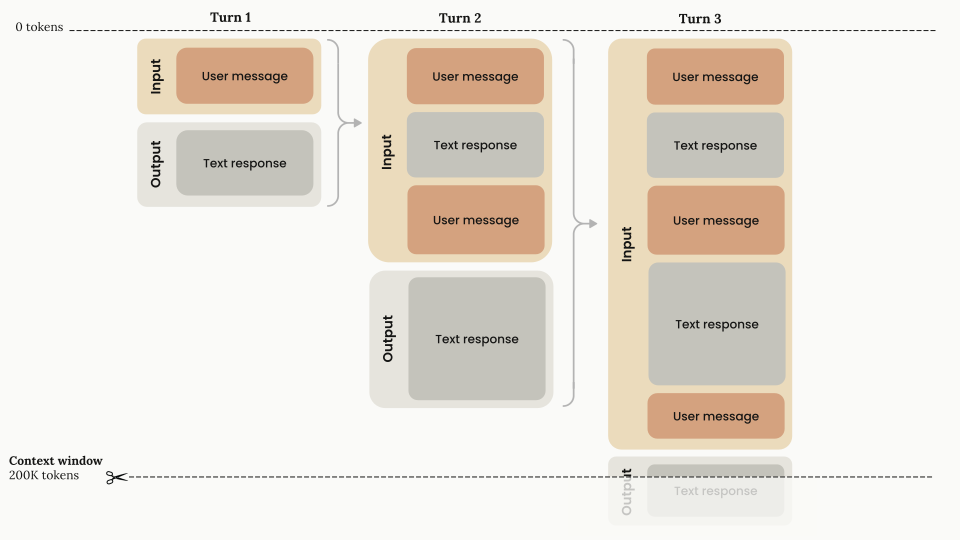
19<Frame>
20 
21</Frame>
2022
2123*1 Chat interfaces such as [claude.ai](https://claude.ai/) can also manage the context window on a rolling "first in, first out" basis.*
2224
from line 35
3335
3436## Context window sizes by model
3537
36Claude Fable 5.1, Claude Mythos 5.1, Claude Fable 5, Claude Mythos 5, Claude Opus 5.5, Claude Opus 5, Claude Opus 4.8, Claude Opus 4.7, Claude Opus 4.6, Claude Sonnet 5.5, Claude Sonnet 5, Claude Sonnet 4.6, and [Claude Mythos Preview](https://anthropic.com/glasswing) have a 1M-token context window. A single request to any of them can generate up to 128k output tokens (`max_tokens`). Other Claude models, including Claude Sonnet 4.5 (deprecated), have a 200k-token context window.
38Claude Fable 5.1, Claude Mythos 5.1, Claude Fable 5, Claude Mythos 5, Claude Opus 5.5, Claude Opus 5, Claude Opus 4.8, Claude Opus 4.7, Claude Opus 4.6, Claude Sonnet 5.5, Claude Sonnet 5, Claude Sonnet 4.6, Claude Haiku 5.5, and [Claude Mythos Preview](https://anthropic.com/glasswing) have a 1M-token context window. A single request to any of them can generate up to 128k output tokens (`max_tokens`). Other Claude models, including Claude Sonnet 4.5 (deprecated), have a 200k-token context window.
3739
38For every model with a 1M-token context window, 1M is the default: you don't need a beta header, and long-context requests are billed at [standard pricing](https://platform.claude.com/docs/en/about-claude/pricing#long-context-pricing).
40For every model with a 1M-token context window, 1M is the default: you don't need a beta header, and long-context requests are billed at [standard pricing](https://platform.claude.com/docs/en/about-claude/pricing#long-context-pricing), except on Claude Haiku 5.5, where prompts over 100,000 tokens cost more.
3941
4042A single request can include up to 600 images or PDF pages (100 for models with a 200k-token context window). If you send many images or large documents, you might reach [request size limits](https://platform.claude.com/docs/en/api/overview#request-size-limits) before the token limit.
4143
from line 49
4749
4850Thinking tokens are a subset of your `max_tokens` parameter, are billed as output tokens, and count toward rate limits. With [adaptive thinking](https://platform.claude.com/docs/en/build-with-claude/thinking), Claude determines its thinking allocation dynamically, so thinking token usage varies from request to request.
4951
50Whether thinking blocks from previous assistant turns stay in the context window depends on the model. On Claude Opus 4.5 and later Opus models, Claude Sonnet 4.6 and later Sonnet models, Claude Fable 5.1, Claude Mythos 5.1, Claude Fable 5, Claude Mythos 5, and Claude Mythos Preview, the API keeps previous thinking blocks by default, and they count toward the context window like any other input tokens. On earlier Opus and Sonnet models and all Haiku models, the API automatically strips previous thinking blocks from the conversation history when you pass them back, which preserves token capacity for conversation content. For the per-model defaults, see [thinking block preservation by model](https://platform.claude.com/docs/en/build-with-claude/thinking#thinking-block-preservation-by-model). To override the default in either direction, use [thinking block clearing](https://platform.claude.com/docs/en/build-with-claude/context-editing#thinking-block-clearing).
52Whether thinking blocks from previous assistant turns stay in the context window depends on the model. On Claude Opus 4.5 and later Opus models, Claude Sonnet 4.6 and later Sonnet models, Claude Haiku 5.5, Claude Fable 5.1, Claude Mythos 5.1, Claude Fable 5, Claude Mythos 5, and Claude Mythos Preview, the API keeps previous thinking blocks by default, and they count toward the context window like any other input tokens. On earlier Opus and Sonnet models and all Haiku models through Claude Haiku 4.5, the API automatically strips previous thinking blocks from the conversation history when you pass them back, which preserves token capacity for conversation content. For the per-model defaults, see [thinking block preservation by model](https://platform.claude.com/docs/en/build-with-claude/thinking#thinking-block-preservation-by-model). To override the default in either direction, use [thinking block clearing](https://platform.claude.com/docs/en/build-with-claude/context-editing#thinking-block-clearing).
5153
5254The following diagram shows how tokens are managed when thinking is enabled on a model that strips previous thinking blocks:
5355
54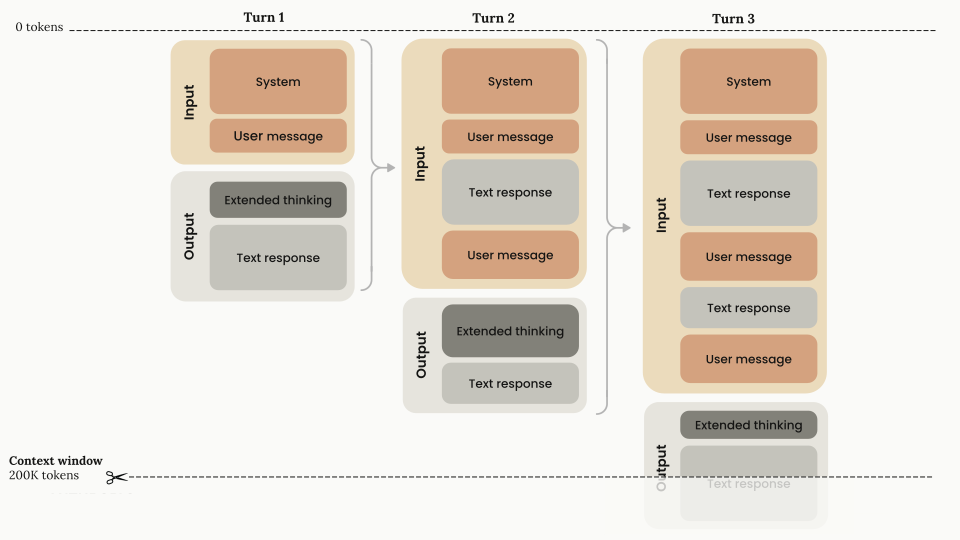
56<Frame>
57 
58</Frame>
5559
5660* **Stripping thinking blocks:** On models that strip previous thinking blocks, thinking blocks (shown in dark gray) are generated during each turn's output phase but are not carried forward as input tokens for subsequent turns. You do not need to strip the thinking blocks yourself: if you pass them back, the Claude API strips them automatically.
5761* **Billing:** Thinking tokens are billed as output tokens once, when they are generated. On models that keep previous thinking blocks, the kept blocks are then part of later requests' input and are billed as input tokens, like the rest of the conversation history.
from line 68
6468
6569The following diagram illustrates how tokens are managed when you combine thinking with tool use on a model that strips previous thinking blocks:
6670
67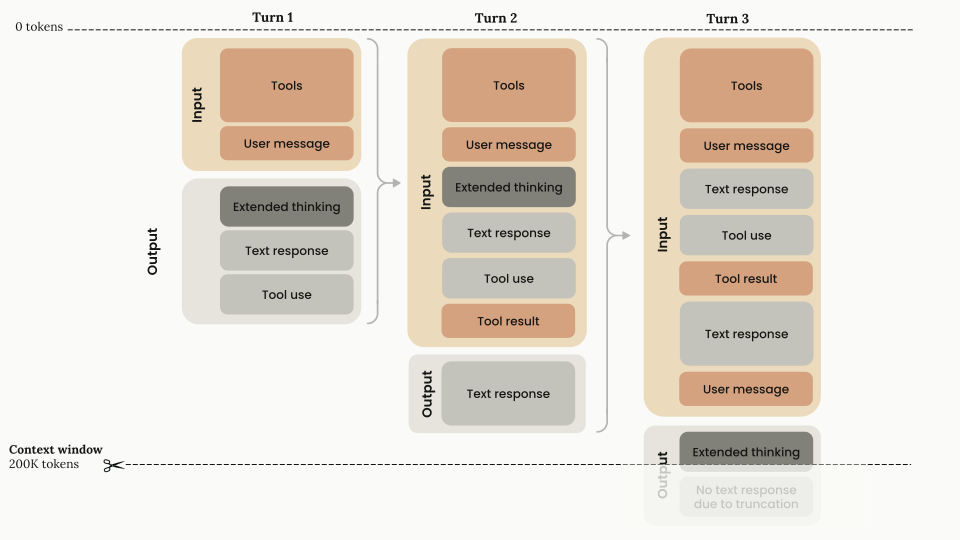
71<Frame>
72 
73</Frame>
6874
6975<Steps>
7076 <Step title="First turn architecture">
from line 127
121127
122128Image tokens are included in these budgets.
123129
124Claude Opus 4.7 and later Opus models, Claude Sonnet 5.5, Claude Fable 5.1, Claude Mythos 5.1, Claude Fable 5, and Claude Mythos 5 don't receive these injected tags. On these models, you can give the model an explicit budget with [task budgets](https://platform.claude.com/docs/en/build-with-claude/task-budgets), which are in beta.
130Claude Opus 4.7 and later Opus models, Claude Sonnet 5.5, Claude Fable 5.1, Claude Mythos 5.1, Claude Fable 5, Claude Mythos 5, and Claude Haiku 5.5 don't receive these injected tags. On these models, you can give the model an explicit budget with [task budgets](https://platform.claude.com/docs/en/build-with-claude/task-budgets), which are in beta.
125131
126132<Tip>
127133 For agents that span multiple sessions, design your state artifacts so that context recovery is fast when a new session starts. The [memory tool's multisession pattern](https://platform.claude.com/docs/en/agents-and-tools/tool-use/memory-tool#multisession-software-development-pattern) walks through a concrete approach. See also [Effective harnesses for long-running agents](https://www.anthropic.com/engineering/effective-harnesses-for-long-running-agents).
build-with-claude/effort Changed · +23 / -14 lines
### Recommended effort levels for Claude Haiku 5.5
from line 22
2222 - claude-sonnet-5-5
2323 - claude-sonnet-5
2424 - claude-sonnet-4-6
25 - claude-haiku-5-5
2526 supportedPlatforms:
2627 Claude API: ga
2728 Claude Platform on AWS: ga
from line 222
221222
222223## How effort works
223224
224Most Claude models default to high effort, spending as many tokens as needed for excellent results; Claude Opus 5.5 defaults to medium. You can raise the effort level to `max` for the absolute highest capability, or lower it to be more conservative with token usage, optimizing for speed and cost while accepting some reduction in capability.
225Most Claude models default to high effort, spending as many tokens as needed for excellent results; Claude Opus 5.5 and Claude Haiku 5.5 default to medium. You can raise the effort level to `max` for the absolute highest capability, or lower it to be more conservative with token usage, optimizing for speed and cost while accepting some reduction in capability.
225226
226227<Tip>
227 Setting `effort` to the model's default (`"medium"` on Claude Opus 5.5, `"high"` on other models) produces exactly the same behavior as omitting the `effort` parameter entirely.
228 Setting `effort` to the model's default (`"medium"` on Claude Opus 5.5 and Claude Haiku 5.5, `"high"` on other models) produces exactly the same behavior as omitting the `effort` parameter entirely.
228229</Tip>
229230
230231The effort parameter affects **all tokens** in the response, including:
from line 238
237238
238239### Effort levels
239240
240| Level | Description | Typical use case |
241| -------- | -------------------------------------------------------------------------------------------------------------------------------------------------------------------------------------------------------------------------------------------------------------------------------------------------------------------------- | ------------------------------------------------------------------------------------------ |
242| `max` | Absolute maximum capability with no constraints on token spending. Available on Claude Fable 5.1, Claude Mythos 5.1, Claude Fable 5, Claude Mythos 5, Claude Mythos Preview, Claude Opus 5.5, Claude Opus 5, Claude Opus 4.8, Claude Opus 4.7, Claude Opus 4.6, Claude Sonnet 5.5, Claude Sonnet 5, and Claude Sonnet 4.6. | Tasks requiring the deepest possible reasoning and most thorough analysis |
243| `xhigh` | Extended capability for long-horizon work. Available on Claude Fable 5.1, Claude Mythos 5.1, Claude Fable 5, Claude Mythos 5, Claude Opus 5.5, Claude Opus 5, Claude Opus 4.8, Claude Opus 4.7, Claude Sonnet 5.5, and Claude Sonnet 5. | Long-running agentic and coding tasks (over 30 minutes) with token budgets in the millions |
244| `high` | Spends as many tokens as the task needs for excellent results. The default on every model that supports effort except Claude Opus 5.5. | Complex reasoning, difficult coding problems, agentic tasks |
245| `medium` | Balanced approach with moderate token savings. The default on Claude Opus 5.5. | Agentic tasks that require a balance of speed, cost, and performance |
246| `low` | Most efficient. Significant token savings with some capability reduction. | Simpler tasks that need the best speed and lowest costs, such as subagents |
241| Level | Description | Typical use case |
242| -------- | -------------------------------------------------------------------------------------------------------------------------------------------------------------------------------------------------------------------------------------------------------------------------------------------------------------------------------------------- | ------------------------------------------------------------------------------------------ |
243| `max` | Absolute maximum capability with no constraints on token spending. Available on Claude Fable 5.1, Claude Mythos 5.1, Claude Fable 5, Claude Mythos 5, Claude Mythos Preview, Claude Opus 5.5, Claude Opus 5, Claude Opus 4.8, Claude Opus 4.7, Claude Opus 4.6, Claude Sonnet 5.5, Claude Sonnet 5, Claude Sonnet 4.6, and Claude Haiku 5.5. | Tasks requiring the deepest possible reasoning and most thorough analysis |
244| `xhigh` | Extended capability for long-horizon work. Available on Claude Fable 5.1, Claude Mythos 5.1, Claude Fable 5, Claude Mythos 5, Claude Opus 5.5, Claude Opus 5, Claude Opus 4.8, Claude Opus 4.7, Claude Sonnet 5.5, Claude Sonnet 5, and Claude Haiku 5.5. | Long-running agentic and coding tasks (over 30 minutes) with token budgets in the millions |
245| `high` | Spends as many tokens as the task needs for excellent results. The default on every model that supports effort except Claude Opus 5.5 and Claude Haiku 5.5. | Complex reasoning, difficult coding problems, agentic tasks |
246| `medium` | Balanced approach with moderate token savings. The default on Claude Opus 5.5 and Claude Haiku 5.5. | Agentic tasks that require a balance of speed, cost, and performance |
247| `low` | Most efficient. Significant token savings with some capability reduction. | Simpler tasks that need the best speed and lowest costs, such as subagents |
247248
248249Not every model that supports `max` supports `xhigh`.
249250
from line 337
336337* **High effort:** For complex reasoning and tasks where quality matters more than speed or cost.
337338* **Max effort:** For tasks requiring the absolute highest capability with no constraints on token spending.
338339
340### Recommended effort levels for Claude Haiku 5.5
341
342Claude Haiku 5.5 supports all five effort levels, and `medium` is the default on the Claude API and in Claude Code. Effort is the main control for how much the model thinks, and with it quality, latency, and cost. **Start with `medium`** for most work, including agentic coding. Use `low`, the cheapest and fastest level, for chat, short tool tasks, and simple, high-volume requests. In long agent prompts, the model is more likely to skip a search, stop early, or skip a check at `low`. Use `high` for knowledge work, longer agent tasks, and strict instruction following. Use `xhigh` or `max` only where your evals show a quality gain, and compare them with Claude Sonnet 5.5 on performance, cost, and speed. Thinking is on by default and counts toward `max_tokens`, so leave room for it. See [Prompting Claude Haiku 5.5](https://platform.claude.com/docs/en/build-with-claude/prompt-engineering/prompting-claude-haiku-5-5#use-effort-to-control-thinking).
343
344To get less thinking, lower the effort level. You can also send `thinking: {"type": "disabled"}` at `high` effort or below. At `xhigh` or `max`, it returns a 400 error, so use adaptive thinking there: omit the `thinking` field or send `thinking: {"type": "adaptive"}`.
345
346On the Claude API and Google Cloud, Claude Haiku 5.5 also supports [changing effort mid-conversation](https://platform.claude.com/docs/en/build-with-claude/effort#change-effort-mid-conversation-beta) with a per-message `output_config`, which preserves the prompt cache. With `thinking: {"type": "disabled"}`, effort can't change mid-conversation: a per-message `output_config.effort` that differs from the level in effect returns a 400 error. To vary effort per turn, use adaptive thinking.
347
339348## Effort with tool use
340349
341350When using tools, the effort parameter affects both the explanations around tool calls and the tool calls themselves. Lower effort levels tend to:
from line 373
364373
365374## Change effort mid-conversation
366375
367You can run later turns of a conversation at a different effort level in two ways. On Claude Fable 5.1, Claude Mythos 5.1, Claude Opus 5.5, Claude Opus 5, and Claude Sonnet 5.5, use a per-message effort change, which keeps the prompt cache. On other models, set a new top-level value on the next request, which starts the cache over.
376You can run later turns of a conversation at a different effort level in two ways. On Claude Fable 5.1, Claude Mythos 5.1, Claude Opus 5.5, Claude Opus 5, Claude Sonnet 5.5, and Claude Haiku 5.5, use a per-message effort change, which keeps the prompt cache. On other models, set a new top-level value on the next request, which starts the cache over.
368377
369378### Per-message effort (beta)
370379
371Per-message effort is in beta. On the Claude API and [Google Cloud](https://platform.claude.com/docs/en/build-with-claude/claude-on-vertex-ai), it's available on Claude Fable 5.1, Claude Mythos 5.1, Claude Opus 5.5, Claude Opus 5, and Claude Sonnet 5.5. On [Amazon Bedrock](https://platform.claude.com/docs/en/build-with-claude/claude-in-amazon-bedrock), it's available on Claude Fable 5.1, Claude Mythos 5.1, and Claude Opus 5.5. It requires the [beta header](https://platform.claude.com/docs/en/api/beta-headers) `mid-conversation-output-config-2026-07-01`. With the Amazon Bedrock [InvokeModel API](https://platform.claude.com/docs/en/build-with-claude/claude-on-amazon-bedrock-legacy), it's available on Claude Fable 5.1 and Claude Opus 5.5, and you send that value in the `anthropic_beta` array of the request body instead.
380Per-message effort is in beta. On the Claude API and [Google Cloud](https://platform.claude.com/docs/en/build-with-claude/claude-on-vertex-ai), it's available on Claude Fable 5.1, Claude Mythos 5.1, Claude Opus 5.5, Claude Opus 5, Claude Sonnet 5.5, and Claude Haiku 5.5. On [Amazon Bedrock](https://platform.claude.com/docs/en/build-with-claude/claude-in-amazon-bedrock), it's available on Claude Fable 5.1, Claude Mythos 5.1, and Claude Opus 5.5. It requires the [beta header](https://platform.claude.com/docs/en/api/beta-headers) `mid-conversation-output-config-2026-07-01`. With the Amazon Bedrock [InvokeModel API](https://platform.claude.com/docs/en/build-with-claude/claude-on-amazon-bedrock-legacy), it's available on Claude Fable 5.1 and Claude Opus 5.5, and you send that value in the `anthropic_beta` array of the request body instead.
372381
373Without the beta value, a per-message `output_config` returns a 400 error: `messages.N.output_config: Extra inputs are not permitted`, where `N` is the index of the `system` message in `messages`. With the beta value, models without per-message effort, including Claude Fable 5, return a 400 error: `output_config.effort requires a model that supports per-turn effort; this model does not`. On Amazon Bedrock, those models and Claude Opus 5 return the `Extra inputs are not permitted` error instead. On Claude Sonnet 5.5 with `thinking: {"type": "between_tools"}`, effort can't change mid-conversation: a per-message `output_config.effort` that differs from the level in effect returns a 400 error. To vary effort per turn, use adaptive thinking.
382Without the beta value, a per-message `output_config` returns a 400 error: `messages.N.output_config: Extra inputs are not permitted`, where `N` is the index of the `system` message in `messages`. With the beta value, models without per-message effort, including Claude Fable 5, return a 400 error: `output_config.effort requires a model that supports per-turn effort; this model does not`. On Amazon Bedrock, those models and Claude Opus 5 return the `Extra inputs are not permitted` error instead. On Claude Sonnet 5.5 with `thinking: {"type": "between_tools"}` and on Claude Haiku 5.5 with `thinking: {"type": "disabled"}`, effort can't change mid-conversation: a per-message `output_config.effort` that differs from the level in effect returns a 400 error. To vary effort per turn, use adaptive thinking.
374383
375384Add a `role: "system"` message with empty `content` and the new level in `output_config.effort`. The new level takes effect from the next `user` turn and holds until a later message changes it. Everything before that message is unchanged, so the cached prefix still matches.
376385
from line 662
653662
654663## Best practices
655664
6561. **Set effort explicitly:** The API defaults to `high` (`medium` on Claude Opus 5.5), but the right starting point depends on your model and workload.
6651. **Set effort explicitly:** The API defaults to `high` (`medium` on Claude Opus 5.5 and Claude Haiku 5.5), but the right starting point depends on your model and workload.
6576662. **Use low for speed-sensitive or simple tasks:** When latency matters or tasks are straightforward, low effort can significantly reduce response times and costs.
6586673. **Test your use case:** The impact of effort levels varies by task type. Evaluate performance on your specific use cases before deploying.
6596684. **Consider dynamic effort:** Adjust effort based on task complexity. Simple queries may warrant low effort while agentic coding and complex reasoning benefit from high effort. See the next item before varying it within one conversation.
build-with-claude/mid-conversation-system-messages Changed · +5 / -5 lines
from line 15
1515<Note>
1616 Mid-conversation system messages are available on the Claude API, [Claude in Amazon Bedrock](https://platform.claude.com/docs/en/build-with-claude/claude-in-amazon-bedrock), and [Google Cloud](https://platform.claude.com/docs/en/build-with-claude/claude-on-vertex-ai).
1717
18 This feature is available on Claude Fable 5.1, [Claude Mythos 5.1](https://platform.claude.com/docs/en/models/mythos-5-1/overview), Claude Fable 5, [Claude Mythos 5](https://platform.claude.com/docs/en/models/mythos-5/overview), Claude Opus 5.5, Claude Opus 4.8, Claude Opus 5, and Claude Sonnet 5.5. No beta header is required for mid-conversation system messages. This feature is not available on Claude Sonnet 5. Use the top-level `system` field there instead.
18 This feature is available on Claude Fable 5.1, [Claude Mythos 5.1](https://platform.claude.com/docs/en/models/mythos-5-1/overview), Claude Fable 5, [Claude Mythos 5](https://platform.claude.com/docs/en/models/mythos-5/overview), Claude Opus 5.5, Claude Opus 4.8, Claude Opus 5, Claude Sonnet 5.5, and Claude Haiku 5.5. No beta header is required for mid-conversation system messages. This feature is not available on Claude Sonnet 5. Use the top-level `system` field there instead.
1919
2020 [Mid-conversation tool changes](https://platform.claude.com/docs/en/build-with-claude/mid-conversation-system-messages#mid-conversation-tool-changes) are in beta on the same models. On the Claude API, send the `inline-tools-2026-09-15` beta header, which also covers [defining a tool inside a `tool_addition` block](https://platform.claude.com/docs/en/build-with-claude/mid-conversation-system-messages#define-tools-in-a-message-beta). [Adding an MCP server that way](https://platform.claude.com/docs/en/build-with-claude/mid-conversation-system-messages#add-an-mcp-server-mid-conversation-beta) needs a second beta header, `mcp-client-2026-09-15`, which is available on the Claude API. The `mid-conversation-tool-changes-2026-07-01` header works for changes that name a tool by reference, on the Claude API, Amazon Bedrock, and Google Cloud.
2121
from line 1642
16421642
16431643You can still set the top-level `system` field for instructions that should apply to the entire conversation. Reserve mid-conversation system messages for instructions that only become relevant later, or that you want to add without invalidating the cached prefix.
16441644
1645A `role: "system"` message can also carry `output_config.effort` to change the [effort](https://platform.claude.com/docs/en/build-with-claude/effort) level partway through a conversation. This is in beta on Claude Fable 5.1, Claude Mythos 5.1, Claude Opus 5.5, Claude Opus 5, and Claude Sonnet 5.5 on the Claude API and Google Cloud, and requires the `mid-conversation-output-config-2026-07-01` beta header. On Amazon Bedrock, it's in beta on Claude Fable 5.1, Claude Mythos 5.1, and Claude Opus 5.5, with the same beta value. Claude Opus 5 doesn't support it on Amazon Bedrock. See [Per-message effort](https://platform.claude.com/docs/en/build-with-claude/effort#change-effort-mid-conversation-beta).
1645A `role: "system"` message can also carry `output_config.effort` to change the [effort](https://platform.claude.com/docs/en/build-with-claude/effort) level partway through a conversation. This is in beta on Claude Fable 5.1, Claude Mythos 5.1, Claude Opus 5.5, Claude Opus 5, Claude Sonnet 5.5, and Claude Haiku 5.5 on the Claude API and Google Cloud, and requires the `mid-conversation-output-config-2026-07-01` beta header. On Amazon Bedrock, it's in beta on Claude Fable 5.1, Claude Mythos 5.1, and Claude Opus 5.5, with the same beta value. Claude Opus 5 doesn't support it on Amazon Bedrock. See [Per-message effort](https://platform.claude.com/docs/en/build-with-claude/effort#change-effort-mid-conversation-beta).
16461646
16471647<CodeGroup>
16481648 ```bash cURL
from line 2000
20002000}
20012001```
20022002
2003The main use is a per-turn reminder in a tool loop. Append the reminder after the `tool_result` message each time you want the model to see it, and leave every earlier copy where it is. The model sees only the copies that come after the last user message, so the reminder never piles up. Nothing earlier in `messages` changes, so the [prompt cache](https://platform.claude.com/docs/en/build-with-claude/prompt-caching) keeps matching. On Claude Fable 5.1, Claude Opus 5.5, and Claude Sonnet 5.5 this also keeps later [thinking blocks valid](https://platform.claude.com/docs/en/build-with-claude/thinking#preserved-in-conversation): deleting an earlier reminder would change the conversation before those blocks and fail the conversation check, while a cleared message stays in the array and leaves that conversation unchanged.
2003The main use is a per-turn reminder in a tool loop. Append the reminder after the `tool_result` message each time you want the model to see it, and leave every earlier copy where it is. The model sees only the copies that come after the last user message, so the reminder never piles up. Nothing earlier in `messages` changes, so the [prompt cache](https://platform.claude.com/docs/en/build-with-claude/prompt-caching) keeps matching. On Claude Fable 5.1, Claude Opus 5.5, Claude Sonnet 5.5, and Claude Haiku 5.5 this also keeps later [thinking blocks valid](https://platform.claude.com/docs/en/build-with-claude/thinking#preserved-in-conversation): deleting an earlier reminder would change the conversation before those blocks and fail the conversation check, while a cleared message stays in the array and leaves that conversation unchanged.
20042004
20052005The following request is a later step of an agent loop. `messages[3]` rendered on the earlier request, when it was the last message in the array. Once `messages[5]` (a later user message) exists, `messages[3]` is cleared: the cleared message stays in the array, so the conversation before the thinking block in `messages[4]` is unchanged, but the model no longer sees its text. `messages[6]` and `messages[7]` both render, in order.
20062006
from line 2077
20772077
20782078Rules for turn-scoped messages:
20792079
2080* **Re-send cleared messages verbatim.** A cleared message is still part of the conversation history. Rebuilding it from current state (a fresh token count, a timestamp), dropping it as redundant, or changing its `clear_at` value is an edit to an earlier message. The prompt cache misses from that point, and on Claude Fable 5.1, Claude Opus 5.5, and Claude Sonnet 5.5 every thinking block produced after it fails the [conversation check](https://platform.claude.com/docs/en/build-with-claude/thinking#preserved-in-conversation).
2080* **Re-send cleared messages verbatim.** A cleared message is still part of the conversation history. Rebuilding it from current state (a fresh token count, a timestamp), dropping it as redundant, or changing its `clear_at` value is an edit to an earlier message. The prompt cache misses from that point, and on Claude Fable 5.1, Claude Opus 5.5, Claude Sonnet 5.5, and Claude Haiku 5.5 every thinking block produced after it fails the [conversation check](https://platform.claude.com/docs/en/build-with-claude/thinking#preserved-in-conversation).
20812081* **Text only.** `content` is one or more `text` blocks (or a string). `tool_addition` and `tool_removal` blocks return a 400 error on a turn-scoped message, and so does `output_config`. Use a separate `role: "system"` message without `clear_at` for those.
20822082* **No `cache_control` on its blocks.** A cleared message is never part of a cache key, so a breakpoint on it could never match. Put the breakpoint on the last block of the preceding user turn instead, as the example does. The top-level [automatic caching](https://platform.claude.com/docs/en/build-with-claude/prompt-caching#automatic-caching) field skips turn-scoped messages when it picks a breakpoint. On the request that clears a message, the reusable cached prefix ends at the user turn before it, so only the one assistant turn between that message and the new user message is reprocessed.
20832083* **Placement rules still apply**, cleared or not. A turn-scoped message must follow a `user` turn (or an `assistant` turn ending in a server tool result) and precede an `assistant` turn or end the array, like any mid-conversation system message. One that ends the array always renders. One followed directly by another `user` message is a 400 error, not a cleared message: put all of a tool round's results in one user message and the reminders after it.
from line 2334
23342334* **Append the system message after the breakpoint.** Because it comes after the cached prefix, it does not change the prefix hash and the cache still hits.
23352335* **A mid-conversation system message is itself cacheable.** Once it is in the conversation, it becomes part of the stable history. On the next turn you can move your cache breakpoint past it (or rely on [automatic caching](https://platform.claude.com/docs/en/build-with-claude/prompt-caching#automatic-caching) to do so) and the system message is read from cache like any other turn.
23362336
2337Avoid editing or removing a mid-conversation system message that has already been sent. Like any other change to earlier messages, that invalidates the cache from that point forward. On Claude Fable 5.1, Claude Opus 5.5, and Claude Sonnet 5.5 it also invalidates the [thinking blocks](https://platform.claude.com/docs/en/build-with-claude/thinking#preserved-in-conversation) in every later assistant turn. For guidance that should apply to one turn only, use a [turn-scoped system message](https://platform.claude.com/docs/en/build-with-claude/mid-conversation-system-messages#turn-scoped-system-messages) and leave it in place. If the instruction needs to evolve, append a new system message rather than rewriting the old one. Consecutive system messages are accepted and treated as a single system section, which follows the same placement rule as a whole.
2337Avoid editing or removing a mid-conversation system message that has already been sent. Like any other change to earlier messages, that invalidates the cache from that point forward. On Claude Fable 5.1, Claude Opus 5.5, Claude Sonnet 5.5, and Claude Haiku 5.5 it also invalidates the [thinking blocks](https://platform.claude.com/docs/en/build-with-claude/thinking#preserved-in-conversation) in every later assistant turn. For guidance that should apply to one turn only, use a [turn-scoped system message](https://platform.claude.com/docs/en/build-with-claude/mid-conversation-system-messages#turn-scoped-system-messages) and leave it in place. If the instruction needs to evolve, append a new system message rather than rewriting the old one. Consecutive system messages are accepted and treated as a single system section, which follows the same placement rule as a whole.
23382338
23392339## Limitations
23402340
build-with-claude/preserved-thinking Changed · +18 / -18 lines
from line 9
99* **The model can read the block.** Each model reads its own thinking blocks and those of a fixed set of other models. Claude Fable 5.1 reads blocks from Claude Opus 5 and, on the Claude API, from Claude Opus 5.5; neither Claude Opus 5 nor Claude Opus 5.5 reads blocks from Claude Fable 5.1. If the current model can't read a block, the API drops it from that request without an error. See [Switching models mid-conversation](https://platform.claude.com/docs/en/build-with-claude/preserved-thinking#switching-models).
1010* **Nothing before the thinking block has changed.** The top-level `system` prompt, `tools`, and `messages` before the block are its prefix. If the prefix differs from what you sent when the block was produced, that block and every later thinking block are invalid, and the API rejects the request with a 400 error or drops the invalid blocks, whichever you choose. See [Keeping the prefix unchanged](https://platform.claude.com/docs/en/build-with-claude/preserved-thinking#prefix-check).
1111
12Claude Sonnet 5.5's thinking blocks are also tied to the account that produced them. See [Thinking blocks stay with the account that produced them](https://platform.claude.com/docs/en/build-with-claude/preserved-thinking#account-bound-thinking) for where the API enforces this.
12Thinking blocks from Claude Sonnet 5.5 and Claude Haiku 5.5 are also tied to the account that produced them. See [Thinking blocks stay with the account that produced them](https://platform.claude.com/docs/en/build-with-claude/preserved-thinking#account-bound-thinking) for where the API enforces this.
1313
1414The model check applies to every account. The API enforces the prefix check by default for accounts created on or after August 31, 2026, 00:00 UTC. On older accounts, it enforces the prefix check only on requests that set `thinking.block_binding.prefix_mismatch_behavior`. **Make your integration append-only regardless of your account's age**, so the same code works on every account, including newer accounts enforced by default.
1515
from line 30
3030
3131On an older account, none of these produces an error unless the request sets `prefix_mismatch_behavior`, so a run with no errors on your own key doesn't show whether your code is affected. If people run your tool with their own API keys, those on newer accounts get the 400 error before you do. To see what they see without changing how your requests behave, send the `thinking-binding-controls-2026-08-01` beta header. On an older account, each response then flags blocks that fail the check, and the model still reads them (see [Set the mismatch behavior and read `input_transformations`](https://platform.claude.com/docs/en/build-with-claude/preserved-thinking#preserved-thinking-controls)).
3232
33Also check your integration if it sends Claude Sonnet 5.5 thinking blocks from one account in a request made by a different account. See [Thinking blocks stay with the account that produced them](https://platform.claude.com/docs/en/build-with-claude/preserved-thinking#account-bound-thinking).
33Also check your integration if it sends Claude Sonnet 5.5 or Claude Haiku 5.5 thinking blocks from one account in a request made by a different account. See [Thinking blocks stay with the account that produced them](https://platform.claude.com/docs/en/build-with-claude/preserved-thinking#account-bound-thinking).
3434
3535## Switching models mid-conversation
3636
3737Claude Fable 5.1 and Claude Mythos 5.1 read thinking blocks produced by each other and by earlier Claude models. No earlier model reads thinking blocks from Claude Fable 5.1 or Claude Mythos 5.1.
3838
39Claude Opus 5.5 reads thinking blocks from Claude Opus 5, from earlier Opus, Sonnet, and Haiku models, and, on the Claude API and Google Cloud, from Claude Sonnet 5.5, but not from Claude Fable or Claude Mythos models. On the Claude API, Claude Fable 5.1 and Claude Mythos 5.1 read thinking blocks from Claude Opus 5.5; no other model does. So a conversation that moves from Claude Opus 5 onto Claude Opus 5.5 keeps its reasoning, and so does one that moves from Claude Opus 5.5 up to Claude Fable 5.1 or Claude Mythos 5.1 on the Claude API. One that moves from Claude Fable 5.1 or Claude Mythos 5.1 to Claude Opus 5.5, or from Claude Opus 5.5 to any model other than those two, runs the turns after the switch without the previous model's reasoning. The blocks are dropped, not rejected, as described below.
39Claude Opus 5.5 reads thinking blocks from Claude Opus 5, from earlier Opus, Sonnet, and Haiku models, and, on the Claude API and Google Cloud, from Claude Sonnet 5.5 and Claude Haiku 5.5, but not from Claude Fable or Claude Mythos models. On the Claude API, Claude Fable 5.1 and Claude Mythos 5.1 read thinking blocks from Claude Opus 5.5; no other model does. So a conversation that moves from Claude Opus 5 onto Claude Opus 5.5 keeps its reasoning, and so does one that moves from Claude Opus 5.5 up to Claude Fable 5.1 or Claude Mythos 5.1 on the Claude API. One that moves from Claude Fable 5.1 or Claude Mythos 5.1 to Claude Opus 5.5, or from Claude Opus 5.5 to any model other than those two, runs the turns after the switch without the previous model's reasoning. The blocks are dropped, not rejected, as described later in this section.
4040
41Claude Sonnet 5.5 reads thinking blocks from Claude Sonnet 5, Claude Opus 4.8, Claude Haiku 4.5, and earlier models, but not from Claude Opus 5, Claude Opus 5.5, or any Claude Fable or Claude Mythos model. On the Claude API and Google Cloud, Claude Opus 5.5 reads thinking blocks from Claude Sonnet 5.5; no other model does. So a conversation that moves from Claude Sonnet 5 onto Claude Sonnet 5.5 keeps its reasoning, and so does one that moves from Claude Sonnet 5.5 up to Claude Opus 5.5 on the Claude API and Google Cloud. One that moves onto Claude Sonnet 5.5 from Claude Opus 5, Claude Opus 5.5, or a Claude Fable or Claude Mythos model runs the turns after the switch without the previous model's reasoning. So does any other move away from Claude Sonnet 5.5, for example a [server-side fallback](https://platform.claude.com/docs/en/build-with-claude/refusals-and-fallback#server-side-fallback) to Claude Sonnet 5.
41Claude Sonnet 5.5 reads thinking blocks from Claude Sonnet 5, Claude Opus 4.8, Claude Haiku 4.5, and earlier models, and, on the Claude API and Google Cloud, from Claude Haiku 5.5, but not from Claude Opus 5, Claude Opus 5.5, or any Claude Fable or Claude Mythos model. On the Claude API and Google Cloud, Claude Opus 5.5 reads thinking blocks from Claude Sonnet 5.5; no other model does. So a conversation that moves from Claude Sonnet 5 onto Claude Sonnet 5.5 keeps its reasoning, and so does one that moves from Claude Sonnet 5.5 up to Claude Opus 5.5 on the Claude API and Google Cloud. One that moves onto Claude Sonnet 5.5 from Claude Opus 5, Claude Opus 5.5, or a Claude Fable or Claude Mythos model runs the turns after the switch without the previous model's reasoning. So does any other move away from Claude Sonnet 5.5, for example a [server-side fallback](https://platform.claude.com/docs/en/build-with-claude/refusals-and-fallback#server-side-fallback) to Claude Sonnet 5.
4242
4343* **A conversation that moves to Claude Fable 5.1 from an earlier model, or from Claude Opus 5.5 on the Claude API, keeps its reasoning.** The earlier model's thinking blocks stay readable, so the model thinks as usual from the first turn after the switch.
4444* **A conversation that moves down to an earlier model loses Claude Fable 5.1's reasoning for that request.** This happens when a router sends a turn to a cheaper model, after a [classifier refusal fallback](https://platform.claude.com/docs/en/build-with-claude/refusals-and-fallback), or during a [server-side fallback](https://platform.claude.com/docs/en/build-with-claude/refusals-and-fallback#server-side-fallback). The API removes the unreadable blocks before the prompt reaches the model. They aren't billed and don't count toward `input_tokens`.
from line 67
6767
6868## Thinking blocks stay with the account that produced them
6969
70Thinking blocks that Claude Sonnet 5.5 produces work only in the account that produced them, or in an account linked to it. When another account sends one of these blocks, the API drops the block before the model sees it, and the request succeeds. The model answers without the reasoning in the dropped blocks. Blocks from earlier models aren't affected.
70Thinking blocks that Claude Sonnet 5.5 or Claude Haiku 5.5 produces work only in the account that produced them, or in an account linked to it. When another account sends one of these blocks, the API drops the block before the model sees it, and the request succeeds. The model answers without the reasoning in the dropped blocks. Blocks from earlier models aren't affected.
7171
7272On the Claude API and Google Cloud, with the `thinking-binding-controls-2026-08-01` [beta header](https://platform.claude.com/docs/en/api/beta-headers), the response lists each dropped block in `input_transformations` as a `thinking_dropped` entry with `reason: "organization_binding_mismatch"`. Without the header, the drop is silent.
7373
7474## Keeping the prefix unchanged
7575
76On Claude Fable 5.1, Claude Opus 5.5, and Claude Sonnet 5.5, a thinking block stays valid only while everything you sent before it is unchanged on later requests. The checked prefix has three parts:
76On Claude Fable 5.1, Claude Opus 5.5, Claude Sonnet 5.5, and Claude Haiku 5.5, a thinking block stays valid only while everything you sent before it is unchanged on later requests. The checked prefix has three parts:
7777
7878* The top-level `system` prompt
7979* The set of `tools`
from line 120
120120
121121#### Handle the error in code
122122
123This is the 400 `invalid_request_error` shown earlier in this section. Don't resend the same body: it fails the same way every time. Retry once with the beta header and `prefix_mismatch_behavior: "drop_block"`, and store that choice with the session so every later request sends it too, including after a restart. On Claude Sonnet 5.5, `block_binding` works only with `thinking: {"type": "adaptive"}`. With `between_tools`, keep the history append-only, or strip the thinking blocks from the edited turn on. If you can't send the beta header, remove every `thinking` and `redacted_thinking` block from the history once, leave them out, and continue. Then fix the edit that caused the mismatch.
123This is the 400 `invalid_request_error` shown earlier in this section. Don't resend the same body: it fails the same way every time. Retry once with the beta header and `prefix_mismatch_behavior: "drop_block"`, and store that choice with the session so every later request sends it too, including after a restart. On Claude Sonnet 5.5 and Claude Haiku 5.5, `block_binding` works only with `thinking: {"type": "adaptive"}`. With `between_tools` on Claude Sonnet 5.5, or `thinking: {"type": "disabled"}` on Claude Haiku 5.5, keep the history append-only, or strip the thinking blocks from the edited turn on. If you can't send the beta header, remove every `thinking` and `redacted_thinking` block from the history once, leave them out, and continue. Then fix the edit that caused the mismatch.
124124
125125### Set the mismatch behavior and read `input_transformations`
126126
from line 129
129129* A top-level `input_transformations` array on every response
130130* A `block_binding` object on the `thinking` configuration, whose one field is `prefix_mismatch_behavior`
131131
132`block_binding` is accepted alongside `thinking.type: "adaptive"` and `thinking.type: "enabled"`. On Claude Sonnet 5.5, `block_binding` works only with `thinking: {"type": "adaptive"}`. Sending it with `between_tools` returns a 400 error. Sending it without the beta header returns a 400 error whose message ends `block_binding: Extra inputs are not permitted`. Models that don't run the prefix check accept the object and report only model-check drops, so one request body works across models. The API reference calls the prefix check the conversation check.
132`block_binding` is accepted alongside `thinking.type: "adaptive"` and `thinking.type: "enabled"`. On Claude Sonnet 5.5 and Claude Haiku 5.5, `block_binding` works only with `thinking: {"type": "adaptive"}`. Sending it with `between_tools` on Claude Sonnet 5.5, or with `thinking: {"type": "disabled"}` on Claude Haiku 5.5, returns a 400 error. Sending it without the beta header returns a 400 error whose message ends `block_binding: Extra inputs are not permitted`. Models that don't run the prefix check accept the object and report only model-check drops, so one request body works across models. The API reference calls the prefix check the conversation check.
133133
134134The following request opts into dropping rather than rejecting. On a first turn there's nothing to replay, so `input_transformations` comes back empty:
135135
from line 396
396396
397397### When the API enforces the check
398398
399The API enforces the prefix check on Claude Fable 5.1, Claude Opus 5.5, and Claude Sonnet 5.5 for new accounts.
399The API enforces the prefix check on Claude Fable 5.1, Claude Opus 5.5, Claude Sonnet 5.5, and Claude Haiku 5.5 for new accounts.
400400
401* **Accounts created on or after August 31, 2026, 00:00 UTC:** the API checks Claude Fable 5.1, Claude Opus 5.5, and Claude Sonnet 5.5 requests and applies `"error"` unless you set `"drop_block"`. The same definition of a new account applies to the Claude API and to cloud platforms.
401* **Accounts created on or after August 31, 2026, 00:00 UTC:** the API checks Claude Fable 5.1, Claude Opus 5.5, Claude Sonnet 5.5, and Claude Haiku 5.5 requests and applies `"error"` unless you set `"drop_block"`. The same definition of a new account applies to the Claude API and to cloud platforms.
402402* **Older accounts:** the API enforces the check only on requests that set `prefix_mismatch_behavior`. Setting the field opts a request in, so you can see what a new account sees without creating one. On requests that leave it unset, the API still runs the check but lets failing blocks through to the model. With the beta header, the response lists each one in `input_transformations` as `thinking_mismatch_allowed`, so you can find prefix edits without changing what the model receives.
403403
404404To find out which group your account is in, take a Claude Fable 5.1 conversation that contains a thinking block, change something before that block, and send it to Claude Fable 5.1 without the beta header or the `block_binding` field. A 400 response that names the header means your account is enforced by default. A 200 response means it isn't. To confirm, send the same request again with the beta header, still without `block_binding`: the response lists every thinking block after your edit in `input_transformations` as `thinking_mismatch_allowed`.
from line 1259
12591259
12601260Store the `content` array from each response and send it back unchanged as the assistant turn: every block type, in the order received, including `thinking` blocks whose `thinking` field is empty. A serializer that drops unknown block types, drops empty fields, or reorders blocks edits the prefix for every later turn.
12611261
1262On Claude Fable 5.1, the `thinking` field is empty by default and the `signature` carries the reasoning, so a serializer that skips empty blocks removes thinking. If it removes all of them, nothing fails and the model loses its earlier reasoning on every turn. If you parse the stream yourself, keep the block even when no thinking text arrives: it opens, receives its `signature` in a `signature_delta` event, and closes. A block sent back with an empty `signature` fails.
1262On Claude Fable 5.1 and Claude Haiku 5.5, the `thinking` field is empty by default and the `signature` carries the reasoning, so a serializer that skips empty blocks removes thinking. If it removes all of them, nothing fails and the model loses its earlier reasoning on every turn. If you parse the stream yourself, keep the block even when no thinking text arrives: it opens, receives its `signature` in a `signature_delta` event, and closes. A block sent back with an empty `signature` fails.
12631263
12641264### Add instructions with a mid-conversation system message
12651265
from line 1356
13561356* **Declare every tool up front.** Put every tool the session might need in `tools` on the first request, with `defer_loading: true` on any the model shouldn't see yet. Then turn tools on and off with `tool_addition` and `tool_removal` blocks that name them.
13571357* **Start with a snapshot and add tools as you go.** Put the tools you know about in `tools` on the first request. When a new tool comes along, define it inside a `tool_addition` block instead of editing `tools`.
13581358
1359Either way, `tools` never changes, so earlier thinking stays valid and the prompt cache still hits, with the one exception noted below.
1359Either way, `tools` never changes, so earlier thinking stays valid and the prompt cache still hits, with the one exception noted later in this section.
13601360
13611361For example, to withdraw a dangerous tool after a mode switch:
13621362
from line 1417
14171417
14181418### Change effort with a per-message `output_config`
14191419
1420Changing top-level `output_config.effort` between requests doesn't invalidate thinking, because effort isn't part of the prefix. Changing top-level effort does restart the prompt cache. On Claude Fable 5.1, use [per-message effort](https://platform.claude.com/docs/en/build-with-claude/effort#change-effort-mid-conversation-beta) instead: append a `role: "system"` message with empty `content` and the new level. It needs the beta header `mid-conversation-output-config-2026-07-01`.
1420Changing top-level `output_config.effort` between requests doesn't invalidate thinking, because effort isn't part of the prefix. Changing top-level effort does restart the prompt cache. On Claude Fable 5.1 and on Claude Haiku 5.5 with adaptive thinking, use [per-message effort](https://platform.claude.com/docs/en/build-with-claude/effort#change-effort-mid-conversation-beta) instead: append a `role: "system"` message with empty `content` and the new level. It needs the beta header `mid-conversation-output-config-2026-07-01`.
14211421
14221422```json
14231423{ "role": "system", "content": [], "output_config": { "effort": "low" } }
from line 1717
17171717 </Accordion>
17181718
17191719 <Accordion title="Does changing effort or other thinking settings between requests invalidate earlier thinking?">
1720 No. `output_config.effort`, `max_tokens`, and the `thinking` configuration aren't part of the checked prefix, which covers only `system`, `tools`, and `messages`. A top-level effort change invalidates most of the prompt cache. On Claude Fable 5.1, a [per-message effort](https://platform.claude.com/docs/en/build-with-claude/preserved-thinking#effort-changes) change keeps the prompt cache and is used as the new effort level until changed again.
1720 No. `output_config.effort`, `max_tokens`, and the `thinking` configuration aren't part of the checked prefix, which covers only `system`, `tools`, and `messages`. A top-level effort change invalidates most of the prompt cache. On Claude Fable 5.1 and on Claude Haiku 5.5 with adaptive thinking, a [per-message effort](https://platform.claude.com/docs/en/build-with-claude/preserved-thinking#effort-changes) change keeps the prompt cache and is used as the new effort level until changed again.
17211721 </Accordion>
17221722
17231723 <Accordion title="My tool list changes mid-session. How do I avoid invalidating the conversation?">
from line 1739
17391739 </Accordion>
17401740
17411741 <Accordion title="A saved session now fails on every request. How do I get it working again?">
1742 The stored history has an edit in it, so replaying it can't succeed. Send that session with `prefix_mismatch_behavior: "drop_block"` from now on, or remove its `thinking` and `redacted_thinking` blocks once and continue. On Claude Sonnet 5.5, `block_binding` works only with `thinking: {"type": "adaptive"}`. With `between_tools`, keep the history append-only, or strip the thinking blocks from the edited turn on. Thinking the model produces from that point on stays valid as long as nothing before it changes again. Then find the edit so that new sessions don't hit it. See [Handle the error in code](https://platform.claude.com/docs/en/build-with-claude/preserved-thinking#handle-the-error-in-code).
1742 The stored history has an edit in it, so replaying it can't succeed. Send that session with `prefix_mismatch_behavior: "drop_block"` from now on, or remove its `thinking` and `redacted_thinking` blocks once and continue. On Claude Sonnet 5.5 and Claude Haiku 5.5, `block_binding` works only with `thinking: {"type": "adaptive"}`. With `between_tools` on Claude Sonnet 5.5, or `thinking: {"type": "disabled"}` on Claude Haiku 5.5, keep the history append-only, or strip the thinking blocks from the edited turn on. Thinking the model produces from that point on stays valid as long as nothing before it changes again. Then find the edit so that new sessions don't hit it. See [Handle the error in code](https://platform.claude.com/docs/en/build-with-claude/preserved-thinking#handle-the-error-in-code).
17431743 </Accordion>
17441744
17451745 <Accordion title="My harness can route a turn to a non-Claude model. Do those turns invalidate Claude's earlier thinking?">
from line 1747
17471747 </Accordion>
17481748
17491749 <Accordion title="Can I carry a conversation's reasoning into a new conversation?">
1750 Not into a different conversation. A thinking block is usable only when it follows the exact `system`, `tools`, and `messages` it was produced from. A branch that replays that history unchanged up to the fork point keeps its thinking. A conversation that starts from anything else can't use it, so start that conversation from a summary of the task state, as in [simple compaction](https://platform.claude.com/docs/en/build-with-claude/preserved-thinking#custom-compaction-on-the-client): the goal, decisions made, files and results so far, and the next step. Claude Sonnet 5.5's thinking blocks also can't be reused from another account (see [Thinking blocks stay with the account that produced them](https://platform.claude.com/docs/en/build-with-claude/preserved-thinking#account-bound-thinking)).
1750 Not into a different conversation. A thinking block is usable only when it follows the exact `system`, `tools`, and `messages` it was produced from. A branch that replays that history unchanged up to the fork point keeps its thinking. A conversation that starts from anything else can't use it, so start that conversation from a summary of the task state, as in [simple compaction](https://platform.claude.com/docs/en/build-with-claude/preserved-thinking#custom-compaction-on-the-client): the goal, decisions made, files and results so far, and the next step. Thinking blocks from Claude Sonnet 5.5 and Claude Haiku 5.5 also can't be reused from another account (see [Thinking blocks stay with the account that produced them](https://platform.claude.com/docs/en/build-with-claude/preserved-thinking#account-bound-thinking)).
17511751 </Accordion>
17521752</AccordionGroup>
17531753
build-with-claude/prompt-caching Changed · +15 / -9 lines
from line 250
250250| Claude Sonnet 4.6 | $3 / MTok | $3.75 / MTok | $6 / MTok | $0.30 / MTok | $15 / MTok |
251251| Claude Sonnet 4.5 | $3 / MTok | $3.75 / MTok | $6 / MTok | $0.30 / MTok | $15 / MTok |
252252| Claude Sonnet 4 ([retired, except on Bedrock and Google Cloud](https://platform.claude.com/docs/en/about-claude/model-deprecations)) | $3 / MTok | $3.75 / MTok | $6 / MTok | $0.30 / MTok | $15 / MTok |
253| Claude Haiku 5.5 (for prompts up to 100,000 tokens) | $0.10 / MTok | $0.125 / MTok | $0.20 / MTok | $0.01 / MTok | $0.50 / MTok |
254| Claude Haiku 5.5 (for prompts over 100,000 tokens) | $0.50 / MTok | $0.625 / MTok | $1 / MTok | $0.05 / MTok | $2.50 / MTok |
253255| Claude Haiku 4.5 | $1 / MTok | $1.25 / MTok | $2 / MTok | $0.10 / MTok | $5 / MTok |
254256| Claude Haiku 3.5 ([retired, except on Bedrock and Google Cloud](https://platform.claude.com/docs/en/about-claude/model-deprecations)) | $0.80 / MTok | $1 / MTok | $1.60 / MTok | $0.08 / MTok | $4 / MTok |
255257
from line 592
590592**Cache breakpoints themselves don't add any cost.** You are only charged for:
591593
592594* **Cache writes:** When new content is written to the cache (25% more than base input tokens for 5-minute TTL)
593* **Cache reads:** When cached content is used (10% of base input token price, or 2.5% on Claude Fable 5.1 and Claude Mythos 5.1, and 5% on Claude Opus 5.5)
595* **Cache reads:** When cached content is used (10% of base input token price, or 2.5% on Claude Fable 5.1 and Claude Mythos 5.1, and 5% on Claude Opus 5.5 and Claude Sonnet 5.5)
594596* **Regular input tokens:** For any uncached content
595597
596598Adding more `cache_control` breakpoints doesn't increase your costs; you still pay the same amount based on what content is actually cached and read. The breakpoints give you control over what sections can be cached independently.
from line 605
603605
604606On the Claude API, [Claude Platform on AWS](https://platform.claude.com/docs/en/build-with-claude/claude-platform-on-aws), [Google Cloud](https://platform.claude.com/docs/en/build-with-claude/claude-on-vertex-ai), and [Microsoft Foundry](https://platform.claude.com/docs/en/build-with-claude/claude-in-microsoft-foundry), the minimum cacheable prompt length is:
605607
606* 512 tokens for Claude Fable 5.1, [Claude Mythos 5.1](https://platform.claude.com/docs/en/models/mythos-5-1/overview), Claude Opus 5.5, Claude Opus 5, Claude Sonnet 5.5, Claude Fable 5, and [Claude Mythos 5](https://platform.claude.com/docs/en/models/mythos-5/overview)
608* 512 tokens for Claude Fable 5.1, [Claude Mythos 5.1](https://platform.claude.com/docs/en/models/mythos-5-1/overview), Claude Opus 5.5, Claude Opus 5, Claude Sonnet 5.5, Claude Fable 5, [Claude Mythos 5](https://platform.claude.com/docs/en/models/mythos-5/overview), and Claude Haiku 5.5
607609* 2,048 tokens for [Claude Mythos Preview](https://anthropic.com/glasswing) and Claude Opus 4.7
608610* 4,096 tokens for Claude Opus 4.6 and Claude Opus 4.5
609611* 1,024 tokens for Claude Opus 4.8, Claude Sonnet 5, Claude Sonnet 4.6, Claude Sonnet 4.5 ([deprecated](https://platform.claude.com/docs/en/about-claude/model-deprecations)), Claude Opus 4.1 ([retired, except on Bedrock and Google Cloud](https://platform.claude.com/docs/en/about-claude/model-deprecations)), Claude Opus 4 ([retired, except on Google Cloud](https://platform.claude.com/docs/en/about-claude/model-deprecations)), and Claude Sonnet 4 ([retired, except on Bedrock and Google Cloud](https://platform.claude.com/docs/en/about-claude/model-deprecations))
from line 668
666668| **Images** | ✓ | ✓ | ✘ | Adding/removing images anywhere in the prompt affects message blocks |
667669| **Thinking parameters** | Model-specific | Model-specific | ✘ | The thinking configuration (mode, and `budget_tokens` in extended mode) is rendered into the prompt, so changing it always invalidates message blocks; tool and system caches are also invalidated on models that render the configuration ahead of them. See [Thinking and prompt caching](https://platform.claude.com/docs/en/build-with-claude/thinking#thinking-and-prompt-caching). |
668670| **Effort setting** | Model-specific | Model-specific | ✘ | Changing the [`output_config.effort`](https://platform.claude.com/docs/en/build-with-claude/effort) value always invalidates message blocks, with the same model-specific effect on tool and system caches as thinking parameters. Setting effort explicitly to the model's default is equivalent to omitting it and does not invalidate. On models that support [per-message effort](https://platform.claude.com/docs/en/build-with-claude/effort#change-effort-mid-conversation-beta), an effort change carried in a `role: "system"` message inside `messages` leaves the cached prefix intact. |
669| **Non-tool results passed to extended thinking requests** | ✓ | ✓ | Model-specific | On Opus 4.5+ and Sonnet 4.6+, thinking blocks are preserved by default, so the cache remains valid (✓). On earlier Opus/Sonnet models and all Haiku models, all previously-cached thinking blocks are stripped from context, and any messages that follow those thinking blocks are removed from the cache (✘). For more details, see [Caching with thinking blocks](https://platform.claude.com/docs/en/build-with-claude/prompt-caching#caching-with-thinking-blocks). |
670| **Dropped thinking blocks** | ✓ | ✓ | ✘ | When the API drops a Claude Fable 5.1, Claude Mythos 5.1, Claude Opus 5.5, or Claude Sonnet 5.5 thinking block that isn't [preserved](https://platform.claude.com/docs/en/build-with-claude/thinking#preserved-thinking) on that request (for example, one you replay to a model that can't read it), the cached prefix changes from that block's position onward on that request. Blocks the receiving model can read, passed back unchanged, keep the cache intact. |
671| **Non-tool results passed to extended thinking requests** | ✓ | ✓ | Model-specific | On Opus 4.5+, Sonnet 4.6+, and Haiku 5.5, thinking blocks are preserved by default, so the cache remains valid (✓). On earlier Opus/Sonnet models and Haiku models through Claude Haiku 4.5, all previously-cached thinking blocks are stripped from context, and any messages that follow those thinking blocks are removed from the cache (✘). For more details, see [Caching with thinking blocks](https://platform.claude.com/docs/en/build-with-claude/prompt-caching#caching-with-thinking-blocks). |
672| **Dropped thinking blocks** | ✓ | ✓ | ✘ | When the API drops a Claude Fable 5.1, Claude Mythos 5.1, Claude Opus 5.5, Claude Sonnet 5.5, or Claude Haiku 5.5 thinking block that isn't [preserved](https://platform.claude.com/docs/en/build-with-claude/thinking#preserved-thinking) on that request (for example, one you replay to a model that can't read it), the cached prefix changes from that block's position onward on that request. Blocks the receiving model can read, passed back unchanged, keep the cache intact. |
671673
672674On models that support [mid-conversation tool changes](https://platform.claude.com/docs/en/build-with-claude/mid-conversation-system-messages#mid-conversation-tool-changes), the `inline-tools-2026-09-15` beta header lets you add a tool, or change a tool's definition, partway through a conversation without editing `tools`. Send the definition in a `tool_addition` block in a mid-conversation system message and leave `tools` exactly as you first sent it. The cached prefix still matches, so only the appended message is processed as new input. The one exception is a `tools` array with no non-deferred tool, where the first tool defined this way costs one full cache miss on that request. See [Define tools in a message](https://platform.claude.com/docs/en/build-with-claude/mid-conversation-system-messages#define-tools-in-a-message-beta).
673675
674676<Note>
675 On Claude Fable 5.1, [Claude Mythos 5.1](https://platform.claude.com/docs/en/models/mythos-5-1/overview), Claude Fable 5, [Claude Mythos 5](https://platform.claude.com/docs/en/models/mythos-5/overview), Claude Opus 5.5, Claude Opus 4.8, Claude Opus 5, and Claude Sonnet 5.5, you can add a new system instruction partway through a conversation without invalidating the system or message caches. Append a `{"role": "system"}` message to `messages` instead of editing the top-level `system` field, so the cached prefix stays unchanged. This feature is not available on Claude Sonnet 5. Use the top-level `system` field instead. See [Mid-conversation system messages](https://platform.claude.com/docs/en/build-with-claude/mid-conversation-system-messages).
677 On Claude Fable 5.1, [Claude Mythos 5.1](https://platform.claude.com/docs/en/models/mythos-5-1/overview), Claude Fable 5, [Claude Mythos 5](https://platform.claude.com/docs/en/models/mythos-5/overview), Claude Opus 5.5, Claude Opus 4.8, Claude Opus 5, Claude Sonnet 5.5, and Claude Haiku 5.5, you can add a new system instruction partway through a conversation without invalidating the system or message caches. Append a `{"role": "system"}` message to `messages` instead of editing the top-level `system` field, so the cached prefix stays unchanged. This feature is not available on Claude Sonnet 5. Use the top-level `system` field instead. See [Mid-conversation system messages](https://platform.claude.com/docs/en/build-with-claude/mid-conversation-system-messages).
676678</Note>
677679
678680### Tracking cache performance
from line 723
721723**Cache invalidation patterns:**
722724
723725* Cache remains valid when only tool results are provided as user messages
724* On Opus 4.5+ and Sonnet 4.6+, thinking blocks are preserved by default even when non-tool-result user content is added, so the cache remains valid
725* On earlier Opus/Sonnet models and all Haiku models, cache gets invalidated when non-tool-result user content is added, causing all previous thinking blocks to be stripped from context
726* On Opus 4.5+, Sonnet 4.6+, and Haiku 5.5, thinking blocks are preserved by default even when non-tool-result user content is added, so the cache remains valid
727* On earlier Opus/Sonnet models and Haiku models through Claude Haiku 4.5, cache gets invalidated when non-tool-result user content is added, causing all previous thinking blocks to be stripped from context
726728* This caching behavior occurs even without explicit `cache_control` markers
727729
728730For more details on cache invalidation, see [What invalidates the cache](https://platform.claude.com/docs/en/build-with-claude/prompt-caching#what-invalidates-the-cache).
from line 752
750752# Depending on the model, this non-tool-result user block either keeps prior thinking blocks or strips them (see the next paragraph)
751753```
752754
753On earlier Opus/Sonnet models and all Haiku models, all previous thinking blocks are removed from context at this point. On Opus 4.5+ and Sonnet 4.6+, prior thinking blocks are kept by default and remain part of the cached prefix.
755On earlier Opus/Sonnet models and Haiku models through Claude Haiku 4.5, all previous thinking blocks are removed from context at this point. On Opus 4.5+, Sonnet 4.6+, and Haiku 5.5, prior thinking blocks are kept by default and remain part of the cached prefix.
754756
755757For more detailed information, see [Thinking and prompt caching](https://platform.claude.com/docs/en/build-with-claude/thinking#thinking-and-prompt-caching).
756758
from line 886
8848862. 1-hour cache write tokens for `(B - A)`.
8858873. 5-minute cache write tokens for `(C - B)`.
886888
887Here are three examples. This depicts the input tokens of 3 requests, each of which has different cache hits and cache misses. Each has a different calculated pricing, shown in the colored boxes, as a result. 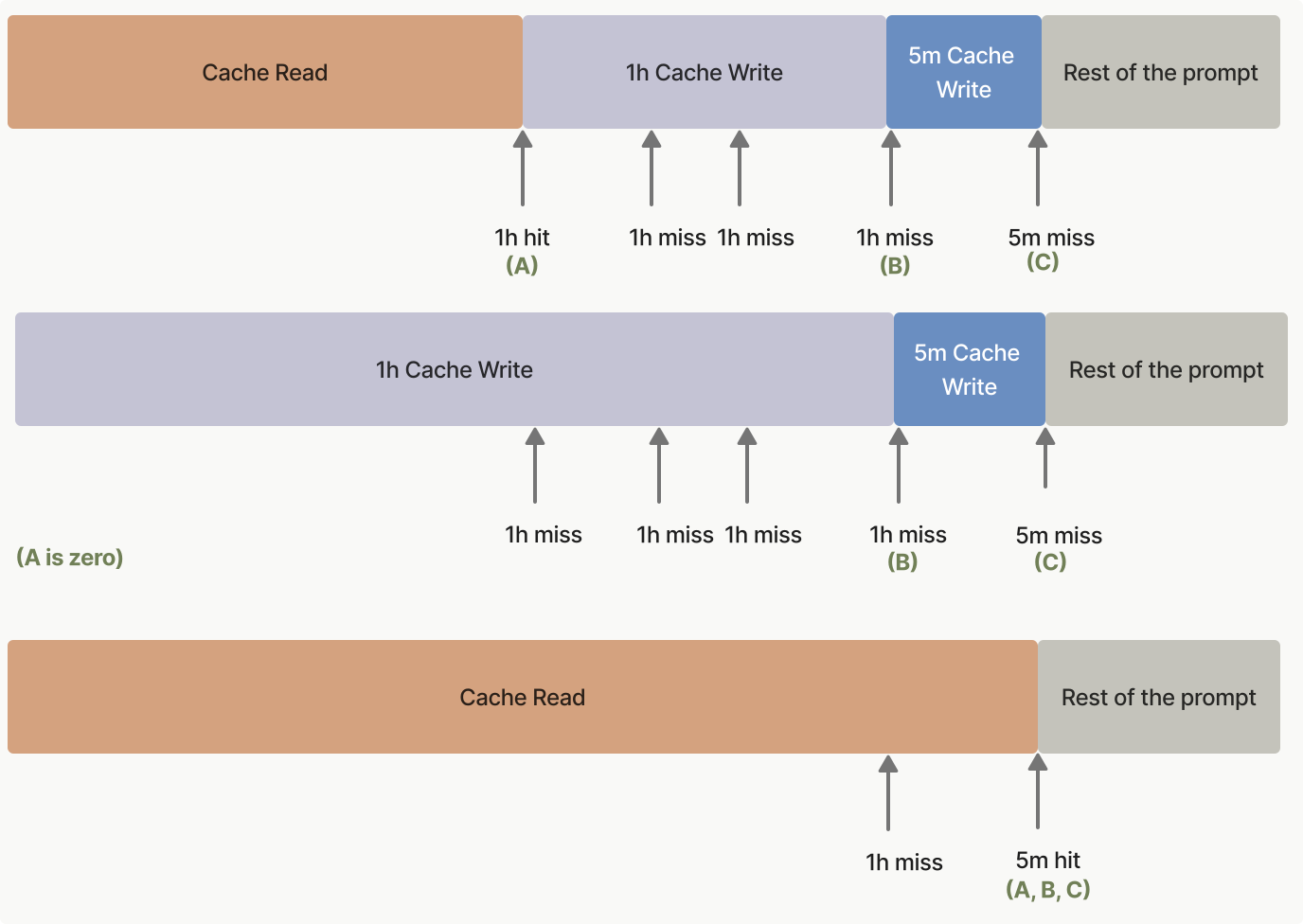
889Here are three examples. This depicts the input tokens of 3 requests, each of which has different cache hits and cache misses. Each has a different calculated pricing, shown in the colored boxes, as a result.
890
891<Frame>
892 
893</Frame>
888894
889895***
890896
build-with-claude/prompt-engineering/claude-prompting-best-practices Changed · +9 / -4 lines
from line 4
44description: Comprehensive guide to prompt engineering techniques for Claude's latest models, covering clarity, examples, XML structuring, thinking, and agentic systems.
55---
66
7This is the reference for prompt engineering with current Claude models, including Claude Fable 5.1, Claude Mythos 5.1, Claude Fable 5, Claude Mythos 5, Claude Opus 5.5, Claude Opus 5, Claude Opus 4.8, Claude Opus 4.7, Claude Opus 4.6, Claude Sonnet 5.5, Claude Sonnet 5, Claude Sonnet 4.6, and Claude Haiku 4.5. The page is organized in three parts:
7This is the reference for prompt engineering with current Claude models, including Claude Fable 5.1, Claude Mythos 5.1, Claude Fable 5, Claude Mythos 5, Claude Opus 5.5, Claude Opus 5, Claude Opus 4.8, Claude Opus 4.7, Claude Opus 4.6, Claude Sonnet 5.5, Claude Sonnet 5, Claude Sonnet 4.6, Claude Haiku 5.5, and Claude Haiku 4.5. The page is organized in three parts:
88
99* **[Model-specific guidance](https://platform.claude.com/docs/en/build-with-claude/prompt-engineering/claude-prompting-best-practices#model-specific-guidance)** first: where a single model behaves differently and what to change in your prompt.
1010* **Techniques for all current models** after that: general principles, output and formatting, tool use, thinking, and agentic systems.
from line 11
1111* **Migration considerations** last, for prompts moving from earlier generations.
1212
1313<Tip>
14 For an overview of model capabilities, see the [models overview](https://platform.claude.com/docs/en/models/overview). For Claude Fable 5.1 capabilities and API changes, see [What's new in Claude Fable 5.1](https://platform.claude.com/docs/en/models/fable-5-1/whats-new-fable-5-1). For Claude Fable 5 capabilities and API changes, see [Introducing Claude Fable 5 and Claude Mythos 5](https://platform.claude.com/docs/en/models/fable-5/introducing-claude-fable-5-and-claude-mythos-5). For migration guidance, see the [Migration guide](https://platform.claude.com/docs/en/about-claude/models/migration-guide). For Claude Opus 5.5, see [What's new in Claude Opus 5.5](https://platform.claude.com/docs/en/models/opus-5-5/whats-new-opus-5-5). For Claude Sonnet 5.5, see [What's new in Claude Sonnet 5.5](https://platform.claude.com/docs/en/models/sonnet-5-5/whats-new-sonnet-5-5).
14 For an overview of model capabilities, see the [models overview](https://platform.claude.com/docs/en/models/overview). For Claude Fable 5.1 capabilities and API changes, see [What's new in Claude Fable 5.1](https://platform.claude.com/docs/en/models/fable-5-1/whats-new-fable-5-1). For Claude Fable 5 capabilities and API changes, see [Introducing Claude Fable 5 and Claude Mythos 5](https://platform.claude.com/docs/en/models/fable-5/introducing-claude-fable-5-and-claude-mythos-5). For migration guidance, see the [Migration guide](https://platform.claude.com/docs/en/about-claude/models/migration-guide). For Claude Opus 5.5, see [What's new in Claude Opus 5.5](https://platform.claude.com/docs/en/models/opus-5-5/whats-new-opus-5-5). For Claude Sonnet 5.5, see [What's new in Claude Sonnet 5.5](https://platform.claude.com/docs/en/models/sonnet-5-5/whats-new-sonnet-5-5). For Claude Haiku 5.5, see [What's new in Claude Haiku 5.5](https://platform.claude.com/docs/en/models/haiku-5-5/whats-new-haiku-5-5).
1515</Tip>
1616
1717## Model-specific guidance
from line 27
2727| Claude Opus 5.5 | [Prompting Claude Opus 5.5](https://platform.claude.com/docs/en/build-with-claude/prompt-engineering/prompting-claude-opus-5-5) | Differences from Claude Opus 5: effort calibration, prompts written for thinking disabled, user-facing progress updates, safeguard refusals, and tools for complex visual inputs. |
2828| Claude Opus 5 | [Prompting Claude Opus 5](https://platform.claude.com/docs/en/build-with-claude/prompt-engineering/prompting-claude-opus-5) | Differences from prior Opus models: response length and verbosity, user-facing progress updates, written deliverable length, task scope and over-verification, subagent control, and self-correction. |
2929| Claude Opus 4.8 | [Prompting Claude Opus 4.8](https://platform.claude.com/docs/en/build-with-claude/prompt-engineering/prompting-claude-opus-4-8) | Response length, effort and thinking-depth calibration, tool use triggering, literal instruction following, subagent control, and design and frontend defaults. |
30| Claude Haiku 5.5 | [Prompting Claude Haiku 5.5](https://platform.claude.com/docs/en/build-with-claude/prompt-engineering/prompting-claude-haiku-5-5) | Differences from Claude Haiku 4.5: effort levels, search, JSON output with your own tools, early stopping in long agent prompts, verification on coding tasks, mid-turn user messages, system prompt adherence in chatbots, and safeguard refusals. |
3031
3132## General principles
3233
from line 774
773774 ```
774775</CodeGroup>
775776
776If you are not using extended thinking, no changes are required. On Claude Opus 4.6 through Claude Opus 4.8 and Claude Sonnet 4.6, thinking is off when you omit the `thinking` parameter. On Claude Opus 5, Claude Sonnet 5.5, and Claude Sonnet 5, thinking is on by default when you omit the `thinking` parameter. On Claude Opus 5, you can disable it only at effort `high` or lower. On Claude Sonnet 5.5, the lowest thinking setting is `between_tools`, accepted at effort `high` or lower. On Claude Fable 5.1, Claude Mythos 5.1, Claude Fable 5, Claude Mythos 5, and Claude Opus 5.5, thinking is always on, regardless of whether you set the `thinking` parameter.
777If you are not using extended thinking, no changes are required. On Claude Opus 4.6 through Claude Opus 4.8 and Claude Sonnet 4.6, thinking is off when you omit the `thinking` parameter. On Claude Opus 5, Claude Sonnet 5.5, Claude Sonnet 5, and Claude Haiku 5.5, thinking is on by default when you omit the `thinking` parameter. On Claude Opus 5 and Claude Haiku 5.5, you can disable it only at effort `high` or lower. On Claude Sonnet 5.5, the lowest thinking setting is `between_tools`, accepted at effort `high` or lower. On Claude Fable 5.1, Claude Mythos 5.1, Claude Fable 5, Claude Mythos 5, and Claude Opus 5.5, thinking is always on, regardless of whether you set the `thinking` parameter.
777778
778779* **Prefer general instructions over prescriptive steps.** A prompt like "think thoroughly" often produces better reasoning than a hand-written step-by-step plan. Claude's reasoning frequently exceeds what a human would prescribe.
779780* **Multishot examples work with thinking.** Worked examples in your prompt shape how Claude approaches similar problems in its own thinking blocks. Present each example as a problem, the method to apply, and the expected answer.
from line 1083
10821083
108310846. **Tune anti-laziness prompting:** If your prompts previously encouraged the model to be more thorough or use tools more aggressively, dial back that guidance. Claude 4.6 models are more proactive and may overtrigger on instructions that were needed for previous models.
10841085
10857. **Pass thinking blocks back unchanged and keep history append-only:** Append each assistant turn exactly as the API returned it, thinking blocks included. On Claude Fable 5.1, Claude Opus 5.5, and Claude Sonnet 5.5, [modifying the conversation before a thinking block](https://platform.claude.com/docs/en/build-with-claude/thinking#preserved-in-conversation) results in an error, or in the block being dropped if you opt into that: editing earlier messages, rebuilding `system` or `tools`, or summarizing older turns in place between requests invalidates every later thinking block, so move those changes to mid-conversation system messages and server-side context management. See [Keep the conversation history append-only](https://platform.claude.com/docs/en/build-with-claude/prompt-engineering/prompting-claude-fable-5-1#keep-the-conversation-history-append-only).
10867. **Pass thinking blocks back unchanged and keep history append-only:** Append each assistant turn exactly as the API returned it, thinking blocks included. On Claude Fable 5.1, Claude Opus 5.5, Claude Sonnet 5.5, and Claude Haiku 5.5, [modifying the conversation before a thinking block](https://platform.claude.com/docs/en/build-with-claude/thinking#preserved-in-conversation) results in an error, or in the block being dropped if you opt into that: editing earlier messages, rebuilding `system` or `tools`, or summarizing older turns in place between requests invalidates every later thinking block, so move those changes to mid-conversation system messages and server-side context management. See [Keep the conversation history append-only](https://platform.claude.com/docs/en/build-with-claude/prompt-engineering/prompting-claude-fable-5-1#keep-the-conversation-history-append-only).
10861087
10871088For detailed migration steps, see the [Migration guide](https://platform.claude.com/docs/en/about-claude/models/migration-guide).
10881089
from line 1116
11151116
11161117 <Card title="Prompting Claude Opus 5" icon="terminal" href="https://platform.claude.com/docs/en/build-with-claude/prompt-engineering/prompting-claude-opus-5">
11171118 Behavioral differences and prompting patterns for Claude Opus 5, covering response verbosity, agentic narration, task scoping, subagent delegation, and self-correction.
1119 </Card>
1120
1121 <Card title="Prompting Claude Haiku 5.5" icon="terminal" href="https://platform.claude.com/docs/en/build-with-claude/prompt-engineering/prompting-claude-haiku-5-5">
1122 Behavioral differences and prompting patterns for Claude Haiku 5.5, covering effort, search, JSON output with your own tools, early stopping, coding verification, mid-turn user messages, system prompt adherence in chatbots, and safeguard refusals.
11181123 </Card>
11191124
11201125 <Card title="Prompt engineering overview" icon="edit" href="https://platform.claude.com/docs/en/build-with-claude/prompt-engineering/overview">