
thinking changedbuild-with-claude/thinking
Nearest release: v2.1.293, published 2 hours after this site recorded the change. Shown because the two are within 24 hours of each other. Nothing here says the release caused the edit.
Recorded here
Lines+5added
Lines−5removed
From line
17
where the diff opens
First seen
14 Aug 2026
this site's first read of the page
Recorded edits22to this page, all time
The whole hunk
from line 17, old and new numbered
/
from line 17
1717## How thinking works
1818
1919<Frame>
20 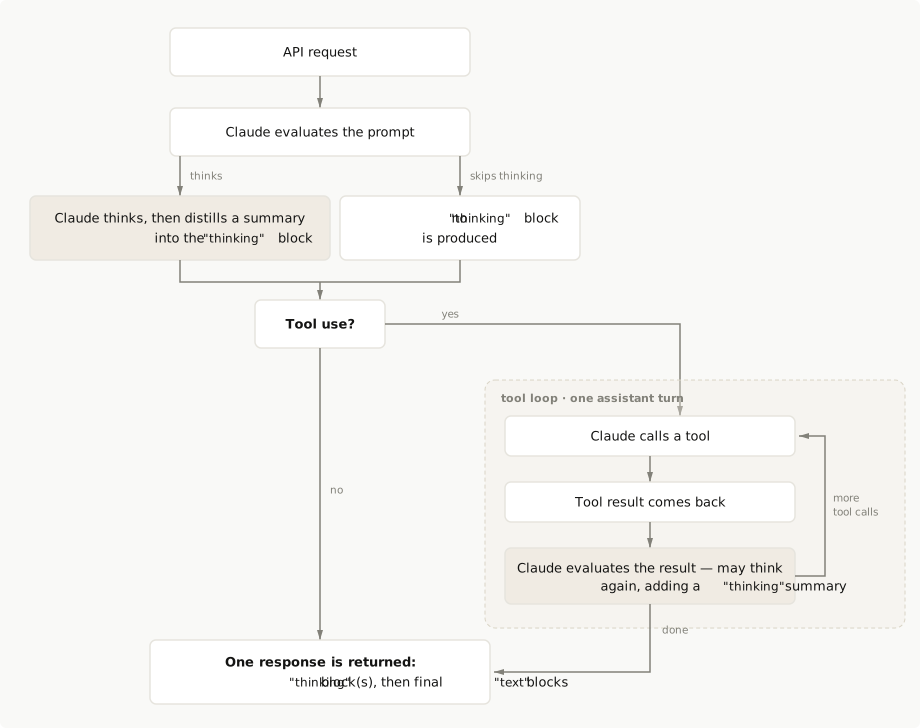
20 
2121</Frame>
2222
2323Whether Claude thinks on a given request, and how deeply, depends on your thinking configuration and the complexity of the request.
from line 71
7171
7272On Claude Opus 5.5, Claude Opus 5, Claude Sonnet 5.5, Claude Sonnet 5, Claude Fable 5.1, Claude Mythos 5.1, Claude Fable 5, Claude Mythos 5, and Claude Mythos Preview, thinking is already on and needs no configuration. `display` defaults to `"omitted"` on these models, so the thinking text is hidden until you opt in. Opt in with `thinking: {"type": "adaptive", "display": "summarized"}`, which is exactly the following request with the [model string](https://platform.claude.com/docs/en/models/overview) swapped.
7373
74On Claude Opus 4.8, Claude Opus 4.7, Claude Opus 4.6, and Claude Sonnet 4.6, thinking is off until you set `thinking: {type: "adaptive"}`, which lets Claude decide when and how deeply to think based on the request. The following examples do that, set `display: "summarized"` so the thinking text is visible, and use a roomy `max_tokens`:
74On Claude Opus 4.8, Claude Opus 4.7, Claude Opus 4.6, and Claude Sonnet 4.6, thinking is off until you set `thinking: {type: "adaptive"}`, which lets Claude determine when and how deeply to think based on the request. The following examples do that, set `display: "summarized"` so the thinking text is visible, and use a roomy `max_tokens`:
7575
7676<CodeGroup>
7777 ```bash cURL
from line 966
966966
967967Interleaved thinking lets Claude think between tool calls, reasoning about each tool result before acting on it. With interleaved thinking, Claude can:
968968
969* Reason about the results of a tool call before deciding what to do next
969* Reason about the results of a tool call before determining what to do next
970970* Chain multiple tool calls with reasoning steps in between
971971* Make more nuanced decisions based on intermediate results
972972
from line 994
994994
995995On Claude Sonnet 5.5, the lowest thinking setting is `thinking: {type: "between_tools"}`. It turns off up-front thinking, and each progress update comes back with its summary text, as it would under `display: "updates"`. `between_tools` is accepted only at [effort](https://platform.claude.com/docs/en/build-with-claude/effort) `high` or below. At `xhigh` or `max`, a request with it returns a 400 error. `between_tools` takes no other field: `display`, `budget_tokens`, or `block_binding` sent with it returns a 400 error. The setting needs no beta header and works on every platform that offers Claude Sonnet 5.5. Pass the blocks back unchanged: a progress-update block you send back gives the model the full note it wrote, not the summary.
996996
997Use `display: "updates"` for an agent interface that keeps reasoning hidden and shows the user a status line at each step. Under it, any `thinking` block with non-empty text is a progress update, so render those and nothing else. It's in beta and requires the beta header `thinking-display-updates-2026-08-18` (on Amazon Bedrock, Google Cloud, and Microsoft Foundry, pass the beta value as described in [Beta headers](https://platform.claude.com/docs/en/api/beta-headers)). Without it, the value is rejected with the same 400 `invalid_request_error` as an unknown `display` value.
997Use `display: "updates"` for an agent interface that keeps reasoning hidden and shows the user a status line at each step. Under it, any `thinking` block with non-empty text is a progress update, so render those and nothing else. It's in beta and requires the beta header `thinking-display-updates-2026-08-18` (to send it on Amazon Bedrock, Google Cloud, or Microsoft Foundry, see [Beta features on other platforms](https://platform.claude.com/docs/en/api/beta-headers#beta-features-on-other-platforms)). Without it, the value is rejected with the same 400 `invalid_request_error` as an unknown `display` value.
998998
999999```json
10001000{
from line 1076
10761076
10771077## Preserved thinking
10781078
1079[Preserved thinking](https://platform.claude.com/docs/en/build-with-claude/preserved-thinking) decides whether the model can use a thinking block that you send back from an earlier turn. Starting with Claude Fable 5.1, the API checks the `signature` of every `thinking` or `redacted_thinking` block in a request for two things:
1079[Preserved thinking](https://platform.claude.com/docs/en/build-with-claude/preserved-thinking) determines whether the model can use a thinking block that you send back from an earlier turn. Starting with Claude Fable 5.1, the API checks the `signature` of every `thinking` or `redacted_thinking` block in a request for two things:
10801080
10811081* **The model that produced it.** Each model reads its own thinking blocks and those of a fixed set of other models. Claude Fable 5.1 reads blocks from Claude Opus 5 and, on the Claude API, from Claude Opus 5.5; neither Claude Opus 5 nor Claude Opus 5.5 reads blocks from Claude Fable 5.1. The API drops a block the current model can't read, without an error and without billing it. See [Switching models mid-conversation](https://platform.claude.com/docs/en/build-with-claude/preserved-thinking#switching-models).
10821082* **Everything sent before it.** A block stays valid only while the top-level `system` prompt, the `tools`, and the messages before it are unchanged. If any of them changes, that block and every later thinking block are invalid, and the API rejects the request with a 400 error or drops the invalid blocks, whichever you choose. See [Keeping the prefix unchanged](https://platform.claude.com/docs/en/build-with-claude/preserved-thinking#prefix-check).
No line in this hunk matches that.