
One read of Claude Developer Platformapi-20261007T150733Z
49 pages moved out of 754 read.
Pages moved
49
significant first
Pages read
754
in this capture
Captured
15:07 UTC
Corpus hash
f58c4401bfdf
index-hash
What this read moved
1-25 of 49, page 1 of 2This capture is too large to show at once. Changes 1-25 of 49 are below, significant first; the rest are on the following screens.
agents-and-tools/tool-use/computer-use-tool Changed · +5 / -5 lines
from line 433
433433
434434Claude then sees which actions succeeded, which one failed, and which were skipped, and replans on its next turn. A request that leaves any `tool_use` block in the batch unanswered is rejected with an `invalid_request_error`, so an agent loop that reads only the first block fails on its next call. If your application asks a human to confirm consequential actions, make that check before each block runs, because a batch can complete a multistep action within one turn.
435435
436Claude typically finishes a batch with `screenshot` so it can observe the outcome before deciding what to do next. When a batch doesn't end with one, your application can attach a screenshot as an extra `image` block on the last result in the batch so that Claude always sees the current state of the screen, which saves a round trip compared with waiting for Claude to ask. You can also prompt Claude to end every batch with a screenshot (see [Optimize model performance with prompting](https://platform.claude.com/docs/en/agents-and-tools/tool-use/computer-use-tool#optimize-model-performance-with-prompting)).
436Claude typically finishes a batch with `screenshot` so it can observe the outcome before determining what to do next. When a batch doesn't end with one, your application can attach a screenshot as an extra `image` block on the last result in the batch so that Claude always sees the current state of the screen, which saves a round trip compared with waiting for Claude to ask. You can also prompt Claude to end every batch with a screenshot (see [Optimize model performance with prompting](https://platform.claude.com/docs/en/agents-and-tools/tool-use/computer-use-tool#optimize-model-performance-with-prompting)).
437437
438438### The computing environment
439439
from line 2176
21762176
21772177Two earlier versions of the computer use tool remain available in beta for existing integrations, for models that don't support the toolset, and on platforms where the toolset isn't currently available. Each requires its [beta header](https://platform.claude.com/docs/en/api/beta-headers) on every request, and their parameters are documented in the [beta Messages API reference](https://platform.claude.com/docs/en/api/beta/messages/create). With the SDK, pass the header through `betas` (python, typescript, php, ruby; csharp, go: `Betas`; java: `.addBeta()`) and use the beta namespace; only the computer use tool needs the header, not the bash or text editor tools in the same request.
21782178
2179| Tool version | Beta header | Use with | Parameters |
2180| ------------------- | ------------------------- | ------------------------------------------------------------------------------------------------------------------------------------------------------------------------------------------------------------------------------------------------------------------------------------------------------------------------------------------------------------------------------------------------------------------------------------------- | ----------------------------------------------------------------------------- |
2181| `computer_20251124` | `computer-use-2025-11-24` | Claude Fable 5.1, Claude Mythos 5.1, Claude Fable 5, Claude Mythos 5, Claude Opus 5, Claude Sonnet 5, Claude Opus 4.8, Claude Opus 4.7, Claude Opus 4.6, Claude Sonnet 4.6, and Claude Opus 4.5; on Amazon Bedrock, also Claude Opus 5.5 and Claude Sonnet 5.5 | [API reference](https://platform.claude.com/docs/en/api/beta/messages/create) |
2182| `computer_20250124` | `computer-use-2025-01-24` | Claude Sonnet 4.5, Claude Haiku 4.5, Claude Opus 4.1 ([retired, except on Bedrock and Google Cloud](https://platform.claude.com/docs/en/about-claude/model-deprecations)), Claude Sonnet 4 ([retired, except on Bedrock and Google Cloud](https://platform.claude.com/docs/en/about-claude/model-deprecations)), and Claude Opus 4 ([retired, except on Google Cloud](https://platform.claude.com/docs/en/about-claude/model-deprecations)) | [API reference](https://platform.claude.com/docs/en/api/beta/messages/create) |
2179| Tool version | Beta header | Use with | Parameters |
2180| ------------------- | ------------------------- | ------------------------------------------------------------------------------------------------------------------------------------------------------------------------------------------------------------------------------------------------------------------------------------------------------------------------------------------------------------------------------------------------------------------------------------------------------------------------------------------------------------------------------- | ----------------------------------------------------------------------------- |
2181| `computer_20251124` | `computer-use-2025-11-24` | Claude Fable 5.1, Claude Mythos 5.1, Claude Fable 5, Claude Mythos 5, Claude Opus 5, Claude Sonnet 5, Claude Opus 4.8, Claude Opus 4.7, Claude Opus 4.6, Claude Sonnet 4.6, and Claude Opus 4.5; on Amazon Bedrock, also Claude Opus 5.5 and Claude Sonnet 5.5 | [API reference](https://platform.claude.com/docs/en/api/beta/messages/create) |
2182| `computer_20250124` | `computer-use-2025-01-24` | Claude Sonnet 4.5 ([deprecated](https://platform.claude.com/docs/en/about-claude/model-deprecations)), Claude Haiku 4.5, Claude Opus 4.1 ([retired, except on Bedrock and Google Cloud](https://platform.claude.com/docs/en/about-claude/model-deprecations)), Claude Sonnet 4 ([retired, except on Bedrock and Google Cloud](https://platform.claude.com/docs/en/about-claude/model-deprecations)), and Claude Opus 4 ([retired, except on Google Cloud](https://platform.claude.com/docs/en/about-claude/model-deprecations)) | [API reference](https://platform.claude.com/docs/en/api/beta/messages/create) |
21832183
21842184***
21852185
agents-and-tools/tool-use/tool-search-tool Changed · +16 / -16 lines
from line 39
3939
4040Both tool search variants are available on the following models:
4141
42| Model | Tool versions |
43| ---------------------------------------------- | ------------------------------------------------------------------- |
44| Claude Fable 5.1 (claude-fable-5-1) | `tool_search_tool_regex_20251119`, `tool_search_tool_bm25_20251119` |
45| Claude Mythos 5.1 (claude-mythos-5-1) | `tool_search_tool_regex_20251119`, `tool_search_tool_bm25_20251119` |
46| Claude Fable 5 (claude-fable-5) | `tool_search_tool_regex_20251119`, `tool_search_tool_bm25_20251119` |
47| Claude Mythos 5 (claude-mythos-5) | `tool_search_tool_regex_20251119`, `tool_search_tool_bm25_20251119` |
48| Claude Opus 5.5 (claude-opus-5-5) | `tool_search_tool_regex_20251119`, `tool_search_tool_bm25_20251119` |
49| Claude Opus 5 (claude-opus-5) | `tool_search_tool_regex_20251119`, `tool_search_tool_bm25_20251119` |
50| Claude Sonnet 5.5 (claude-sonnet-5-5) | `tool_search_tool_regex_20251119`, `tool_search_tool_bm25_20251119` |
51| Claude Opus 4.8 (claude-opus-4-8) | `tool_search_tool_regex_20251119`, `tool_search_tool_bm25_20251119` |
52| Claude Opus 4.7 (claude-opus-4-7) | `tool_search_tool_regex_20251119`, `tool_search_tool_bm25_20251119` |
53| Claude Opus 4.6 (claude-opus-4-6) | `tool_search_tool_regex_20251119`, `tool_search_tool_bm25_20251119` |
54| Claude Sonnet 4.6 (claude-sonnet-4-6) | `tool_search_tool_regex_20251119`, `tool_search_tool_bm25_20251119` |
55| Claude Opus 4.5 (claude-opus-4-5-20251101) | `tool_search_tool_regex_20251119`, `tool_search_tool_bm25_20251119` |
56| Claude Sonnet 4.5 (claude-sonnet-4-5-20250929) | `tool_search_tool_regex_20251119`, `tool_search_tool_bm25_20251119` |
57| Claude Haiku 4.5 (claude-haiku-4-5-20251001) | `tool_search_tool_regex_20251119`, `tool_search_tool_bm25_20251119` |
42| Model | Tool versions |
43| ---------------------------------------------------------------------------------------------------------------------------------- | ------------------------------------------------------------------- |
44| Claude Fable 5.1 (claude-fable-5-1) | `tool_search_tool_regex_20251119`, `tool_search_tool_bm25_20251119` |
45| Claude Mythos 5.1 (claude-mythos-5-1) | `tool_search_tool_regex_20251119`, `tool_search_tool_bm25_20251119` |
46| Claude Fable 5 (claude-fable-5) | `tool_search_tool_regex_20251119`, `tool_search_tool_bm25_20251119` |
47| Claude Mythos 5 (claude-mythos-5) | `tool_search_tool_regex_20251119`, `tool_search_tool_bm25_20251119` |
48| Claude Opus 5.5 (claude-opus-5-5) | `tool_search_tool_regex_20251119`, `tool_search_tool_bm25_20251119` |
49| Claude Opus 5 (claude-opus-5) | `tool_search_tool_regex_20251119`, `tool_search_tool_bm25_20251119` |
50| Claude Sonnet 5.5 (claude-sonnet-5-5) | `tool_search_tool_regex_20251119`, `tool_search_tool_bm25_20251119` |
51| Claude Opus 4.8 (claude-opus-4-8) | `tool_search_tool_regex_20251119`, `tool_search_tool_bm25_20251119` |
52| Claude Opus 4.7 (claude-opus-4-7) | `tool_search_tool_regex_20251119`, `tool_search_tool_bm25_20251119` |
53| Claude Opus 4.6 (claude-opus-4-6) | `tool_search_tool_regex_20251119`, `tool_search_tool_bm25_20251119` |
54| Claude Sonnet 4.6 (claude-sonnet-4-6) | `tool_search_tool_regex_20251119`, `tool_search_tool_bm25_20251119` |
55| Claude Opus 4.5 (claude-opus-4-5-20251101) | `tool_search_tool_regex_20251119`, `tool_search_tool_bm25_20251119` |
56| Claude Sonnet 4.5 (claude-sonnet-4-5-20250929) ([deprecated](https://platform.claude.com/docs/en/about-claude/model-deprecations)) | `tool_search_tool_regex_20251119`, `tool_search_tool_bm25_20251119` |
57| Claude Haiku 4.5 (claude-haiku-4-5-20251001) | `tool_search_tool_regex_20251119`, `tool_search_tool_bm25_20251119` |
5858
5959Claude Opus 4.1 and earlier models don't support the tool search tool.
6060
api/beta-headers Changed · +9 / -0 lines
### Beta features on other platforms
from line 178
178178
179179With the SDK, list each feature (for example, `betas=["feature1", "feature2"]` (python; typescript, ruby: `betas: ["feature1", "feature2"]`; php: `betas: ['feature1', 'feature2']`; csharp: `Betas = ["feature1", "feature2"]`; go: `Betas: []anthropic.AnthropicBeta{"feature1", "feature2"}`; java: `.addBeta("feature1").addBeta("feature2")`)). With the CLI, pass a single `--beta` flag with the feature names separated by commas (for example, `--beta feature1,feature2`). You can also repeat the flag (for example, `--beta feature1 --beta feature2`).
180180
181### Beta features on other platforms
182
183Beta names are the same on every platform that accepts them, but not every platform accepts every beta. [Claude Platform on AWS](https://platform.claude.com/docs/en/build-with-claude/claude-platform-on-aws), [Microsoft Foundry](https://platform.claude.com/docs/en/build-with-claude/claude-in-microsoft-foundry), and [Google Cloud](https://platform.claude.com/docs/en/build-with-claude/claude-on-vertex-ai) take beta names in the `anthropic-beta` header, as the Claude API does. To send several betas, put their names in one header, separated by commas: Google Cloud reads only one `anthropic-beta` header and ignores the rest, so betas in the others don't take effect.
184
185On Amazon Bedrock, where beta names go depends on the API you call:
186
187* [Claude in Amazon Bedrock](https://platform.claude.com/docs/en/build-with-claude/claude-in-amazon-bedrock) (`bedrock-mantle` endpoints) takes them in the `anthropic-beta` header.
188* The [InvokeModel API](https://platform.claude.com/docs/en/build-with-claude/claude-on-amazon-bedrock-legacy) reads them from the request body, not from a header. List them in the body's `anthropic_beta` array, one name per element, for example `"anthropic_beta": ["feature1", "feature2"]`.
189
181190### Endpoint-specific headers
182191
183192Some beta APIs are scoped to specific endpoints and require a feature-specific beta header on every request:
build-with-claude/claude-on-amazon-bedrock-legacy Changed · +8 / -6 lines
from line 756
756756
757757### Mid-conversation system messages on Bedrock
758758
759[Mid-conversation system messages](https://platform.claude.com/docs/en/build-with-claude/mid-conversation-system-messages) are available through the InvokeModel API for Claude Fable 5.1, Claude Fable 5, Claude Opus 5.5, Claude Opus 5, Claude Opus 4.8, and Claude Sonnet 5.5. As described in the note under [API model IDs](https://platform.claude.com/docs/en/build-with-claude/claude-on-amazon-bedrock-legacy#api-model-ids), these requests are served by the same infrastructure as the [Claude in Amazon Bedrock](https://platform.claude.com/docs/en/build-with-claude/claude-in-amazon-bedrock) endpoint. No beta header is required. This feature is not available on Claude Sonnet 5. Use the top-level `system` field instead. It is not available for the ARN-versioned models in the model table on this page.
759[Mid-conversation system messages](https://platform.claude.com/docs/en/build-with-claude/mid-conversation-system-messages) are available through the InvokeModel API for Claude Fable 5.1, Claude Fable 5, Claude Opus 5.5, Claude Opus 5, Claude Opus 4.8, and Claude Sonnet 5.5. As described in the note under [API model IDs](https://platform.claude.com/docs/en/build-with-claude/claude-on-amazon-bedrock-legacy#api-model-ids), these requests are served by the same infrastructure as the [Claude in Amazon Bedrock](https://platform.claude.com/docs/en/build-with-claude/claude-in-amazon-bedrock) endpoint. No beta header is required for mid-conversation system messages. This feature is not available on Claude Sonnet 5. Use the top-level `system` field instead. It is not available for the ARN-versioned models in the model table on this page.
760760
761A `role: "system"` message can also set `output_config.effort` to [change effort mid-conversation](https://platform.claude.com/docs/en/build-with-claude/effort#change-effort-mid-conversation-beta) on Claude Fable 5.1 and Claude Opus 5.5. This is in beta: add `mid-conversation-output-config-2026-07-01` to the `anthropic_beta` array in the request body. Without that value, or on Claude Fable 5, Claude Opus 5, or Claude Opus 4.8, the request returns a 400 error: `messages.N.output_config: Extra inputs are not permitted`. In the error, `N` is the index of the `system` message in `messages`.
762
761763**For Converse API users:** the Converse API accepts system instructions through its top-level [`system` parameter](https://docs.aws.amazon.com/bedrock/latest/APIReference/API_runtime_Converse.html). To add system instructions mid-conversation, use the InvokeModel API.
762764
763765### Context window
764766
765Claude Fable 5.1, Claude Fable 5, Claude Opus 5.5, Claude Opus 5, Claude Opus 4.8, Claude Opus 4.7, Claude Opus 4.6, Claude Sonnet 5.5, Claude Sonnet 5, and Claude Sonnet 4.6 have a [1M-token context window](https://platform.claude.com/docs/en/build-with-claude/context-windows) on Amazon Bedrock. Other Claude models, including Sonnet 4.5 and Sonnet 4 (deprecated), have a 200k-token context window.
767Claude Fable 5.1, Claude Fable 5, Claude Opus 5.5, Claude Opus 5, Claude Opus 4.8, Claude Opus 4.7, Claude Opus 4.6, Claude Sonnet 5.5, Claude Sonnet 5, and Claude Sonnet 4.6 have a [1M-token context window](https://platform.claude.com/docs/en/build-with-claude/context-windows) on Amazon Bedrock. Other Claude models, including Sonnet 4.5 (deprecated) and Sonnet 4 (deprecated), have a 200k-token context window.
766768
767769Bedrock limits request payloads to 20 MB. When sending large documents or many images, you may reach this limit before the token limit.
768770
from line 778
776778Regional endpoints include a 10% pricing premium over global endpoints.
777779
778780<Note>
779 This applies to Claude Sonnet 4.5 and future models only. Older models (Claude Sonnet 4 (deprecated) and earlier) maintain their existing pricing structures.
781 This applies to Claude Sonnet 4.5 (deprecated) and future models only. Older models (Claude Sonnet 4 (deprecated) and earlier) maintain their existing pricing structures.
780782</Note>
781783
782784### When to use each option
from line 799
797799
798800### Implementation
799801
800**Using global endpoints (default for Opus 4.6, Sonnet 4.6, and Sonnet 4.5):**
802**Using global endpoints (default for Opus 4.6, Sonnet 4.6, and Sonnet 4.5 (deprecated)):**
801803
802The model IDs for Claude Opus 4.6, Sonnet 4.6, and Sonnet 4.5 already include the `global.` prefix:
804The model IDs for Claude Opus 4.6, Sonnet 4.6, and Sonnet 4.5 (deprecated) already include the `global.` prefix:
803805
804806<Tabs>
805807 <Tab title="cURL">
build-with-claude/claude-platform-on-aws Changed · +3 / -3 lines
from line 28
2828| **API surface** | Claude API (`/v1/{endpoint}`) | Messages API at `/anthropic/v1/messages` | Bedrock Converse / InvokeModel |
2929| **Feature availability** | Typically same-day as Claude API (see [feature limitations](https://platform.claude.com/docs/en/build-with-claude/claude-platform-on-aws#features-not-supported)) | Per Amazon Bedrock release schedule | Per Amazon Bedrock release schedule |
3030| **Agent Skills** | Available | Not available (requires code execution) | Not available |
31| **Beta features** | Pass through with `anthropic-beta` headers (see [feature limitations](https://platform.claude.com/docs/en/build-with-claude/claude-platform-on-aws#features-not-supported)) | `anthropic-beta` header not supported | `anthropic-beta` header not supported |
31| **Beta features** | Pass through with `anthropic-beta` headers (see [feature limitations](https://platform.claude.com/docs/en/build-with-claude/claude-platform-on-aws#features-not-supported)) | The beta features Amazon Bedrock supports, through the `anthropic-beta` header | The beta features Amazon Bedrock supports, through the `anthropic_beta` field of the InvokeModel request body |
3232| **Authentication** | AWS IAM / SigV4 or API key | AWS IAM / SigV4 | AWS IAM / SigV4 or bearer token |
3333| **Billing** | AWS Marketplace | AWS (native service) | AWS (native service) |
3434| **Base URL** | `aws-external-anthropic.{region}.api.aws` | `bedrock-mantle.{region}.api.aws` | `bedrock-runtime.{region}.amazonaws.com` |
from line 594
594594Set the inference geography per request with the `inference_geo` parameter:
595595
596596<Note>
597 The `inference_geo` parameter is supported on Claude 4.6 and later models. Requests with `inference_geo` on Claude Opus 4.5, Claude Sonnet 4.5, or Claude Haiku 4.5 return a 400 error. See [Data residency](https://platform.claude.com/docs/en/manage-claude/data-residency) for model availability details.
597 The `inference_geo` parameter is supported on Claude 4.6 and later models. Requests with `inference_geo` on Claude Opus 4.5, Claude Sonnet 4.5 (deprecated), or Claude Haiku 4.5 return a 400 error. See [Data residency](https://platform.claude.com/docs/en/manage-claude/data-residency) for model availability details.
598598</Note>
599599
600600<CodeGroup>
from line 1063
10631063* Typically same-day access to new models and features (see [feature limitations](https://platform.claude.com/docs/en/build-with-claude/claude-platform-on-aws#features-not-supported))
10641064* Agent Skills for document generation (PowerPoint, Excel, Word, PDF)
10651065* Code execution in Anthropic's managed sandbox
1066* Beta features through the `anthropic-beta` header (see [feature limitations](https://platform.claude.com/docs/en/build-with-claude/claude-platform-on-aws#features-not-supported))
1066* Claude API beta features that Amazon Bedrock doesn't offer, through the `anthropic-beta` header (see [feature limitations](https://platform.claude.com/docs/en/build-with-claude/claude-platform-on-aws#features-not-supported))
10671067* Claude Console for quota visibility and usage analytics
10681068* Direct Anthropic support
10691069* API key authentication as an alternative to SigV4 (see [API key authentication](https://platform.claude.com/docs/en/build-with-claude/claude-platform-on-aws#api-key-authentication))
build-with-claude/context-editing Changed · +6 / -6 lines
from line 46
4646<Tip>
4747 **Default behavior:** The default varies by model class.
4848
49 | Model class | Keep all prior thinking | Keep only the last turn's thinking |
50 | ---------------- | --------------------------- | ----------------------------------- |
51 | Opus | Claude Opus 4.5 and later | Claude Opus 4.1 and earlier |
52 | Sonnet | Claude Sonnet 4.6 and later | Claude Sonnet 4.5 and earlier |
53 | Haiku | (none) | All models through Claude Haiku 4.5 |
54 | Fable and Mythos | All models | (none) |
49 | Model class | Keep all prior thinking | Keep only the last turn's thinking |
50 | ---------------- | --------------------------- | ------------------------------------------ |
51 | Opus | Claude Opus 4.5 and later | Claude Opus 4.1 and earlier |
52 | Sonnet | Claude Sonnet 4.6 and later | Claude Sonnet 4.5 (deprecated) and earlier |
53 | Haiku | (none) | All models through Claude Haiku 4.5 |
54 | Fable and Mythos | All models | (none) |
5555
5656 Use this strategy to override the default. If your code runs across multiple model tiers, set `keep` explicitly rather than relying on the per-model default.
5757</Tip>
build-with-claude/context-windows Changed · +4 / -4 lines
from line 33
3333
3434## Context window sizes by model
3535
36Claude Fable 5.1, Claude Mythos 5.1, Claude Fable 5, Claude Mythos 5, Claude Opus 5.5, Claude Opus 5, Claude Opus 4.8, Claude Opus 4.7, Claude Opus 4.6, Claude Sonnet 5.5, Claude Sonnet 5, Claude Sonnet 4.6, and [Claude Mythos Preview](https://anthropic.com/glasswing) have a 1M-token context window. A single request to any of them can generate up to 128k output tokens (`max_tokens`). Other Claude models, including Claude Sonnet 4.5, have a 200k-token context window.
36Claude Fable 5.1, Claude Mythos 5.1, Claude Fable 5, Claude Mythos 5, Claude Opus 5.5, Claude Opus 5, Claude Opus 4.8, Claude Opus 4.7, Claude Opus 4.6, Claude Sonnet 5.5, Claude Sonnet 5, Claude Sonnet 4.6, and [Claude Mythos Preview](https://anthropic.com/glasswing) have a 1M-token context window. A single request to any of them can generate up to 128k output tokens (`max_tokens`). Other Claude models, including Claude Sonnet 4.5 (deprecated), have a 200k-token context window.
3737
3838For every model with a 1M-token context window, 1M is the default: you don't need a beta header, and long-context requests are billed at [standard pricing](https://platform.claude.com/docs/en/about-claude/pricing#long-context-pricing).
3939
from line 92
9292 * The API uses cryptographic signatures to verify thinking block authenticity. If you modify a thinking block, the API returns an error.
9393
9494<Note>
95 Most current Claude models support [interleaved thinking](https://platform.claude.com/docs/en/build-with-claude/thinking#interleaved-thinking), which lets Claude think between tool calls, including after it receives tool results. It is automatic on models with adaptive thinking; Claude Opus 4.5, Claude Sonnet 4.5, and earlier Claude 4 models require the `interleaved-thinking-2025-05-14` beta header, and Claude Haiku 4.5 does not support it.
95 Most current Claude models support [interleaved thinking](https://platform.claude.com/docs/en/build-with-claude/thinking#interleaved-thinking), which lets Claude think between tool calls, including after it receives tool results. It is automatic on models with adaptive thinking; Claude Opus 4.5, Claude Sonnet 4.5 (deprecated), and earlier Claude 4 models require the `interleaved-thinking-2025-05-14` beta header, and Claude Haiku 4.5 does not support it.
9696
9797 For more information about using tools with thinking, see [Thinking with tool use](https://platform.claude.com/docs/en/build-with-claude/thinking#thinking-with-tool-use).
9898</Note>
from line 101
101101
102102## Context awareness
103103
104Claude Sonnet 5, Claude Sonnet 4.6, Claude Sonnet 4.5, and Claude Haiku 4.5 have **context awareness:** these models track their remaining context window (their "token budget") throughout a conversation. This lets the model manage long-running tasks against the space that remains rather than guess how many tokens are left. Context awareness is automatic: there is nothing for you to enable, and you never send the tags shown in this section yourself. The API injects them.
104Claude Sonnet 5, Claude Sonnet 4.6, Claude Sonnet 4.5 (deprecated), and Claude Haiku 4.5 have **context awareness:** these models track their remaining context window (their "token budget") throughout a conversation. This lets the model manage long-running tasks against the space that remains rather than guess how many tokens are left. Context awareness is automatic: there is nothing for you to enable, and you never send the tags shown in this section yourself. The API injects them.
105105
106106### How it works
107107
from line 111
111111<budget:token_budget>200000</budget:token_budget>
112112```
113113
114The budget matches the context window available to your request: 1M tokens for Claude Sonnet 5 and Claude Sonnet 4.6, and 200k tokens for Claude Sonnet 4.5 and Claude Haiku 4.5. The examples in this section show a model with a 200k-token context window.
114The budget matches the context window available to your request: 1M tokens for Claude Sonnet 5 and Claude Sonnet 4.6, and 200k tokens for Claude Sonnet 4.5 (deprecated) and Claude Haiku 4.5. The examples in this section show a model with a 200k-token context window.
115115
116116After each tool call, the API gives Claude an update on its remaining capacity:
117117
build-with-claude/effort Changed · +5 / -3 lines
from line 281
281281
282282When running Claude Opus 5 at `xhigh` or `max` effort, set a large `max_tokens` so the model has room to think and act across subagents and tool calls. Starting at 64k tokens and tuning from there is a reasonable default.
283283
284Claude Opus 5 also supports [changing effort mid-conversation](https://platform.claude.com/docs/en/build-with-claude/effort#change-effort-mid-conversation-beta) with a per-message `output_config`, which preserves the prompt cache.
284Claude Opus 5 also supports [changing effort mid-conversation](https://platform.claude.com/docs/en/build-with-claude/effort#change-effort-mid-conversation-beta) with a per-message `output_config`, which preserves the prompt cache. Per-message effort isn't available for Claude Opus 5 on Amazon Bedrock.
285285
286286### Recommended effort levels for Claude Opus 4.8
287287
from line 368
368368
369369### Per-message effort (beta)
370370
371Per-message effort is in beta and requires the [beta header](https://platform.claude.com/docs/en/api/beta-headers) `mid-conversation-output-config-2026-07-01`. Models without per-message effort, including Claude Fable 5, return a 400 error: `output_config.effort requires a model that supports per-turn effort; this model does not`. On Claude Sonnet 5.5 with `thinking: {"type": "between_tools"}`, effort can't change mid-conversation: a per-message `output_config.effort` that differs from the level in effect returns a 400 error. To vary effort per turn, use adaptive thinking.
371Per-message effort is in beta. On the Claude API and [Google Cloud](https://platform.claude.com/docs/en/build-with-claude/claude-on-vertex-ai), it's available on Claude Fable 5.1, Claude Mythos 5.1, Claude Opus 5.5, Claude Opus 5, and Claude Sonnet 5.5. On [Amazon Bedrock](https://platform.claude.com/docs/en/build-with-claude/claude-in-amazon-bedrock), it's available on Claude Fable 5.1, Claude Mythos 5.1, and Claude Opus 5.5. It requires the [beta header](https://platform.claude.com/docs/en/api/beta-headers) `mid-conversation-output-config-2026-07-01`. With the Amazon Bedrock [InvokeModel API](https://platform.claude.com/docs/en/build-with-claude/claude-on-amazon-bedrock-legacy), it's available on Claude Fable 5.1 and Claude Opus 5.5, and you send that value in the `anthropic_beta` array of the request body instead.
372372
373Without the beta value, a per-message `output_config` returns a 400 error: `messages.N.output_config: Extra inputs are not permitted`, where `N` is the index of the `system` message in `messages`. With the beta value, models without per-message effort, including Claude Fable 5, return a 400 error: `output_config.effort requires a model that supports per-turn effort; this model does not`. On Amazon Bedrock, those models and Claude Opus 5 return the `Extra inputs are not permitted` error instead. On Claude Sonnet 5.5 with `thinking: {"type": "between_tools"}`, effort can't change mid-conversation: a per-message `output_config.effort` that differs from the level in effect returns a 400 error. To vary effort per turn, use adaptive thinking.
374
373375Add a `role: "system"` message with empty `content` and the new level in `output_config.effort`. The new level takes effect from the next `user` turn and holds until a later message changes it. Everything before that message is unchanged, so the cached prefix still matches.
374376
375377The following example starts at `high`, then drops to `low` for a routine follow-up:
from line 667
665667 </Card>
666668
667669 <Card title="Steering thinking" icon="compass" href="https://platform.claude.com/docs/en/build-with-claude/thinking-steering-and-cost">
668 Understand adaptive thinking, where Claude decides when and how much to think, and steer it with effort and prompting.
670 Understand adaptive thinking, where Claude determines when and how much to think, and steer it with effort and prompting.
669671 </Card>
670672
671673 <Card title="Thinking" icon="brain" href="https://platform.claude.com/docs/en/build-with-claude/thinking">
build-with-claude/extended-thinking Changed · +6 / -6 lines
from line 290
290290
291291## Interleaved thinking in manual mode
292292
293Interleaved thinking lets Claude think between tool calls within a single assistant turn, reasoning about each tool result before deciding what to do next. For the concept, the turn structure, and how it behaves on adaptive-thinking models, see [interleaved thinking](https://platform.claude.com/docs/en/build-with-claude/thinking#interleaved-thinking) in the thinking overview. This section covers how to enable it when you use manual `type: "enabled"` thinking.
293Interleaved thinking lets Claude think between tool calls within a single assistant turn, reasoning about each tool result before determining what to do next. For the concept, the turn structure, and how it behaves on adaptive-thinking models, see [interleaved thinking](https://platform.claude.com/docs/en/build-with-claude/thinking#interleaved-thinking) in the thinking overview. This section covers how to enable it when you use manual `type: "enabled"` thinking.
294294
295On Claude Opus 4.5, Claude Sonnet 4.5, and earlier Claude 4 models, add the `interleaved-thinking-2025-05-14` [beta header](https://platform.claude.com/docs/en/api/beta-headers) to your API request.
295On Claude Opus 4.5, Claude Sonnet 4.5 (deprecated), and earlier Claude 4 models, add the `interleaved-thinking-2025-05-14` [beta header](https://platform.claude.com/docs/en/api/beta-headers) to your API request.
296296
297297The 4.6 generation splits in manual mode:
298298
from line 349
349349
350350## Migrating to adaptive thinking
351351
352If your model supports only extended thinking (Claude Sonnet 4.5, Claude Opus 4.5, Claude Haiku 4.5, and earlier Claude 4 models), no action is needed now: adaptive thinking is not available there, and `type: "adaptive"` [returns a 400 error](https://platform.claude.com/docs/en/build-with-claude/thinking-troubleshooting#error-thinking-type-adaptive). Keep `budget_tokens` until you move to a model that supports adaptive thinking, then apply the mapping that follows.
352If your model supports only extended thinking (Claude Sonnet 4.5 (deprecated), Claude Opus 4.5, Claude Haiku 4.5, and earlier Claude 4 models), no action is needed now: adaptive thinking is not available there, and `type: "adaptive"` [returns a 400 error](https://platform.claude.com/docs/en/build-with-claude/thinking-troubleshooting#error-thinking-type-adaptive). Keep `budget_tokens` until you move to a model that supports adaptive thinking, then apply the mapping that follows.
353353
354354You need to migrate off `type: "enabled"` if:
355355
from line 386
386386
387387`effort: "high"` matches the API default; it appears here only to show where the depth control now lives, and omitting it produces identical behavior.
388388
389Expect a behavioral difference, not just a syntax change. With a fixed budget, Claude thinks on every request. With adaptive thinking, Claude decides whether and how much to think on each request, and at lower [effort](https://platform.claude.com/docs/en/build-with-claude/effort) settings it may skip thinking entirely on easy inputs. You can also remove the `interleaved-thinking-2025-05-14` beta header after migrating: adaptive thinking interleaves automatically, and the Claude API ignores the header on these models. Thinking block preservation changes too: Claude Opus 4.5 and models numbered 4.6 and higher keep prior turns' thinking blocks in context and bill them as input, where Claude Sonnet 4.5, Claude Haiku 4.5, and earlier models stripped them; see [thinking block preservation by model](https://platform.claude.com/docs/en/build-with-claude/thinking#thinking-block-preservation-by-model).
389Expect a behavioral difference, not just a syntax change. With a fixed budget, Claude thinks on every request. With adaptive thinking, Claude determines whether and how much to think on each request, and at lower [effort](https://platform.claude.com/docs/en/build-with-claude/effort) settings it may skip thinking entirely on easy inputs. You can also remove the `interleaved-thinking-2025-05-14` beta header after migrating: adaptive thinking interleaves automatically, and the Claude API ignores the header on these models. Thinking block preservation changes too: Claude Opus 4.5 and models numbered 4.6 and higher keep prior turns' thinking blocks in context and bill them as input, where Claude Sonnet 4.5 (deprecated), Claude Haiku 4.5, and earlier models stripped them; see [thinking block preservation by model](https://platform.claude.com/docs/en/build-with-claude/thinking#thinking-block-preservation-by-model).
390390
391391Switching modes is a thinking-configuration change, so the first request after the switch invalidates cache breakpoints, as described in [Prompt caching in manual mode](https://platform.claude.com/docs/en/build-with-claude/extended-thinking#extended-thinking-with-prompt-caching).
392392
from line 400
400400 </Card>
401401
402402 <Card title="Steering thinking" icon="compass" href="https://platform.claude.com/docs/en/build-with-claude/thinking-steering-and-cost">
403 Let Claude decide when and how much to think on each request.
403 Let Claude determine when and how much to think on each request.
404404 </Card>
405405
406406 <Card title="Thinking in tool and multi-turn workflows" icon="wrench" href="https://platform.claude.com/docs/en/build-with-claude/thinking-tool-workflows">
build-with-claude/multilingual-support Changed · +17 / -17 lines
from line 14
1414
1515The following table shows zero-shot chain-of-thought evaluation scores for Claude models across languages, expressed as a percentage relative to English performance (100%):
1616
17| Language | Claude Sonnet 4.51 | Claude Haiku 4.51 |
18| --------------------------------- | ------------------ | ----------------- |
19| English (baseline, fixed to 100%) | 100% | 100% |
20| Spanish | 98.2% | 96.4% |
21| Portuguese (Brazil) | 97.8% | 96.1% |
22| Italian | 97.9% | 96.0% |
23| French | 97.5% | 95.7% |
24| Indonesian | 97.3% | 94.2% |
25| German | 97.0% | 94.3% |
26| Arabic | 97.2% | 92.5% |
27| Chinese (Simplified) | 96.9% | 94.2% |
28| Korean | 96.7% | 93.3% |
29| Japanese | 96.8% | 93.5% |
30| Hindi | 96.7% | 92.4% |
31| Bengali | 95.4% | 90.4% |
32| Swahili | 91.1% | 78.3% |
33| Yoruba | 79.7% | 52.7% |
17| Language | Claude Sonnet 4.5 (deprecated)1 | Claude Haiku 4.51 |
18| --------------------------------- | ------------------------------- | ----------------- |
19| English (baseline, fixed to 100%) | 100% | 100% |
20| Spanish | 98.2% | 96.4% |
21| Portuguese (Brazil) | 97.8% | 96.1% |
22| Italian | 97.9% | 96.0% |
23| French | 97.5% | 95.7% |
24| Indonesian | 97.3% | 94.2% |
25| German | 97.0% | 94.3% |
26| Arabic | 97.2% | 92.5% |
27| Chinese (Simplified) | 96.9% | 94.2% |
28| Korean | 96.7% | 93.3% |
29| Japanese | 96.8% | 93.5% |
30| Hindi | 96.7% | 92.4% |
31| Bengali | 95.4% | 90.4% |
32| Swahili | 91.1% | 78.3% |
33| Yoruba | 79.7% | 52.7% |
3434
35351 With [extended thinking](https://platform.claude.com/docs/en/build-with-claude/extended-thinking).
3636
build-with-claude/preserved-thinking Changed · +4 / -2 lines
from line 4
44description: Preserved thinking lets a model use a thinking block from an earlier turn only if that model or one of a fixed set of other models produced it and nothing before the block has changed.
55---
66
7Preserved thinking is a property of newer Claude models that guards against distillation. It decides whether the model can use a thinking block that you send back from an earlier turn. Starting with Claude Fable 5.1, when a `thinking` or `redacted_thinking` block comes back in a request, the API checks the block's `signature` for two things:
7Preserved thinking is a property of newer Claude models that guards against distillation. It determines whether the model can use a thinking block that you send back from an earlier turn. Starting with Claude Fable 5.1, when a `thinking` or `redacted_thinking` block comes back in a request, the API checks the block's `signature` for two things:
88
99* **The model can read the block.** Each model reads its own thinking blocks and those of a fixed set of other models. Claude Fable 5.1 reads blocks from Claude Opus 5 and, on the Claude API, from Claude Opus 5.5; neither Claude Opus 5 nor Claude Opus 5.5 reads blocks from Claude Fable 5.1. If the current model can't read a block, the API drops it from that request without an error. See [Switching models mid-conversation](https://platform.claude.com/docs/en/build-with-claude/preserved-thinking#switching-models).
1010* **Nothing before the thinking block has changed.** The top-level `system` prompt, `tools`, and `messages` before the block are its prefix. If the prefix differs from what you sent when the block was produced, that block and every later thinking block are invalid, and the API rejects the request with a 400 error or drops the invalid blocks, whichever you choose. See [Keeping the prefix unchanged](https://platform.claude.com/docs/en/build-with-claude/preserved-thinking#prefix-check).
from line 1247
12471247
12481248All of these assume you [send assistant turns back exactly as returned](https://platform.claude.com/docs/en/build-with-claude/preserved-thinking#append-assistant-turns-exactly-as-returned). Mid-conversation system messages, turn-scoped system messages, and tool changes aren't available on every model: [Mid-conversation system messages and tool changes](https://platform.claude.com/docs/en/build-with-claude/mid-conversation-system-messages) lists the models that accept them. If your code serves several models, keep editing the top-level `system` prompt for the models that don't accept them.
12491249
1250To use several betas in one request, combine the values in one `anthropic-beta` header. Beta names are the same on Amazon Bedrock and Google Cloud wherever the beta is available there (see [Beta headers](https://platform.claude.com/docs/en/api/beta-headers)):
1250To use several betas in one request on the Claude API, combine their names in one `anthropic-beta` header:
12511251
12521252```text wrap
12531253anthropic-beta: thinking-binding-controls-2026-08-01,mid-conversation-system-clear-at-2026-08-21,inline-tools-2026-09-15
12541254```
1255
1256Other platforms that offer these betas use the same names. To send them there, see [Beta features on other platforms](https://platform.claude.com/docs/en/api/beta-headers#beta-features-on-other-platforms).
12551257
12561258### Send assistant turns back exactly as returned
12571259
build-with-claude/thinking Changed · +5 / -5 lines
from line 17
1717## How thinking works
1818
1919<Frame>
20 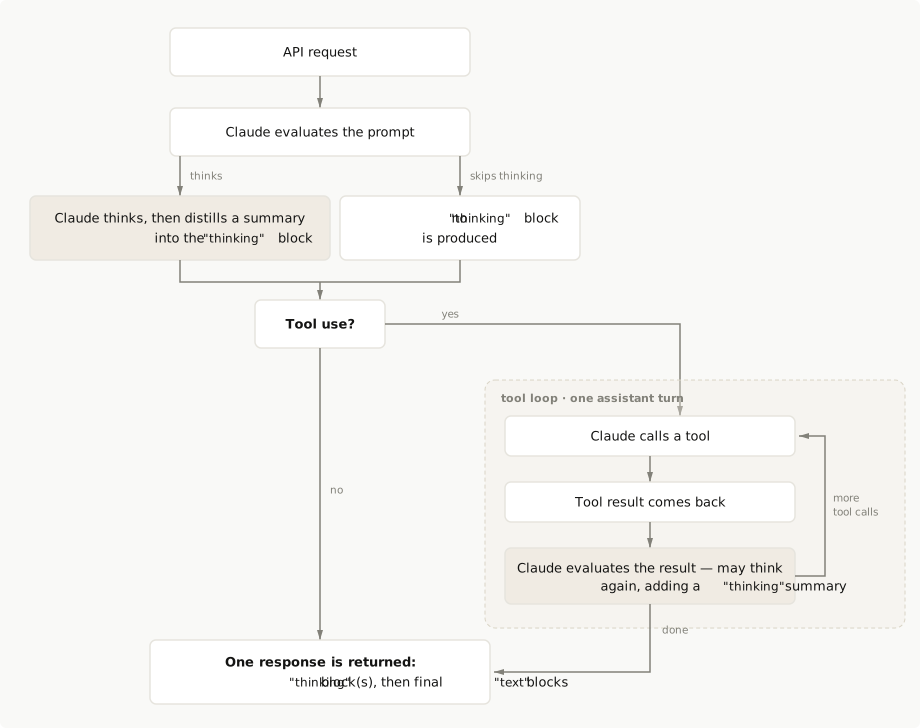
20 
2121</Frame>
2222
2323Whether Claude thinks on a given request, and how deeply, depends on your thinking configuration and the complexity of the request.
from line 71
7171
7272On Claude Opus 5.5, Claude Opus 5, Claude Sonnet 5.5, Claude Sonnet 5, Claude Fable 5.1, Claude Mythos 5.1, Claude Fable 5, Claude Mythos 5, and Claude Mythos Preview, thinking is already on and needs no configuration. `display` defaults to `"omitted"` on these models, so the thinking text is hidden until you opt in. Opt in with `thinking: {"type": "adaptive", "display": "summarized"}`, which is exactly the following request with the [model string](https://platform.claude.com/docs/en/models/overview) swapped.
7373
74On Claude Opus 4.8, Claude Opus 4.7, Claude Opus 4.6, and Claude Sonnet 4.6, thinking is off until you set `thinking: {type: "adaptive"}`, which lets Claude decide when and how deeply to think based on the request. The following examples do that, set `display: "summarized"` so the thinking text is visible, and use a roomy `max_tokens`:
74On Claude Opus 4.8, Claude Opus 4.7, Claude Opus 4.6, and Claude Sonnet 4.6, thinking is off until you set `thinking: {type: "adaptive"}`, which lets Claude determine when and how deeply to think based on the request. The following examples do that, set `display: "summarized"` so the thinking text is visible, and use a roomy `max_tokens`:
7575
7676<CodeGroup>
7777 ```bash cURL
from line 966
966966
967967Interleaved thinking lets Claude think between tool calls, reasoning about each tool result before acting on it. With interleaved thinking, Claude can:
968968
969* Reason about the results of a tool call before deciding what to do next
969* Reason about the results of a tool call before determining what to do next
970970* Chain multiple tool calls with reasoning steps in between
971971* Make more nuanced decisions based on intermediate results
972972
from line 994
994994
995995On Claude Sonnet 5.5, the lowest thinking setting is `thinking: {type: "between_tools"}`. It turns off up-front thinking, and each progress update comes back with its summary text, as it would under `display: "updates"`. `between_tools` is accepted only at [effort](https://platform.claude.com/docs/en/build-with-claude/effort) `high` or below. At `xhigh` or `max`, a request with it returns a 400 error. `between_tools` takes no other field: `display`, `budget_tokens`, or `block_binding` sent with it returns a 400 error. The setting needs no beta header and works on every platform that offers Claude Sonnet 5.5. Pass the blocks back unchanged: a progress-update block you send back gives the model the full note it wrote, not the summary.
996996
997Use `display: "updates"` for an agent interface that keeps reasoning hidden and shows the user a status line at each step. Under it, any `thinking` block with non-empty text is a progress update, so render those and nothing else. It's in beta and requires the beta header `thinking-display-updates-2026-08-18` (on Amazon Bedrock, Google Cloud, and Microsoft Foundry, pass the beta value as described in [Beta headers](https://platform.claude.com/docs/en/api/beta-headers)). Without it, the value is rejected with the same 400 `invalid_request_error` as an unknown `display` value.
997Use `display: "updates"` for an agent interface that keeps reasoning hidden and shows the user a status line at each step. Under it, any `thinking` block with non-empty text is a progress update, so render those and nothing else. It's in beta and requires the beta header `thinking-display-updates-2026-08-18` (to send it on Amazon Bedrock, Google Cloud, or Microsoft Foundry, see [Beta features on other platforms](https://platform.claude.com/docs/en/api/beta-headers#beta-features-on-other-platforms)). Without it, the value is rejected with the same 400 `invalid_request_error` as an unknown `display` value.
998998
999999```json
10001000{
from line 1076
10761076
10771077## Preserved thinking
10781078
1079[Preserved thinking](https://platform.claude.com/docs/en/build-with-claude/preserved-thinking) decides whether the model can use a thinking block that you send back from an earlier turn. Starting with Claude Fable 5.1, the API checks the `signature` of every `thinking` or `redacted_thinking` block in a request for two things:
1079[Preserved thinking](https://platform.claude.com/docs/en/build-with-claude/preserved-thinking) determines whether the model can use a thinking block that you send back from an earlier turn. Starting with Claude Fable 5.1, the API checks the `signature` of every `thinking` or `redacted_thinking` block in a request for two things:
10801080
10811081* **The model that produced it.** Each model reads its own thinking blocks and those of a fixed set of other models. Claude Fable 5.1 reads blocks from Claude Opus 5 and, on the Claude API, from Claude Opus 5.5; neither Claude Opus 5 nor Claude Opus 5.5 reads blocks from Claude Fable 5.1. The API drops a block the current model can't read, without an error and without billing it. See [Switching models mid-conversation](https://platform.claude.com/docs/en/build-with-claude/preserved-thinking#switching-models).
10821082* **Everything sent before it.** A block stays valid only while the top-level `system` prompt, the `tools`, and the messages before it are unchanged. If any of them changes, that block and every later thinking block are invalid, and the API rejects the request with a 400 error or drops the invalid blocks, whichever you choose. See [Keeping the prefix unchanged](https://platform.claude.com/docs/en/build-with-claude/preserved-thinking#prefix-check).
build-with-claude/thinking-steering-and-cost Changed · +8 / -8 lines
## How Claude determines when to think ## How Claude decides when to think
from line 8
88 To learn how zero data retention (ZDR) applies to this feature, see [API and data retention](https://platform.claude.com/docs/en/manage-claude/api-and-data-retention).
99</Note>
1010
11Claude's thinking is adaptive: the model evaluates each request and decides for itself whether to think and how much. You set an intent, optionally specify the effort, and the model allocates reasoning where it judges reasoning will help.
11Claude's thinking is adaptive: the model evaluates each request and determines whether to think and how much. You set an intent, optionally specify the effort, and the model allocates reasoning where it judges reasoning will help.
1212
1313This makes thinking a strong fit for workloads that mix trivial and complex requests, and for long-horizon agentic workflows where the right amount of reasoning varies from step to step.
1414
15To learn how to turn thinking on, how to read thinking output, and about [thinking output on Claude Fable 5 and Claude Mythos 5](https://platform.claude.com/docs/en/build-with-claude/thinking#thinking-output-on-claude-fable-5-and-claude-mythos-5), see the [Thinking](https://platform.claude.com/docs/en/build-with-claude/thinking) overview. This page covers how Claude decides when to think, how to steer that decision, and the caching, cost, and pricing mechanics that follow from it.
15To learn how to turn thinking on, how to read thinking output, and about [thinking output on Claude Fable 5 and Claude Mythos 5](https://platform.claude.com/docs/en/build-with-claude/thinking#thinking-output-on-claude-fable-5-and-claude-mythos-5), see the [Thinking](https://platform.claude.com/docs/en/build-with-claude/thinking) overview. This page covers how Claude determines when to think, how to steer thinking, and the caching, cost, and pricing mechanics that follow from it.
1616
17## How Claude decides when to think
17## How Claude determines when to think
1818
19Thinking is optional for the model. On each request, Claude weighs the complexity of the input and decides whether deeper reasoning would improve the answer. A simple factual question may get a direct response with no thinking block at all; a multistep math problem or a tricky debugging task triggers deeper reasoning.
19Thinking is optional for the model. On each request, Claude weighs the complexity of the input and determines whether deeper reasoning would improve the answer. A simple factual question may get a direct response with no thinking block at all; a multistep math problem or a tricky debugging task triggers deeper reasoning.
2020
2121The decision happens per request. The same conversation can contain turns with and without thinking, and a turn where Claude chose not to think contains no thinking block. Don't build application logic that assumes every assistant turn starts with one.
2222
from line 24
2424
2525If you want Claude to think less often, lower the effort level before reaching for prompt-based steering.
2626
27Thinking also interleaves with tool use automatically: Claude can think between tool calls, reflecting on each tool result before deciding what to do next ([interleaved thinking](https://platform.claude.com/docs/en/build-with-claude/thinking#interleaved-thinking)). You don't need a beta header or any additional configuration for this.
27Thinking also interleaves with tool use automatically: Claude can think between tool calls, reflecting on each tool result before determining what to do next ([interleaved thinking](https://platform.claude.com/docs/en/build-with-claude/thinking#interleaved-thinking)). You don't need a beta header or any additional configuration for this.
2828
2929For the full picture of how the thinking configuration and the effort parameter interact, see [Thinking and effort](https://platform.claude.com/docs/en/build-with-claude/thinking#thinking-and-effort).
3030
from line 51
5151| `medium` (default on Claude Opus 5.5) | Claude uses moderate thinking. May skip thinking for simple queries. |
5252| `low` | Claude minimizes thinking. Skips thinking for simple tasks where speed matters most. |
5353
54At every level, Claude decides per request whether to think. In a tool-use loop, the first request after new user input typically carries most of the reasoning, and follow-up requests that only process tool results can skip thinking, including at `xhigh` and `max`. Thinking per request also tends to decrease as a conversation grows longer. No level guarantees a thinking block on every request.
54At every level, Claude determines per request whether to think. In a tool-use loop, the first request after new user input typically carries most of the reasoning, and follow-up requests that only process tool results can skip thinking, including at `xhigh` and `max`. Thinking per request also tends to decrease as a conversation grows longer. No level guarantees a thinking block on every request.
5555
5656This table describes how each level changes thinking behavior. For guidance on which level to choose for a given workload, including per-model recommendations, see [When to adjust the effort parameter](https://platform.claude.com/docs/en/build-with-claude/effort#when-to-adjust-the-effort-parameter) on the effort page.
5757
claude_api_primer Changed · +3 / -3 lines
from line 238
238238
239239## Thinking
240240
241Thinking can sometimes help Claude with very hard tasks. The current mechanism is [adaptive thinking](https://platform.claude.com/docs/en/build-with-claude/thinking) (`thinking: {"type": "adaptive"}`): Claude decides when and how much to think, and you steer thinking depth with the [`effort`](https://platform.claude.com/docs/en/build-with-claude/effort) parameter rather than a token budget. Adaptive thinking is supported on Claude 4.6 and later models and Claude Mythos Preview. On Claude 5 models and Claude Mythos Preview, thinking is on by default when the `thinking` parameter is omitted.
241Thinking can sometimes help Claude with very hard tasks. The current mechanism is [adaptive thinking](https://platform.claude.com/docs/en/build-with-claude/thinking) (`thinking: {"type": "adaptive"}`): Claude determines when and how much to think, and you steer thinking depth with the [`effort`](https://platform.claude.com/docs/en/build-with-claude/effort) parameter rather than a token budget. Adaptive thinking is supported on Claude 4.6 and later models and Claude Mythos Preview. On Claude 5 models and Claude Mythos Preview, thinking is on by default when the `thinking` parameter is omitted.
242242
243243Temperature must be set to 1 (or left unset) whenever thinking is enabled, on all models. On Claude 4.7 and later models and Claude Mythos Preview, `temperature` is deprecated and only its default value is accepted, even when thinking is off.
244244
from line 253
253253* Claude Opus 4.6 (`claude-opus-4-6`, adaptive or legacy manual thinking)
254254* Claude Sonnet 4.6 (`claude-sonnet-4-6`, adaptive or legacy manual thinking)
255255* Claude Opus 4.5 (`claude-opus-4-5-20251101`, legacy manual thinking only)
256* Claude Sonnet 4.5 (`claude-sonnet-4-5-20250929`, legacy manual thinking only)
256* Claude Sonnet 4.5 (`claude-sonnet-4-5-20250929`, [deprecated](https://platform.claude.com/docs/en/about-claude/model-deprecations), legacy manual thinking only)
257257* Claude Haiku 4.5 (`claude-haiku-4-5-20251001`, legacy manual thinking only)
258258
259259<Note>
from line 444
444444
445445### Interleaved thinking
446446
447Interleaved thinking enables Claude to think between tool calls, reasoning about tool results before deciding the next step.
447Interleaved thinking enables Claude to think between tool calls, reasoning about tool results before determining the next step.
448448
449449<Info>
450450 On models with [adaptive thinking](https://platform.claude.com/docs/en/build-with-claude/thinking) (`thinking: {type: "adaptive"}`), interleaved thinking is automatically enabled. No beta header is needed. Sonnet 4.6 supports both the `interleaved-thinking-2025-05-14` beta header with manual extended thinking and adaptive thinking.
manage-claude/authentication Changed · +3 / -3 lines
from line 48
4848
4949The legacy `x-api-key: YOUR_API_KEY` header is still supported in place of `Authorization`.
5050
51Store API keys in a secrets manager, rotate them periodically, and disable or delete any key you suspect has leaked. On the [API keys page](https://platform.claude.com/settings/keys), **Disable** is reversible (the Admin API reports the key's `status` as `"inactive"`, and **Re-enable** returns it to `"active"`), while **Delete** is permanent: the key is archived and still appears in [List API Keys](https://platform.claude.com/docs/en/api/beta/organization/api_keys/list) with `status: "archived"`. Expired keys can only be deleted. You can also set an [expiration](https://platform.claude.com/docs/en/manage-claude/authentication#key-expiration) when you create a key to limit how long a leaked credential stays usable.
51Store API keys in a secrets manager, rotate them periodically, and disable or delete any key you suspect has leaked. On the [API keys page](https://platform.claude.com/settings/keys), **Disable** is reversible (the Admin API reports the key's `status` as `"inactive"`, and **Re-enable** returns it to `"active"`), while **Delete** is permanent: the key is archived and still appears in [List API Keys](https://platform.claude.com/docs/en/api/organization/api_keys/list) with `status: "archived"`. Expired keys can only be deleted. You can also set an [expiration](https://platform.claude.com/docs/en/manage-claude/authentication#key-expiration) when you create a key to limit how long a leaked credential stays usable.
5252
5353<CodeGroup>
5454 ```bash cURL
from line 129
129129
130130The [Admin API](https://platform.claude.com/docs/en/manage-claude/admin-api) accepts a personal key or service account key only if the key isn't scoped to a specific workspace.
131131
132You can find a workspace's ID in the **ID** column of [Settings → Workspaces](https://platform.claude.com/settings/workspaces) in the Claude Console, or by calling the [List Workspaces](https://platform.claude.com/docs/en/api/beta/organization/workspaces/list) endpoint. List Workspaces includes the Default Workspace only when you pass `include_default=true`; its ID is also in the `anthropic-workspace-id` [response header](https://platform.claude.com/docs/en/manage-claude/workspaces#identify-the-workspace-behind-an-api-response) of any request that runs there.
132You can find a workspace's ID in the **ID** column of [Settings → Workspaces](https://platform.claude.com/settings/workspaces) in the Claude Console, or by calling the [List Workspaces](https://platform.claude.com/docs/en/api/organization/workspaces/list) endpoint. List Workspaces includes the Default Workspace only when you pass `include_default=true`; its ID is also in the `anthropic-workspace-id` [response header](https://platform.claude.com/docs/en/manage-claude/workspaces#identify-the-workspace-behind-an-api-response) of any request that runs there.
133133
134134<CodeGroup>
135135 ```bash cURL
from line 334
334334
335335After a key expires, requests made with it return a `401 authentication_error`. Create a new key to restore access; expired keys cannot be reactivated.
336336
337The Console API keys table shows each key's expiration, and the Admin API reports each key's `expires_at` timestamp on the [List API Keys](https://platform.claude.com/docs/en/api/beta/organization/api_keys/list) and [Retrieve API Key](https://platform.claude.com/docs/en/api/beta/organization/api_keys/retrieve) endpoints, so you can audit and rotate keys before they expire. The field is `null` for keys without an expiration.
337The Console API keys table shows each key's expiration, and the Admin API reports each key's `expires_at` timestamp on the [List API Keys](https://platform.claude.com/docs/en/api/organization/api_keys/list) and [Retrieve API Key](https://platform.claude.com/docs/en/api/organization/api_keys/retrieve) endpoints, so you can audit and rotate keys before they expire. The field is `null` for keys without an expiration.
338338
339339Expiration limits the lifetime of a leaked credential, but it is not a substitute for secret hygiene. Regardless of expiration, store keys in a secrets manager and disable or delete any key you suspect has leaked.
340340
manage-claude/usage-cost-api Changed · +3 / -3 lines
from line 153
153153```
154154
155155<Tip>
156 To retrieve your organization's API key IDs, use the [List API Keys](https://platform.claude.com/docs/en/api/beta/organization/api_keys/list) endpoint.
156 To retrieve your organization's API key IDs, use the [List API Keys](https://platform.claude.com/docs/en/api/organization/api_keys/list) endpoint.
157157
158 To retrieve your organization's workspace IDs, use the [List Workspaces](https://platform.claude.com/docs/en/api/beta/organization/workspaces/list) endpoint, or find your organization's workspace IDs in the Claude Console.
158 To retrieve your organization's workspace IDs, use the [List Workspaces](https://platform.claude.com/docs/en/api/organization/workspaces/list) endpoint, or find your organization's workspace IDs in the Claude Console.
159159</Tip>
160160
161161#### Data residency
manage-claude/user-management Changed · +8 / -8 lines
from line 121
121121
122122`GET /v1/organizations/users` returns the organization's members, most recently added first. Filter by `email` to look up a specific member; the match is case-insensitive and tolerates common variants of the same address (for example, `[email protected]` matches `[email protected]`). Requires the `read:members` scope.
123123
124For complete parameter details and response schemas, see [List users](https://platform.claude.com/docs/en/api/beta/organization/users/list) in the API reference.
124For complete parameter details and response schemas, see [List users](https://platform.claude.com/docs/en/api/organization/users/list) in the API reference.
125125
126126```bash cURL
from line 133
133133
134134`GET /v1/organizations/users/{user_id}` returns one member by ID. Requires the `read:members` scope.
135135
136For complete parameter details and response schemas, see [Get user](https://platform.claude.com/docs/en/api/beta/organization/users/retrieve) in the API reference.
136For complete parameter details and response schemas, see [Get user](https://platform.claude.com/docs/en/api/organization/users/retrieve) in the API reference.
137137
138138```bash cURL
139139curl "https://api.anthropic.com/v1/organizations/users/user_01AbCdEfGhIjKlMnOpQrSt" \
from line 145
145145
146146`POST /v1/organizations/users/{user_id}` sets the member's role to `user` or `managed`. Members holding an administrative role (`owner`, `membership_admin`, or `primary_owner`) cannot be changed through this endpoint, and administrative roles cannot be assigned; both return 400 and are managed in claude.ai organization settings. If your organization's identity provider manages roles (advanced SSO or advanced SCIM provisioning), role updates return 400. Requires the `write:members` scope.
147147
148For complete parameter details and response schemas, see [Update user](https://platform.claude.com/docs/en/api/beta/organization/users/update) in the API reference.
148For complete parameter details and response schemas, see [Update user](https://platform.claude.com/docs/en/api/organization/users/update) in the API reference.
149149
150150```bash cURL
151151curl -X POST "https://api.anthropic.com/v1/organizations/users/user_01AbCdEfGhIjKlMnOpQrSt" \
from line 159
159159
160160`DELETE /v1/organizations/users/{user_id}` removes the member from the organization, returning any purchased seat they occupied to the organization's pool. Members holding an administrative role cannot be removed through this endpoint, and if your identity provider manages membership (SCIM), removals return 400. Requires the `write:members` scope.
161161
162For complete parameter details and response schemas, see [Remove user](https://platform.claude.com/docs/en/api/beta/organization/users/remove) in the API reference.
162For complete parameter details and response schemas, see [Remove user](https://platform.claude.com/docs/en/api/organization/users/remove) in the API reference.
163163
164164```bash cURL
165165curl -X DELETE "https://api.anthropic.com/v1/organizations/users/user_01AbCdEfGhIjKlMnOpQrSt" \
from line 184
184184
185185The optional `rbac_group_ids` field lists groups (by `rbac_group_`-prefixed ID) to assign to the member when they accept. Passing a non-empty `rbac_group_ids` additionally requires the key to carry the `write:rbac_groups` scope, because group assignment can grant the permissions attached to the group's roles.
186186
187For complete parameter details and response schemas, see [Create invite](https://platform.claude.com/docs/en/api/beta/organization/invites/create) in the API reference.
187For complete parameter details and response schemas, see [Create invite](https://platform.claude.com/docs/en/api/organization/invites/create) in the API reference.
188188
189189```bash cURL
190190curl -X POST "https://api.anthropic.com/v1/organizations/invites" \
from line 216
216216
217217`GET /v1/organizations/invites` returns the organization's invites, most recent first, across the `pending`, `accepted`, and `expired` states; there is no status filter. Requires the `read:members` scope.
218218
219For complete parameter details and response schemas, see [List invites](https://platform.claude.com/docs/en/api/beta/organization/invites/list) in the API reference.
219For complete parameter details and response schemas, see [List invites](https://platform.claude.com/docs/en/api/organization/invites/list) in the API reference.
220220
221221```bash cURL
222222curl "https://api.anthropic.com/v1/organizations/invites?limit=20" \
from line 228
228228
229229`GET /v1/organizations/invites/{invite_id}` returns one invite by ID. Requires the `read:members` scope.
230230
231For complete parameter details and response schemas, see [Get invite](https://platform.claude.com/docs/en/api/beta/organization/invites/retrieve) in the API reference.
231For complete parameter details and response schemas, see [Get invite](https://platform.claude.com/docs/en/api/organization/invites/retrieve) in the API reference.
232232
233233```bash cURL
234234curl "https://api.anthropic.com/v1/organizations/invites/invite_01QrStUvWxYzAbCdEfGhIj" \
from line 240
240240
241241`DELETE /v1/organizations/invites/{invite_id}` withdraws a `pending` invite, deactivating the link in the invitation email. Withdrawing an `accepted` invite returns 400 (remove the member instead); withdrawing an `expired` invite returns 400. Requires the `write:members` scope.
242242
243For complete parameter details and response schemas, see [Delete invite](https://platform.claude.com/docs/en/api/beta/organization/invites/delete) in the API reference.
243For complete parameter details and response schemas, see [Delete invite](https://platform.claude.com/docs/en/api/organization/invites/delete) in the API reference.
244244
245245```bash cURL
246246curl -X DELETE "https://api.anthropic.com/v1/organizations/invites/invite_01QrStUvWxYzAbCdEfGhIj" \
manage-claude/wif-reference Changed · +10 / -10 lines
from line 143
143143
144144Anthropic enforces these constraints when you create or update issuers and rules, and when verifying an incoming JWT at exchange time.
145145
146For complete parameter details and response schemas, see the [Service accounts API reference](https://platform.claude.com/docs/en/api/beta/organization/service_accounts), [Federation issuers API reference](https://platform.claude.com/docs/en/api/beta/organization/federation/issuers), and [Federation rules API reference](https://platform.claude.com/docs/en/api/beta/organization/federation/rules).
146For complete parameter details and response schemas, see the [Service accounts API reference](https://platform.claude.com/docs/en/api/organization/service_accounts), [Federation issuers API reference](https://platform.claude.com/docs/en/api/organization/federation/issuers), and [Federation rules API reference](https://platform.claude.com/docs/en/api/organization/federation/rules).
147147
148148### Resource fields
149149
from line 172
172172
173173### JWT verification
174174
175| Constraint | Detail |
176| ----------------- | ------------------------------------------------------------------------------------------------------------------------------------------------------------------------------------------------------------------------------------------------------------------------------------------------------------------------------------------------------------------------------------------------------------ |
177| Maximum size | The `assertion` JWT must be at most 16 KiB. |
178| Signing algorithm | Only asymmetric algorithms (RSA and ECDSA families: ES256, ES384, ES512, RS256, RS384, RS512, PS256, PS384, PS512) are accepted. HMAC (`HS256`, `HS384`, `HS512`) and `none` are rejected. |
179| Key ID | The JWT header must carry a `kid` that matches a key in the issuer's JWKS. Tokens without `kid` are rejected. |
180| Required claims | `sub` must be present. `iat` must be present and not in the future. `exp` must be present and in the future. |
181| Single use | An assertion that carries a `jti` claim can be exchanged only once per issuer: repeating an exchange with the same `jti` is rejected as a replay. The issuer's `check_jti` field (enabled by default) controls this check; assertions without a `jti` claim are not subject to it. See the [Federation issuers API reference](https://platform.claude.com/docs/en/api/beta/organization/federation/issuers). |
182| Maximum lifetime | The token's lifetime (`exp` minus `iat`) must not exceed the issuer's configured maximum (1 hour by default, configurable for each issuer in the Claude Console). |
183| Clock skew | A 30-second leeway is applied to `exp`, `nbf`, and `iat`. |
175| Constraint | Detail |
176| ----------------- | ------------------------------------------------------------------------------------------------------------------------------------------------------------------------------------------------------------------------------------------------------------------------------------------------------------------------------------------------------------------------------------------------------- |
177| Maximum size | The `assertion` JWT must be at most 16 KiB. |
178| Signing algorithm | Only asymmetric algorithms (RSA and ECDSA families: ES256, ES384, ES512, RS256, RS384, RS512, PS256, PS384, PS512) are accepted. HMAC (`HS256`, `HS384`, `HS512`) and `none` are rejected. |
179| Key ID | The JWT header must carry a `kid` that matches a key in the issuer's JWKS. Tokens without `kid` are rejected. |
180| Required claims | `sub` must be present. `iat` must be present and not in the future. `exp` must be present and in the future. |
181| Single use | An assertion that carries a `jti` claim can be exchanged only once per issuer: repeating an exchange with the same `jti` is rejected as a replay. The issuer's `check_jti` field (enabled by default) controls this check; assertions without a `jti` claim are not subject to it. See the [Federation issuers API reference](https://platform.claude.com/docs/en/api/organization/federation/issuers). |
182| Maximum lifetime | The token's lifetime (`exp` minus `iat`) must not exceed the issuer's configured maximum (1 hour by default, configurable for each issuer in the Claude Console). |
183| Clock skew | A 30-second leeway is applied to `exp`, `nbf`, and `iat`. |
184184
185185## Rule matching semantics
186186
managed-agents/environments Changed · +4 / -2 lines
from line 416
416416
417417### Networking
418418
419The `networking` field controls the sandbox's outbound network access. It does not affect the `web_search` or `web_fetch` tools, which run on Anthropic's servers; to restrict the sites those tools can reach, set `allowed_domains` or `blocked_domains` on the tool's entry in the agent toolset. See [Restrict web search and web fetch domains](https://platform.claude.com/docs/en/managed-agents/tools-web-restrictions).
419The `networking` field controls the sandbox's outbound network access.
420420
421With `limited` networking, `allowed_hosts` also applies to the `web_search` and `web_fetch` tools, which run on Anthropic's servers. A `web_fetch` call for a URL on a host that `allowed_hosts` does not match returns an error result to the agent. `web_search` omits results from hosts that `allowed_hosts` does not match. `allow_package_managers` and `allow_mcp_servers` add no hosts for these tools. When `allowed_hosts` lists no hosts, no `web_fetch` or `web_search` call returns a page or a search result. A host that you add to `allowed_hosts` for these tools is also open to the sandbox. `unrestricted` networking and self-hosted environments do not limit these tools. To restrict them further, set `allowed_domains` or `blocked_domains` on the tool's entry in the agent toolset. See [Restrict web search and web fetch domains](https://platform.claude.com/docs/en/managed-agents/tools-web-restrictions).
422
421423| Mode | Description |
422424| -------------- | ---------------------------------------------------------------------------------------------------------------------------------------------------------------------------------------------------------------------------------------- |
423425| `limited` | Restricts sandbox network access to the hosts in `allowed_hosts`. Set `allow_package_managers` and `allow_mcp_servers` to `true` to allow additional access. Use this mode unless the agent must reach sites you cannot list in advance. |
from line 644
642644}
643645```
644646
645An agent that only uses the `web_search` and `web_fetch` tools does not need `unrestricted` networking if you can list the sites it needs. [Networking](https://platform.claude.com/docs/en/managed-agents/environments#networking) says when `allowed_hosts` applies to those tools. Where it does, list those sites in `allowed_hosts`. Listing them in `web_search`'s `allowed_domains` too makes it search those sites. A host that you add to `allowed_hosts` is also open to the sandbox. To restrict the tools further, see [Restrict web search and web fetch domains](https://platform.claude.com/docs/en/managed-agents/tools-web-restrictions).
647An agent that only uses the `web_search` and `web_fetch` tools does not need `unrestricted` networking if you can list the sites it needs. With `limited` networking, `allowed_hosts` also applies to those tools (see [Networking](https://platform.claude.com/docs/en/managed-agents/environments#networking)), so list those sites in `allowed_hosts`. Listing them in `web_search`'s `allowed_domains` too makes it search those sites. A host that you add to `allowed_hosts` is also open to the sandbox. To restrict the tools further, see [Restrict web search and web fetch domains](https://platform.claude.com/docs/en/managed-agents/tools-web-restrictions).
646648
647649Use `unrestricted` only when the agent must reach sites you cannot list in advance. In that case, keep secrets and sensitive files out of the sandbox, and give the agent only the credentials the task needs. Consider setting the `bash` tool's permission policy to `always_ask` or `auto`, and [watch the session's events](https://platform.claude.com/docs/en/managed-agents/events-and-streaming).
648650
managed-agents/tools-web-restrictions Changed · +5 / -4 lines
from line 18
1818Each tool carries its own list, so `web_search` and `web_fetch` can have different restrictions.
1919
2020<Note>
21 These per-tool lists are the way to restrict what the web tools can reach. Two other settings do not affect these tools:
22
23 * **Environment networking:** An environment's [`networking`](https://platform.claude.com/docs/en/managed-agents/environments#networking) settings control the sandbox's own outbound traffic. `web_search` and `web_fetch` run on Anthropic's servers, whether the environment is a cloud or self-hosted sandbox.
24 * **Organization settings:** Organization-level web search and web fetch settings in the Claude Console apply to the Messages API. They do not apply to Managed Agents sessions.
21 `web_search` and `web_fetch` run on Anthropic's servers, not in the sandbox. A cloud environment with `limited` [networking](https://platform.claude.com/docs/en/managed-agents/environments#networking) also applies its `allowed_hosts` to them; see [Set domain lists on an agent](https://platform.claude.com/docs/en/managed-agents/tools-web-restrictions#set-domain-lists-on-an-agent). `unrestricted` networking and self-hosted environments do not limit them. The per-tool lists restrict these tools further. Organization-level web search and web fetch settings in the Claude Console apply to the Messages API. They do not apply to Managed Agents sessions.
2522</Note>
2623
2724## Set domain lists on an agent
from line 370
373370 ```
374371</CodeGroup>
375372
373In a cloud environment with `limited` [networking](https://platform.claude.com/docs/en/managed-agents/environments#networking), the environment's `allowed_hosts` also applies to `web_search` and `web_fetch`. Creating a session fails with a 400 error when an enabled web tool's `allowed_domains` has an entry that is not within `allowed_hosts`. So does a session update that adds such an entry. To fix it, add the host to `allowed_hosts` or remove the entry from `allowed_domains`. At runtime, a `web_fetch` call for a URL on a host that `allowed_hosts` does not match returns a `url_not_allowed` error result. `web_search` omits results from such hosts. The two lists match differently: a tool's entry covers its subdomains, but an `allowed_hosts` entry matches one exact host unless it starts with `*.`. For example, the tool entry `docs.example.com` is not within an `allowed_hosts` of `["example.com"]`, but it is within `["docs.example.com"]` or `["*.example.com"]`.
374
376375In the Claude Console, set allowed or blocked domains from the `web_search` and `web_fetch` rows of the **Built-in tools** card on the agent form. Set `max_content_tokens` and `user_location` in the **Raw** view of the agent's configuration.
377376
378377## Settings
from line 448
449448* A domain in `allowed_domains` that Anthropic's crawler is not permitted to access.
450449* A `user_location.country` that the search provider does not support. The message ends in `user_location.country: not a country the search provider supports`.
451450* A `user_location.timezone` that is not a valid IANA name.
451
452In a cloud environment with `limited` [networking](https://platform.claude.com/docs/en/managed-agents/environments#networking), session create and update also check `allowed_domains` against the environment's `allowed_hosts`. See the rule in [Set domain lists on an agent](https://platform.claude.com/docs/en/managed-agents/tools-web-restrictions#set-domain-lists-on-an-agent).
452453
453454### When an accepted setting is no longer valid
454455
models/fable-5-1/migration-guide Changed · +4 / -4 lines
from line 1
11---
2title: Migrating to Claude Fable 5.1 and Claude Mythos 5.1
2title: Claude Fable 5.1 and Claude Mythos 5.1 migration guide
33url: https://platform.claude.com/docs/en/models/fable-5-1/migration-guide
4description: "Migrate to Claude Fable 5.1 and Claude Mythos 5.1 from Claude Fable 5, Claude Mythos 5, Claude Opus 5, or Claude Opus 4.8: model IDs, breaking changes, and migration checklists."
4description: Switch to Claude Fable 5.1 and Claude Mythos 5.1 from Claude Fable 5, Claude Mythos 5, Claude Opus 5, or Claude Opus 4.8 with this migration guide. The guidance to enable Claude Fable 5.1 and Claude Mythos 5.1 includes model IDs, breaking changes, and migration checklists.
55---
66
77<Note>
from line 22
2222
2323The baseline settings shared by `claude-fable-5-1` and `claude-mythos-5-1`:
2424
25* **Thinking:** [Adaptive thinking](https://platform.claude.com/docs/en/build-with-claude/thinking) is always on, unchanged from Claude Fable 5. The model decides when and how much to think. No `thinking` configuration is required. Both `thinking: {type: "disabled"}` and manual extended thinking (`thinking: {type: "enabled", budget_tokens: N}`) return a 400 error.
25* **Thinking:** [Adaptive thinking](https://platform.claude.com/docs/en/build-with-claude/thinking) is always on, unchanged from Claude Fable 5. The model determines when and how much to think. No `thinking` configuration is required. Both `thinking: {type: "disabled"}` and manual extended thinking (`thinking: {type: "enabled", budget_tokens: N}`) return a 400 error.
2626* **Prefill:** Prefilling the assistant message returns a 400 error, unchanged from Claude Fable 5. Use system prompt instructions instead.
2727* **Tool choice:** `{type: "auto"}` (the default) and `{type: "none"}` are supported. Forcing a tool call with `{type: "any"}` or `{type: "tool", name: "..."}` returns a 400 error. See [Breaking changes](https://platform.claude.com/docs/en/models/fable-5-1/migration-guide#fable-5-1-breaking-changes).
2828* **Preserved thinking across models:** Claude Fable 5.1 reads thinking blocks from Claude Opus 5, Claude Fable 5, Claude Mythos 5, and earlier Claude models. None of those models can read Claude Fable 5.1's blocks. See [Breaking changes](https://platform.claude.com/docs/en/models/fable-5-1/migration-guide#fable-5-1-breaking-changes).
from line 1574
15741574
15751575## Migrating to Claude Fable 5.1 from Claude Opus 4.8 or earlier
15761576
1577First apply [Migrating to Claude Mythos 5 and Claude Fable 5 from Claude Opus 4.8](https://platform.claude.com/docs/en/models/fable-5/migration-guide#migrating-from-claude-opus-48) for the API-level changes from Claude Opus 4.8. It covers adaptive thinking, thinking output, refusals, effort, the caching minimum, pricing, and data retention. Then apply the remaining delta in [Migrating to Claude Fable 5.1 from Claude Fable 5](https://platform.claude.com/docs/en/models/fable-5-1/migration-guide#migrating-from-claude-fable-5-to-claude-fable-5-1). On Claude Opus 4.7 or earlier, start with the matching [Migrating to Claude Opus 5.5](https://platform.claude.com/docs/en/models/opus-5-5/migration-guide) section.
1577First apply [Migrating to Claude Mythos 5 and Claude Fable 5 from Claude Opus 4.8](https://platform.claude.com/docs/en/models/fable-5/migration-guide#migrating-from-claude-opus-48) for the API-level changes from Claude Opus 4.8. It covers adaptive thinking, thinking output, refusals, effort, the caching minimum, pricing, and data retention. Then apply the remaining delta in [Migrating to Claude Fable 5.1 from Claude Fable 5](https://platform.claude.com/docs/en/models/fable-5-1/migration-guide#migrating-from-claude-fable-5-to-claude-fable-5-1). On Claude Opus 4.7 or earlier, start with the matching [Claude Opus 5.5 migration guide](https://platform.claude.com/docs/en/models/opus-5-5/migration-guide) section.
15781578
15791579### Update your model name
15801580
models/fable-5/migration-guide Changed · +3 / -3 lines
from line 1
11---
2title: Migrating to Claude Mythos 5 and Claude Fable 5
2title: Claude Mythos 5 and Claude Fable 5 migration guide
33url: https://platform.claude.com/docs/en/models/fable-5/migration-guide
4description: "Migrate to Claude Mythos 5 and Claude Fable 5 from Claude Mythos Preview, Claude Opus 5, or Claude Opus 4.8: model IDs, API changes, and migration checklists."
4description: Switch to Claude Mythos 5 and Claude Fable 5 from Claude Mythos Preview, Claude Opus 5, or Claude Opus 4.8 with this migration guide. The guidance to enable Claude Mythos 5 and Claude Fable 5 includes model IDs, API changes, and migration checklists.
55---
66
77<Note>
from line 362
362362## Migrating to Claude Mythos 5 and Claude Fable 5 from Claude Opus 4.8
363363
364364<Note>
365 If your code is on Claude Opus 4.7 or earlier, first apply the relevant [Migrating to Claude Opus 5.5](https://platform.claude.com/docs/en/models/opus-5-5/migration-guide) from-section for the API-level changes from your current model, then the remaining delta in this section.
365 If your code is on Claude Opus 4.7 or earlier, first apply the relevant [Claude Opus 5.5 migration guide](https://platform.claude.com/docs/en/models/opus-5-5/migration-guide) from-section for the API-level changes from your current model, then the remaining delta in this section.
366366</Note>
367367
368368Migration is mostly drop-in. Claude Fable 5 and Claude Mythos 5 use the same [Messages API](https://platform.claude.com/docs/en/build-with-claude/working-with-messages) and the same [tool use](https://platform.claude.com/docs/en/agents-and-tools/tool-use/overview) patterns as Claude Opus 4.8, with the same [1M token context window](https://platform.claude.com/docs/en/build-with-claude/context-windows) by default and the same [128k max output tokens](https://platform.claude.com/docs/en/models/overview). Token counts are roughly unchanged because the models use the same tokenizer. The key changes to check are always-on [adaptive thinking](https://platform.claude.com/docs/en/build-with-claude/thinking), thinking output, safety classifier refusals, and pricing.
about-claude/models/optimizing-for-cost-and-intelligence Changed · +1 / -1 lines
from line 244
244244
245245## Trade cost against intelligence
246246
247These levers set where a single model sits between cost and intelligence: model choice, effort, re-running failures at a higher setting, the budgets and caps it works within, and whether it can see how much time has passed. Start with an effort sweep on your current model ([Tune effort](https://platform.claude.com/docs/en/about-claude/models/optimizing-for-cost-and-intelligence#tune-effort)). From lowest to highest cost and capability, the current models are Claude Haiku 4.5, Claude Sonnet 5, Claude Opus 5.5, and Claude Fable 5.1 (the frontier model); [Models overview](https://platform.claude.com/docs/en/models/overview) has the full lineup and prices.
247These levers set where a single model sits between cost and intelligence: model choice, effort, re-running failures at a higher setting, the budgets and caps it works within, and whether it can see how much time has passed. Start with an effort sweep on your current model ([Tune effort](https://platform.claude.com/docs/en/about-claude/models/optimizing-for-cost-and-intelligence#tune-effort)). From lowest to highest cost and capability, the current models are Claude Haiku 4.5, Claude Sonnet 5.5, Claude Opus 5.5, and Claude Fable 5.1 (the frontier model); [Models overview](https://platform.claude.com/docs/en/models/overview) has the full lineup and prices.
248248
249249### Compare models on cost per task
250250
about-claude/pricing Changed · +1 / -1 lines
from line 70
7070
7171 Regional and multi-region endpoints include a 10% premium over global endpoints. The Claude API (first-party) is global by default; for first-party data residency options and pricing, see [Data residency pricing](https://platform.claude.com/docs/en/about-claude/pricing#data-residency-pricing).
7272
73 **Scope:** This pricing structure applies to Claude Sonnet 4.5, Haiku 4.5, Opus 4.5, and all future models. Earlier models (Claude Opus 4.1 and prior releases) retain their existing pricing.
73 **Scope:** This pricing structure applies to Claude Sonnet 4.5 (deprecated), Haiku 4.5, Opus 4.5, and all future models. Earlier models (Claude Opus 4.1 and prior releases) retain their existing pricing.
7474
7575 For implementation details and code examples:
7676
agents-and-tools/agent-skills/claude-api-skill Changed · +1 / -1 lines
from line 129
129129
130130As it edits, the skill explains each change and its motivation inline. On completion, it produces a checklist of items that require manual verification (typically integration tests, length-control prompt tuning, and cost/rate-limit re-baselining).
131131
132For the full list of model-specific changes the skill applies, see [Migrating to Claude Opus 5.5 from Claude Opus 5](https://platform.claude.com/docs/en/models/opus-5-5/migration-guide#migrating-from-claude-opus-5), [Migrating to Claude Opus 5.5 from Claude Opus 4.8](https://platform.claude.com/docs/en/models/opus-5-5/migration-guide#migrating-from-claude-opus-4-8), [Migrating to Claude Sonnet 5.5 from Claude Sonnet 5](https://platform.claude.com/docs/en/models/sonnet-5-5/migration-guide#migrating-from-claude-sonnet-5), and [Migrating to Claude Fable 5.1](https://platform.claude.com/docs/en/models/fable-5-1/migration-guide).
132For the full list of model-specific changes the skill applies, see [Migrating to Claude Opus 5.5 from Claude Opus 5](https://platform.claude.com/docs/en/models/opus-5-5/migration-guide#migrating-from-claude-opus-5), [Migrating to Claude Opus 5.5 from Claude Opus 4.8](https://platform.claude.com/docs/en/models/opus-5-5/migration-guide#migrating-from-claude-opus-4-8), [Migrating to Claude Sonnet 5.5 from Claude Sonnet 5](https://platform.claude.com/docs/en/models/sonnet-5-5/migration-guide#migrating-from-claude-sonnet-5), and [Claude Fable 5.1 and Claude Mythos 5.1 migration guide](https://platform.claude.com/docs/en/models/fable-5-1/migration-guide).
133133
134134## Checking an integration for preserved thinking
135135