
context-windows changedbuild-with-claude/context-windows
Nearest release: v2.1.312, published under an hour before this site recorded the change. Shown because the two are within 24 hours of each other. Nothing here says the release caused the edit.
Recorded here
Lines+10added
Lines−10removed
From line
4
where the diff opens
First seen
14 Aug 2026
this site's first read of the page
Recorded edits10to this page, all time
The whole hunk
from line 4, old and new numbered
/
from line 4
44description: Understand how the context window works, how extended thinking and tool use count toward it, and how to manage context as conversations grow.
55---
66
7As conversations grow, you'll eventually approach context window limits. For long-running conversations and agentic workflows, [server-side compaction](https://platform.claude.com/docs/en/build-with-claude/compaction) is the primary strategy for context management.
7As conversations grow, you’ll eventually approach context window limits. For long-running conversations and agentic workflows, [server-side compaction](https://platform.claude.com/docs/en/build-with-claude/compaction) is the primary strategy for context management.
88
99## How the context window works
1010
11The "context window" refers to all the text a language model can reference when generating a response, including the response itself. This is different from the large corpus of data the language model was trained on, and instead represents a "working memory" for the model. A larger context window allows the model to handle more complex and lengthy prompts, but more context isn't automatically better. As token count grows, accuracy and recall degrade, a phenomenon known as *context rot*. This makes curating what's in context just as important as how much space is available.
11The “context window” refers to all the text a language model can reference when generating a response, including the response itself. This is different from the large corpus of data the language model was trained on, and instead represents a “working memory” for the model. A larger context window allows the model to handle more complex and lengthy prompts, but more context isn’t automatically better. As token count grows, accuracy and recall degrade, a phenomenon known as *context rot*. This makes curating what’s in context just as important as how much space is available.
1212
1313<Tip>
1414 For more on why long contexts degrade and how to engineer around it, see [Effective context engineering](https://www.anthropic.com/engineering/effective-context-engineering-for-ai-agents).
from line 20
2020 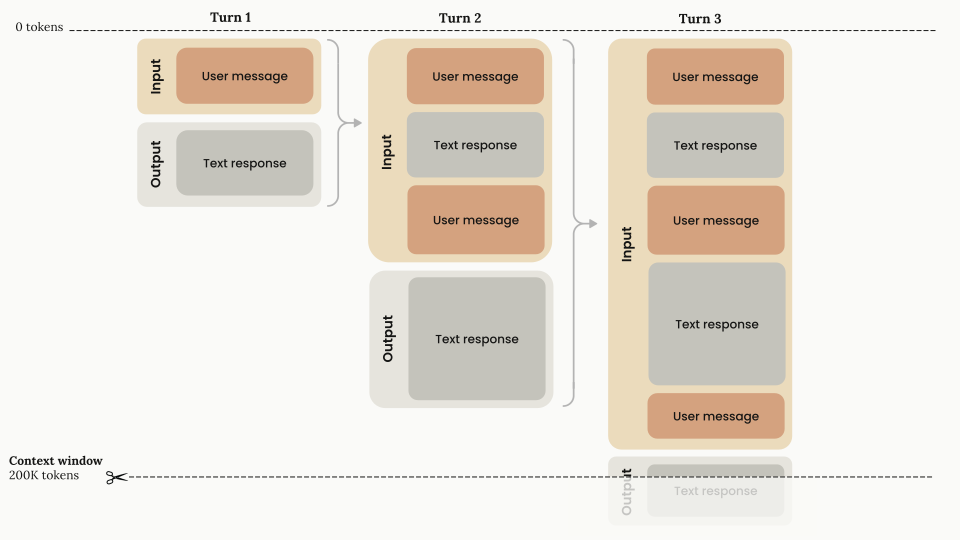
2121</Frame>
2222
23*1 Chat interfaces such as [claude.ai](https://claude.ai/) can also manage the context window on a rolling "first in, first out" basis.*
23*1 Chat interfaces such as [claude.ai](https://claude.ai/) can also manage the context window on a rolling “first in, first out” basis.*
2424
2525* **Progressive token accumulation:** As the conversation advances through turns, each user message and assistant response accumulates within the context window, and previous turns are preserved completely.
2626
from line 37
3737
3838Claude Fable 5.1, Claude Mythos 5.1, Claude Fable 5, Claude Mythos 5, Claude Opus 5.5, Claude Opus 5, Claude Opus 4.8, Claude Opus 4.7, Claude Opus 4.6, Claude Sonnet 5.5, Claude Sonnet 5, Claude Sonnet 4.6, Claude Haiku 5.5, and [Claude Mythos Preview](https://anthropic.com/glasswing) have a 1M-token context window. A single request to any of them can generate up to 128k output tokens (`max_tokens`). Other Claude models, including Claude Sonnet 4.5 (deprecated), have a 200k-token context window.
3939
40For every model with a 1M-token context window, 1M is the default: you don't need a beta header, and long-context requests are billed at [standard pricing](https://platform.claude.com/docs/en/about-claude/pricing#long-context-pricing), except on Claude Haiku 5.5, where prompts over 100,000 tokens cost more.
40For every model with a 1M-token context window, 1M is the default: you don’t need a beta header, and long-context requests are billed at [standard pricing](https://platform.claude.com/docs/en/about-claude/pricing#long-context-pricing), except on Claude Haiku 5.5, where prompts over 100,000 tokens cost more.
4141
4242A single request can include up to 600 images or PDF pages (100 for models with a 200k-token context window). If you send many images or large documents, you might reach [request size limits](https://platform.claude.com/docs/en/api/overview#request-size-limits) before the token limit.
4343
from line 57
5757 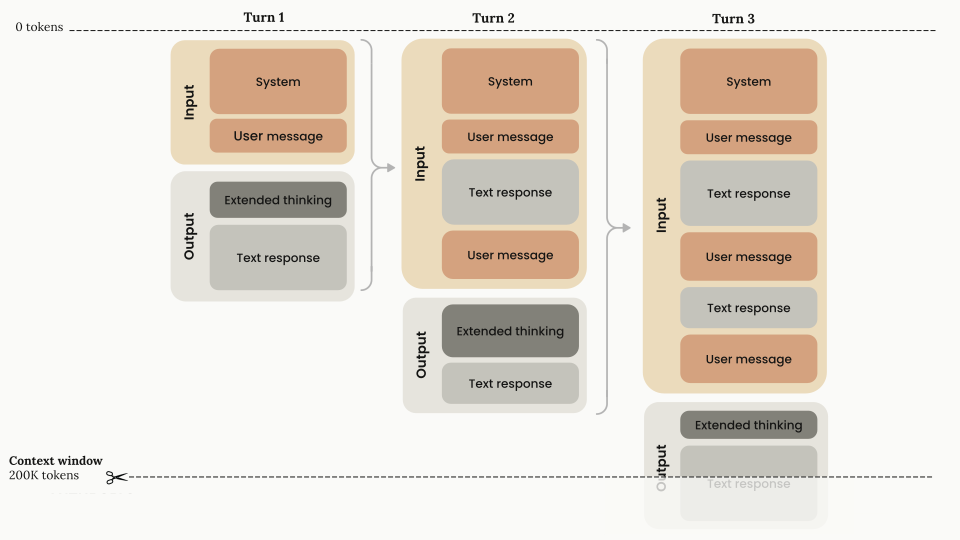
5858</Frame>
5959
60* **Stripping thinking blocks:** On models that strip previous thinking blocks, thinking blocks (shown in dark gray) are generated during each turn's output phase but are not carried forward as input tokens for subsequent turns. You do not need to strip the thinking blocks yourself: if you pass them back, the Claude API strips them automatically.
61* **Billing:** Thinking tokens are billed as output tokens once, when they are generated. On models that keep previous thinking blocks, the kept blocks are then part of later requests' input and are billed as input tokens, like the rest of the conversation history.
60* **Stripping thinking blocks:** On models that strip previous thinking blocks, thinking blocks (shown in dark gray) are generated during each turn’s output phase but are not carried forward as input tokens for subsequent turns. You do not need to strip the thinking blocks yourself: if you pass them back, the Claude API strips them automatically.
61* **Billing:** Thinking tokens are billed as output tokens once, when they are generated. On models that keep previous thinking blocks, the kept blocks are then part of later requests’ input and are billed as input tokens, like the rest of the conversation history.
6262
6363<Note>
6464 You can read more about the context window and thinking in the [Thinking](https://platform.claude.com/docs/en/build-with-claude/thinking) guide.
from line 107
107107
108108## Context awareness
109109
110Claude Sonnet 5, Claude Sonnet 4.6, Claude Sonnet 4.5 (deprecated), and Claude Haiku 4.5 have **context awareness:** these models track their remaining context window (their "token budget") throughout a conversation. This lets the model manage long-running tasks against the space that remains rather than guess how many tokens are left. Context awareness is automatic: there is nothing for you to enable, and you never send the tags shown in this section yourself. The API injects them.
110Claude Sonnet 5, Claude Sonnet 4.6, Claude Sonnet 4.5 (deprecated), and Claude Haiku 4.5 have **context awareness:** these models track their remaining context window (their “token budget”) throughout a conversation. This lets the model manage long-running tasks against the space that remains rather than guess how many tokens are left. Context awareness is automatic: there is nothing for you to enable, and you never send the tags shown in this section yourself. The API injects them.
111111
112112### How it works
113113
from line 127
127127
128128Image tokens are included in these budgets.
129129
130Claude Opus 4.7 and later Opus models, Claude Sonnet 5.5, Claude Fable 5.1, Claude Mythos 5.1, Claude Fable 5, Claude Mythos 5, and Claude Haiku 5.5 don't receive these injected tags. On these models, you can give the model an explicit budget with [task budgets](https://platform.claude.com/docs/en/build-with-claude/task-budgets), which are in beta.
130Claude Opus 4.7 and later Opus models, Claude Sonnet 5.5, Claude Fable 5.1, Claude Mythos 5.1, Claude Fable 5, Claude Mythos 5, and Claude Haiku 5.5 don’t receive these injected tags. On these models, you can give the model an explicit budget with [task budgets](https://platform.claude.com/docs/en/build-with-claude/task-budgets), which are in beta.
131131
132132<Tip>
133 For agents that span multiple sessions, design your state artifacts so that context recovery is fast when a new session starts. The [memory tool's multisession pattern](https://platform.claude.com/docs/en/agents-and-tools/tool-use/memory-tool#multisession-software-development-pattern) walks through a concrete approach. See also [Effective harnesses for long-running agents](https://www.anthropic.com/engineering/effective-harnesses-for-long-running-agents).
133 For agents that span multiple sessions, design your state artifacts so that context recovery is fast when a new session starts. The [memory tool’s multisession pattern](https://platform.claude.com/docs/en/agents-and-tools/tool-use/memory-tool#multisession-software-development-pattern) walks through a concrete approach. See also [Effective harnesses for long-running agents](https://www.anthropic.com/engineering/effective-harnesses-for-long-running-agents).
134134</Tip>
135135
136136For prompting guidance on using context awareness, see [Prompting best practices](https://platform.claude.com/docs/en/build-with-claude/prompt-engineering/claude-prompting-best-practices#context-awareness-and-multiwindow-workflows).
from line 148
148148
149149## Context window overflow behavior
150150
151If the input alone already exceeds the model's context window, the API returns a 400 `invalid_request_error` ("prompt is too long") on every model.
151If the input alone already exceeds the model’s context window, the API returns a 400 `invalid_request_error` (“prompt is too long”) on every model.
152152
153153On Claude 4.5 models and newer, if input tokens plus `max_tokens` exceeds the context window size, the API accepts the request. If generation then reaches the context window limit, it stops with `stop_reason: "model_context_window_exceeded"`. On earlier models, the API returns a [validation error](https://platform.claude.com/docs/en/api/errors) instead. To opt in to the `model_context_window_exceeded` behavior on those models, use the `model-context-window-exceeded-2025-08-26` beta header. See [Stop reasons and fallback](https://platform.claude.com/docs/en/build-with-claude/handling-stop-reasons) for details.
154154
No line in this hunk matches that.