
context-windows changedbuild-with-claude/context-windows
Nearest release: v2.1.293, published an hour before this site recorded the change. Shown because the two are within 24 hours of each other. Nothing here says the release caused the edit.
Recorded here
Lines+13added
Lines−7removed
From line
16
where the diff opens
First seen
14 Aug 2026
this site's first read of the page
Recorded edits9to this page, all time
The whole hunk
from line 16, old and new numbered
/
from line 16
1616
1717The following diagram illustrates the standard context window behavior for API requests1:
1818
19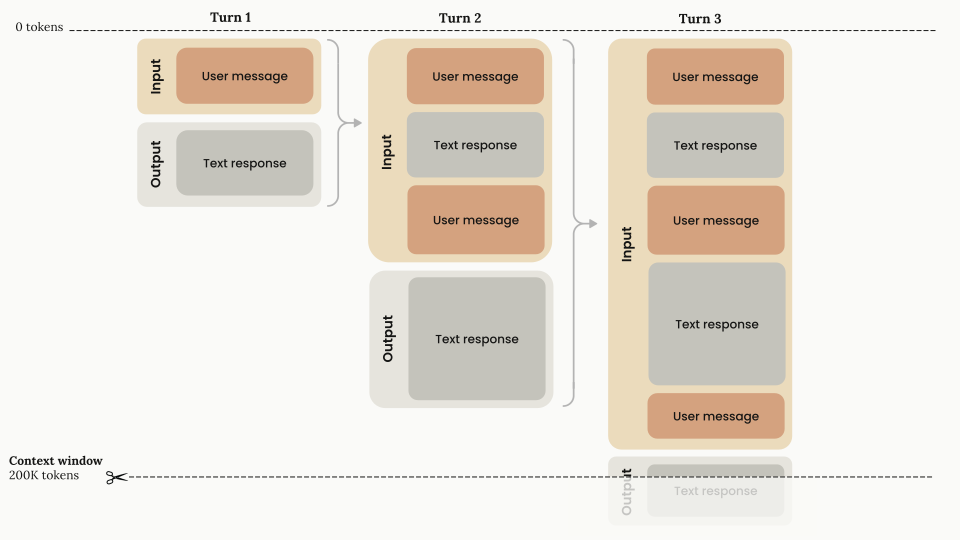
19<Frame>
20 
21</Frame>
2022
2123*1 Chat interfaces such as [claude.ai](https://claude.ai/) can also manage the context window on a rolling "first in, first out" basis.*
2224
from line 35
3335
3436## Context window sizes by model
3537
36Claude Fable 5.1, Claude Mythos 5.1, Claude Fable 5, Claude Mythos 5, Claude Opus 5.5, Claude Opus 5, Claude Opus 4.8, Claude Opus 4.7, Claude Opus 4.6, Claude Sonnet 5.5, Claude Sonnet 5, Claude Sonnet 4.6, and [Claude Mythos Preview](https://anthropic.com/glasswing) have a 1M-token context window. A single request to any of them can generate up to 128k output tokens (`max_tokens`). Other Claude models, including Claude Sonnet 4.5 (deprecated), have a 200k-token context window.
38Claude Fable 5.1, Claude Mythos 5.1, Claude Fable 5, Claude Mythos 5, Claude Opus 5.5, Claude Opus 5, Claude Opus 4.8, Claude Opus 4.7, Claude Opus 4.6, Claude Sonnet 5.5, Claude Sonnet 5, Claude Sonnet 4.6, Claude Haiku 5.5, and [Claude Mythos Preview](https://anthropic.com/glasswing) have a 1M-token context window. A single request to any of them can generate up to 128k output tokens (`max_tokens`). Other Claude models, including Claude Sonnet 4.5 (deprecated), have a 200k-token context window.
3739
38For every model with a 1M-token context window, 1M is the default: you don't need a beta header, and long-context requests are billed at [standard pricing](https://platform.claude.com/docs/en/about-claude/pricing#long-context-pricing).
40For every model with a 1M-token context window, 1M is the default: you don't need a beta header, and long-context requests are billed at [standard pricing](https://platform.claude.com/docs/en/about-claude/pricing#long-context-pricing), except on Claude Haiku 5.5, where prompts over 100,000 tokens cost more.
3941
4042A single request can include up to 600 images or PDF pages (100 for models with a 200k-token context window). If you send many images or large documents, you might reach [request size limits](https://platform.claude.com/docs/en/api/overview#request-size-limits) before the token limit.
4143
from line 49
4749
4850Thinking tokens are a subset of your `max_tokens` parameter, are billed as output tokens, and count toward rate limits. With [adaptive thinking](https://platform.claude.com/docs/en/build-with-claude/thinking), Claude determines its thinking allocation dynamically, so thinking token usage varies from request to request.
4951
50Whether thinking blocks from previous assistant turns stay in the context window depends on the model. On Claude Opus 4.5 and later Opus models, Claude Sonnet 4.6 and later Sonnet models, Claude Fable 5.1, Claude Mythos 5.1, Claude Fable 5, Claude Mythos 5, and Claude Mythos Preview, the API keeps previous thinking blocks by default, and they count toward the context window like any other input tokens. On earlier Opus and Sonnet models and all Haiku models, the API automatically strips previous thinking blocks from the conversation history when you pass them back, which preserves token capacity for conversation content. For the per-model defaults, see [thinking block preservation by model](https://platform.claude.com/docs/en/build-with-claude/thinking#thinking-block-preservation-by-model). To override the default in either direction, use [thinking block clearing](https://platform.claude.com/docs/en/build-with-claude/context-editing#thinking-block-clearing).
52Whether thinking blocks from previous assistant turns stay in the context window depends on the model. On Claude Opus 4.5 and later Opus models, Claude Sonnet 4.6 and later Sonnet models, Claude Haiku 5.5, Claude Fable 5.1, Claude Mythos 5.1, Claude Fable 5, Claude Mythos 5, and Claude Mythos Preview, the API keeps previous thinking blocks by default, and they count toward the context window like any other input tokens. On earlier Opus and Sonnet models and all Haiku models through Claude Haiku 4.5, the API automatically strips previous thinking blocks from the conversation history when you pass them back, which preserves token capacity for conversation content. For the per-model defaults, see [thinking block preservation by model](https://platform.claude.com/docs/en/build-with-claude/thinking#thinking-block-preservation-by-model). To override the default in either direction, use [thinking block clearing](https://platform.claude.com/docs/en/build-with-claude/context-editing#thinking-block-clearing).
5153
5254The following diagram shows how tokens are managed when thinking is enabled on a model that strips previous thinking blocks:
5355
54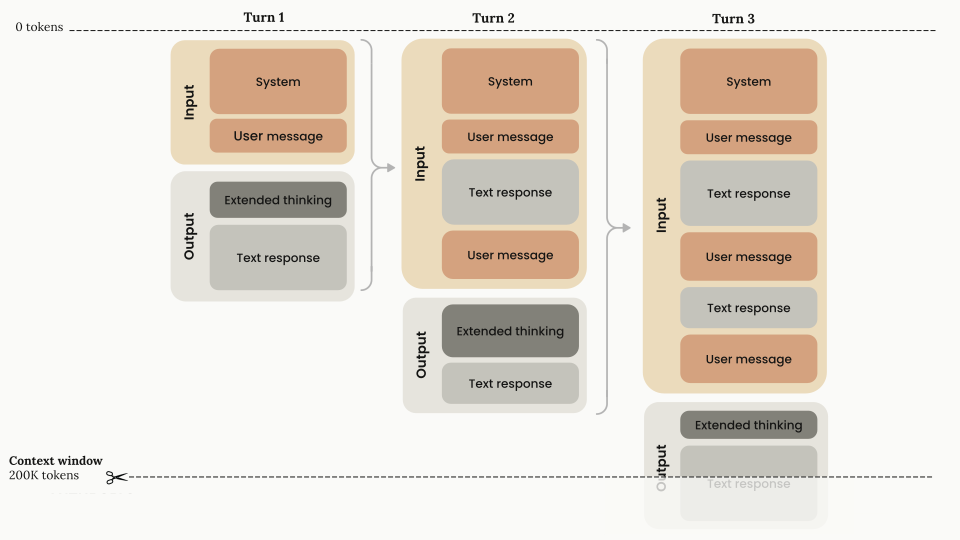
56<Frame>
57 
58</Frame>
5559
5660* **Stripping thinking blocks:** On models that strip previous thinking blocks, thinking blocks (shown in dark gray) are generated during each turn's output phase but are not carried forward as input tokens for subsequent turns. You do not need to strip the thinking blocks yourself: if you pass them back, the Claude API strips them automatically.
5761* **Billing:** Thinking tokens are billed as output tokens once, when they are generated. On models that keep previous thinking blocks, the kept blocks are then part of later requests' input and are billed as input tokens, like the rest of the conversation history.
from line 68
6468
6569The following diagram illustrates how tokens are managed when you combine thinking with tool use on a model that strips previous thinking blocks:
6670
67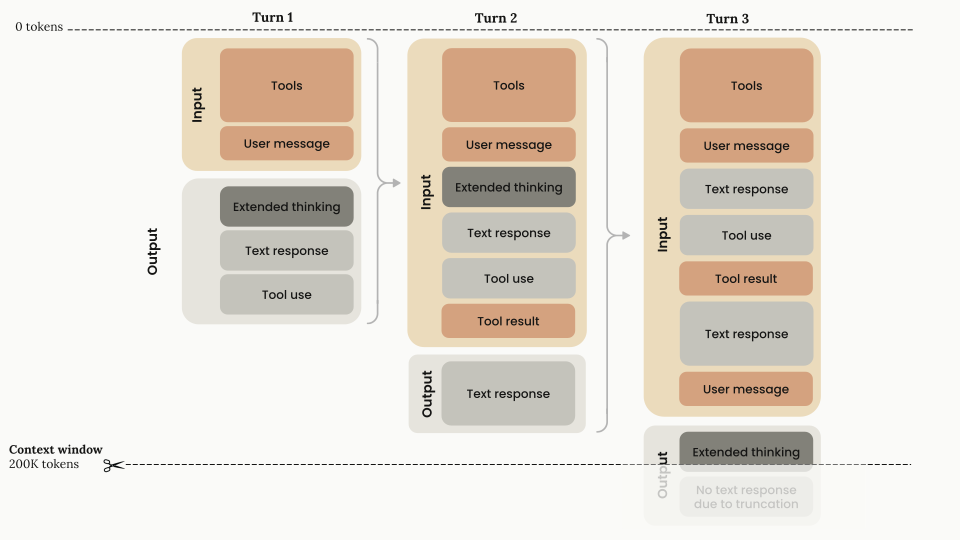
71<Frame>
72 
73</Frame>
6874
6975<Steps>
7076 <Step title="First turn architecture">
from line 127
121127
122128Image tokens are included in these budgets.
123129
124Claude Opus 4.7 and later Opus models, Claude Sonnet 5.5, Claude Fable 5.1, Claude Mythos 5.1, Claude Fable 5, and Claude Mythos 5 don't receive these injected tags. On these models, you can give the model an explicit budget with [task budgets](https://platform.claude.com/docs/en/build-with-claude/task-budgets), which are in beta.
130Claude Opus 4.7 and later Opus models, Claude Sonnet 5.5, Claude Fable 5.1, Claude Mythos 5.1, Claude Fable 5, Claude Mythos 5, and Claude Haiku 5.5 don't receive these injected tags. On these models, you can give the model an explicit budget with [task budgets](https://platform.claude.com/docs/en/build-with-claude/task-budgets), which are in beta.
125131
126132<Tip>
127133 For agents that span multiple sessions, design your state artifacts so that context recovery is fast when a new session starts. The [memory tool's multisession pattern](https://platform.claude.com/docs/en/agents-and-tools/tool-use/memory-tool#multisession-software-development-pattern) walks through a concrete approach. See also [Effective harnesses for long-running agents](https://www.anthropic.com/engineering/effective-harnesses-for-long-running-agents).
No line in this hunk matches that.