
thinking changedbuild-with-claude/thinking
Nearest release: v2.1.232, published 7 hours before this site recorded the change. Shown because the two are within 24 hours of each other. Nothing here says the release caused the edit.
## How thinking works ## Configuring thinking ### Turning thinking off ## Reading thinking output ### Controlling thinking display ### Summarized thinking ### Streaming thinking ## Thinking and effort ## Thinking with tool use ### Preserving thinking blocks ### Interleaved thinking ### Thinking block preservation by model ## Thinking and prompt caching ## Thinking and the context window ## Thinking encryption ## Redacted thinking blocks ## Thinking output on Claude Fable 5 and Claude Mythos 5 ## Limits and feature compatibility ## Next steps
The whole hunk
1044 lines, first recordedThe first capture of this source. The page was already there, and this is what it said.
---
title: Thinking
url: https://platform.claude.com/docs/en/build-with-claude/thinking
description: "Understand how Claude's thinking works: turn it on, read thinking output, steer thinking depth with effort, and use thinking with tools, caching, and streaming."
---
<Note>
For how zero data retention (ZDR) applies to this feature, see [API and data retention](https://platform.claude.com/docs/en/manage-claude/api-and-data-retention).
</Note>
A model that answers in a single pass has to get everything right on the first try: no scratch work, no checking, no changing course halfway through. For a proof, a tricky bug, or a long agentic task, the first approach is often not the best one.
Thinking removes that constraint. When thinking is active, Claude works through the problem in its own words before answering: it restates what is being asked, tries approaches, checks intermediate results, and abandons paths that do not hold up. That reasoning arrives in `thinking` content blocks ahead of the response, and Claude draws on it to produce the final answer. This is why thinking improves performance on complex tasks like math, coding, analysis, and long-running agentic work, where the quality of the answer depends on intermediate work that would otherwise be compressed into the response itself or skipped.
Thinking has a cost: the tokens Claude spends reasoning are billed as output tokens, even when the thinking text isn't returned to you, and they count toward `max_tokens` alongside the response text. This page covers how thinking behaves across the API surface: turning it on, reading its output, and managing its interactions with tools, streaming, caching, and the context window.
## How thinking works
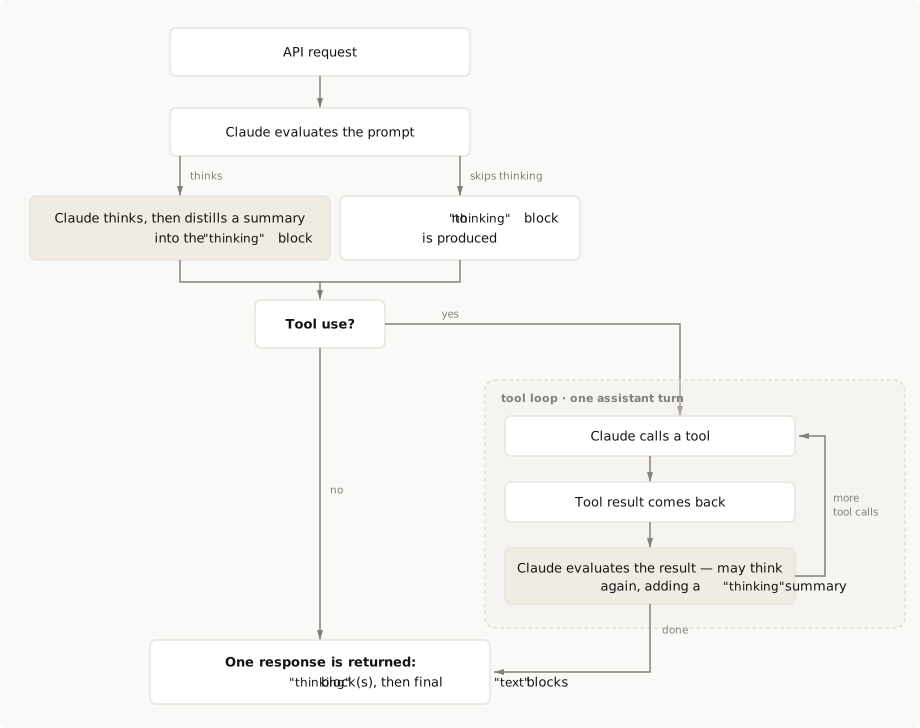
Whether Claude thinks on a given request, and how deeply, depends on your thinking configuration and the complexity of the request.
Here is what thinking looks like in a response: one or more `thinking` content blocks arrive before the `text` blocks. The thinking block is still generated content, like the `text` block that follows it, but it is separated from the canonical response. Each thinking block also carries a `signature` field, an encrypted copy of the full reasoning that you pass back unchanged in multi-turn and tool-use conversations (see [Thinking encryption](https://platform.claude.com/docs/en/build-with-claude/thinking#thinking-encryption)):
```json
{
"content": [
{
"type": "thinking",
"thinking": "Let me break this down. The question has two parts, so I'll start with the simpler one and use its result to constrain the second...",
"signature": "WaUjzkypQ2mUEVM36O2Txu...."
},
{
"type": "text",
"text": "Based on my analysis..."
}
]
}
```
You don't always see this text, and what you see is never the raw chain of thought: the text in a thinking block is a [summary of Claude's reasoning](https://platform.claude.com/docs/en/build-with-claude/thinking#summarized-thinking). The `display` field on the thinking configuration controls whether that summary is returned at all: `"summarized"` returns it, while `"omitted"`, the default on the newest models, returns thinking blocks with an empty `thinking` field. Either way the block is billed the same and passed back the same in multi-turn conversations. See [Controlling thinking display](https://platform.claude.com/docs/en/build-with-claude/thinking#controlling-thinking-display) for per-model defaults and details.
If Claude uses tools, thinking can also appear between tool calls. See [Thinking with tool use](https://platform.claude.com/docs/en/build-with-claude/thinking#thinking-with-tool-use). For the full response format, see the [Messages API reference](https://platform.claude.com/docs/en/api/messages/create).
## Configuring thinking
On current models, thinking is on by default or one parameter away. Which configuration each model accepts, and what it defaults to, is listed in the [per-model configuration table](https://platform.claude.com/docs/en/build-with-claude/thinking-troubleshooting#supported-models) on the Troubleshooting page.
On Claude Opus 5, Claude Sonnet 5, Claude Fable 5, Claude Mythos 5, and Claude Mythos Preview, thinking is already on: no configuration needed. The first thing most developers need on these models is to see the thinking text, because `display` defaults to `"omitted"` there. Opt in with `thinking: {"type": "adaptive", "display": "summarized"}`, which is exactly the following request with the [model string](https://platform.claude.com/docs/en/about-claude/models/overview) swapped.
On Claude Opus 4.8, Claude Opus 4.7, Claude Opus 4.6, and Claude Sonnet 4.6, thinking is off until you set `thinking: {type: "adaptive"}`, which lets Claude decide when and how deeply to think based on the request. The following examples do that, set `display: "summarized"` so the thinking text is visible, and use a roomy `max_tokens`:
<CodeGroup>
```bash cURL
curl https://api.anthropic.com/v1/messages \
-H "x-api-key: $ANTHROPIC_API_KEY" \
-H "anthropic-version: 2023-06-01" \
-H "content-type: application/json" \
-d '{
"model": "claude-opus-4-8",
"max_tokens": 16000,
"thinking": {
"type": "adaptive",
"display": "summarized"
},
"messages": [
{
"role": "user",
"content": "What is the greatest common divisor of 1071 and 462?"
}
]
}'
```
```bash CLI
ant messages create \
--model claude-opus-4-8 \
--max-tokens 16000 \
--thinking '{type: adaptive, display: summarized}' \
--message '{role: user, content: "What is the greatest common divisor of 1071 and 462?"}' \
--transform content \
--format yaml
```
```python Python
client = anthropic.Anthropic()
response = client.messages.create(
model="claude-opus-4-8",
max_tokens=16000,
thinking={"type": "adaptive", "display": "summarized"},
messages=[
{
"role": "user",
"content": "What is the greatest common divisor of 1071 and 462?",
}
],
)
for block in response.content:
if block.type == "thinking":
print(f"\nThinking: {block.thinking}")
elif block.type == "text":
print(f"\nResponse: {block.text}")
```
```typescript TypeScript
const client = new Anthropic();
const response = await client.messages.create({
model: "claude-opus-4-8",
max_tokens: 16000,
thinking: {
type: "adaptive",
display: "summarized"
},
messages: [
{
role: "user",
content: "What is the greatest common divisor of 1071 and 462?"
}
]
});
for (const block of response.content) {
if (block.type === "thinking") {
console.log(`\nThinking: ${block.thinking}`);
} else if (block.type === "text") {
console.log(`\nResponse: ${block.text}`);
}
}
```
```csharp C#
AnthropicClient client = new();
var parameters = new MessageCreateParams
{
Model = Model.ClaudeOpus4_8,
MaxTokens = 16000,
Thinking = new ThinkingConfigAdaptive { Display = Display.Summarized },
Messages = [
new() {
Role = Role.User,
Content = "What is the greatest common divisor of 1071 and 462?"
}
]
};
var message = await client.Messages.Create(parameters);
foreach (var block in message.Content)
{
if (block.TryPickThinking(out ThinkingBlock? thinking))
{
Console.WriteLine($"\nThinking: {thinking.Thinking}");
}
else if (block.TryPickText(out TextBlock? text))
{
Console.WriteLine($"\nResponse: {text.Text}");
}
}
```
```go Go
client := anthropic.NewClient()
response, err := client.Messages.New(context.TODO(), anthropic.MessageNewParams{
Model: anthropic.ModelClaudeOpus4_8,
MaxTokens: 16000,
Thinking: anthropic.ThinkingConfigParamUnion{
OfAdaptive: &anthropic.ThinkingConfigAdaptiveParam{
Display: anthropic.ThinkingConfigAdaptiveDisplaySummarized,
},
},
Messages: []anthropic.MessageParam{
anthropic.NewUserMessage(anthropic.NewTextBlock("What is the greatest common divisor of 1071 and 462?")),
},
})
if err != nil {
log.Fatal(err)
}
for _, block := range response.Content {
switch v := block.AsAny().(type) {
case anthropic.ThinkingBlock:
fmt.Printf("\nThinking: %s", v.Thinking)
case anthropic.TextBlock:
fmt.Printf("\nResponse: %s", v.Text)
}
}
```
```java Java
import com.anthropic.models.messages.ThinkingConfigAdaptive;
void main() {
AnthropicClient client = AnthropicOkHttpClient.fromEnv();
MessageCreateParams params = MessageCreateParams.builder()
.model(Model.CLAUDE_OPUS_4_8)
.maxTokens(16000L)
.thinking(ThinkingConfigAdaptive.builder()
.display(ThinkingConfigAdaptive.Display.SUMMARIZED)
.build())
.addUserMessage("What is the greatest common divisor of 1071 and 462?")
.build();
Message response = client.messages().create(params);
response.content().forEach(block -> {
block.thinking().ifPresent(thinkingBlock ->
IO.println("\nThinking: " + thinkingBlock.thinking())
);
block.text().ifPresent(textBlock ->
IO.println("\nResponse: " + textBlock.text())
);
});
}
```
```php PHP
$client = new Client();
$message = $client->messages->create(
maxTokens: 16000,
messages: [
[
'role' => 'user',
'content' => 'What is the greatest common divisor of 1071 and 462?'
]
],
model: 'claude-opus-4-8',
thinking: ['type' => 'adaptive', 'display' => 'summarized'],
);
foreach ($message->content as $block) {
if ($block->type === 'thinking') {
echo "\nThinking: " . $block->thinking;
} elseif ($block->type === 'text') {
echo "\nResponse: " . $block->text;
}
}
```
```ruby Ruby
client = Anthropic::Client.new
message = client.messages.create(
model: "claude-opus-4-8",
max_tokens: 16000,
thinking: {
type: "adaptive",
display: "summarized"
},
messages: [
{
role: "user",
content: "What is the greatest common divisor of 1071 and 462?"
}
]
)
message.content.each do |block|
case block.type
when :thinking
puts "\nThinking: #{block.thinking}"
when :text
puts "\nResponse: #{block.text}"
end
end
```
</CodeGroup>
Running the example prints the summarized thinking, then the answer:
```text Output wrap
Thinking: Use Euclidean algorithm.
1071 = 2*462 + 147
462 = 3*147 + 21
147 = 7*21 + 0
GCD = 21
Response: ## Finding GCD of 1071 and 462
I'll use the **Euclidean algorithm**, repeatedly dividing and taking remainders...
```
Thinking tokens count toward `max_tokens`, so set it high enough to leave room for both the thinking and the response text. See [Cost control](https://platform.claude.com/docs/en/build-with-claude/thinking-steering-and-cost#cost-control) on the steering page and [Thinking and the context window](https://platform.claude.com/docs/en/build-with-claude/thinking#thinking-and-the-context-window).
### Turning thinking off
On Claude Sonnet 5, where thinking is on by default, you can turn it off:
<CodeGroup>
```bash cURL
curl https://api.anthropic.com/v1/messages \
-H "x-api-key: $ANTHROPIC_API_KEY" \
-H "anthropic-version: 2023-06-01" \
-H "content-type: application/json" \
Cut at 300 lines. The page has the rest.
No line in this hunk matches that.