
thinking changedbuild-with-claude/thinking
Nearest release: v2.1.307, published an hour after this site recorded the change. Shown because the two are within 24 hours of each other. Nothing here says the release caused the edit.
Recorded here
Lines+31added
Lines−31removed
From line
8
where the diff opens
First seen
14 Aug 2026
this site's first read of the page
Recorded edits29to this page, all time
The whole hunk
from line 8, old and new numbered
/
from line 8
88 To learn how zero data retention (ZDR) applies to this feature, see [API and data retention](https://platform.claude.com/docs/en/manage-claude/api-and-data-retention).
99</Note>
1010
11A model that answers in a single pass has to get everything right on the first try: no scratch work, no checking, no changing course halfway through. For a proof, a tricky bug, or a long agentic task, the first approach is often not the best one.
11A model that answers in a single pass has to get everything right on the first try: no scratch work, no checking, no changing approach halfway through. For a proof, a tricky bug, or a long agentic task, the first approach is often not the best one.
1212
13Thinking removes that constraint. When thinking is active, Claude works through the problem in its own words before answering: it restates what is being asked, tries approaches, checks intermediate results, and abandons paths that do not hold up. That up-front thinking arrives in `thinking` content blocks ahead of the response, and Claude draws on it to produce the final answer. This is why thinking improves performance on complex tasks like math, coding, analysis, and long-running agentic work, where the quality of the answer depends on intermediate work that would otherwise be compressed into the response itself or skipped.
13Thinking removes that constraint. When thinking is active, Claude works through the problem in its own words before answering: it restates what is being asked, tries approaches, checks intermediate results, and abandons paths that do not hold up. That up-front thinking arrives in `thinking` content blocks ahead of the response, and Claude draws on it to produce the final answer. This is why thinking improves performance on complex tasks such as math, coding, analysis, and long-running agentic work, where the quality of the answer depends on intermediate work that would otherwise be compressed into the response itself or skipped.
1414
1515Thinking has a cost: the tokens Claude spends reasoning are billed as output tokens, even when the thinking text isn't returned to you, and they count toward `max_tokens` alongside the response text. This page covers how thinking behaves across the API surface: turning it on, reading its output, and managing its interactions with tools, streaming, caching, and the context window.
1616
from line 17
1717## How thinking works
1818
1919<Frame>
20 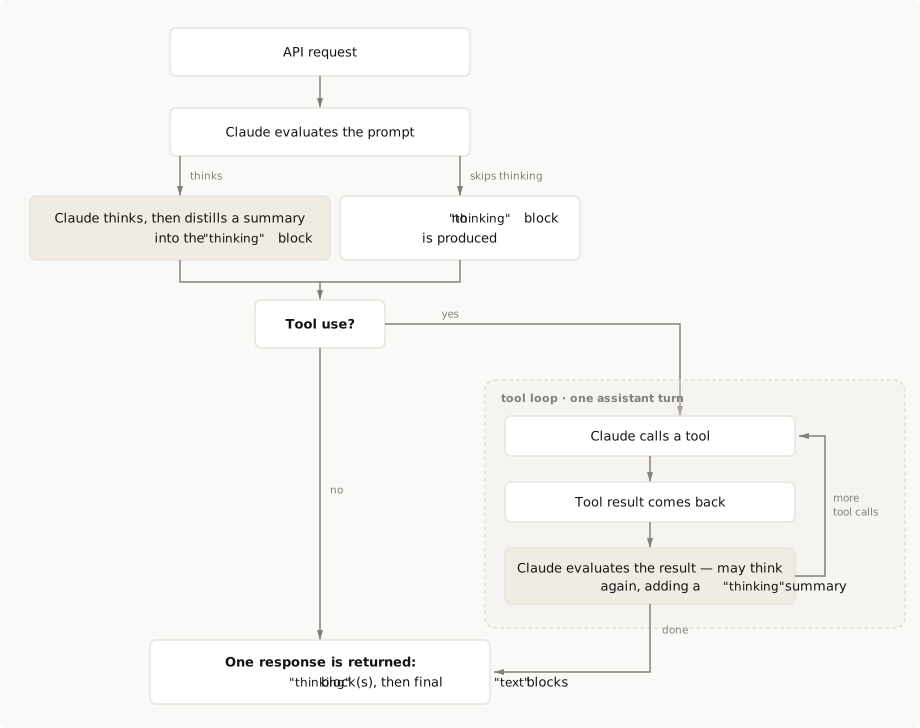
20 
2121</Frame>
2222
2323Whether Claude thinks on a given request, and how deeply, depends on your thinking configuration and the complexity of the request.
from line 40
4040}
4141```
4242
43You don't always see this text, and what you see is never the raw chain of thought: the text in a thinking block is a [summary of Claude's reasoning](https://platform.claude.com/docs/en/build-with-claude/thinking#summarized-thinking). The `display` field on the thinking configuration controls whether that summary is returned at all: `"summarized"` returns it, while `"omitted"`, the default on many models, returns thinking blocks with an empty `thinking` field. Either way the block is billed the same and passed back the same in multi-turn conversations. See [Controlling thinking display](https://platform.claude.com/docs/en/build-with-claude/thinking#controlling-thinking-display) for per-model defaults and details.
43You don't always see this text, and what you see is never the raw chain of thought: the text in a thinking block is a [summary of Claude's reasoning](https://platform.claude.com/docs/en/build-with-claude/thinking#summarized-thinking). The `display` field on the thinking configuration controls whether that summary is returned at all: `"summarized"` returns it, whereas `"omitted"`, the default on many models, returns thinking blocks with an empty `thinking` field. Either way the block is billed the same and passed back the same in multi-turn conversations. See [Controlling thinking display](https://platform.claude.com/docs/en/build-with-claude/thinking#controlling-thinking-display) for per-model defaults and details.
4444
4545If Claude uses tools, thinking can also appear between tool calls. See [Thinking with tool use](https://platform.claude.com/docs/en/build-with-claude/thinking#thinking-with-tool-use). For the full response format, see the [Messages API reference](https://platform.claude.com/docs/en/api/messages/create).
4646
4747## Configuring thinking
4848
49On most models, thinking is on by default or one parameter away. The following table shows what each model does with each `thinking` value a request can send. A 400 error means the API rejects the request, and [Troubleshooting thinking](https://platform.claude.com/docs/en/build-with-claude/thinking-troubleshooting) has each error and its fix.
49On most models, thinking is on by default or needs only one parameter. The following table shows what each model does with each `thinking` value a request can send. A 400 error means the API rejects the request, and [Troubleshooting thinking](https://platform.claude.com/docs/en/build-with-claude/thinking-troubleshooting) has each error and its fix.
5050
5151| Model | No `thinking` field | `"adaptive"` | `"enabled"` with `budget_tokens` | `"between_tools"` | `"disabled"` |
5252| --------------------- | ------------------- | ----------------- | -------------------------------- | ----------------------------------------------- | -------------------------------------- |
from line 72
7272
7373On Claude Opus 5.5, Claude Opus 5, Claude Sonnet 5.5, Claude Sonnet 5, Claude Fable 5.1, Claude Mythos 5.1, Claude Fable 5, Claude Mythos 5, Claude Mythos Preview, and Claude Haiku 5.5, thinking is already on and needs no configuration. `display` defaults to `"omitted"` on these models, so the thinking text is hidden until you opt in. Opt in with `thinking: {"type": "adaptive", "display": "summarized"}`, as the following examples do.
7474
75On Claude Opus 4.8, Claude Opus 4.7, Claude Opus 4.6, and Claude Sonnet 4.6, thinking is off until you set `thinking: {type: "adaptive"}`, which lets Claude determine when and how deeply to think based on the request. The same request, with the [model string](https://platform.claude.com/docs/en/models/overview) swapped, turns it on there. The following examples set `display: "summarized"` so the thinking text is visible, and use a roomy `max_tokens`:
75On Claude Opus 4.8, Claude Opus 4.7, Claude Opus 4.6, and Claude Sonnet 4.6, thinking is off until you set `thinking: {type: "adaptive"}`, which lets Claude determine when and how deeply to think based on the request. The same request, with the [model string](https://platform.claude.com/docs/en/models/overview) swapped, turns it on there. The following examples set `display: "summarized"` so the thinking text is visible, and use a large `max_tokens`:
7676
7777<CodeGroup>
7878 ```bash cURL
from line 276
276276 client = Anthropic::Client.new
277277
278278 message = client.messages.create(
279 model: "claude-opus-5-5",
279 model: Anthropic::Model::CLAUDE_OPUS_5_5,
280280 max_tokens: 16000,
281281 thinking: {
282282 type: "adaptive",
from line 442
442442 client = Anthropic::Client.new
443443
444444 message = client.messages.create(
445 model: "claude-sonnet-5",
445 model: Anthropic::Model::CLAUDE_SONNET_5,
446446 max_tokens: 4096,
447447 thinking: { type: "disabled" },
448448 messages: [
from line 477
477477* `"omitted"`: thinking blocks are returned with an empty `thinking` field. The `signature` field still carries the encrypted full thinking for multi-turn continuity (see [Thinking encryption](https://platform.claude.com/docs/en/build-with-claude/thinking#thinking-encryption)). This is the default on Claude Fable 5.1, Claude Mythos 5.1, Claude Fable 5, Claude Mythos 5, Claude Opus 5.5, Claude Opus 5, Claude Sonnet 5.5, Claude Sonnet 5, Claude Opus 4.8, Claude Opus 4.7, [Claude Mythos Preview](https://anthropic.com/glasswing), and Claude Haiku 5.5.
478478* `"updates"` (beta): reasoning blocks are returned with an empty `thinking` field, as with `"omitted"`, and the short [progress updates](https://platform.claude.com/docs/en/build-with-claude/thinking#progress-updates) some models write between tool calls come back as readable text. Requires the beta header `thinking-display-updates-2026-08-18`.
479479
480Set `display: "omitted"` when your application doesn't surface thinking content to users. The primary benefit is faster time-to-first-text-token when streaming: the server skips streaming thinking tokens entirely and delivers only the signature, so the final text response begins streaming sooner.
480Set `display: "omitted"` when your application doesn't surface thinking content to users. The primary benefit is faster time-to-first-text-token when streaming: the server skips streaming thinking tokens entirely and delivers only the signature, so the final text response starts streaming sooner.
481481
482482With `display: "omitted"`, the response contains `thinking` blocks with an empty `thinking` field:
483483
from line 502
502502* You're still charged for the full thinking tokens. Omitting reduces latency, not cost.
503503* If you pass thinking blocks back in multi-turn conversations, pass them unchanged. The server decrypts the `signature` to reconstruct the original thinking for prompt construction (see [Preserving thinking blocks](https://platform.claude.com/docs/en/build-with-claude/thinking#preserving-thinking-blocks)). Any text you place in the `thinking` field of a round-tripped omitted block is ignored.
504504* `display` is invalid with `thinking.type: "disabled"` (there is nothing to display) and with `thinking.type: "between_tools"` (Claude Sonnet 5.5 only), which accepts no other field. With `between_tools`, progress updates still come back with summary text, as they do under `display: "updates"` (see [Progress updates](https://platform.claude.com/docs/en/build-with-claude/thinking#progress-updates)).
505* When using `thinking.type: "adaptive"` and the model skips thinking for a simple request, no thinking block is produced regardless of `display`.
505* When you use `thinking.type: "adaptive"` and the model skips thinking for a simple request, no thinking block is produced regardless of `display`.
506506* When streaming with `display: "omitted"`, no thinking text is streamed. Each thinking block streams a `thinking_delta` with an empty `thinking` string, then its `signature_delta`. With `display: "updates"`, only [progress-update blocks](https://platform.claude.com/docs/en/build-with-claude/thinking#progress-updates) stream `thinking_delta` events that carry text. See [Streaming thinking](https://platform.claude.com/docs/en/build-with-claude/thinking#streaming-thinking) for the event sequence.
507507
508508<Note>
from line 518
518518* You're charged for the full thinking tokens generated by the original request, not the summary tokens. The billed output token count does not match the count of tokens you see in the response.
519519* On Claude Opus 4.6, Claude Sonnet 4.6, and earlier models, the first few lines of thinking output are more verbose, providing detailed reasoning that's particularly helpful for prompt engineering purposes. [Claude Mythos Preview](https://anthropic.com/glasswing) summarizes from the first token, so its thinking blocks do not show this verbose preamble.
520520* Summarization preserves the key ideas of Claude's thinking process with minimal added latency, so summaries can stream as they arrive.
521* Summarization is processed by a different model from the one you target in your requests. The thinking model does not see the summarized output.
521* Summarization is processed by a different model from the one you target in your requests. The thinking model does not receive the summarized output.
522522* As Anthropic seeks to improve the thinking feature, summarization behavior is subject to change.
523523
524524<Note>
from line 532
532532Thinking works with [streaming](https://platform.claude.com/docs/en/build-with-claude/streaming). Thinking blocks stream as `thinking_delta` events inside `content_block_delta` events, followed by a single `signature_delta` event just before the block's `content_block_stop`. Text blocks stream afterward as usual.
533533
534534<Frame>
535 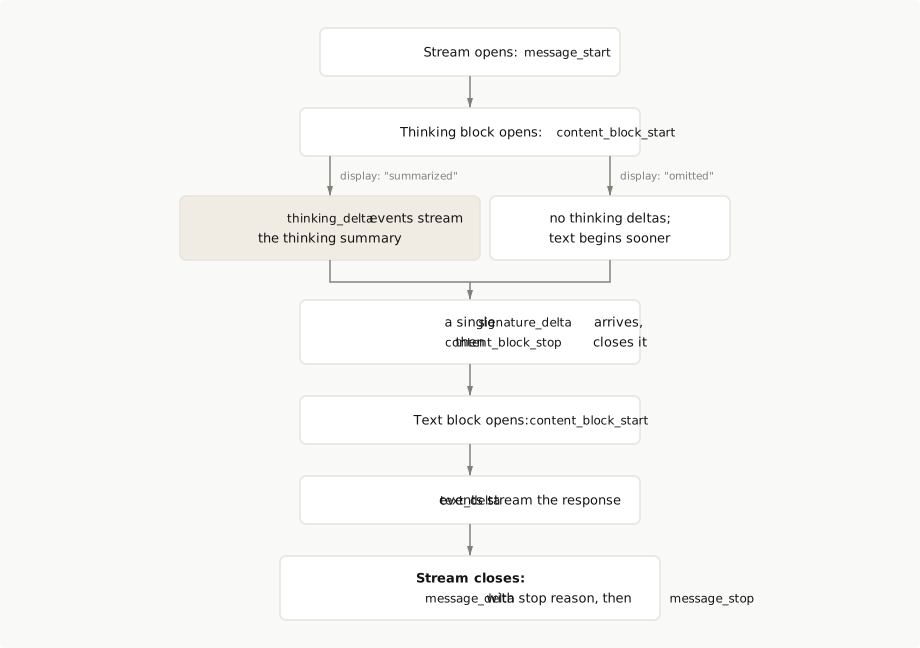
535 
536536</Frame>
537537
538538The following examples stream a response with adaptive thinking, printing thinking and text deltas as they arrive:
from line 773
773773 client = Anthropic::Client.new
774774
775775 stream = client.messages.stream(
776 model: "claude-opus-5-5",
776 model: Anthropic::Model::CLAUDE_OPUS_5_5,
777777 max_tokens: 16000,
778778 # A plain hash like this one takes display:. The typed ThinkingConfigAdaptive class
779779 # spells it display_ (trailing underscore) to avoid shadowing Ruby's Kernel#display.
from line 838
838838 ```
839839</Accordion>
840840
841When `display: "omitted"` is set, the thinking block opens, a `thinking_delta` with an empty `thinking` string arrives, a single `signature_delta` follows, and the block closes. Text streaming begins immediately after:
841When `display: "omitted"` is set, the thinking block opens, a `thinking_delta` with an empty `thinking` string arrives, a single `signature_delta` follows, and the block closes. Text streaming starts immediately after:
842842
843843```sse Output
844844event: content_block_start
from line 884
884884 The streaming system processes content in batches, which can delay and group streaming events into this "chunky" delivery pattern.
885885</Note>
886886
887For general streaming mechanics, see [Streaming Messages](https://platform.claude.com/docs/en/build-with-claude/streaming).
887For general streaming mechanics, see [Streaming messages](https://platform.claude.com/docs/en/build-with-claude/streaming).
888888
889889## Thinking and effort
890890
from line 906
9069061. **Tool choice limitation (manual mode):** tool use with manual extended thinking (`thinking: {type: "enabled"}`) only supports `tool_choice: {"type": "auto"}` (the default) or `tool_choice: {"type": "none"}`. Using `tool_choice: {"type": "any"}` or `tool_choice: {"type": "tool", "name": "..."}` results in an error because these options force tool use, which is incompatible with manual extended thinking. Adaptive thinking, including on models where thinking is on by default, supports forced tool use, except on Claude Opus 5.5, Claude Sonnet 5.5, Claude Fable 5.1, and Claude Mythos 5.1 (see [Response prefill and forced tool use](https://platform.claude.com/docs/en/build-with-claude/thinking#limits-and-feature-compatibility)). Where forced tool use is accepted, the response starts with the tool call and has no `thinking` block.
9079072. **Preserving thinking blocks:** when you return tool results, you must pass the thinking blocks from the assistant message back to the API, complete and unmodified. See [Preserving thinking blocks](https://platform.claude.com/docs/en/build-with-claude/thinking#preserving-thinking-blocks).
908908
909**A tool-use loop is one assistant turn.** From the model's perspective, an assistant turn doesn't complete until Claude finishes its full response, which may include multiple tool calls and results. This whole sequence is a single assistant turn:
909**A tool-use loop is one assistant turn.** From the model's perspective, an assistant turn doesn't complete until Claude finishes its full response, which might include multiple tool calls and results. This whole sequence is a single assistant turn:
910910
911911```text wrap
912912User: "What's the weather in Paris?"
from line 915
915915Assistant: [text: "The weather in Paris is 20°C and sunny"]
916916```
917917
918The entire turn runs in a single thinking mode: you can't toggle thinking in the middle of a turn, including during the tool-use loop. In extended (manual) mode, the API additionally enforces that the final assistant turn of a thinking-enabled request begins with a thinking block. Adaptive mode relaxes this: no assistant turn needs to start with one.
918The entire turn runs in a single thinking mode: you can't toggle thinking in the middle of a turn, including during the tool-use loop. In extended (manual) mode, the API additionally enforces that the final assistant turn of a thinking-enabled request starts with a thinking block. Adaptive mode relaxes this: no assistant turn needs to start with one.
919919
920**Mid-turn conflicts degrade gracefully.** If you toggle thinking mid-turn (for example, between sending a tool call and returning its result), the API doesn't error. Instead, it silently disables thinking for that request. To preserve model quality, the API may strip thinking blocks that would create an invalid turn structure, or disable thinking when the conversation history is incompatible with thinking being enabled. To confirm whether thinking was active, check for the presence of `thinking` blocks in the response.
920**Mid-turn conflicts degrade gracefully.** If you toggle thinking mid-turn (for example, between sending a tool call and returning its result), the API doesn't error. Instead, it silently disables thinking for that request. To preserve model quality, the API might strip thinking blocks that would create an invalid turn structure, or disable thinking when the conversation history is incompatible with thinking being enabled. To confirm whether thinking was active, check for the presence of `thinking` blocks in the response.
921921
922922**Toggle between turns, not within them.** Plan your thinking strategy at the start of each turn. Complete the assistant turn, then change the thinking configuration for the next one:
923923
from line 934
934934
935935### Preserving thinking blocks
936936
937When Claude invokes a tool, it pauses construction of its response to await external information. When you return the tool result, Claude continues building that same response, so its earlier reasoning must still be present. Pass every `thinking` block back to the API complete and unmodified, alongside the `tool_use` block it accompanied. This matters for two reasons:
937When Claude calls a tool, it pauses construction of its response to await external information. When you return the tool result, Claude continues building that same response, so its earlier reasoning must still be present. Pass every `thinking` block back to the API complete and unmodified, alongside the `tool_use` block it accompanied. This matters for two reasons:
938938
9399391. **Reasoning continuity:** the thinking blocks capture the step-by-step reasoning that led to the tool requests. Including them lets Claude continue reasoning from where it left off.
9409402. **Context maintenance:** tool results appear as user messages in the API structure, but they're part of one continuous reasoning flow. Preserving thinking blocks maintains that flow across API calls.
from line 1047
10471047* Pass progress-update blocks back unchanged with the rest of the assistant turn, like any other `thinking` block.
10481048* The text you receive is a summary of the progress update, normally a sentence or two. Don't rely on its length. The progress update counts toward `usage.output_tokens` at its full length, not the summary's.
10491049* A progress-update block can come back with an empty `thinking` field under any `display` value. Render nothing for an empty block. Under `"updates"` it looks the same as an empty reasoning block and needs no separate handling.
1050* When a response stops on `max_tokens`, `model_context_window_exceeded`, or `stop_sequence` soon after a tool call or tool result, its last block can be a progress-update block standing in for the work the model hadn't finished. Under `"updates"` and `"summarized"` its text is exactly `This part of the response was interrupted before it finished.` and you can show it like any other update. Under `"omitted"` it's empty. To continue, pass the assistant turn back unchanged and append a new `user` message (with a `tool_result` for each `tool_use` block in that turn).
1050* When a response stops on `max_tokens`, `model_context_window_exceeded`, or `stop_sequence` soon after a tool call or tool result, its last block can be a progress-update block standing in for the work the model hadn't completed. Under `"updates"` and `"summarized"` its text is exactly `This part of the response was interrupted before it finished.` and you can show it like any other update. Under `"omitted"` it's empty. To continue, pass the assistant turn back unchanged and append a new `user` message (with a `tool_result` for each `tool_use` block in that turn).
10511051* When [streaming](https://platform.claude.com/docs/en/build-with-claude/thinking#streaming-thinking), expect a pause of several seconds before a progress-update block opens. See the `"updates"` trace in [Streaming thinking](https://platform.claude.com/docs/en/build-with-claude/thinking#streaming-thinking).
10521052* These models write fewer progress updates at higher [effort](https://platform.claude.com/docs/en/build-with-claude/effort) and in long tool chains. If your interface depends on them, see [Ask for user-facing progress updates](https://platform.claude.com/docs/en/build-with-claude/prompt-engineering/prompting-claude-fable-5-1#ask-for-user-facing-progress-updates) or, for Claude Opus 5.5, [User-facing progress updates](https://platform.claude.com/docs/en/build-with-claude/prompt-engineering/prompting-claude-opus-5-5#user-facing-progress-updates). For Claude Sonnet 5.5, see [User-facing progress updates](https://platform.claude.com/docs/en/build-with-claude/prompt-engineering/prompting-claude-sonnet-5-5#user-facing-progress-updates).
10531053
from line 1060
10601060
10611061Preservation brings two benefits:
10621062
1063* **Cache optimization:** preserved thinking blocks enable cache hits during tool use, as they are passed back with tool results and cached incrementally across the assistant turn, resulting in token savings in multistep workflows.
1063* **Cache optimization:** preserved thinking blocks allow cache hits during tool use, as they are passed back with tool results and cached incrementally across the assistant turn, resulting in token savings in multistep workflows.
10641064* **No intelligence impact:** preserving thinking blocks has no negative effect on model performance.
10651065
10661066The tradeoff is context usage: long conversations consume more context space on keep-all models, because retained thinking blocks count as input like any other conversation history (see [Thinking and the context window](https://platform.claude.com/docs/en/build-with-claude/thinking#thinking-and-the-context-window)). The behavior is automatic in both regimes. No code changes or beta headers are required, and you should keep passing complete, unmodified thinking blocks back as described in [Preserving thinking blocks](https://platform.claude.com/docs/en/build-with-claude/thinking#preserving-thinking-blocks). To override the default in either direction, use [thinking block clearing](https://platform.claude.com/docs/en/build-with-claude/context-editing#thinking-block-clearing).
from line 1081
10811081To keep thinking valid, send every assistant turn back exactly as you received it and add new messages only at the end of `messages`. If your code builds the `messages` array itself, the Preserved thinking page covers:
10821082
10831083* [What counts as an edit](https://platform.claude.com/docs/en/build-with-claude/preserved-thinking#what-counts-as-an-edit), and [how to check whether your code makes one](https://platform.claude.com/docs/en/build-with-claude/preserved-thinking#how-to-tell-whether-your-integration-is-impacted).
1084* [The API feature that replaces each common edit](https://platform.claude.com/docs/en/build-with-claude/preserved-thinking#replace-prefix-edits): mid-conversation system messages for new instructions and per-turn reminders, `tool_addition` and `tool_removal` blocks for tool changes, per-message `output_config` for effort changes, and server-side compaction and context editing for trimming.
1084* The [API feature that replaces each common edit](https://platform.claude.com/docs/en/build-with-claude/preserved-thinking#replace-prefix-edits): mid-conversation system messages for new instructions and per-turn reminders, `tool_addition` and `tool_removal` blocks for tool changes, per-message `output_config` for effort changes, and server-side compaction and context editing for trimming.
10851085* [Client-side compaction](https://platform.claude.com/docs/en/build-with-claude/preserved-thinking#custom-compaction-on-the-client): which patterns keep thinking valid and which don't.
1086* [The `thinking-binding-controls-2026-08-01` beta header](https://platform.claude.com/docs/en/build-with-claude/preserved-thinking#preserved-thinking-controls). It adds a `block_binding.prefix_mismatch_behavior` field (`"error"` or `"drop_block"`) to the thinking configuration and an `input_transformations` array to every response. The array lists each thinking block that the API dropped, or that failed the prefix check and was let through.
1086* The [`thinking-binding-controls-2026-08-01` beta header](https://platform.claude.com/docs/en/build-with-claude/preserved-thinking#preserved-thinking-controls). It adds a `block_binding.prefix_mismatch_behavior` field (`"error"` or `"drop_block"`) to the thinking configuration and an `input_transformations` array to every response. The array lists each thinking block that the API dropped, or that failed the prefix check and was let through.
10871087
10881088## Thinking and prompt caching
10891089
from line 1138
11381138The following diagrams illustrate the last-turn-only (stripping) regime. The first shows a multi-turn conversation: each turn's thinking block is generated in the output but not carried into later turns' input.
11391139
11401140<Frame>
1141 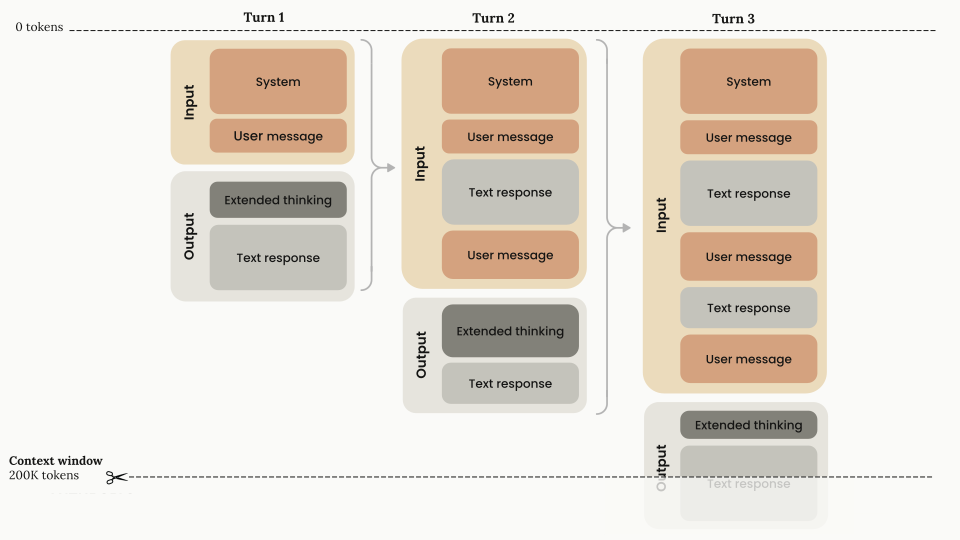
1141 
11421142</Frame>
11431143
11441144The second shows the same regime with tool use: thinking stays in context alongside its tool result for the duration of the assistant turn, then drops out on the next user turn.
11451145
11461146<Frame>
1147 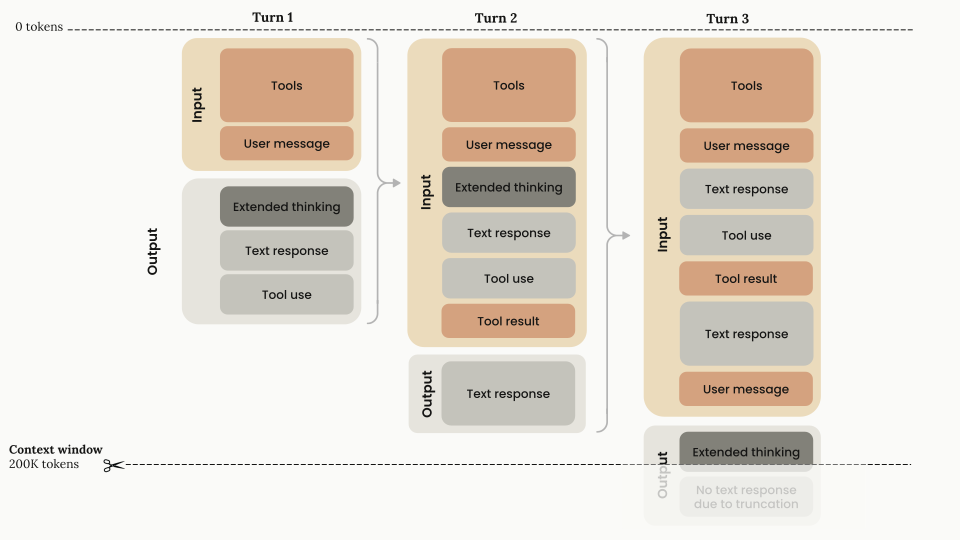
1147 
11481148</Frame>
11491149
11501150Use the [token counting API](https://platform.claude.com/docs/en/build-with-claude/token-counting) to get accurate counts for your specific use case, especially for multi-turn conversations that include thinking.
from line 1164
11641164
11651165## Redacted thinking blocks
11661166
1167In addition to regular `thinking` blocks, the API may return `redacted_thinking` blocks when portions of Claude's reasoning are safety-redacted. A `redacted_thinking` block contains encrypted thinking content in a `data` field, with no readable text:
1167In addition to regular `thinking` blocks, the API might return `redacted_thinking` blocks when portions of Claude's reasoning are safety-redacted. A `redacted_thinking` block contains encrypted thinking content in a `data` field, with no readable text:
11681168
11691169```json
11701170{
from line 1173
11731173}
11741174```
11751175
1176The `data` field is opaque and encrypted. Like the `signature` field on regular thinking blocks, pass `redacted_thinking` blocks back to the API unchanged when continuing a multi-turn conversation with [tools](https://platform.claude.com/docs/en/build-with-claude/thinking#thinking-with-tool-use).
1176The `data` field is opaque and encrypted. As with the `signature` field on regular thinking blocks, pass `redacted_thinking` blocks back to the API unchanged when continuing a multi-turn conversation with [tools](https://platform.claude.com/docs/en/build-with-claude/thinking#thinking-with-tool-use).
11771177
11781178<Tip>
11791179 If your code filters content blocks by type (for example, `block.type == "thinking"`) when round-tripping responses with tool use, also include `redacted_thinking` blocks. Filtering on `block.type == "thinking"` alone silently drops `redacted_thinking` blocks and breaks the multi-turn protocol described in [Preserving thinking blocks](https://platform.claude.com/docs/en/build-with-claude/thinking#preserving-thinking-blocks).
from line 1221
12211221
12221222### Long requests
12231223
1224The SDK requires streaming when `max_tokens` is greater than 21,333, to avoid HTTP timeouts on long-running requests. This is a client-side validation, not an API restriction. If you don't need to process events incrementally, use `.stream()` (java: `.createStreaming()`; csharp: `.CreateStreaming()`; go: `.NewStreaming()`; php: `->createStream()`) with `.get_final_message()` (typescript: `.finalMessage()`; ruby: `.accumulated_message`; csharp: `.Aggregate()`; go: `message.Accumulate(event)`; java, php: `MessageAccumulator`) to get the complete `Message` object without assembling it from individual events yourself. See [Streaming Messages](https://platform.claude.com/docs/en/build-with-claude/streaming#get-the-final-message-without-handling-events). Expect longer response times when thinking is active, because generating thinking blocks adds processing time. For workloads that push thinking above roughly 32k tokens per request, use [batch processing](https://platform.claude.com/docs/en/build-with-claude/batch-processing) to avoid networking issues: such requests can run long enough to hit system timeouts and open connection limits.
1224The SDK requires streaming when `max_tokens` is greater than 21,333, to avoid HTTP timeouts on long-running requests. This is a client-side validation, not an API restriction. If you don't need to process events incrementally, use `.stream()` (java: `.createStreaming()`; csharp: `.CreateStreaming()`; go: `.NewStreaming()`; php: `->createStream()`) with `.get_final_message()` (typescript: `.finalMessage()`; ruby: `.accumulated_message`; csharp: `.Aggregate()`; go: `message.Accumulate(event)`; java, php: `MessageAccumulator`) to get the complete `Message` object without assembling it from individual events yourself. See [Streaming messages](https://platform.claude.com/docs/en/build-with-claude/streaming#get-the-final-message-without-handling-events). Expect longer response times when thinking is active, because generating thinking blocks adds processing time. For workloads that push thinking above roughly 32k tokens per request, use [batch processing](https://platform.claude.com/docs/en/build-with-claude/batch-processing) to avoid networking issues: such requests can run long enough to hit system timeouts and open connection limits.
12251225
12261226## Next steps
12271227
from line 1239
12391239 </Card>
12401240
12411241 <Card title="Troubleshooting thinking" icon="hammer" href="https://platform.claude.com/docs/en/build-with-claude/thinking-troubleshooting">
1242 Diagnose and fix the most common thinking failures: configuration 400 errors, empty or missing thinking blocks, max\_tokens stops, and cache misses.
1242 Diagnose and fix the most common thinking failures: configuration 400 errors, empty or missing thinking blocks, `max_tokens` stops, and cache misses.
12431243 </Card>
12441244
12451245 <Card title="Effort" icon="sliders" href="https://platform.claude.com/docs/en/build-with-claude/effort">
No line in this hunk matches that.