
optimizing-for-cost-and-intelligence changedabout-claude/models/optimizing-for-cost-and-intelligence
Nearest release: v2.1.242, published an hour before this site recorded the change. Shown because the two are within 24 hours of each other. Nothing here says the release caused the edit.
Recorded here
Lines+14added
Lines−2removed
From line
21
where the diff opens
First seen
14 Aug 2026
this site's first read of the page
Recorded edits25to this page, all time
### Upgrade the model
The whole hunk
from line 21, old and new numbered
/
from line 21
2121| ------------------------------------------------ | ----------------------------------------------------------------------------------------------------------------------------------------------------------------------------------- | ----------------------------------------------------------------------------------------------------------------------------------------------------------------------------------------------------------------------------------------------------------------------------------------- |
2222| Any workload, any model | Turn on prompt caching and trim unneeded tokens; both are free | [Cache repeated context](https://platform.claude.com/docs/en/about-claude/models/optimizing-for-cost-and-intelligence#cache-repeated-context) · [Trim tokens](https://platform.claude.com/docs/en/about-claude/models/optimizing-for-cost-and-intelligence#trim-input-and-context-tokens) |
2323| Costs are too high; quality is fine | Sweep effort down on your current model | [Tune effort](https://platform.claude.com/docs/en/about-claude/models/optimizing-for-cost-and-intelligence#tune-effort) |
24| You are not on the latest model | Upgrade; the current model solves more, usually at lower cost per solved task | [Upgrade the model](https://platform.claude.com/docs/en/about-claude/models/optimizing-for-cost-and-intelligence#upgrade-the-model) |
2425| You are choosing or switching models | Compare on cost per completed task, not per token | [Compare models](https://platform.claude.com/docs/en/about-claude/models/optimizing-for-cost-and-intelligence#compare-models-on-cost-per-task) |
2526| Quality isn't good enough | If you lowered effort, restore it; otherwise try the next tier up at `low` effort | [Tune effort](https://platform.claude.com/docs/en/about-claude/models/optimizing-for-cost-and-intelligence#tune-effort) · [Compare models](https://platform.claude.com/docs/en/about-claude/models/optimizing-for-cost-and-intelligence#compare-models-on-cost-per-task) |
2627| Attempts end with `stop_reason: max_tokens` | Raise `max_tokens`; 64,000 covered every turn measured and cost nothing extra per solved task | [Set budgets](https://platform.claude.com/docs/en/about-claude/models/optimizing-for-cost-and-intelligence#set-budgets-and-output-caps) |
from line 177
176177
177178## Trade cost against intelligence
178179
179These levers set where a single model sits between cost and intelligence: model choice, effort, re-running failures at a higher setting, and the budgets and caps it works within. Start with an effort sweep on your current model ([Tune effort](https://platform.claude.com/docs/en/about-claude/models/optimizing-for-cost-and-intelligence#tune-effort)). From lowest to highest cost and capability, the current models are Claude Haiku 4.5, Claude Sonnet 5, Claude Opus 5, and Claude Fable 5 (the frontier model); [Models overview](https://platform.claude.com/docs/en/about-claude/models/overview) has the full lineup and prices.
180These levers set where a single model sits between cost and intelligence: model choice, effort, re-running failures at a higher setting, and the budgets and caps it works within. Start with an effort sweep on your current model ([Tune effort](https://platform.claude.com/docs/en/about-claude/models/optimizing-for-cost-and-intelligence#tune-effort)). From lowest to highest cost and capability, the current models are Claude Haiku 4.5, Claude Sonnet 5, Claude Opus 5, and Claude Fable 5 (the frontier model); [Models overview](https://platform.claude.com/docs/en/models/overview) has the full lineup and prices.
180181
181182### Compare models on cost per task
182183
from line 199
198199
199200The [multi-model strategies](https://platform.claude.com/docs/en/about-claude/models/optimizing-for-cost-and-intelligence#combine-models) exist to spend frontier intelligence on that tail without paying frontier rates for the rest.
200201
202### Upgrade the model
203
204If you are a model or two behind, the cheapest lever is the model string. Anthropic ran recent Claude Opus and Claude Sonnet models through the same harness on the SWE-bench Pro[3](https://platform.claude.com/docs/en/about-claude/models/optimizing-for-cost-and-intelligence#refs) subset, each at its shipped defaults, and priced each at list rates:
205
206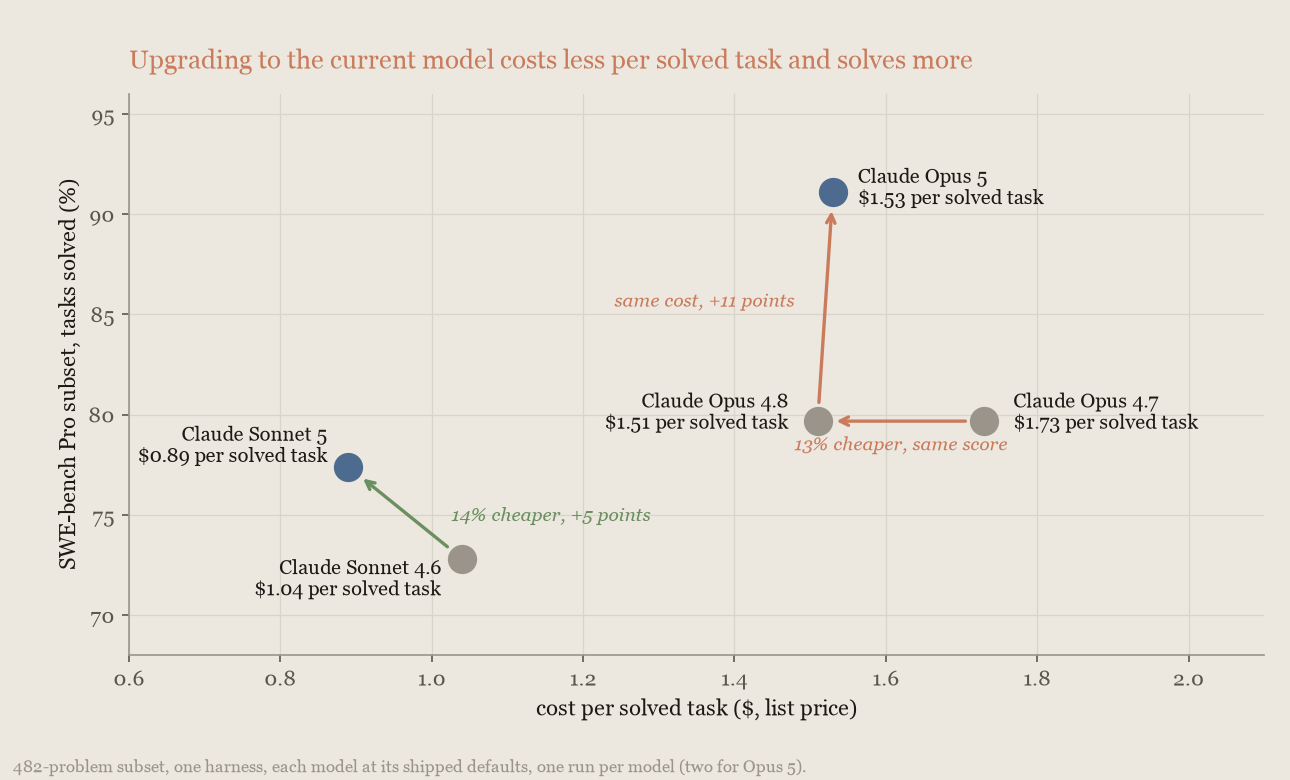
207
208Anthropic prices the Opus line identically per token across versions, so any saving comes from efficiency: Opus 4.8 takes fewer turns and rereads less than Opus 4.7, so each solved task costs 13% less, and Opus 5 then solves 11 more points of tasks at the same cost. Sonnet 5's savings come from its lower per-token price, which more than offsets the extra tokens it uses per task compared with Sonnet 4.6.
209
210Compare on cost per solved task, not per token: the same text costs about 30% more tokens on Claude Opus 4.7 and later, so a per-token comparison makes the newer models look more expensive by construction.
211
201212### Tune effort
202213
203214Effort is the most direct way to tune a model to your task. The `effort` parameter governs how much thinking, tool calling, and self-verification the model does, and the default (`high`) suits demanding tasks. Cost scales with all that activity; accuracy scales only with the part your task needs. Below the model's ceiling, the highest effort levels pay for depth the task never uses.
from line 619
608619| Data files through code execution | 92% on a 25-question data task | A gain, 25 of 25 instead of 6 of 25 | Faster | [Trim input and context tokens](https://platform.claude.com/docs/en/about-claude/models/optimizing-for-cost-and-intelligence#trim-input-and-context-tokens) |
609620| Batch API | 50% | None | Results within 24 hours | [Batch work that can wait](https://platform.claude.com/docs/en/about-claude/models/optimizing-for-cost-and-intelligence#batch-work-that-can-wait) |
610621| Prompt audit against the current model | 14% on both migrations measured | None; a gain on one | Faster (fewer tool rounds) | [Audit prompts against the current model](https://platform.claude.com/docs/en/about-claude/models/optimizing-for-cost-and-intelligence#audit-prompts-against-the-current-model) |
622| Upgrade the model | Opus 4.7 to Opus 5: about 12% less per solved task, 11 more points; Sonnet 4.6 to Sonnet 5: 14% less, 5 more points | A gain | Neutral | [Upgrade the model](https://platform.claude.com/docs/en/about-claude/models/optimizing-for-cost-and-intelligence#upgrade-the-model) |
611623| Lower effort | Knowledge work: `medium` 15% to 30%, `low` a third to a half; long coding: `medium` about half, `low` about three quarters | 1 to 3 points on knowledge work, 2 to 8 on long coding | Faster | [Tune effort](https://platform.claude.com/docs/en/about-claude/models/optimizing-for-cost-and-intelligence#tune-effort) |
612624| Re-run failures | About half, at the same pass rate | None | Two runs on the tasks that fail | [Re-run failures at higher effort](https://platform.claude.com/docs/en/about-claude/models/optimizing-for-cost-and-intelligence#re-run-failures-at-higher-effort) |
613625| Task budget | 18% to 47% | 3 to 4 points | Faster | [Set budgets and output caps](https://platform.claude.com/docs/en/about-claude/models/optimizing-for-cost-and-intelligence#set-budgets-and-output-caps) |
from line 634
622634
6236351. **WideSearch:** Wong et al., "WideSearch: Benchmarking Agentic Broad Info-Seeking," arXiv:2508.07999, 2025. Broad web-research tasks graded on a many-row table's completeness and accuracy; 200 problems, 3 runs per configuration. The caching and effort charts come from separate runs, so per-problem costs differ slightly. The cost-concentration chart is a separate 20-problem run, 3 runs per problem, costed from per-request billing records.
6246362. **GDPval:** OpenAI, "GDPval: Evaluating AI Model Performance on Real-World Economically Valuable Tasks," 2025. Knowledge-work deliverables graded against task rubrics; a 210-task run of the released gold set, one attempt per task. A Claude model grades, so absolute scores may differ from published results.
6253. **SWE-bench Pro:** Scale AI, "SWE-Bench Pro: Can AI Agents Solve Long-Horizon Software Engineering Tasks?", 2025. A 482-problem subset selected for compatibility with Anthropic's evaluation harness; scores are not comparable to the public leaderboard. Claude Opus 5 at the default effort averages two runs; reduced-effort settings are single runs. Escalation figures come task by task from those runs: `low` first, then the default on its failures, solved 92.5% to 93.6% across run pairings for about $0.70; `medium` first, 93.8% to 94.2% for about $0.95; the default re-run on its own failures, 94.0% for $1.58; everything at the default, 90.9% to 92.5% for $1.39. The Claude Sonnet 5 executor pairings on the advisor chart come from the same August 2026 series on this subset: the Sonnet-plus-Opus pairing was run twice (a run and an exact replication), the low-effort pairing once, and Claude Sonnet 5 alone twice (77.4%, the baseline for both Pro rows); the task-budget figures are one run per budget on the same subset. The Claude Fable 5 figure in [Compare models](https://platform.claude.com/docs/en/about-claude/models/optimizing-for-cost-and-intelligence#compare-models-on-cost-per-task) is a single July 2026 run, also the task-budget chart's unbudgeted baseline; every budgeted run completed all 482 problems without harness errors.
6373. **SWE-bench Pro:** Scale AI, "SWE-Bench Pro: Can AI Agents Solve Long-Horizon Software Engineering Tasks?", 2025. A 482-problem subset selected for compatibility with Anthropic's evaluation harness; scores are not comparable to the public leaderboard. Claude Opus 5 at the default effort averages two runs; reduced-effort settings are single runs. Escalation figures come task by task from those runs: `low` first, then the default on its failures, solved 92.5% to 93.6% across run pairings for about $0.70; `medium` first, 93.8% to 94.2% for about $0.95; the default re-run on its own failures, 94.0% for $1.58; everything at the default, 90.9% to 92.5% for $1.39. The Claude Sonnet 5 executor pairings on the advisor chart come from the same August 2026 series on this subset: the Sonnet-plus-Opus pairing was run twice (a run and an exact replication), the low-effort pairing once, and Claude Sonnet 5 alone twice (77.4%, the baseline for both Pro rows); the task-budget figures are one run per budget on the same subset. The Claude Fable 5 figure in [Compare models](https://platform.claude.com/docs/en/about-claude/models/optimizing-for-cost-and-intelligence#compare-models-on-cost-per-task) is a single July 2026 run, also the task-budget chart's unbudgeted baseline; every budgeted run completed all 482 problems without harness errors. The upgrade ladder is one run per model at its shipped defaults (two each for Opus 5 and Sonnet 5), run the same week in one harness and organization.
6266384. **BrowseComp:** Wei et al., "BrowseComp: A Simple Yet Challenging Benchmark for Browsing Agents," OpenAI, 2025. Effort figures use a 500-problem cut, one to three runs per setting. The cost-insurance chart uses 10 reliably solved problems from a 26-problem slice, 50 delegated and 70 solo runs ($6.45 compared with $11.99 per run in expectation); delegated figures carry a measurement band of about 20%.
6276395. **Agent-architecture scaling:** Kim et al., "Towards a Science of Scaling Agent Systems," arXiv:2512.08296, 2025. Independent external study, cited only for the direction of the finding on when delegation does not pay, not for any figure.
6286406. **DeepWideSearch:** "DeepWideSearch: Benchmarking Depth and Width in Agentic Information Seeking," arXiv:2510.20168, 2025. The 220 questions span 15 domains, each combining many-row collection with multi-hop retrieval; measured on the benchmark's standing row set, 3 runs per configuration.
No line in this hunk matches that.