
optimizing-for-cost-and-intelligence changedabout-claude/models/optimizing-for-cost-and-intelligence
Nearest release: v2.1.238, published under an hour after this site recorded the change. Shown because the two are within 24 hours of each other. Nothing here says the release caused the edit.
Recorded here
Lines+15added
Lines−11removed
From line
51
where the diff opens
First seen
14 Aug 2026
this site's first read of the page
Recorded edits24to this page, all time
The whole hunk
from line 51, old and new numbered
/
from line 51
5151
5252```text wrap
5353$ claude
54> add prompt caching to this integration
54> /claude-api add prompt caching to this integration
5555
5656Done. Prompt caching is now wired into the harness. Two changes:
5757
from line 201
201201Three controls do three different jobs. A task budget saves money, because the model sees it. `max_tokens` is a safety cap that saves nothing. On Claude Managed Agents, a session budget is the hard dollar stop behind both. Set all three: a task budget, a high `max_tokens`, and a session cap for the run you never want on a bill, with a [workspace spend limit](https://platform.claude.com/docs/en/api/rate-limits#setting-lower-limits-for-workspaces) as the final backstop.
202202
203203* **Task budgets** are in beta (beta header `task-budgets-2026-03-13`) on Claude Opus 5, Claude Fable 5, Claude Opus 4.8, and Claude Opus 4.7, but not Claude Sonnet 5; check the [support table](https://platform.claude.com/docs/en/build-with-claude/task-budgets#feature-support) first. Start near your loop's 90th-percentile token usage, then tighten ([Choosing a budget](https://platform.claude.com/docs/en/build-with-claude/task-budgets#choosing-a-budget) shows how to collect that distribution). Budgets below the current 20,000-token floor are rejected, and very tight budgets can produce refusal-like behavior. Set the budget once, on the first request, because a mid-task change [invalidates the cache](https://platform.claude.com/docs/en/about-claude/models/optimizing-for-cost-and-intelligence#cache-repeated-context). The budget is advisory, steering the model rather than stopping it, so verify adherence on your workload.
204* **`max_tokens`** caps a single response, invisibly to the model, so lowering it does not make the model economize. The turns that needed the room are discarded and still billed. On an internal repository-task benchmark[12](https://platform.claude.com/docs/en/about-claude/models/optimizing-for-cost-and-intelligence#refs), a 16,384-token cap ended 15% of Claude Opus 5's attempts and a third of Claude Fable 5's, none of them solved. Capped runs spent less per attempt but bought proportionally fewer solves, so cost per solved task was the same as at 64,000. At that setting nothing was cut off, and Fable solved 54.6% of tasks instead of 33.3% (on a separate cut of the SWE-bench Pro[3](https://platform.claude.com/docs/en/about-claude/models/optimizing-for-cost-and-intelligence#refs) subset, described in reference 12, 92% instead of 90%). Retrying capped attempts only adds cost: at the same cap they never succeeded, and at a higher one you also pay for the wasted attempt. Set `max_tokens` to 64,000 for agentic work (128,000, the maximum, at `xhigh` or `max` effort), [stream responses](https://platform.claude.com/docs/en/build-with-claude/streaming) that large, treat [`stop_reason: max_tokens`](https://platform.claude.com/docs/en/build-with-claude/handling-stop-reasons#max-tokens) as a failure, and save money with effort and task budgets, which the model can see.
204* **`max_tokens`** caps a single response, invisibly to the model, so lowering it does not make the model economize. The turns that needed the room are discarded and still billed. On an internal repository-task benchmark[12](https://platform.claude.com/docs/en/about-claude/models/optimizing-for-cost-and-intelligence#refs), a 16,384-token cap ended 15% of Claude Opus 5's attempts and a third of Claude Fable 5's, none of them solved. Capped runs spent less per attempt but bought proportionally fewer solves, so cost per solved task was the same as at 64,000. At that setting nothing was cut off, and Fable solved 54.6% of tasks instead of 36.6% on the problems both runs scored (on a separate cut of the SWE-bench Pro[3](https://platform.claude.com/docs/en/about-claude/models/optimizing-for-cost-and-intelligence#refs) subset, described in reference 12, 92% instead of 90%). Retrying capped attempts only adds cost: at the same cap they never succeeded, and at a higher one you also pay for the wasted attempt. Set `max_tokens` to 64,000 for agentic work (128,000, the maximum, at `xhigh` or `max` effort), [stream responses](https://platform.claude.com/docs/en/build-with-claude/streaming) that large, treat [`stop_reason: max_tokens`](https://platform.claude.com/docs/en/build-with-claude/handling-stop-reasons#max-tokens) as a failure, and save money with effort and task budgets, which the model can see.
205205* **Session budgets on Claude Managed Agents** are the hard stop. A [session budget](https://platform.claude.com/docs/en/managed-agents/budgets) is a dollar cap on one session at list rates for tokens, searches, and session time. At the cap, the session pauses with `stop_reason: budget_reached`; raising the budget resumes it. It is platform-enforced, works on any model with a list price (including Claude Sonnet 5), and combines with the advisory task budget. Deployments apply the same field to every run.
206206
207207The first of two `max_tokens` charts plots cost per attempt and per solved task at each cap:
from line 269
269269
270270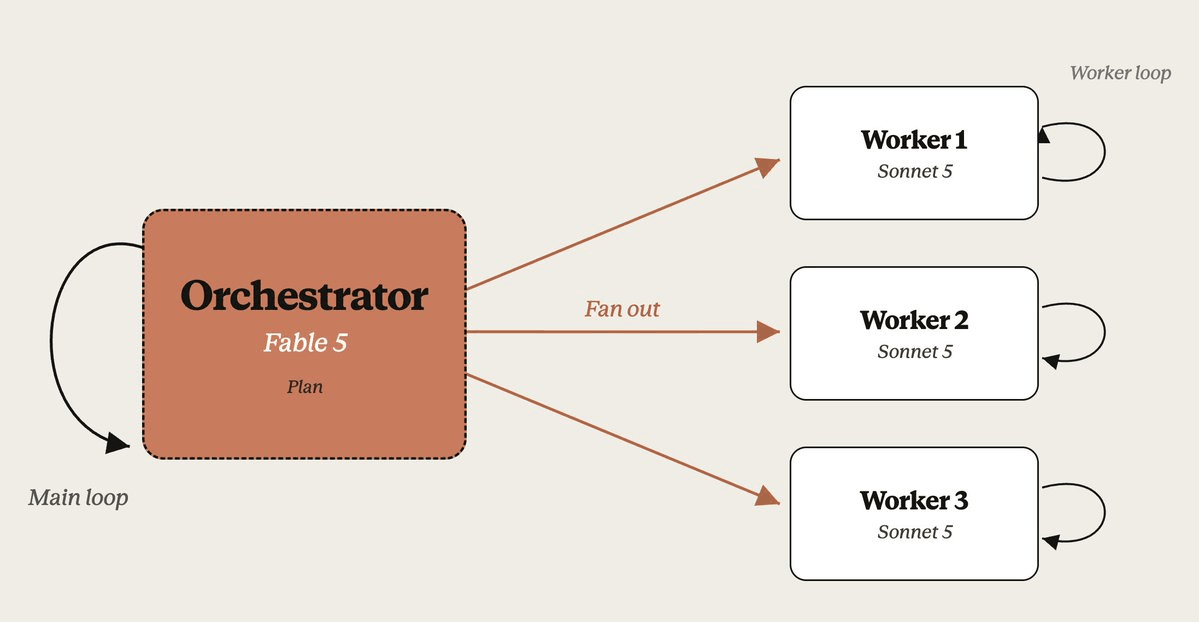
271271
272This pattern saves wall-clock time when workers can run in parallel: on the corpus benchmark[8](https://platform.claude.com/docs/en/about-claude/models/optimizing-for-cost-and-intelligence#refs) later in this section, an episode took 1.9 hours with the coordinator compared with 11.4 hours solo. It saved money in only two measured situations. On work a single model could handle alone, the same model at lower effort was cheaper every time.
272This pattern saves wall-clock time when workers can run in parallel: on the corpus benchmark[8](https://platform.claude.com/docs/en/about-claude/models/optimizing-for-cost-and-intelligence#refs), an episode took a little over 2 hours with the coordinator running the platform's documented limit of 25 concurrent workers, compared with 11.4 hours solo. It saved money in only two measured situations. On work a single model could handle alone, the same model at lower effort was cheaper every time.
273273
274274**Case 1: insurance against the cost tail on routine work.** A frontier model running alone occasionally spirals on a routine problem it would normally solve. Because you cannot tell in advance which those will be, a few such runs dominate the bill. A coordinator that hands routine work to a lower-cost worker caps that tail, because any spiraling now happens at worker rates.
275275
from line 281
281281
282282**Case 2: work larger than one context window.** A solo model must work through an input that large serially, one context window at a time, paying to re-read its own state on every pass. Workers each read their own partition, in parallel and at worker rates. Reading-heavy work that still fits in one context window is a model-choice problem, not a delegation problem: on reading cost alone, the orchestrator comes out ahead only when no single context can hold the work.
283283
284Anthropic built a benchmark for this case[8](https://platform.claude.com/docs/en/about-claude/models/optimizing-for-cost-and-intelligence#refs): a 21.6-million-token corpus of 14 public Python packages with 130 planted defects, too large for any context window. Lowering effort cannot help, because the bill is the corpus read itself: Claude Fable 5 solo cost $720 to $764 per episode at every effort setting, and only its accuracy moved. The coordinator configuration cost 55% less than any of those settings and scored 3 to 7 points below Fable at `medium` or the default, while beating a Claude Sonnet 5 solo baseline outright:
284Anthropic built a benchmark for this case[8](https://platform.claude.com/docs/en/about-claude/models/optimizing-for-cost-and-intelligence#refs): a 21.6-million-token corpus of 14 public Python packages with 130 planted defects, too large for any context window. Lowering effort cannot help, because the bill is the corpus read itself: Claude Fable 5 solo cost $720 to $764 per episode at every effort setting, and only its accuracy moved. The coordinator configuration cost more than 60% less than any of those settings and scored 2 to 6 points below Fable at `medium` or the default, while beating a Claude Sonnet 5 solo baseline outright:
285285
286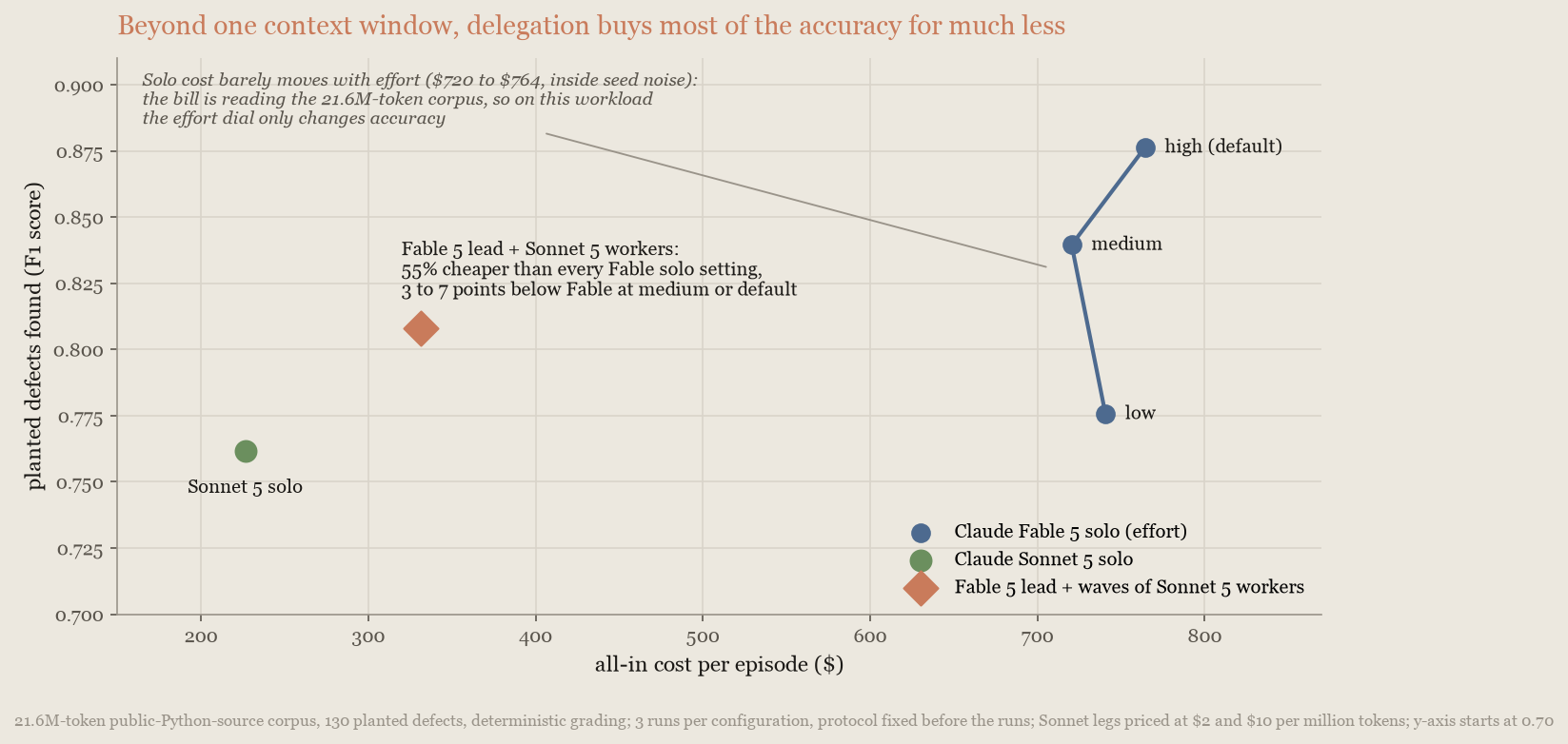
286
287287
288The token accounting shows why. The coordinator configuration read more than the solo model (32 million input tokens compared with 14.5 million) and still cost less, because partitioned reading at worker rates is cheaper than repeated re-reading at frontier rates. Fable 5 at default effort still holds peak accuracy, at 2.3 times the coordinator configuration's cost, so delegation here buys most of the accuracy, not all of it.
288The token accounting shows why. Both bills are mostly corpus reading served from the cache: the coordinator configuration read about 570 million cached tokens per episode, nearly three times the solo model's roughly 200 million, and still cost less than half as much, because its reads were billed at Claude Sonnet 5's cache-read rate rather than Claude Fable 5's. Fable 5 at default effort still holds peak accuracy, at 2.8 times the coordinator configuration's cost, so delegation here buys most of the accuracy, not all of it.
289289
290290**When delegation doesn't pay.** An orchestrator buys something only when there is bulk to hand off: many independent pieces, ideally too many for one context window. When the work is one dependent chain, or fits in a single context, the orchestrator pays for a plan, a handoff, and a merge that a single model gets for free. In every such case measured, the coordinator's model alone at lower effort came out ahead.
291291
from line 538
538538| Lower effort | Knowledge work: `medium` 15% to 30%, `low` a third to a half; long coding: `medium` about half, `low` about three quarters | 1 to 3 points on knowledge work, 2 to 8 on long coding | Faster | [Tune effort](https://platform.claude.com/docs/en/about-claude/models/optimizing-for-cost-and-intelligence#tune-effort) |
539539| Re-run failures | About half, at the same pass rate | None | Two runs on the tasks that fail | [Re-run failures at higher effort](https://platform.claude.com/docs/en/about-claude/models/optimizing-for-cost-and-intelligence#re-run-failures-at-higher-effort) |
540540| Task budget | 18% to 47% | 3 to 4 points | Faster | [Set budgets and output caps](https://platform.claude.com/docs/en/about-claude/models/optimizing-for-cost-and-intelligence#set-budgets-and-output-caps) |
541| Raising `max_tokens` | None per solved task, but more tasks solved | Gains of 2 to 21 points | Neutral | [Set budgets and output caps](https://platform.claude.com/docs/en/about-claude/models/optimizing-for-cost-and-intelligence#set-budgets-and-output-caps) |
541| Raising `max_tokens` | None per solved task, but more tasks solved | Gains of 2 to 18 points | Neutral | [Set budgets and output caps](https://platform.claude.com/docs/en/about-claude/models/optimizing-for-cost-and-intelligence#set-budgets-and-output-caps) |
542542| Advisor | Depends on the capability gap and the consult rate; the chart-reading pairing scored above both models' effort curves, the coding pairing only marginally | Small gains | About two extra calls per task | [Advisor strategy](https://platform.claude.com/docs/en/about-claude/models/optimizing-for-cost-and-intelligence#advisor-strategy-escalate-hard-decisions) |
543| Orchestrator | 55% below the frontier model beyond one context window; about half on routine tails | 3 to 7 points below the frontier model | Much faster on large inputs | [Orchestrator strategy](https://platform.claude.com/docs/en/about-claude/models/optimizing-for-cost-and-intelligence#orchestrator-strategy-delegate-bulk-work) |
543| Orchestrator | More than 60% below the frontier model beyond one context window; about half on routine tails | 2 to 6 points below the frontier model | Much faster on large inputs | [Orchestrator strategy](https://platform.claude.com/docs/en/about-claude/models/optimizing-for-cost-and-intelligence#orchestrator-strategy-delegate-bulk-work) |
544544
545545## Benchmarks referenced
546546
from line 553
5535535. **Agent-architecture scaling:** Kim et al., "Towards a Science of Scaling Agent Systems," arXiv.08296, 2025. Independent external study, cited only for the direction of the finding on when delegation does not pay, not for any figure.
5545546. **DeepWideSearch:** "DeepWideSearch: Benchmarking Depth and Width in Agentic Information Seeking," arXiv.20168, 2025. The 220 questions span 15 domains, each combining many-row collection with multi-hop retrieval; measured on the benchmark's standing row set, 3 runs per configuration.
5555557. **DeepResearch Bench II:** Li et al., "DeepResearch Bench II: Diagnosing Deep Research Agents via Rubrics from Expert Report," arXiv.08536, 2026. Its 132 research tasks across 22 domains are graded against expert-derived binary rubrics; measured on a 50-task subset stratified across all themes, one attempt per task, 3 runs, scored on tasks no configuration refused. Claude Opus 4.6 judges under the benchmark's rubric protocol; the original uses a different judge, and an Anthropic judge may favor the house style. The runs predate Claude Opus 5, hence its absence from the [Compare models](https://platform.claude.com/docs/en/about-claude/models/optimizing-for-cost-and-intelligence#compare-models-on-cost-per-task) chart. The Sonnet 5 cost differs slightly between the caching chart (inference cost, with and without caching) and that chart (all-in cost, caching on); both come from the same runs.
5568. **Corpus defect sweep:** Anthropic-internal, for work larger than one context window: a 21.6-million-token corpus from 14 public Python package sources with 130 planted defects and deterministic grading; protocol fixed before the runs and internally reviewed; three runs per configuration. The charted team configuration ran its workers on Claude Managed Agents: each of six waves was one session in which the Claude Fable 5 lead ran 40 Claude Sonnet 5 worker threads, the platform's limit at the time (the current default is lower), with a small external driver sequencing the waves and carrying the findings between them. Absolute F1 is specific to this corpus build, not comparable across benchmarks; configuration comparisons are like for like.
5568. **Corpus defect sweep:** Anthropic-internal, for work larger than one context window: a 21.6-million-token corpus from 14 public Python package sources with 130 planted defects and deterministic grading; protocol fixed before the runs and internally reviewed; three runs per configuration. Every configuration ran on Claude Managed Agents. The charted team configuration is an August 2026 run in which the Claude Fable 5 coordinator ran the whole sweep inside the platform at its documented limit of 25 concurrent Claude Sonnet 5 workers; its three episodes scored F1 0.842, 0.805, and 0.810 for $263, $299, and $261. The solo configurations are July 2026 runs on the same corpus build. Absolute F1 is specific to this corpus build, not comparable across benchmarks; configuration comparisons are like for like.
5575579. **GPQA Diamond:** Rein et al., "GPQA: A Graduate-Level Google-Proof Q\&A Benchmark," 2023. The 198-question Diamond subset, measured August 2026, two runs per configuration, model-graded against reference answers, advisor tokens metered per request. A platform safety check refused two biology questions on the Sonnet and Opus executors; excluding them changes no comparison by more than one point.
55855810. **DeepSWE:** Datacurve, "DeepSWE: Measuring Frontier Coding Agents on Original, Long-Horizon Engineering Tasks," arXiv.07946, 2026. Measured August 2026: 113 original tasks across five languages with program-based verifiers. Pairings are two runs each with advisor tokens metered per request, and used a client-side advisor loop rather than the advisor tool, with identical accounting. Single-model effort sweeps are single runs priced from token counts, a cache-aware approximation. Costs per task are run totals divided by 113.
55955911. **Internal agentic-coding benchmark:** Anthropic-internal: 370 repository tasks graded by the repositories' own tests. The API figures (Opus 5 alone, Fable 5 alone, and the pairing) were measured August 2026 at the default effort with a 128,000-token output cap, one run per configuration: five attempts per task at the default settings and for the pairing, one at `low` and `medium`; the pairing averaged about two advisor consultations per attempt; costs are per attempt. The Claude Code figures are July 2026 runs of the same tasks, one run per configuration, costs approximate.
from line 586
586586
587587 <Card title="Pricing" icon="dollar-sign" href="https://platform.claude.com/docs/en/about-claude/pricing">
588588 See current per-token pricing for every Claude model.
589 </Card>
590
591 <Card title="Cookbook: cost optimization on the Claude API" icon="book" href="https://platform.claude.com/cookbook/cost-optimization-cost-optimization">
592 Apply these levers one at a time to a working agent in a runnable notebook, with cost per task after each step.
589593 </Card>
590594
591595 <Card title="Webinar: Building on the Claude Platform" icon="play" href="https://www.anthropic.com/webinars/building-on-the-claude-platform-claude-fable-5-and-model-orchestration-patterns">
No line in this hunk matches that.