
What this read moved
1–11 of 11api/beta Changed · +0 / -13 lines
## Beta › Webhooks ### Unwrap ### Parse Unverified
This page is larger than the 256 KiB this site keeps, so one side of the diff below stops where the stored text does.
Nothing in the body moved in this read. What changed is above.
api/beta/webhooks Changed · +0 / -11 lines
## Unwrap ## Parse Unverified
from line 5
55
66# Webhooks
77
8## Unwrap
9
10Verifies the webhook signature from the `webhook-id`, `webhook-timestamp` and `webhook-signature`
11headers using your webhook signing key, then parses the payload into an event. Fails if the
12signature is missing or invalid.
13
14## Parse Unverified
15
16Parses a webhook payload into an event without verifying its signature. Prefer `unwrap()` unless
17you have already verified the signature yourself.
18
198## Domain types
209
2110### Beta Webhook Agent Archived Event Data
cli-sdks-libraries/cli/apply Changed · +9 / -7 lines
from line 104
104104
105105Any resource except a skill can be written as YAML, JSON, or Markdown. In Markdown, the frontmatter is the body and the prose fills the kind's text field: an agent's `system`, an environment's or memory store's `description`, a deployment's first message.
106106
107Resources refer to each other by path. Wherever the API expects another resource's ID, write the relative path to that resource's file instead. In this project, the reviewer agent lists `../skills/pr-summary` under `skills`, the lead agent lists `./reviewer.md` in its roster, and the deployment names its agent, environment, and memory store by path. `ant apply` creates them in dependency order and fills in the real IDs. Apply the whole directory:
107Resources refer to each other by path. Wherever the API expects another resource's ID, write the relative path to that resource's file instead. In this project, the reviewer agent lists `../skills/pr-summary` under `skills`, the lead agent lists `./reviewer.md` in its roster, and the deployment names its agent, environment, and memory store by path. `ant apply` creates them in dependency order and fills in the real IDs. The project has six files:
108108
109<MultiFileExample language="cli" label="CLI">
110 ```bash CLI
111 ant apply .
112 ```
113
109<MultiFileExample variant="explorer">
114110 <File filename="agents/reviewer.md">
115111 ```markdown
116112 ---
from line 187
191187 ```
192188 </File>
193189</MultiFileExample>
190
191Apply the whole directory:
192
193```bash CLI
194ant apply .
195```
194196
195197`claude-lock.json` then has an entry for every file in the project.
196198
api/errors Changed · +1 / -1 lines
from line 507
507507messages.{i}.content.{j}: Invalid `signature` in `thinking` block. The block is bound to a different conversation. Remove the block, or set `thinking.block_binding.prefix_mismatch_behavior` to "drop_block".
508508```
509509
510Without the `thinking-binding-controls-2026-08-01` beta header the message also names that header. Keep the conversation history append-only, or send the beta header with `prefix_mismatch_behavior: "drop_block"` to drop the block and continue. A block from a model the target model can't read is dropped rather than rejected. See [Preserved thinking](https://platform.claude.com/docs/en/build-with-claude/thinking#preserved-in-conversation) and [Troubleshooting thinking](https://platform.claude.com/docs/en/build-with-claude/thinking-troubleshooting#error-thinking-block-signature).
510Without the `thinking-binding-controls-2026-08-01` beta header the message also names that header. Keep the conversation history append-only, or send the beta header with `prefix_mismatch_behavior: "drop_block"` to drop the block and continue. A block from a model the target model can't read is dropped rather than rejected. See [Keeping the prefix unchanged](https://platform.claude.com/docs/en/build-with-claude/preserved-thinking#prefix-check) and [Troubleshooting thinking](https://platform.claude.com/docs/en/build-with-claude/thinking-troubleshooting#error-thinking-block-signature).
511511
512512Sending `thinking.block_binding` without the `thinking-binding-controls-2026-08-01` [beta header](https://platform.claude.com/docs/en/api/beta-headers) returns a 400 `invalid_request_error` whose message ends in:
513513
build-with-claude/context-editing Changed · +1 / -1 lines
from line 62
6262
6363Context editing is applied server-side before the prompt reaches Claude. Your client application maintains the full, unmodified conversation history. You do not need to sync your client state with the edited version. Continue managing your full conversation history locally as you normally would.
6464
65On Claude Fable 5.1, server-side context management never invalidates thinking blocks. Client-side edits to earlier turns can invalidate the thinking blocks in every later assistant turn. For new accounts created on or after August 31, 2026, a request that replays an invalidated block is rejected unless you opt into dropping it. See [Preserved thinking](https://platform.claude.com/docs/en/build-with-claude/thinking#preserved-in-conversation).
65On Claude Fable 5.1, server-side context management never invalidates thinking blocks. Client-side edits to earlier turns can invalidate the thinking blocks in every later assistant turn. For new accounts created on or after August 31, 2026, a request that replays an invalidated block is rejected unless you opt into dropping it. See [Keeping the prefix unchanged](https://platform.claude.com/docs/en/build-with-claude/preserved-thinking#prefix-check).
6666
6767### Context editing and prompt caching
6868
build-with-claude/thinking Changed · +1 / -1 lines
from line 1002
10021002
10031003The tradeoff is context usage: long conversations consume more context space on keep-all models, because retained thinking blocks count as input like any other conversation history (see [Thinking and the context window](https://platform.claude.com/docs/en/build-with-claude/thinking#thinking-and-the-context-window)). The behavior is automatic in both regimes. No code changes or beta headers are required, and you should keep passing complete, unmodified thinking blocks back as described in [Preserving thinking blocks](https://platform.claude.com/docs/en/build-with-claude/thinking#preserving-thinking-blocks). To override the default in either direction, use [thinking block clearing](https://platform.claude.com/docs/en/build-with-claude/context-editing#thinking-block-clearing).
10041004
1005**Switching models mid-conversation.** Keep passing thinking blocks back unchanged when you switch models, for example after a [classifier refusal fallback](https://platform.claude.com/docs/en/build-with-claude/refusals-and-fallback). A thinking block is readable only by the model that produced it or a newer one, and the API ignores or drops the blocks the target model can't read. On Claude Fable 5.1 and Claude Mythos 5.1 the direction matters: they read every earlier model's thinking blocks and no earlier model reads theirs, so switching up to them keeps the conversation's reasoning and switching down drops it (see [Preserved thinking](https://platform.claude.com/docs/en/build-with-claude/thinking#preserved-for-model) for the exact list and for how dropped blocks are billed and reported). Strip prior `thinking` and `redacted_thinking` blocks yourself only to save input tokens on models that ignore rather than drop them, and never when redeeming a [fallback credit](https://platform.claude.com/docs/en/build-with-claude/fallback-credit), which requires the body unchanged.
1005**Switching models mid-conversation.** Keep passing thinking blocks back unchanged when you switch models, for example after a [classifier refusal fallback](https://platform.claude.com/docs/en/build-with-claude/refusals-and-fallback). A thinking block is readable only by the model that produced it or a newer one, and the API ignores or drops the blocks the target model can't read. On Claude Fable 5.1 and Claude Mythos 5.1 the direction matters: they read every earlier model's thinking blocks and no earlier model reads theirs, so switching up to them keeps the conversation's reasoning and switching down drops it (see [how dropped blocks are billed and reported](https://platform.claude.com/docs/en/build-with-claude/preserved-thinking#switching-models)). Strip prior `thinking` and `redacted_thinking` blocks yourself only to save input tokens on models that ignore rather than drop them, and never when redeeming a [fallback credit](https://platform.claude.com/docs/en/build-with-claude/fallback-credit), which requires the body unchanged.
10061006
10071007## Preserved thinking
10081008
manage-claude/cmek Changed · +1 / -0 lines
from line 69
6969* Compliance API [local session transcripts](https://platform.claude.com/docs/en/manage-claude/compliance-sessions#retrieve-local-sessions) captured from sessions on users' machines. If your key cannot be used, the messages endpoint returns [503 Service Unavailable](https://platform.claude.com/docs/en/manage-claude/compliance-errors#local-sessions-temporarily-unavailable) instead of transcript content. Session metadata is still listed.
7070* Office agents.
7171* Claude in Chrome.
72* Claude Science. Data that users send from the app to their own compute, such as SSH hosts or cloud compute accounts, is held on those systems, not by Anthropic, and is not covered.
7273
7374On both products, backups and snapshots inherit the key.
7475
manage-claude/inference-hooks Changed · +2 / -2 lines
from line 23
23233. Your AI security server evaluates the content and responds with a verdict within the verdict timeout your organization configures (5 seconds by default).
24244. On `allow`, inference proceeds normally. On `deny`, the request is rejected and the user sees a blocked-by-policy message assembled from two parts: the per-request reason your AI security server supplied in the verdict's `deny_reason` field, followed by a standing message your administrators configure (for example, who to contact or where to request an exception). If your administrators haven't configured one, a built-in default directs the user to contact them. Each denial is also recorded in your organization's [Activity Feed](https://platform.claude.com/docs/en/manage-claude/compliance-activity-feed).
2525
26The following diagram traces one example (a Cowork request where Claude also calls an O365 tool) to illustrate which parts of the flow are hooked. The hooked points are the diagram's steps 1 and 5, where the prompt arrives and the tool result returns; each results in the validation exchange with your AI security server shown in steps 2 and 6.
26The following diagram traces one example (a Cowork request where Claude also calls an O365 tool) to illustrate which parts of the flow are hooked. The hooked points are the diagram's steps 1 and 6, where the prompt arrives and the tool result returns; each results in the validation exchange with your AI security server shown in steps 2–3 and 7–8.
2727
28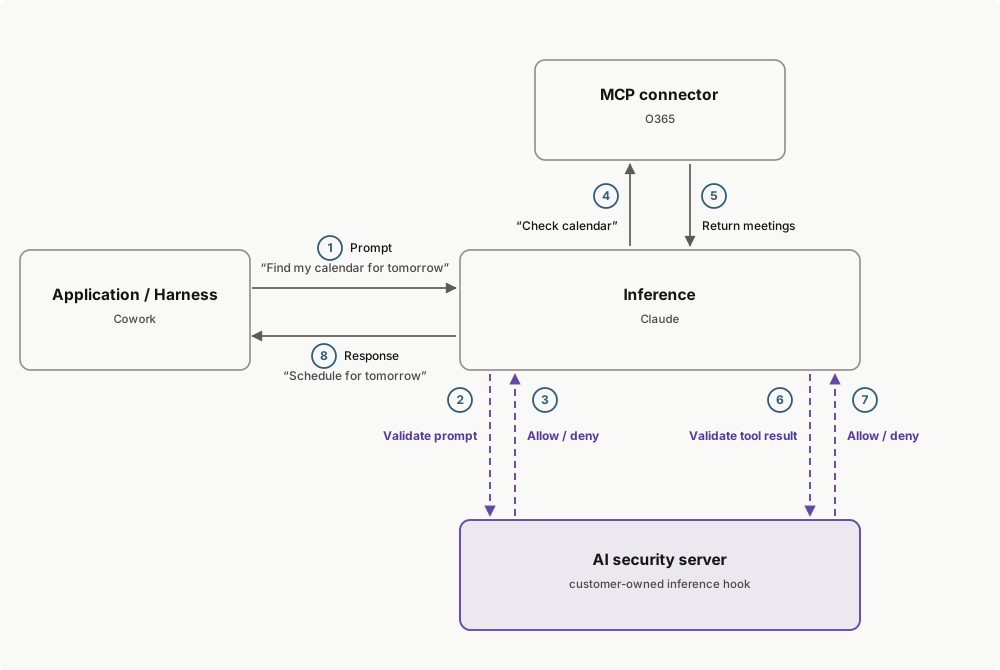
28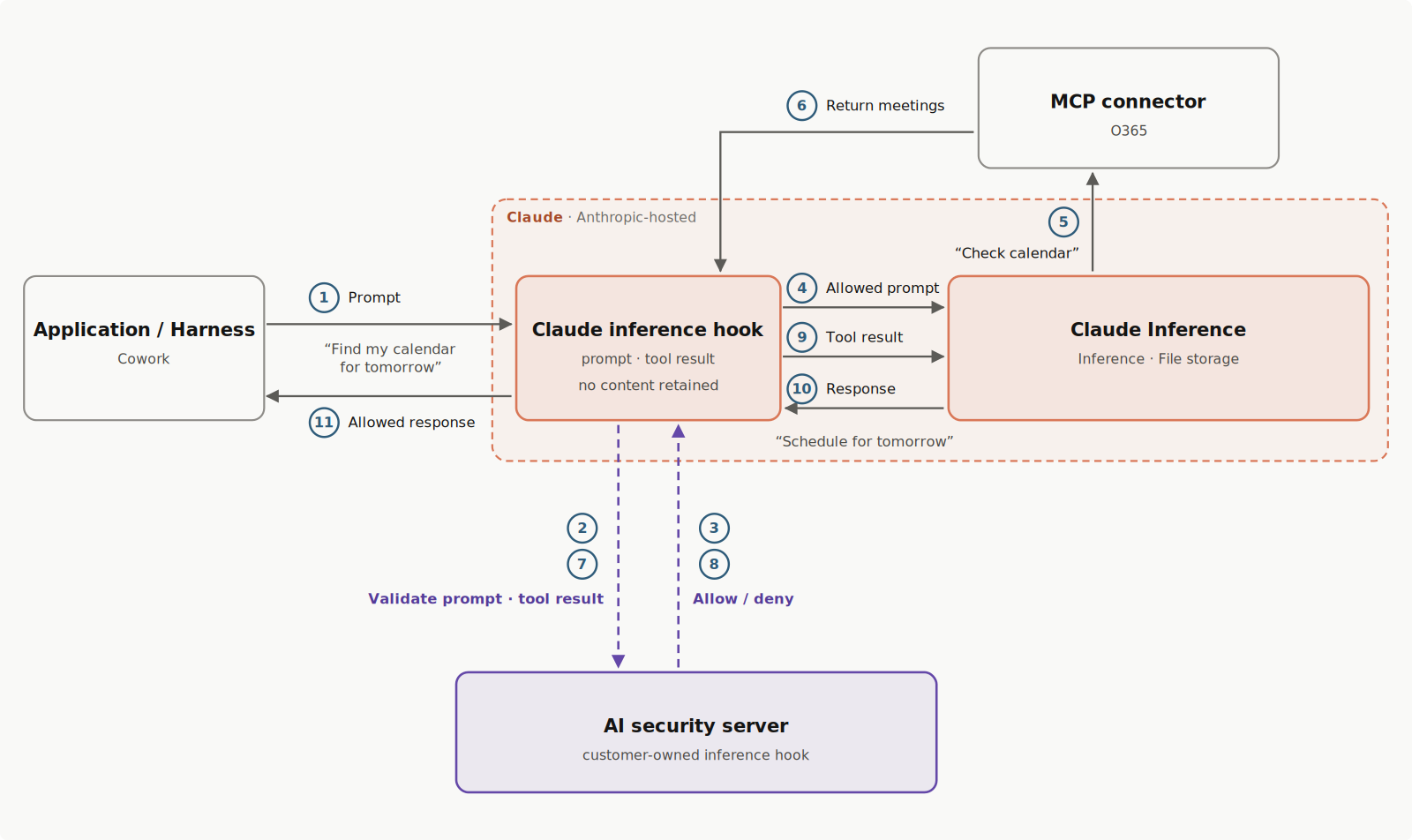
2929
3030A verdict is a small JSON object: `{"action": "allow"}` lets the request proceed, and a deny carries the user-facing reason. For the full verdict schema, see [Return a verdict](https://platform.claude.com/docs/en/manage-claude/inference-hooks-endpoint#return-a-verdict).
3131
models/fable-5-1/migration-guide Changed · +1 / -1 lines
from line 946
946946
9479472. **Thinking blocks are preserved only for the model that produced them, or a newer one:** Every `thinking` block records which model produced it. Claude Fable 5.1 reads its own blocks and those from Claude Mythos 5.1, Claude Opus 5, Claude Fable 5, Claude Mythos 5, and earlier Claude models. A conversation moving onto `claude-fable-5-1` from any of those keeps its earlier reasoning. The condition is one-way: apart from Claude Mythos 5.1, none of those models can read Claude Fable 5.1's blocks.
948948
949 A conversation that ran on Claude Fable 5.1 can land on an older model through a router switch, a client-side retry, or a [classifier refusal fallback](https://platform.claude.com/docs/en/build-with-claude/refusals-and-fallback), including a [server-side fallback](https://platform.claude.com/docs/en/build-with-claude/refusals-and-fallback#server-side-fallback). The API removes the blocks that model can't read before it sees them, the request succeeds, and you aren't billed for the dropped input tokens. The target model re-plans without that reasoning, which can raise cost and latency on the first turn after the switch. To see what was dropped, send the `thinking-binding-controls-2026-08-01` [beta header](https://platform.claude.com/docs/en/api/beta-headers): responses then carry an `input_transformations` array naming each dropped block with `reason: "model_binding_mismatch"`. See [Preserved thinking](https://platform.claude.com/docs/en/build-with-claude/thinking#preserved-for-model).
949 A conversation that ran on Claude Fable 5.1 can land on an older model through a router switch, a client-side retry, or a [classifier refusal fallback](https://platform.claude.com/docs/en/build-with-claude/refusals-and-fallback), including a [server-side fallback](https://platform.claude.com/docs/en/build-with-claude/refusals-and-fallback#server-side-fallback). The API removes the blocks that model can't read before it sees them, the request succeeds, and you aren't billed for the dropped input tokens. The target model re-plans without that reasoning, which can raise cost and latency on the first turn after the switch. To see what was dropped, send the `thinking-binding-controls-2026-08-01` [beta header](https://platform.claude.com/docs/en/api/beta-headers): responses then carry an `input_transformations` array naming each dropped block with `reason: "model_binding_mismatch"`. See [Switching models mid-conversation](https://platform.claude.com/docs/en/build-with-claude/preserved-thinking#switching-models).
950950
9519513. **Editing earlier turns invalidates thinking blocks:** Each `thinking` block from Claude Fable 5.1 is valid only against the `system` prompt, `tools`, and conversation history that preceded it. If Claude Code, claude.ai, [Claude Managed Agents](https://platform.claude.com/docs/en/managed-agents/overview), or the [Claude Agent SDK](https://code.claude.com/docs/en/agent-sdk/overview) manages your conversation history, it already keeps that prefix intact. If your code builds the `messages` array itself, this item applies to you, and [Preserved thinking](https://platform.claude.com/docs/en/build-with-claude/preserved-thinking) is the full integration guide. Where the check is enforced, a request that sends the block back after any of those changed is rejected with a 400 error:
952952
models/fable-5-1/whats-new-fable-5-1 Changed · +2 / -2 lines
from line 42
4242
4343Every thinking block records which model produced it, and it's preserved in one direction only: Claude Fable 5.1 reads earlier models' thinking blocks, and no earlier model reads Claude Fable 5.1's. A conversation that moves onto Claude Fable 5.1 (from Claude Opus 5, Claude Fable 5, or any earlier Claude model) keeps its reasoning. A conversation that moves from Claude Fable 5.1 to any of those models loses it for the turns that run there.
4444
45When a request carries a block the target model can't read (a router or fallback that switches models mid-conversation, for example), the API drops the block before the model sees it. Dropped blocks don't count toward `input_tokens` and aren't billed. With the `thinking-binding-controls-2026-08-01` beta header, the drop is reported in a top-level `input_transformations` array. Without it, the drop is silent. See [Preserved thinking](https://platform.claude.com/docs/en/build-with-claude/thinking#preserved-for-model).
45When a request carries a block the target model can't read (a router or fallback that switches models mid-conversation, for example), the API drops the block before the model sees it. Dropped blocks don't count toward `input_tokens` and aren't billed. With the `thinking-binding-controls-2026-08-01` beta header, the drop is reported in a top-level `input_transformations` array. Without it, the drop is silent. See [Switching models mid-conversation](https://platform.claude.com/docs/en/build-with-claude/preserved-thinking#switching-models).
4646
4747### Editing earlier turns invalidates thinking blocks
4848
from line 59
5959
6060Where the check is enforced, a request that replays an invalidated block is rejected with a 400 whose message says `The block is bound to a different conversation`. To drop the block and continue instead, send the `thinking-binding-controls-2026-08-01` beta header with `thinking.block_binding.prefix_mismatch_behavior: "drop_block"`. The drop is reported in `input_transformations` with `reason: "prefix_binding_mismatch"`.
6161
62To keep thinking valid across a long session, treat the conversation as append-only. Add instructions with a [mid-conversation system message](https://platform.claude.com/docs/en/build-with-claude/mid-conversation-system-messages) ([turn-scoped](https://platform.claude.com/docs/en/models/fable-5-1/whats-new-fable-5-1#turn-scoped-system-messages-beta) if it should apply to one turn only) and change tools with [mid-conversation tool changes](https://platform.claude.com/docs/en/build-with-claude/mid-conversation-system-messages#mid-conversation-tool-changes) rather than editing `system` or `tools`. Trim context with server-side [context editing](https://platform.claude.com/docs/en/build-with-claude/context-editing) or [compaction](https://platform.claude.com/docs/en/build-with-claude/compaction), which don't count as edits. These patterns also keep the [prompt cache](https://platform.claude.com/docs/en/build-with-claude/prompt-caching) warm. To find out whether your integration edits history, run a session with `prefix_mismatch_behavior: "drop_block"` and log `input_transformations`: the [migration guide](https://platform.claude.com/docs/en/models/fable-5-1/migration-guide#fable-5-1-preserved-thinking) has the three-step check. See [Preserved thinking](https://platform.claude.com/docs/en/build-with-claude/thinking#preserved-in-conversation) for the full rules.
62To keep thinking valid across a long session, treat the conversation as append-only. Add instructions with a [mid-conversation system message](https://platform.claude.com/docs/en/build-with-claude/mid-conversation-system-messages) ([turn-scoped](https://platform.claude.com/docs/en/models/fable-5-1/whats-new-fable-5-1#turn-scoped-system-messages-beta) if it should apply to one turn only) and change tools with [mid-conversation tool changes](https://platform.claude.com/docs/en/build-with-claude/mid-conversation-system-messages#mid-conversation-tool-changes) rather than editing `system` or `tools`. Trim context with server-side [context editing](https://platform.claude.com/docs/en/build-with-claude/context-editing) or [compaction](https://platform.claude.com/docs/en/build-with-claude/compaction), which don't count as edits. These patterns also keep the [prompt cache](https://platform.claude.com/docs/en/build-with-claude/prompt-caching) warm. To find out whether your integration edits history, run a session with `prefix_mismatch_behavior: "drop_block"` and log `input_transformations`: the [migration guide](https://platform.claude.com/docs/en/models/fable-5-1/migration-guide#fable-5-1-preserved-thinking) has the three-step check. See [Keeping the prefix unchanged](https://platform.claude.com/docs/en/build-with-claude/preserved-thinking#prefix-check) for the full rules.
6363
6464## New features
6565
models/fable-5/migration-guide Changed · +2 / -2 lines
from line 322
322322* Remove any `thinking: {type: "disabled"}` configuration. Disabling thinking returns an error on `claude-mythos-5` and `claude-fable-5`.
323323* Remove `budget_tokens`. It has no direct replacement: thinking is adaptive, and the `effort` parameter is a separate output-level control, not a thinking budget.
324324* Verify any code that parses the `thinking` field treats it as display text only and passes thinking blocks back unchanged when continuing on the same model. `thinking.display` defaults to `"omitted"` on `claude-mythos-5` and `claude-fable-5`, the same as on Claude Mythos Preview. Set `display: "summarized"` to receive readable summaries. See [Thinking output on Claude Fable and Claude Mythos models](https://platform.claude.com/docs/en/build-with-claude/thinking#thinking-output-on-claude-fable-5-and-claude-mythos-5).
325* If you replay conversation history on an earlier model, strip `thinking` and `redacted_thinking` blocks from prior assistant turns first. Thinking blocks from `claude-fable-5` and `claude-mythos-5` are readable only by the model that produced them or a newer one: earlier models silently ignore them, while Claude Fable 5.1 and Claude Mythos 5.1 read them, so keep them when you move a conversation up to those models (see [Preserved thinking](https://platform.claude.com/docs/en/build-with-claude/thinking#preserved-for-model)). Stripping keeps requests to earlier models minimal and uniform.
325* If you replay conversation history on an earlier model, strip `thinking` and `redacted_thinking` blocks from prior assistant turns first. Thinking blocks from `claude-fable-5` and `claude-mythos-5` are readable only by the model that produced them or a newer one: earlier models silently ignore them, while Claude Fable 5.1 and Claude Mythos 5.1 read them, so keep them when you move a conversation up to those models (see [Switching models mid-conversation](https://platform.claude.com/docs/en/build-with-claude/preserved-thinking#switching-models)). Stripping keeps requests to earlier models minimal and uniform.
326326* If you migrate to Claude Fable 5, handle `stop_reason: "refusal"` and read the `stop_details.category` field. Claude Fable 5 runs safety classifiers that Claude Mythos Preview and Claude Mythos 5 do not have. See [Refusals and fallback](https://platform.claude.com/docs/en/build-with-claude/refusals-and-fallback).
327327* Re-baseline token counts and costs on your own workloads. Token counts are roughly unchanged when migrating from `claude-mythos-preview`.
328328
from line 696
696696* Update response parsing that reads content by position, such as `content[0].text`: with adaptive thinking always on, `thinking` blocks arrive before `text` blocks. Select content blocks by `type` instead, and pass `thinking` blocks back complete and unmodified in tool-use loops; modified blocks return a 400 error. See [Preserving thinking blocks](https://platform.claude.com/docs/en/build-with-claude/thinking#preserving-thinking-blocks).
697697* If you removed manual extended thinking and assistant prefills during earlier migrations, no action is needed: both remain unsupported on `claude-fable-5` and `claude-mythos-5`.
698698* Verify any code that parses the `thinking` field treats it as display text only and passes thinking blocks back unchanged when continuing on the same model. `thinking.display` defaults to `"omitted"` on `claude-fable-5` and `claude-mythos-5`, the same as on Claude Opus 4.8. Set `display: "summarized"` to receive readable summaries. See [Thinking output on Claude Fable and Claude Mythos models](https://platform.claude.com/docs/en/build-with-claude/thinking#thinking-output-on-claude-fable-5-and-claude-mythos-5).
699* If you replay conversation history on an earlier model, strip `thinking` and `redacted_thinking` blocks from prior assistant turns first. Thinking blocks from `claude-fable-5` and `claude-mythos-5` are readable only by the model that produced them or a newer one: earlier models silently ignore them, while Claude Fable 5.1 and Claude Mythos 5.1 read them, so keep them when you move a conversation up to those models (see [Preserved thinking](https://platform.claude.com/docs/en/build-with-claude/thinking#preserved-for-model)). Stripping keeps requests to earlier models minimal and uniform. The exception is redeeming a [fallback credit](https://platform.claude.com/docs/en/build-with-claude/fallback-credit), which requires the request body echoed under that feature's exact rules.
699* If you replay conversation history on an earlier model, strip `thinking` and `redacted_thinking` blocks from prior assistant turns first. Thinking blocks from `claude-fable-5` and `claude-mythos-5` are readable only by the model that produced them or a newer one: earlier models silently ignore them, while Claude Fable 5.1 and Claude Mythos 5.1 read them, so keep them when you move a conversation up to those models (see [Switching models mid-conversation](https://platform.claude.com/docs/en/build-with-claude/preserved-thinking#switching-models)). Stripping keeps requests to earlier models minimal and uniform. The exception is redeeming a [fallback credit](https://platform.claude.com/docs/en/build-with-claude/fallback-credit), which requires the request body echoed under that feature's exact rules.
700700* If you migrate to Claude Fable 5, handle `stop_reason: "refusal"` and read the `stop_details.category` field. To re-run refused requests on another model automatically, consider the opt-in `fallbacks` parameter (beta). See [Refusals and fallback](https://platform.claude.com/docs/en/build-with-claude/refusals-and-fallback).
701701* Re-evaluate your `effort` setting. Start at `high` for most tasks, including workloads that ran at `xhigh` on Claude Opus 4.8.
702702* Re-baseline cost and latency on your own workloads. Token counts are roughly unchanged when migrating from `claude-opus-4-8`; per-token pricing differs, and thinking tokens are billed as output tokens, so workloads that ran without thinking produce more output tokens per request.