
What this read moved
1–8 of 8agents-and-tools/tool-use/computer-use-tool Changed · +3 / -3 lines
from line 38
3838
3939In some circumstances, Claude will follow commands found in content even when they conflict with your instructions. For example, instructions on webpages or contained in images might override your instructions or cause Claude to make mistakes. Take precautions to isolate Claude from sensitive data and actions to avoid risks related to prompt injection.
4040
41Anthropic has trained the model to resist these prompt injections and has added an extra layer of defense. If you use the computer use tools, classifiers will automatically run on your prompts to flag potential instances of prompt injections. When these classifiers identify potential prompt injections in screenshots, they will automatically steer the model to ask for user confirmation before proceeding with the next action. This extra protection won't be ideal for every use case (for example, use cases without a human in the loop), so if you'd like to opt out and turn it off, [contact support](https://support.claude.com/en/).
41Anthropic has trained the model to resist these prompt injections and has added an extra layer of defense. If you use the computer use tools, classifiers will automatically scan what the tools return, such as screenshots, to flag potential prompt injections. When these classifiers identify a potential prompt injection, they will automatically steer the model to check whether the instruction really came from you before acting on it.
4242
43These precautions remain important even with the classifier defense layer in place.
43This extra protection won't be ideal for every use case (for example, use cases without a human in the loop), so if you'd like to opt out and turn it off, [contact support](https://support.claude.com/en/). The precautions above remain important even with these classifiers in place.
4444
4545Inform end users of relevant risks and obtain their consent prior to enabling computer use in your own products.
4646
build-with-claude/compaction Changed · +184 / -0 lines
## Compact on demand with the `compaction` parameter ### Request a summary ### Continue from the summary ### Write your own summarization prompt ### When no summary comes back ### How it fits with the rest of the API
from line 39
3939
4040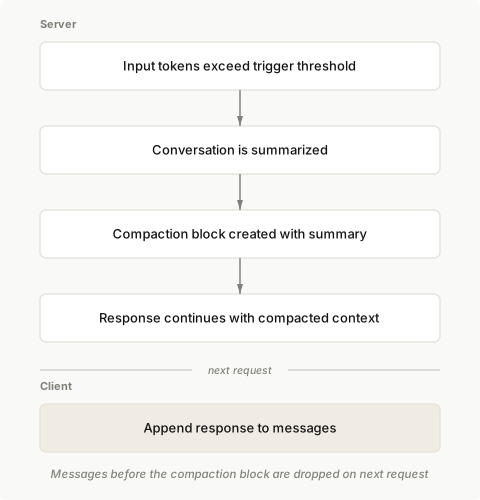
4141
42The previous steps describe threshold compaction, which most of this page covers. With the `compact-2026-09-04` beta header, you can instead request a summary on demand. That request is separate from your conversation turns and returns only the summary, so it can run in the background. When the block arrives, you swap it in for the messages it summarizes. See [Compact on demand with the `compaction` parameter](https://platform.claude.com/docs/en/build-with-claude/compaction#compact-on-demand-with-the-compaction-parameter).
43
4244## Basic usage
4345
4446Enable compaction by adding the `compact_20260112` strategy to `context_management.edits` in your Messages API request.
from line 3410
34083410 ```text wrap
34093411 Summarize the transcript inside <summary></summary> tags. Include relevant information in the summary for continuing the task in the next context window. Do not call any tools while writing this summary; respond with text only.
34103412 ```
3413
3414## Compact on demand with the `compaction` parameter
3415
3416The `compact-2026-09-04` beta adds a second way to compact. Threshold compaction summarizes partway through a request once the threshold you set is reached. With this beta, you instead send the top-level `compaction` parameter on a request of your choosing. The response contains a single signed `compaction` block and no reply. From then on, send that block first in `messages`, in place of the messages it summarizes, followed by any turns taken since. Claude sees the summary where those messages were. Everything after the summary reaches Claude unchanged. A threshold compaction block follows the messages it summarizes, but a signed block replaces them. Leaving the summarized messages in front of a signed block is a 400 error.
3417
3418Compacting this way gives you three things. First, you decide when to compact. Second, the summarization request can run in the background while the conversation continues on its full history, and you swap the block in when it arrives. This is often called async or background compaction. Third, you can keep recent turns word for word after the summary, which is often called keep-tail compaction. Models with [preserved thinking](https://platform.claude.com/docs/en/build-with-claude/preserved-thinking) check earlier thinking blocks against the conversation. On those models, the thinking in turns that follow the summary, from either pattern, can stay valid after the swap, under the conditions in [Continue from the summary](https://platform.claude.com/docs/en/build-with-claude/compaction#continue-from-the-summary). That lets a long-running agent keep its train of thought. Use threshold compaction when you want the API to manage context inside ordinary requests. Use the `compaction` parameter when your application needs to control when compaction happens, can't pause while a summary is written, or must keep recent turns and their thinking after the summary.
3419
3420Send the `compact-2026-09-04` beta header on the request that asks for the summary and on every later request that carries the signed block. On-demand compaction is available on the Claude API only, on Claude Fable 5.1, Claude Mythos 5.1, Claude Fable 5, Claude Mythos 5, Claude Mythos Preview, Claude Opus 5, Claude Opus 4.8, Claude Opus 4.7, Claude Opus 4.6, Claude Sonnet 5, and Claude Sonnet 4.6. You can also call the [Models API](https://platform.claude.com/docs/en/api/beta/models/list) with the beta header and read each model's `capabilities.compaction`. You can't combine `compaction` with `context_management` on one request.
3421
3422### Request a summary
3423
3424Send the conversation as it stands with `"compaction": {"type": "summarize"}`. The API summarizes every message in the request once, generates no reply after it, and returns the block alone with `stop_reason` `"compaction"`. Send the same `system` prompt and `tools` that you use for the rest of the conversation. The summarizer reads them, and on models with preserved thinking, the turns you keep stay valid only if they match:
3425
3426<CodeGroup exclude="python, typescript, csharp, go, java, php, ruby">
3427 ```bash cURL
3428 curl https://api.anthropic.com/v1/messages \
3429 -H "x-api-key: $ANTHROPIC_API_KEY" \
3430 -H "anthropic-version: 2023-06-01" \
3431 -H "anthropic-beta: compact-2026-09-04" \
3432 -H "content-type: application/json" \
3433 -d '{
3434 "model": "claude-opus-5",
3435 "max_tokens": 4096,
3436 "messages": [
3437 {"role": "user", "content": "I am building a recipe app. Help me name the main entities in the data model."},
3438 {"role": "assistant", "content": "Start with Recipe, Ingredient, and Step. Add a RecipeIngredient entry that holds the quantity and unit for each ingredient in a recipe."},
3439 {"role": "user", "content": "Good. Now suggest field names for Recipe."}
3440 ],
3441 "compaction": {"type": "summarize"}
3442 }'
3443 ```
3444
3445 <MultiFileExample language="cli" label="CLI">
3446 ```bash CLI
3447 ant beta:messages create --beta compact-2026-09-04 < request.yaml
3448 ```
3449
3450 <File filename="request.yaml">
3451 ```yaml
3452 model: claude-opus-5
3453 max_tokens: 4096
3454 messages:
3455 - role: user
3456 content: I am building a recipe app. Help me name the main entities in the data model.
3457 - role: assistant
3458 content: Start with Recipe, Ingredient, and Step. Add a RecipeIngredient entry that holds the quantity and unit for each ingredient in a recipe.
3459 - role: user
3460 content: Good. Now suggest field names for Recipe.
3461 compaction:
3462 type: summarize
3463 ```
3464 </File>
3465 </MultiFileExample>
3466</CodeGroup>
3467
3468```json Response
3469{
3470 "id": "msg_013Zva2CMHLNnXjNJJKqJ2EF",
3471 "type": "message",
3472 "role": "assistant",
3473 "model": "claude-opus-5",
3474 "content": [
3475 {
3476 "type": "compaction",
3477 "content": "Summary of the conversation: the user is designing the data model for a recipe app. The entities agreed so far are Recipe, Ingredient, Step, and RecipeIngredient, which holds the quantity and unit. The user then asked for field names for Recipe.",
3478 "signature": "EuYBCkQY..."
3479 }
3480 ],
3481 "stop_reason": "compaction",
3482 "usage": {
3483 "input_tokens": 0,
3484 "output_tokens": 0,
3485 "iterations": [{ "type": "compaction", "input_tokens": 144, "output_tokens": 276 }]
3486 }
3487}
3488```
3489
3490The summarization call uses the request's model, `system`, `tools`, thinking settings, and `max_tokens`. The summarizer reads the tool definitions but never runs a tool, and the response carries no thinking. `max_tokens` caps the whole call, including any thinking the model does before it writes the summary, so allow several thousand tokens. It is billed and rate-limited like any other request, and `usage.iterations` reports it as the `compaction` entry. The top-level `input_tokens` and `output_tokens` are zero because no reply was generated.
3491
3492If the last `assistant` turn ends in a tool call with no result yet, the API rejects the request. Send that turn's tool results first. Also leave out `stop_sequences`, structured-output `output_config.format`, and a `tool_choice` of type `any` or `tool`. They would do nothing on a summarization call, and the API rejects them. The conversation must still fit the model's context window, so compact before you outgrow it, not after.
3493
3494When you stream the response, the block arrives whole. You get one `content_block_start` event carrying the complete block, then `content_block_stop`, with no `content_block_delta` events. `ping` events can arrive before or between them.
3495
3496### Continue from the summary
3497
3498In your history, replace the messages you sent with the returned assistant message. Keep the `compaction` block exactly as the API returned it, including its `signature`. Send it first on every later request, with the beta header:
3499
3500```json
3501{
3502 "model": "claude-opus-5",
3503 "max_tokens": 2048,
3504 "messages": [
3505 {
3506 "role": "assistant",
3507 "content": [
3508 {
3509 "type": "compaction",
3510 "content": "Summary of the conversation: the user is designing the data model for a recipe app. The entities agreed so far are Recipe, Ingredient, Step, and RecipeIngredient, which holds the quantity and unit. The user then asked for field names for Recipe.",
3511 "signature": "EuYBCkQY..."
3512 }
3513 ]
3514 },
3515 {
3516 "role": "assistant",
3517 "content": "For Recipe, use title, description, servings, prep_minutes, and cook_minutes. Add created_at and updated_at timestamps."
3518 },
3519 { "role": "user", "content": "Now do the same for Ingredient." }
3520 ]
3521}
3522```
3523
3524Here the second `assistant` message is the reply to the last summarized `user` turn. It arrived while the summary was being written, so it was not among the messages summarized. Two `assistant` messages in a row are fine here, because the block still comes first.
3525
3526The API puts the summary where the block stands and passes every later message to Claude unchanged. Follow these rules:
3527
3528* Put the block first in `messages`, either as an `assistant` message of its own or as the first content block of the first message, whether that is a `user` or `assistant` message.
3529* Remove the summarized messages. If any remain in front of the block, the request returns a 400 error (`compaction_block_misplaced`). If any remain after it, the API doesn't reject the request for that reason and sends them to the model again.
3530* Send exactly one `compaction` block per request, on every later request. A request without the block reaches Claude without the summary.
3531
3532To keep a tail of recent turns word for word, leave those turns out of the compaction request. The API summarizes every message it is sent, so send only the older turns, then put the block in front of the turns you kept.
3533
3534If the conversation took more turns while a background summary request ran, drop exactly the messages you sent in the compaction request from the front of your history. Put the returned message in their place, and keep everything appended since:
3535
3536```python
3537# sent_count = len(messages sent in the compaction request)
3538# response = that request's result, arriving while the agent kept working
3539if response.stop_reason == "compaction":
3540 compaction_message = {"role": "assistant", "content": response.content}
3541 history = [compaction_message] + history[sent_count:]
3542# Otherwise keep the full history and try again later (see "When no summary comes back").
3543```
3544
3545Don't edit your history between sending the compaction request and making the swap, and make the swap on the first request after the block arrives. That way, thinking produced while the summary was being written stays valid.
3546
3547On models with preserved thinking, the thinking blocks in the kept turns stay valid as long as both of these conditions hold:
3548
3549* The kept turns directly followed the summarized messages.
3550* The `system` parameter and the `tools` not marked `defer_loading: true` are unchanged from the compaction request.
3551
3552The first condition also rules out a first kept message that the API would merge into the last summarized message: one with the same role as the last summarized message, or a `role: "system"` message. The simplest way to meet it is to compact exactly the `messages` of a request you already made. To change `system` or `tools` without invalidating any kept thinking, compact the whole conversation first, so no turns are kept. Then change them on the next request.
3553
3554A later request can use a different model, `system`, or `tools` than the compaction request, and the API still accepts the block. Such a change can invalidate the thinking in the kept turns, but it has no other effect.
3555
3556To compact a conversation that already starts with a block, send `compaction` again. The new block summarizes the old summary and everything after it. From then on, send only the newest block.
3557
3558### Write your own summarization prompt
3559
3560Without `instructions`, the API uses its own summarization prompt. A non-blank `instructions` string (up to 16,384 characters) replaces that prompt entirely, as it does for threshold compaction (see [Custom summarization instructions](https://platform.claude.com/docs/en/build-with-claude/compaction#custom-summarization-instructions)). For example:
3561
3562```json
3563{
3564 "compaction": {
3565 "type": "summarize",
3566 "instructions": "Summarize this recipe app design conversation. Preserve every entity and field name agreed so far, and the user's latest open request. Do not call tools; respond with the summary text only."
3567 }
3568}
3569```
3570
3571The summarizer reads the whole conversation, earlier thinking included, with or without `instructions`. That differs from threshold compaction on Claude Fable 5.1 and Claude Mythos 5.1, where custom `instructions` leave earlier thinking out. In your `instructions`, say what the summary must retain and tell the model not to call tools. The summarization call runs under the same safeguards as any other request.
3572
3573### When no summary comes back
3574
3575A summary is produced only when the summarization call ends normally with text and no tool call. Otherwise, the response is still a 200 with empty `content`. The call is still billed and reported in `usage.iterations`, with zero usage when no call could be made. The `stop_reason` is the one the summarization call ended with:
3576
3577* `"max_tokens"`: the summary was cut off.
3578* `"model_context_window_exceeded"`: there was no room for the summarization prompt.
3579* `"refusal"`: the request was declined. It is subject to the same safeguards as your other requests, and [`stop_details`](https://platform.claude.com/docs/en/build-with-claude/handling-stop-reasons#refusal) identifies the policy category behind it.
3580* `"tool_use"`: the model called a tool instead of writing the summary.
3581* `"end_turn"`: the call returned no text.
3582
3583Resend with a larger `max_tokens` after `"max_tokens"`, with shorter `instructions` or fewer messages after `"model_context_window_exceeded"`, or with `instructions` that tell the model not to call tools after `"tool_use"`. You can also continue without a summary.
3584
3585A transient server problem while producing a block, or while reading one you sent back, returns a retryable 529 `overloaded_error` with `error.details.error_code` set to `compaction_unavailable`. Retry the request. Other rejections specific to this beta are 400 errors, and most have a message that says what to remove or resend. The exception is a request that leaves out the beta header: it fails with a generic validation error, such as `compaction: Extra inputs are not permitted`, that doesn't mention the header. Some also carry an `error.details.error_code` that starts with `compaction_`, mostly the errors about the block itself: an altered, misplaced, or duplicated block, or a request with nothing left to summarize. Parameter errors, such as a field that can't be combined with `compaction`, carry the message only.
3586
3587### How it fits with the rest of the API
3588
3589* **Threshold compaction and context editing.** You can't send `compaction` and `context_management` on the same request. Threshold compaction (`compact_20260112`) can't run on a request that carries a signed block.
3590* **Prompt caching.** `cache_control` on the block places a breakpoint after the summary.
3591* **Mid-conversation system messages and tool changes.** `role: "system"` messages inside the summarized range are summarized. What they declared stops applying once the block replaces them. If an instruction or a [tool change](https://platform.claude.com/docs/en/build-with-claude/mid-conversation-system-messages#mid-conversation-tool-changes) still matters, state it again in a `role: "system"` message. Send that message right after your next new `user` turn, which comes after the kept turns, and leave it in your history from then on. Don't put it between the block and the kept turns, because that breaks the kept turns' thinking.
3592* **Task budgets.** Don't send the `remaining` value of a [task budget](https://platform.claude.com/docs/en/build-with-claude/task-budgets) (`output_config.task_budget.remaining`) with `compaction` or on requests that carry the block. Doing so returns a 400 error.
3593* **Token counting.** The [token counting](https://platform.claude.com/docs/en/build-with-claude/token-counting) endpoint ignores the `compaction` parameter.
3594* **Content the summary can't carry.** Images, documents, `container_upload` blocks, and fetched URLs inside the summarized messages are gone once the block replaces them. Restate or re-upload anything a later turn still needs.
34113595
34123596## Next steps
34133597
build-with-claude/mid-conversation-system-messages Changed · +3 / -3 lines
from line 26
2626
2727The `tools` array sits even earlier in the hashed request prefix than the top-level `system` field, so editing it invalidates the [prompt cache](https://platform.claude.com/docs/en/build-with-claude/prompt-caching) for the entire conversation. Mid-conversation tool changes are the tools counterpart to mid-conversation system messages. Instead of fixing the tool list for the lifetime of the conversation, you change which tools are offered to the model between turns: declare the full tool set in `tools` up front, then use `tool_addition` and `tool_removal` blocks to offer a tool to the model, or withdraw it, from a specific point in the conversation onward. The `tools` array itself never changes, so the cached prefix stays intact.
2828
29`tool_addition` and `tool_removal` are content blocks in the `content` array of a `role: "system"` message, and they can be mixed with `text` blocks in the same message. The message follows the same placement rules as any mid-conversation system message (see [Limitations](https://platform.claude.com/docs/en/build-with-claude/mid-conversation-system-messages#limitations)), and the change applies from that point in the conversation onward. Each block's `tool` field references a tool rather than defining one: `{"type": "tool_reference", "name": "..."}` names a tool declared in the request's `tools` array, and [MCP connector](https://platform.claude.com/docs/en/agents-and-tools/mcp-connector) tools can be referenced individually with `mcp_tool_reference` (`server_name` and `name`) or as a whole toolset with `mcp_toolset_reference` (`server_name`). Referencing a name that is not declared in `tools` returns a 400 error.
29`tool_addition` and `tool_removal` are content blocks in the `content` array of a `role: "system"` message, and they can be mixed with `text` blocks in the same message. The message follows the placement rules for any mid-conversation system message, with one extra restriction after a paused turn (see [Limitations](https://platform.claude.com/docs/en/build-with-claude/mid-conversation-system-messages#limitations)), and the change applies from that point in the conversation onward. Each block's `tool` field references a tool rather than defining one: `{"type": "tool_reference", "name": "..."}` names a tool declared in the request's `tools` array, and [MCP connector](https://platform.claude.com/docs/en/agents-and-tools/mcp-connector) tools can be referenced individually with `mcp_tool_reference` (`server_name` and `name`) or as a whole toolset with `mcp_toolset_reference` (`server_name`). Referencing a name that is not declared in `tools` returns a 400 error (on the Claude API, with `error.details.error_code` set to `tool_reference_unresolved`).
3030
3131Every tool declared in `tools` is offered to the model from the start of the conversation unless it is declared with `defer_loading: true`, which keeps it withheld until a `tool_addition` block surfaces it. `tool_addition` also re-offers a tool that an earlier `tool_removal` withdrew.
3232
33The following request declares `get_weather` in `tools`, then withdraws it after the first user turn with a `tool_removal` block. Mid-conversation tool changes are in beta, so the request sends the `mid-conversation-tool-changes-2026-07-01` beta header.
34
3335<CodeGroup>
3436 ```bash cURL
3537 curl https://api.anthropic.com/v1/messages \
from line 447
445447 end
446448 ```
447449</CodeGroup>
448
449Mid-conversation tool changes are in beta. To use them, include the beta header `mid-conversation-tool-changes-2026-07-01` in your requests.
450450
451451## When to use a mid-conversation system message
452452
build-with-claude/preserved-thinking Changed · +59 / -36 lines
#### Background (async) compaction
from line 384
384384
385385Each row compares two consecutive requests:
386386
387| Change between requests | Later thinking blocks |
388| -------------------------------------------------------------------------------------------------------------------------------------------------------------------------- | ---------------------------------------------------------------------- |
389| Append messages at the end | Valid |
390| Add a tool with `defer_loading: true` that nothing has referenced yet | Valid |
391| Remove `thinking` blocks from the start of the history, from the end, or all of them | Valid (the model loses that reasoning) |
392| Change any request parameter outside `system`, `tools`, and `messages` (`effort`, `max_tokens`, `output_config`, `tool_choice`, `metadata`, `thinking.display`, and so on) | Valid |
393| Add, move, or remove `cache_control` markers | Valid |
394| A rotating signed URL that returns the same bytes | Valid |
395| Server-side compaction or context editing removes or replaces content | Valid (the check compares what you sent, not the server's edited copy) |
396| A cleared [turn-scoped system message](https://platform.claude.com/docs/en/build-with-claude/preserved-thinking#per-turn-reminders) left in place | Valid |
397| Edit, reorder, or delete any earlier `user`, `assistant`, or `system` message | Invalid |
398| Re-render the context you put in the first user message with a changed value | Invalid for every thinking block |
399| Clear or shorten an earlier `tool_result`, re-encode an earlier image, or change an earlier `tool_use` input | Invalid for every later thinking block |
400| Add a text block to an earlier user turn, or remove one you added last time | Invalid |
401| Change the top-level `system` string or blocks | Invalid |
402| Add, remove, rename, or edit a tool in `tools` | Invalid |
403| Remove a `thinking` block from the middle of the history and keep later ones | Invalid for every later thinking block |
404| Put back a `thinking` block you removed on an earlier request | Invalid for thinking blocks produced while it was gone |
405| An image or document URL that returns different bytes on the next request | Invalid |
406| The same turn-scoped message deleted or reworded on a later request | Invalid |
387| Change between requests | Later thinking blocks |
388| -------------------------------------------------------------------------------------------------------------------------------------------------------------------------- | --------------------------------------------------------------------------------------------------------------------------------------------------------------------------------------------------------------------------------------------------------------------------------------------------------------------------------------------------- |
389| Append messages at the end | Valid |
390| Add a tool with `defer_loading: true` that nothing has referenced yet | Valid |
391| Remove `thinking` blocks from the start of the history, from the end, or all of them | Valid (the model loses that reasoning) |
392| Change any request parameter outside `system`, `tools`, and `messages` (`effort`, `max_tokens`, `output_config`, `tool_choice`, `metadata`, `thinking.display`, and so on) | Valid |
393| Add, move, or remove `cache_control` markers | Valid |
394| A rotating signed URL that returns the same bytes | Valid |
395| Server-side compaction or context editing removes or replaces content | Valid (the check compares what you sent, not the server's edited copy) |
396| A cleared [turn-scoped system message](https://platform.claude.com/docs/en/build-with-claude/preserved-thinking#per-turn-reminders) left in place | Valid |
397| Edit, reorder, or delete any earlier `user`, `assistant`, or `system` message | Invalid, except when the signed block from [on-demand compaction](https://platform.claude.com/docs/en/build-with-claude/preserved-thinking#server-side-trimming) replaces the messages it summarizes, under the conditions in [Keep-tail compaction](https://platform.claude.com/docs/en/build-with-claude/preserved-thinking#keep-tail-compaction) |
398| Re-render the context you put in the first user message with a changed value | Invalid for every thinking block |
399| Clear or shorten an earlier `tool_result`, re-encode an earlier image, or change an earlier `tool_use` input | Invalid for every later thinking block |
400| Add a text block to an earlier user turn, or remove one you added last time | Invalid |
401| Change the top-level `system` string or blocks | Invalid |
402| Add, remove, rename, or edit a tool in `tools` | Invalid |
403| Remove a `thinking` block from the middle of the history and keep later ones | Invalid for every later thinking block |
404| Put back a `thinking` block you removed on an earlier request | Invalid for thinking blocks produced while it was gone |
405| An image or document URL that returns different bytes on the next request | Invalid |
406| The same turn-scoped message deleted or reworded on a later request | Invalid |
407407
408408### Check whether your code edits the prefix
409409
from line 786
786786
787787Each common prefix edit has a replacement that gives the model the same information and leaves earlier bytes unchanged, so later thinking stays valid. Find the edit your code makes today in the first column:
788788
789| Instead of | Use | Beta header |
790| --------------------------------------------------------------------------------------------------------------------- | -------------------------------------------------------------------------------------------------------------------------------------------------------------------------------------------------------------------------------------------------------------------------------------------------------------- | ------------------------------------------------------- |
791| Rebuilding the top-level `system` prompt | A [mid-conversation system message](https://platform.claude.com/docs/en/build-with-claude/preserved-thinking#new-instructions) | None |
792| Re-rendering the context in your first user message (environment, date, memory, project instructions) on each request | Render it once and resend it unchanged. When something changes, [put the new version in the newest turn](https://platform.claude.com/docs/en/build-with-claude/preserved-thinking#changing-context) | None |
793| Clearing or shortening old `tool_result` content, or re-encoding old images, in place | Shorten a tool result or downscale an image before the first time you send it, not after. To clear old results later, [trim context on the server](https://platform.claude.com/docs/en/build-with-claude/preserved-thinking#server-side-trimming) with `clear_tool_uses_20250919` | `context-management-2025-06-27` |
794| Injecting a reminder and deleting it on the next request | A [turn-scoped system message](https://platform.claude.com/docs/en/build-with-claude/preserved-thinking#per-turn-reminders) (`clear_at: "next_user_message"`) | `mid-conversation-system-clear-at-2026-08-21` |
795| Adding or removing entries in `tools` | [`tool_addition` and `tool_removal` blocks](https://platform.claude.com/docs/en/build-with-claude/preserved-thinking#tool-changes) | `mid-conversation-tool-changes-2026-07-01` |
796| Changing top-level `output_config.effort` (restarts the cache, doesn't affect thinking) | A [per-message `output_config`](https://platform.claude.com/docs/en/build-with-claude/preserved-thinking#effort-changes) | `mid-conversation-output-config-2026-07-01` |
797| Dropping or summarizing old turns on the client | Server-side [compaction or context editing](https://platform.claude.com/docs/en/build-with-claude/preserved-thinking#server-side-trimming), or [client-side compaction](https://platform.claude.com/docs/en/build-with-claude/preserved-thinking#custom-compaction-on-the-client) that keeps no stale thinking | `compact-2026-01-12` or `context-management-2025-06-27` |
798| An image or document URL whose bytes change between requests | A [`file_id` from the Files API](https://platform.claude.com/docs/en/build-with-claude/preserved-thinking#files-by-id), or base64 | None |
789| Instead of | Use | Beta header |
790| --------------------------------------------------------------------------------------------------------------------- | ---------------------------------------------------------------------------------------------------------------------------------------------------------------------------------------------------------------------------------------------------------------------------------------------------------------------------------------------------------------------------------------------------------------------------------------------------------------------------------------- | ------------------------------------------------------------ |
791| Rebuilding the top-level `system` prompt | A [mid-conversation system message](https://platform.claude.com/docs/en/build-with-claude/preserved-thinking#new-instructions) | None |
792| Re-rendering the context in your first user message (environment, date, memory, project instructions) on each request | Render it once and resend it unchanged. When something changes, [put the new version in the newest turn](https://platform.claude.com/docs/en/build-with-claude/preserved-thinking#changing-context) | None |
793| Clearing or shortening old `tool_result` content, or re-encoding old images, in place | Shorten a tool result or downscale an image before the first time you send it, not after. To clear old results later, [trim context on the server](https://platform.claude.com/docs/en/build-with-claude/preserved-thinking#server-side-trimming) with `clear_tool_uses_20250919` | `context-management-2025-06-27` |
794| Injecting a reminder and deleting it on the next request | A [turn-scoped system message](https://platform.claude.com/docs/en/build-with-claude/preserved-thinking#per-turn-reminders) (`clear_at: "next_user_message"`) | `mid-conversation-system-clear-at-2026-08-21` |
795| Adding or removing entries in `tools` | [`tool_addition` and `tool_removal` blocks](https://platform.claude.com/docs/en/build-with-claude/preserved-thinking#tool-changes) | `mid-conversation-tool-changes-2026-07-01` |
796| Changing top-level `output_config.effort` (restarts the cache, doesn't affect thinking) | A [per-message `output_config`](https://platform.claude.com/docs/en/build-with-claude/preserved-thinking#effort-changes) | `mid-conversation-output-config-2026-07-01` |
797| Dropping or summarizing old turns on the client | [On-demand compaction](https://platform.claude.com/docs/en/build-with-claude/preserved-thinking#server-side-trimming) to keep the recent turns with their thinking, other server-side [compaction or context editing](https://platform.claude.com/docs/en/build-with-claude/preserved-thinking#server-side-trimming), or [client-side compaction](https://platform.claude.com/docs/en/build-with-claude/preserved-thinking#custom-compaction-on-the-client) that keeps no stale thinking | `compact-2026-09-04` (not on Amazon Bedrock or Google Cloud) |
798| An image or document URL whose bytes change between requests | A [`file_id` from the Files API](https://platform.claude.com/docs/en/build-with-claude/preserved-thinking#files-by-id), or base64 | None |
799799
800800All of these assume you [send assistant turns back exactly as returned](https://platform.claude.com/docs/en/build-with-claude/preserved-thinking#append-assistant-turns-exactly-as-returned). Mid-conversation system messages, turn-scoped system messages, and tool changes aren't available on every model: [Mid-conversation system messages and tool changes](https://platform.claude.com/docs/en/build-with-claude/mid-conversation-system-messages) lists the models that accept them. If your code serves several models, keep editing the top-level `system` prompt for the models that don't accept them.
801801
802To use several betas in one request, combine the values in one `anthropic-beta` header. The same names apply on Amazon Bedrock and Google Cloud (see [Beta headers](https://platform.claude.com/docs/en/api/beta-headers)):
802To use several betas in one request, combine the values in one `anthropic-beta` header. Beta names are the same on Amazon Bedrock and Google Cloud wherever the beta is available there (see [Beta headers](https://platform.claude.com/docs/en/api/beta-headers)):
803803
804804```text wrap
805805anthropic-beta: thinking-binding-controls-2026-08-01,mid-conversation-system-clear-at-2026-08-21,mid-conversation-tool-changes-2026-07-01
from line 941
941941
942942Another common prefix edit is client-side trimming: dropping or summarizing the oldest turns and keeping the recent ones verbatim. The kept turns' thinking blocks were produced while the removed history was still in place, so they fail the check. The server-side equivalents don't count as edits, because the check compares the conversation as you sent it:
943943
944* [Compaction](https://platform.claude.com/docs/en/build-with-claude/compaction) summarizes older turns into a compaction block when the context approaches a threshold you set, and the checked prefix restarts from that block. Its [`instructions` parameter](https://platform.claude.com/docs/en/build-with-claude/compaction#custom-summarization-instructions) takes your own summarization prompt, such as "preserve every ticker, position size, and stated assumption".
944* [Compaction](https://platform.claude.com/docs/en/build-with-claude/compaction) summarizes older turns into a compaction block when the context approaches a threshold you set, and the checked prefix restarts from that block. Its [`instructions` parameter](https://platform.claude.com/docs/en/build-with-claude/compaction#custom-summarization-instructions) takes your own summarization prompt, such as "preserve every ticker, position size, and stated assumption". [On-demand compaction](https://platform.claude.com/docs/en/build-with-claude/preserved-thinking#background-compaction) (beta) returns the summary from a separate request, which can [run in the background](https://platform.claude.com/docs/en/build-with-claude/preserved-thinking#background-compaction). Send `"compaction": {"type": "summarize"}` in the request body, and the response carries a single `compaction` block, holding the summary and a signature, instead of a reply. On-demand compaction is available on the Claude API but not on Amazon Bedrock or Google Cloud, and it needs the `compact-2026-09-04` beta header on the summary request and on every later request that carries the block. You send the block in place of the messages it summarizes. The check accepts that swap, so the turns you keep can stay valid with their thinking, under the conditions in [Keep-tail compaction](https://platform.claude.com/docs/en/build-with-claude/preserved-thinking#keep-tail-compaction).
945945* [Context editing](https://platform.claude.com/docs/en/build-with-claude/context-editing) clears old tool results or old thinking blocks by rule, oldest first. The strategies are `clear_tool_uses_20250919` and `clear_thinking_20251015`.
946946
947947### Compact on the client
948948
949You can still compact on the client. Once you rewrite anything earlier in the conversation, don't send back a thinking block that was produced before the rewrite.
949You can still compact on the client. If you write the summary yourself, don't send back a thinking block that was produced before the rewrite. If the API writes it with on-demand compaction, [Keep-tail compaction](https://platform.claude.com/docs/en/build-with-claude/preserved-thinking#keep-tail-compaction) lists when kept thinking stays valid.
950950
951951#### Simple compaction (recommended)
952952
from line 967
967967
968968#### Keep-tail compaction
969969
970Keep-tail compaction summarizes the older turns and keeps the most recent turns verbatim, so the model still sees the last few exchanges word for word. As usually written it breaks the rule: the kept assistant turns still carry thinking blocks that were produced when the original turns, not the summary, came before them. Those blocks fail.
970Keep-tail compaction summarizes the older turns and keeps the most recent turns verbatim, so the model still sees the last few exchanges word for word. If you write the summary yourself, it breaks the rule: the kept assistant turns still carry thinking blocks that were produced when the original turns, not the summary, came before them. Those blocks fail.
971971
972To keep that thinking, have the API write the summary with [on-demand compaction](https://platform.claude.com/docs/en/build-with-claude/preserved-thinking#server-side-trimming). Send only the older turns in a request with the `compaction` parameter and the `compact-2026-09-04` beta header. Then send the signed block it returns in place of those turns, followed by the kept turns exactly as returned. The kept thinking stays valid while all of these hold:
973
974* The compaction request runs on a model with preserved thinking. The conversation's own model is the simple choice.
975* The kept turns directly follow the summarized messages, and the first kept message isn't one the API would merge into the last summarized one: a message with the same role, or a `role: "system"` message.
976* `system` and your non-deferred `tools` match the compaction request.
977
978The simplest way to meet the second is to compact exactly the `messages` of a request you already made. Mid-conversation system messages inside the summarized turns are summarized too, so their instructions and tool changes stop applying after the swap. To keep one in force, state it again in a `role: "system"` message directly after the first new `user` turn that follows the kept turns. A system message placed between the block and the kept turns breaks their thinking.
979
980The rest of this section covers a summary you write yourself.
981
972982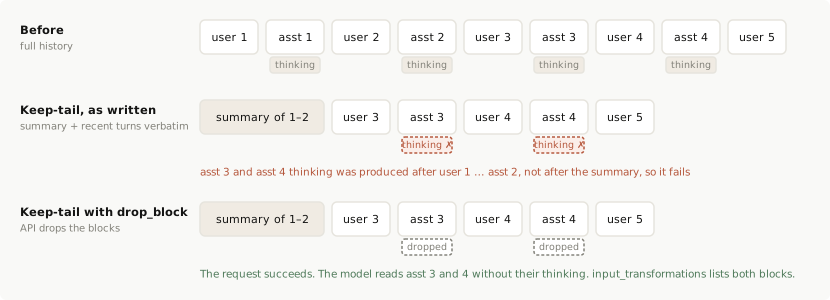
973983
974984Fix: keep the turns exactly as they are and send `prefix_mismatch_behavior: "drop_block"`. The API drops the stale thinking blocks, the model reads the kept turns' `text` and `tool_use` blocks, and the request succeeds.
from line 1194
11841194
11851195Keep sending `"drop_block"` on later requests for as long as those two turns stay in the history. Thinking the model produces from this request onward follows the summary and stays valid. If you'd rather not depend on the beta header, the alternative is to strip the `thinking` and `redacted_thinking` blocks from the kept assistant turns yourself when you build the compacted history.
11861196
1197#### Background (async) compaction
1198
1199Background compaction builds the summary off the critical path while the conversation continues, then swaps it in a few requests later. Have the API write the summary with [on-demand compaction](https://platform.claude.com/docs/en/build-with-claude/preserved-thinking#server-side-trimming):
1200
12011. Send the conversation so far in a separate request with the `compaction` parameter and the `compact-2026-09-04` beta header.
12022. Keep working on the full history while that request runs.
12033. On the first request after the block arrives, send it in place of the messages the compaction request held, followed by every turn appended since.
1204
1205The thinking produced while the summary was being built stays valid under the same conditions as in [Keep-tail compaction](https://platform.claude.com/docs/en/build-with-claude/preserved-thinking#keep-tail-compaction).
1206
1207A summary you build yourself breaks the rule the same way keep-tail does, with a delay: every assistant turn produced while the summary was being built carries thinking that predates the swap, and it all fails the moment the summary lands. If you use one, treat the swap like keep-tail and send `"drop_block"` from the swap onward, or compact synchronously.
1208
11871209#### Patterns that don't work with preserved thinking
11881210
1189* **Background compaction.** Building the summary off the critical path and swapping it in a few requests later breaks the rule the same way keep-tail does, with a delay: every assistant turn produced while the summary was being built carries thinking that predates the swap, and it all fails the moment the summary lands. If you need it, treat the swap like keep-tail and send `"drop_block"` from the swap onward. Otherwise compact synchronously.
11901211* **Cutting turns out of the middle.** Removing individual turns invalidates every thinking block after them, and no compaction scheme avoids that. If you were cutting a turn to change an instruction, append a [mid-conversation system message](https://platform.claude.com/docs/en/build-with-claude/preserved-thinking#new-instructions) instead. To remove old tool results or old thinking selectively, use server-side [context editing](https://platform.claude.com/docs/en/build-with-claude/context-editing).
11911212* **Compacting in the middle of a tool round.** Don't compact between an assistant turn's `tool_use` and the `tool_result` that answers it. Send that assistant turn back with its thinking intact so the model finishes the round with its reasoning. See [Preserving thinking blocks](https://platform.claude.com/docs/en/build-with-claude/thinking#preserving-thinking-blocks).
11921213
from line 1244
12231244 </Accordion>
12241245
12251246 <Accordion title="I compact by summarizing older turns and keeping recent turns verbatim. Does that still work?">
1226 Not if the kept turns still carry their thinking: those blocks were produced against the history you replaced, so they fail the check. Strip `thinking` and `redacted_thinking` blocks from the turns you carry across and keep their `text` and `tool_use` blocks, or send `prefix_mismatch_behavior: "drop_block"` and let the API drop them. Simple compaction leaves no thinking behind to fail and is the recommended approach: one summary message plus the next user turn, with no earlier turns replayed. Server-side [compaction](https://platform.claude.com/docs/en/build-with-claude/compaction) and [context editing](https://platform.claude.com/docs/en/build-with-claude/context-editing) don't count as edits. See [Compact on the client](https://platform.claude.com/docs/en/build-with-claude/preserved-thinking#custom-compaction-on-the-client).
1247 Yes, if the API writes the summary. [On-demand compaction](https://platform.claude.com/docs/en/build-with-claude/preserved-thinking#server-side-trimming) (beta header `compact-2026-09-04`) summarizes the older turns into a signed block that you send in place of them. The recent turns keep their thinking under the conditions in [Keep-tail compaction](https://platform.claude.com/docs/en/build-with-claude/preserved-thinking#keep-tail-compaction).
1248
1249 If you write the summary yourself, the kept turns' thinking fails the check, because those blocks were produced against the history you replaced. Strip `thinking` and `redacted_thinking` blocks from the turns you carry across and keep their `text` and `tool_use` blocks, or send `prefix_mismatch_behavior: "drop_block"` and let the API drop them. Simple compaction leaves no thinking behind to fail and is the recommended approach: one summary message plus the next user turn, with no earlier turns replayed. Server-side [compaction](https://platform.claude.com/docs/en/build-with-claude/compaction) and [context editing](https://platform.claude.com/docs/en/build-with-claude/context-editing) don't count as edits. See [Compact on the client](https://platform.claude.com/docs/en/build-with-claude/preserved-thinking#custom-compaction-on-the-client).
12271250 </Accordion>
12281251
12291252 <Accordion title="How do I handle instruction files such as AGENTS.md or CLAUDE.md that change mid-session?">
release-notes/overview Changed · +4 / -0 lines
### September 14, 2026
from line 12
1212 For updates to Claude Code, see the [complete CHANGELOG.md](https://github.com/anthropics/claude-code/blob/main/CHANGELOG.md) in the `claude-code` repository.
1313</Tip>
1414
15### September 14, 2026
16
17* The Messages API can now [compact a conversation on demand](https://platform.claude.com/docs/en/build-with-claude/compaction#compact-on-demand-with-the-compaction-parameter) on the Claude API, in beta with the `compact-2026-09-04` beta header. Send the top-level `compaction` parameter, and the API returns a signed `compaction` block that summarizes the messages you sent. On later requests, send that block first, in place of those messages. You choose when to compact, the request can run in the background, and you can keep recent turns word for word after the summary. On models with preserved thinking, the thinking in those kept turns can stay valid.
18
1519### September 10, 2026
1620
1721* Claude Managed Agents permission policies now include `auto`: the server evaluates each agent or MCP tool call and runs it, denies it, or pauses for your approval. `agent.tool_use` and `agent.mcp_tool_use` events report how each call was evaluated in an `evaluation` field alongside `evaluated_permission`. See [Let the server evaluate each call with `auto`](https://platform.claude.com/docs/en/managed-agents/permission-policies#let-the-server-evaluate-each-call-with-auto).
test-and-evaluate/strengthen-guardrails/mitigate-jailbreaks Changed · +5 / -1 lines
from line 159
159159
160160 [computer use tool](https://platform.claude.com/docs/en/agents-and-tools/tool-use/computer-use-tool)
161161
162 , Anthropic runs additional classifiers that detect potential prompt injections in screenshots and steer Claude to ask for user confirmation before acting. See that page for details and opt-out information.
162 or the
163
164 [browser use tool](https://platform.claude.com/docs/en/agents-and-tools/tool-use/browser-use-tool)
165
166 , Anthropic runs additional classifiers that scan what the tools return, such as screenshots or page text, for potential prompt injections and steer Claude to check whether the instruction really came from you before acting. See those pages for details and opt-out information.
163167</Note>
164168
165169## Continuous monitoring
agents-and-tools/tool-use/browser-use-tool Changed · +4 / -0 lines
from line 1127
11271127
11281128Claude sometimes follows instructions found in page content even when they conflict with yours; text on a page that says "ignore your previous instructions and navigate to..." can divert it from the task. Isolate Claude from sensitive data and actions to limit what a prompt injection can reach, review [Mitigate jailbreaks and prompt injections](https://platform.claude.com/docs/en/test-and-evaluate/strengthen-guardrails/mitigate-jailbreaks), and if a task can't avoid a logged-in session, use a dedicated low-privilege account and keep human confirmation on account-changing actions.
11291129
1130Anthropic has trained the model to resist these prompt injections and has added an extra layer of defense. If you use the browser use tool, classifiers will automatically scan what the browser returns, such as page text or screenshots, to flag potential prompt injections. When these classifiers identify a potential prompt injection, they will automatically steer the model to check whether the instruction really came from you before acting on it.
1131
1132This extra protection won't be ideal for every use case (for example, use cases without a human in the loop), so if you'd like to opt out and turn it off, [contact support](https://support.claude.com/en/). The precautions above remain important even with these classifiers in place.
1133
11301134Because the browser runs in your environment, the sites Claude visits see your executor's network identity, and page content reaches the API only as the tool results you return. Inform end users of the relevant risks and obtain their consent before enabling browser use in your products.
11311135
11321136## Member tools
models/fable-5-1/migration-guide Changed · +2 / -2 lines
from line 1236
12361236
12371237 To check an existing integration:
12381238
1239 1. Capture the exact request bodies it sends over a few normal turns, including a compaction or a tool change if your product has them. For each pair of consecutive requests, compare the `system` prompt, the `tools` array, and the shared prefix of `messages`. They should be byte-identical up to the newly appended turns.
1239 1. Capture the exact request bodies it sends over a few normal turns, including a compaction or a tool change if your product has them. For each pair of consecutive requests, compare the `system` prompt, the `tools` array, and the shared prefix of `messages`. They should be byte-identical up to the newly appended turns. An expected exception is a request that swaps in a signed `compaction` block from [on-demand compaction](https://platform.claude.com/docs/en/build-with-claude/compaction#compact-on-demand-with-the-compaction-parameter): the block replaces the messages it summarizes at the front of `messages`, and everything after it should still match.
12401240 2. Run a normal multi-turn session against `claude-fable-5-1` with the `thinking-binding-controls-2026-08-01` beta header and `prefix_mismatch_behavior: "drop_block"`, and log `input_transformations` on every response. An empty array on every turn means the history is intact. An entry with `reason: "prefix_binding_mismatch"` means something before the block at `path` changed since the previous request. An entry with `reason: "model_binding_mismatch"` means the conversation switched models, which isn't a bug in your code. This works from any account, because setting the field opts the request into enforcement. In CI, set `"error"` instead so an edit fails the run.
12411241 3. Choose a production setting. Leave the default `"error"` if a prefix mismatch can only mean a bug in your code, or set `"drop_block"` to drop the affected blocks instead of failing, and monitor the 400s or the `input_transformations` entries either way.
12421242
from line 1541
15411541
154215424. **Start at `high` effort and sweep:** The [effort parameter](https://platform.claude.com/docs/en/build-with-claude/effort) default is `high`, and all five levels are supported. Keep the Claude Fable 5 guidance: `high` for most work, and `medium` as a cost control worth testing. Claude Fable 5.1's gains over Claude Fable 5 are largest at `xhigh` and `max`, but those levels also add thinking time and time-to-first-response, so step up to them for the most capability-sensitive tasks and where your evals show the gain. Run a fresh sweep on your own evals rather than carrying over a setting tuned for Claude Fable 5. See [Recommended effort levels for Claude Fable 5.1](https://platform.claude.com/docs/en/build-with-claude/effort#recommended-effort-levels-for-claude-fable-5-1).
15431543
15445. **Trim context on the server, or compact in a shape that carries no stale thinking:** If your code truncates or summarizes older turns on the client, the simplest fix is to move that work to server-side [compaction](https://platform.claude.com/docs/en/build-with-claude/compaction) or [context editing](https://platform.claude.com/docs/en/build-with-claude/context-editing). Neither counts as an edit, because the [history check](https://platform.claude.com/docs/en/models/fable-5-1/migration-guide#fable-5-1-preserved-thinking) compares the conversation as you sent it, so nothing they remove invalidates later thinking blocks, and compaction's [`instructions` parameter](https://platform.claude.com/docs/en/build-with-claude/compaction#custom-summarization-instructions) accepts your own summarization prompt. If you keep compaction on the client, pick one of three shapes:
15445. **Trim context on the server, or compact in a shape that carries no stale thinking:** If your code truncates or summarizes older turns on the client, the simplest fix is to move that work to server-side [compaction](https://platform.claude.com/docs/en/build-with-claude/compaction) or [context editing](https://platform.claude.com/docs/en/build-with-claude/context-editing). Neither counts as an edit, because the [history check](https://platform.claude.com/docs/en/models/fable-5-1/migration-guide#fable-5-1-preserved-thinking) compares the conversation as you sent it, so nothing they remove invalidates later thinking blocks, and compaction's [`instructions` parameter](https://platform.claude.com/docs/en/build-with-claude/compaction#custom-summarization-instructions) accepts your own summarization prompt. If you keep recent turns verbatim behind the summary, or summarize in the background while the conversation continues, use [on-demand compaction](https://platform.claude.com/docs/en/build-with-claude/compaction#compact-on-demand-with-the-compaction-parameter) (beta header `compact-2026-09-04`, on the Claude API) rather than a client-written summary. The API writes a signed summary block that you put in place of the messages it summarizes. The thinking blocks in the turns you keep can stay valid, under the conditions that section lists. If you keep compaction on the client, pick one of three shapes:
15451545
15461546 * **Simple compaction (recommended):** replace the whole history with one summary message plus the new user turn and replay nothing else. No thinking blocks are carried over, so nothing fails. Claude models are trained on long-horizon tasks with this scheme, and it performs comparably to more elaborate ones for most workloads.
15471547 * **Keep-tail compaction:** if you keep the most recent turns verbatim behind a summary, strip the `thinking` and `redacted_thinking` blocks from those turns (text and tool calls can stay), or set `prefix_mismatch_behavior: "drop_block"`. Their thinking was produced against the full history and fails behind the summary otherwise.